
Best Forex Strategies for Maximum Profit


Editorial Note: While we adhere to strict Editorial Integrity, this post may contain references to products from our partners. Here's an explanation for How We Make Money. None of the data and information on this webpage constitutes investment advice according to our Disclaimer.
To increase your profits from Forex trading, you need effective strategies. Each strategy has unique benefits and risks suited to different market conditions. Сhoose the best approach for your goals and trading style. The most profitable strategies are:
Trading on the Forex market can yield significant profits with the right approach and effective strategies. In this article, we will explore the most profitable Forex strategies for maximizing your earnings. Learn how to manage risks and apply proven methods to improve your trading results.
The most profitable types of Forex strategies
A Forex trading strategy is a pre-planned approach to trading that includes a set of rules and criteria for making trading decisions. The goal of a strategy is to ensure consistency and discipline in trading, minimize risks, and maximize potential profits.
A strategy can be based on various methods of analysis, including technical, fundamental, or a combination of both. Incorporating elements of capital and risk management is also an essential part of any successful trading strategy.
Trend trading
Trend trading is based on following the current market movement and entering positions in the direction of the trend. This is a popular strategy because of its simplicity and the possibility of generating stable income.

Although this strategy can be implemented just on the basis of price action and trendlines, traders also often use indicators such as moving averages and Awesome Oscillator to determine the strength of a trend and entry and exit points.

Breakout trading
Breakout trading focuses on identifying key support and resistance levels and opening positions when those levels are broken. This strategy involves high volatility and significant potential for profitable trades. Key support and resistance levels along with indicators such as Bollinger Bands and Donchian Channels are often used to identify possible breakout levels.
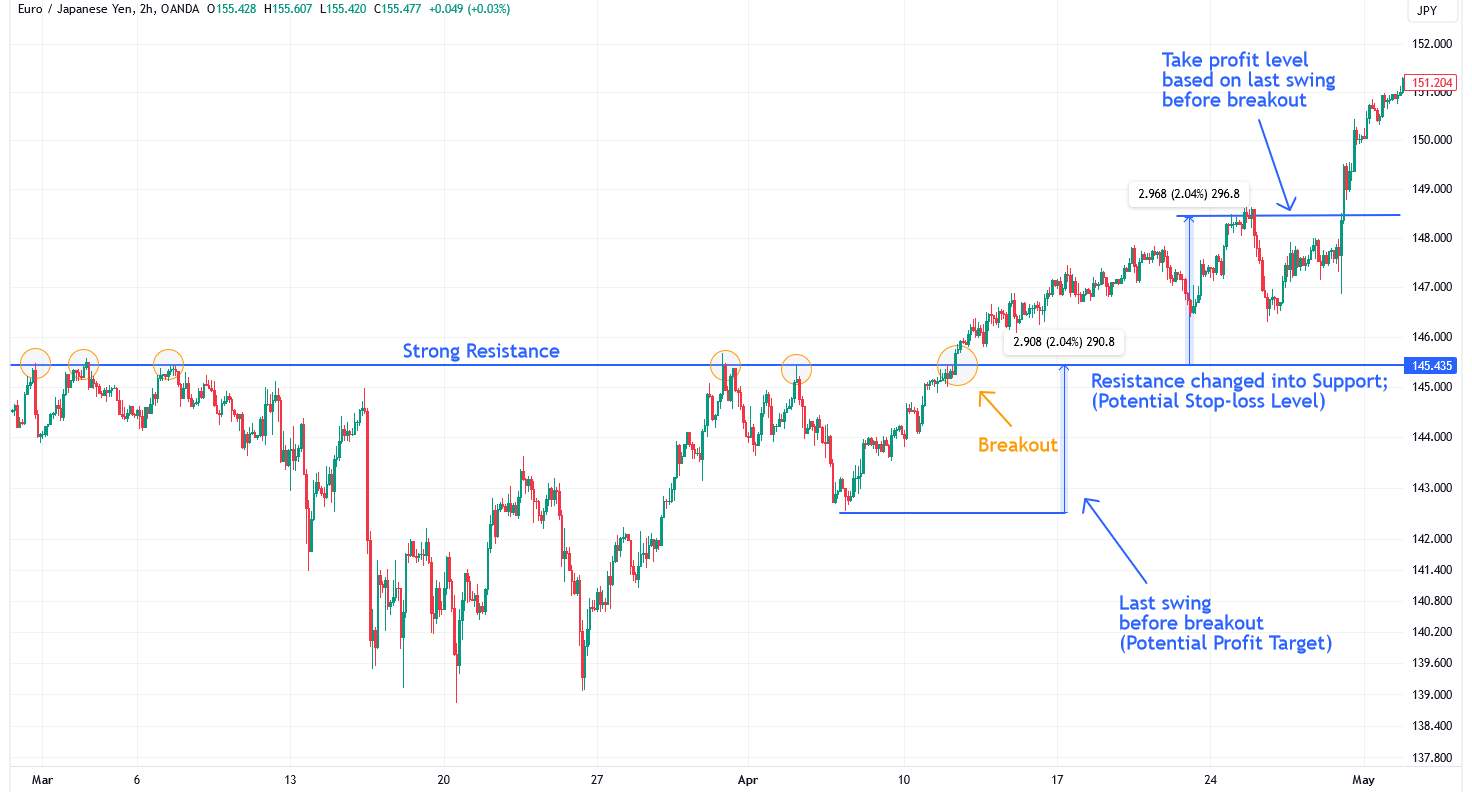
Below is an example of a strategy with a standard breakout interpretation:
Range trading
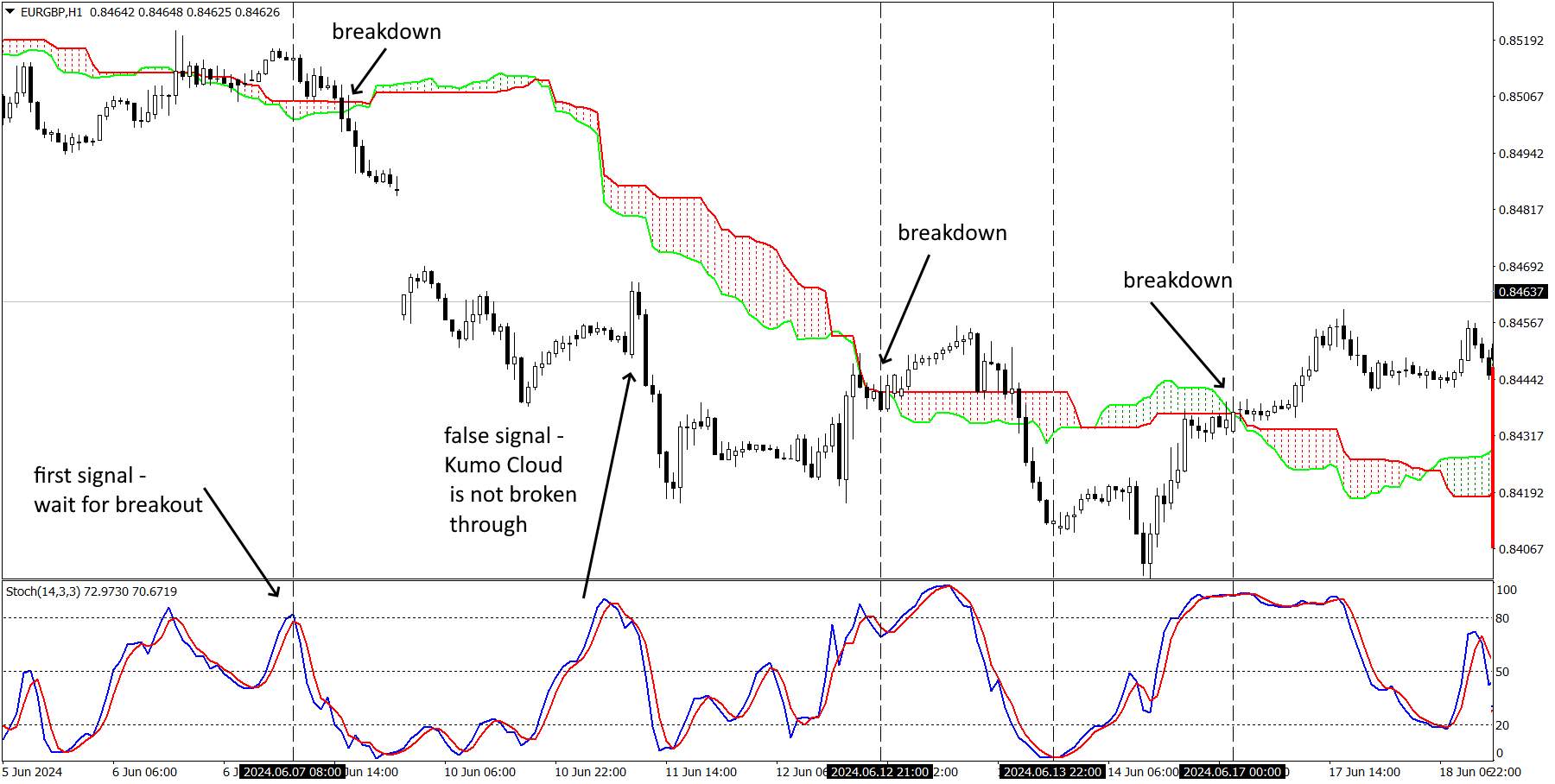
Range trading is based on trading within established support and resistance levels, especially in low volatility environments when the market moves sideways. Traders use price channels as well as indicators such as RSI and stochastic to determine entry and exit points at range boundaries.

Scalping
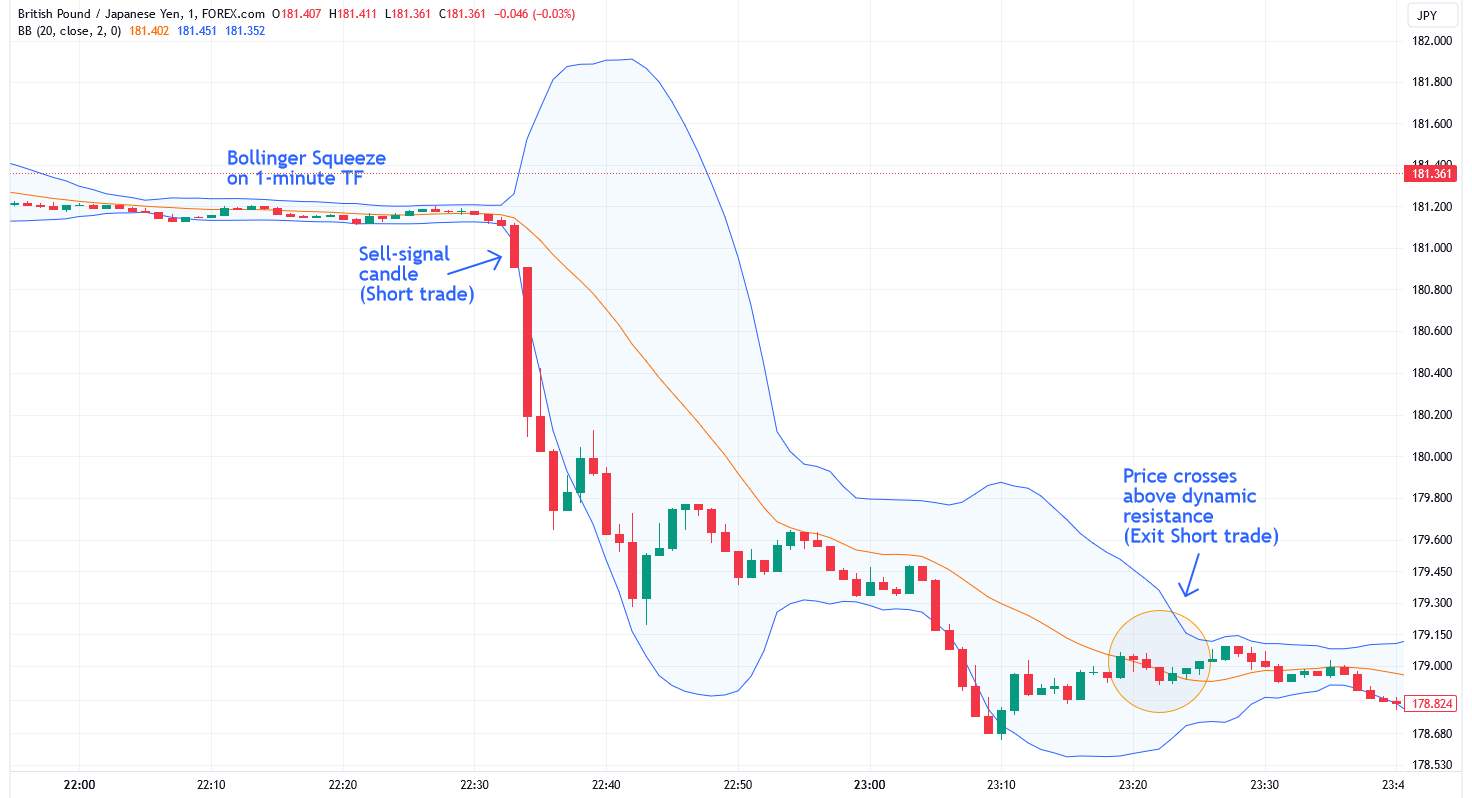
Scalping involves making quick trades over short periods of time in order to make small profits from each price movement. This strategy requires high responsiveness and access to real-time data. Short-term charts and indicators such as Bollinger Bands are often used for scalping.
Position trading
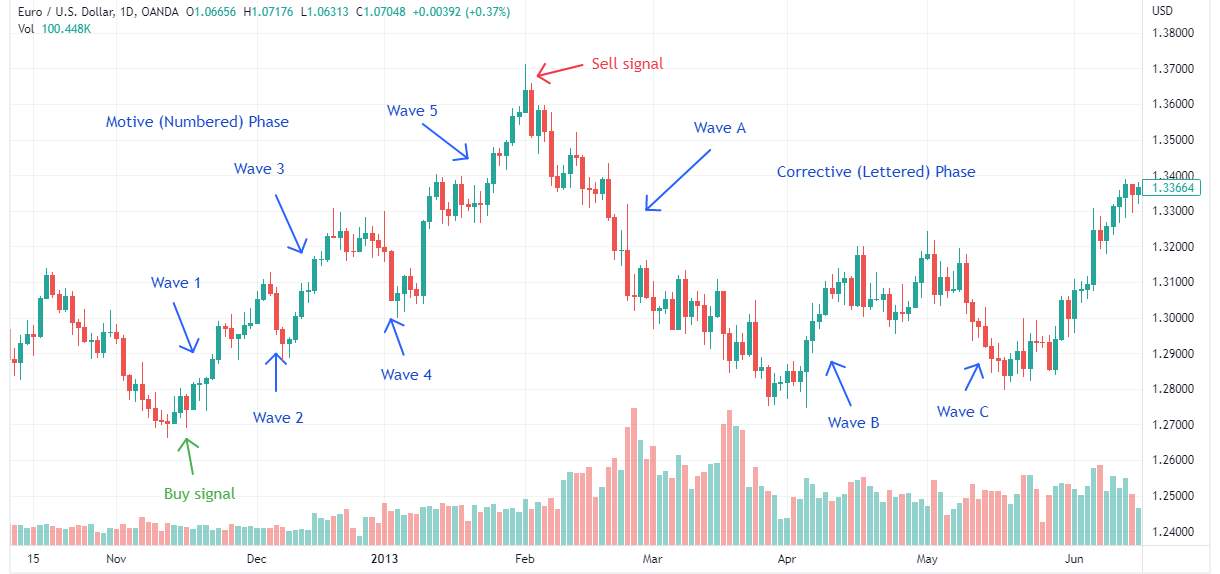
Position trading involves long-term trades that can last weeks or months, with an emphasis on fundamental analysis and the use of technical techniques such as Elliott Wave theory to identify market trends and entry points.
Types of Forex trading strategies, their features, pros and cons
| Strategy | Features | Pros | Cons |
|---|---|---|---|
Trend Trading | Trading in the direction of the main market movement using indicators like moving averages and RSI to determine the strength of the trend and entry/exit points | - High probability of success in trending markets - Potential for significant profits | - Risk of losses if the trend reverses - Ineffective in sideways markets (ranges) |
Breakout Strategy | Identifying key support and resistance levels and trading upon their breakout | - Potential for large profits during strong price movements - Suitable for volatile markets | - False breakouts can lead to losses - Requires close market monitoring |
Range Trading | Trading within established support and resistance boundaries, especially in low-volatility conditions | - Predictability and stability in sideways markets - Frequent small profits | - Limited profit opportunities in trending markets - Risk of losses if the range breaks |
Scalping | Short-term trading aiming to make small profits from multiple trades throughout the day | - Quick profit realization - Minimizes market risks due to short trade duration | - Requires high concentration and quick decision-making - High transaction costs due to frequent trades |
Position Trading | Long-term strategy focusing on fundamental analysis and using technical methods like Elliott Wave Theory | - Potential for significant profits in long-term trends - Less stress compared to short-term strategies | - Long wait for profits - Risk of significant losses with unexpected market changes |
How to choose the most profitable Forex trading strategy
To choose a Forex trading strategy that suits your goals and trading style, focus on several factors:
Determine your trading goals
Before diving into the details of different strategies, it is important to clearly define your trading goals. Do you want to receive a stable income, grow capital or invest for the long term? Understanding your goals will help you determine which strategy is best for your needs. For example, a day trader looking for quick and regular income might prefer scalping, while an investor looking for long-term growth might choose position trading.
Assess your risk tolerance
Each trading strategy carries a certain level of risk. It is important to evaluate how much risk you are willing to take on each trade and in general. High frequency strategies such as scalping may involve less risk per trade, but require great discipline and quick decisions. In contrast, long-term strategies such as trend trading may involve greater risks per trade but can offer significant returns over time.
Testing the chosen strategy
Before risking real money, it is recommended to test your chosen strategy on a demo account. This will allow you to refine your approach, understand its strengths and weaknesses, and gain confidence without the risk of losing money. Most trading platforms offer demo accounts that simulate real market conditions.
Manage risks
Regardless of the strategy, effective risk management is key. Set stop-loss orders to protect against significant losses, and size your position based on your risk tolerance. The general rule is not to risk more than 1-2% of your trading capital on a single trade.
Constantly learn and adapt
The Forex market is dynamic and constant learning is necessary. Follow market news, economic indicators and evolving trading techniques. Be prepared to adapt your strategy in response to changing market conditions.
To read further on choosing the right Forex trading strategies, you can read our article Effective Forex Trading Strategies: Looking for a Winner's Way
After choosing a trading strategy, it is important to test it on a demo account, and then on real trading. For this purpose, we have selected several brokers that are convenient for implementing and testing your strategies. These companies provide high-quality brokerage services and a wide range of trading instruments such as stocks, bonds, cryptocurrencies and other equally interesting offers.
| Trading.com USA | Plus500 | OANDA | FOREX.com | IG Markets | |
|---|---|---|---|---|---|
|
Demo |
Yes | Yes | Yes | Yes | Yes |
|
Min. deposit, $ |
50 | 100 | No | 100 | 1 |
|
Max. leverage |
1:50 | 1:300 | 1:200 | 1:50 | 1:200 |
|
Min Spread EUR/USD, pips |
0.9 | 0.5 | 0.1 | 0.7 | 0.6 |
|
ECN Spread EUR/USD, avg, pips |
No | No | 0.15 | 0.2 | 0.8 |
|
Raw Spread EUR/USD avg, pips |
No | No | No | 0.1 | No |
|
Scalping |
Yes | No | Yes | Yes | Yes |
|
Trading bots (EAs) |
Yes | No | Yes | Yes | Yes |
|
Open account |
Go to broker Your capital is at risk. |
Go to broker 81% of retail CFD accounts lose money. |
Go to broker Your capital is at risk. |
Study review | Study review |
Don't ignore fundamental analysis

As a trader with over ten years of trading experience, I know for sure that choosing the right strategy is a key factor in achieving maximum profits in the Forex market. One of my favorite methods is swing trading, which allows you to profit from short-term trends in the market. To successfully implement this strategy, I recommend using indicators such as moving averages and RSI. They will help you timely identify entry and exit points from positions. Pay attention to support and resistance levels to understand where the price may reverse or slow down.
Another important tip for traders is to not ignore fundamental analysis. News trading can be very profitable if you know how to react quickly to economic and political events. At this time, volatility is especially strong, which promises considerable profits. Follow the economic calendar, stay informed about key events and learn to predict possible market reactions to them. This will help you make more informed trading decisions and increase your Forex profits.
Each strategy has its own advantages and is suitable for different market conditions. Regardless of the chosen strategy, it is important to remember the need for strict adherence to risk management and control of emotions. These aspects will help you avoid large losses and maintain a stable growth of your capital.
Conclusion
Success in Forex trading is achieved through a combination of proper strategy, effective risk management and continuous learning. Therefore, analyze your results and adapt your approaches depending on market conditions - this will help improve your trading performance.
Effective use of Forex trading strategies requires the trader to be constantly up to date. Follow market news, learn new analysis methods, and don't be afraid to make changes to your strategy. Continuous development and adaptation to changing market conditions will help you achieve stable results and maximize profits.
Regardless of the chosen strategy, it is important to follow the rules of money management and set clear limits on losses. This will help to avoid significant losses and maintain the stability of the trading process, even in conditions of high market volatility.
FAQs
What is scalping and how does it help you achieve profit?
Scalping is short-term intraday trading to profit from small price movements. Requires quick reaction and discipline.
What indicators are used in swing trading?
Swing trading uses moving averages, RSI, MACD and support/resistance levels to identify trends and reversals.
How to use news trading for profit?
News trading involves analysis of economic events. It is important to monitor the economic calendar and respond quickly to data.
How to use arbitrage to make profit in Forex?
Forex arbitrage involves buying a currency in one market, where the price is lower, and simultaneously selling it in another, where the price is higher, in order to profit from the difference. This requires quick response and consideration of commissions.
Editors' Top Picks and Insights






Related Articles
Team that worked on the article
Parshwa is a content expert and finance professional possessing deep knowledge of stock and options trading, technical and fundamental analysis, and equity research. As a Chartered Accountant Finalist, Parshwa also has expertise in Forex, crypto trading, and personal taxation.
Dr. BJ Johnson is a PhD in English Language and an editor with over 15 years of experience. He earned his degree in English Language in the U.S and the UK.
Mirjan Hipolito is a journalist and news editor at Traders Union. She is an expert crypto writer with five years of experience in the financial markets.
Volatility refers to the degree of variation or fluctuation in the price or value of a financial asset, such as stocks, bonds, or cryptocurrencies, over a period of time. Higher volatility indicates that an asset's price is experiencing more significant and rapid price swings, while lower volatility suggests relatively stable and gradual price movements.
CFD is a contract between an investor/trader and seller that demonstrates that the trader will need to pay the price difference between the current value of the asset and its value at the time of contract to the seller.
Swing trading is a trading strategy that involves holding positions in financial assets, such as stocks or forex, for several days to weeks, aiming to profit from short- to medium-term price swings or "swings" in the market. Swing traders typically use technical and fundamental analysis to identify potential entry and exit points.
Yield refers to the earnings or income derived from an investment. It mirrors the returns generated by owning assets such as stocks, bonds, or other financial instruments.
Bollinger Bands (BBands) are a technical analysis tool that consists of three lines: a middle moving average and two outer bands that are typically set at a standard deviation away from the moving average. These bands help traders visualize potential price volatility and identify overbought or oversold conditions in the market.

-
 Afghanistan
-
 Albania
-
 Algeria
-
 Angola
-
 Argentina
-
 Armenia
-
 Australia
-
 Austria
-
 Azerbaijan
-
 Bahamas
-
 Bahrain
-
 Bangladesh
-
 Belarus
-
 Belgium
-
 Bolivia
-
 Botswana
-
 Brazil
-
 Brunei
-
 Bulgaria
-
 Cambodia
-
 Cameroon
-
 Canada
-
 Chile
Chile
-
 China
China
-
 Colombia
-
 Congo
Congo
-
 Costa Rica
-
 Cote d'Ivoire
-
 Croatia
-
 Cuba
Cuba
-
 Cyprus
-
 Czechia
-
 DR Congo
-
 Denmark
-
 Dominican Republic
-
 Ecuador
-
 Egypt
Egypt
-
 El Salvador
-
 Estonia
-
 Eswatini
-
 Ethiopia
-
 Finland
-
 France
-
 Georgia
-
 Germany
-
 Ghana
Ghana
-
 Greece
-
 Haiti
Haiti
-
 Hong Kong
-
 Hungary
-
 India
India
-
 Indonesia
-
 Iran, Islamic republic
-
 Iraq
Iraq
-
 Ireland
-
 Israel
-
 Italy
Italy
-
 Jamaica
-
 Japan
Japan
-
 Jordan
-
 Kazakhstan
-
 Kenya
Kenya
-
 Korea
Korea
-
 Kuwait
-
 Kyrgyzstan
-
 Laos
Laos
-
 Latvia
-
 Lebanon
-
 Lesotho
-
 Libya
Libya
-
 Lithuania
-
 Luxembourg
-
 Madagascar
-
 Malaysia
-
 Malta
Malta
-
 Mauritius
-
 Mexico
-
 Moldova
-
 Mongolia
-
 Montenegro
-
 Morocco
-
 Mozambique
-
 Myanmar
-
 Namibia
-
 Nepal
Nepal
-
 Netherlands
-
 New Zealand
-
 Nigeria
-
 North Macedonia
-
 Norway
-
 Oman
Oman
-
 Pakistan
-
 Palestine
-
 Panama
-
 Papua New Guinea
-
 Paraguay
-
 Peru
Peru
-
 Philippines
-
 Poland
-
 Portugal
-
 Puerto Rico
-
 Qatar
Qatar
-
 Reunion
-
 Romania
-
 Rwanda
-
 Saudi Arabia
-
 Serbia
-
 Singapore
-
 Slovakia
-
 Slovenia
-
 Somalia
-
 South Africa
-
 Spain
Spain
-
 Sri Lanka
-
 Sweden
-
 Switzerland
-
 Syria
Syria
-
 Taiwan
-
 Tajikistan
-
 Tanzania
-
 Thailand
-
 Trinidad and Tobago
-
 Tunisia
-
 Turkey
-
 UAE
UAE
-
 Uganda
-
 Ukraine
-
 United Kingdom
-
United States
-
 Uruguay
-
 Uzbekistan
-
 Venezuela
-
 Vietnam
-
 Yemen
Yemen
-
 Zambia
-
 Zimbabwe
- Forex
- Crypto












