
Understanding Liquidation On Binance Futures: From Basics To Strategic Modeling


Editorial Note: While we adhere to strict Editorial Integrity, this post may contain references to products from our partners. Here's an explanation for How We Make Money. None of the data and information on this webpage constitutes investment advice according to our Disclaimer.
Liquidation on Binance Futures occurs when a position can no longer meet the maintenance margin. Binance uses the mark price to trigger liquidations. That makes mark price monitoring critical because it protects the platform from manipulation but can differ from the last traded price. The liquidation clearance fee is applied to the position notional at rates set by Binance.
Leverage amplifies both profits and losses. If you use leverage without proper margin planning you can reach the liquidation price quickly. This article clears up common misconceptions and gives actionable steps to compute the binance liquidation price, manage margin, and use liquidation data as a trading edge.
What is liquidation in Binance futures


Liquidation on Binance Futures occurs when your account balance becomes lower than the required maintenance margin. When this happens, Binance automatically closes your position to prevent further losses and maintain the platform’s stability. The system calculates this threshold using the mark price, which reflects a fair market value derived from spot prices across several exchanges. Using the mark price instead of the last traded price helps reduce unfair liquidations that can result from short-term volatility or price manipulation.
To manage this effectively, traders must understand how factors such as leverage, position size, and maintenance margin influence the Binance futures liquidation price. Knowing these details allows you to anticipate your risk level and keep your positions within safe limits.
Liquidation mechanics and mark price
The mark price acts as a fair market estimate, calculated using spot prices from several leading exchanges along with funding rate data. This ensures a more accurate reflection of the real market and reduces the risk of manipulation that can occur with sudden price spikes. Knowing how this calculation works allows traders to anticipate liquidation events and plan stop-losses or margin top-ups before reaching the danger zone.
Margin models explained
Binance Futures offers two types of margin models: Isolated Margin and Cross Margin. In Isolated Margin, only the funds assigned to a single position are at risk. This means if that position is liquidated, losses are limited to the margin you specifically allocated. It gives traders better control and prevents one losing position from affecting the rest of their portfolio. This margin mode is commonly used by traders who prefer to manage each position independently.
In Cross Margin, the situation is different. All available funds in your Futures Wallet are shared across open positions. If one trade moves against you, Binance can use your remaining wallet balance to prevent liquidation. While this can reduce the risk of a single trade being liquidated too early, it also increases the chance that multiple positions might be affected during extreme volatility.
Mark price, not the last price
Many traders mistakenly believe liquidation is triggered by the market or last traded price, but that is not the case. Binance uses the mark price, which stabilizes price data and reduces manipulation. Still, since the mark price may differ from the last trade, a sudden drop in the mark price may cause liquidation even if the market chart shows a stable last trade.
How to calculate the liquidation price on Binance
Knowing how to calculate the liquidation price on Binance helps you control risk before entering a trade. Binance provides a built-in calculator that uses your entry price, leverage, margin mode, and maintenance rate to determine when liquidation would occur. Traders can also estimate it manually using a simplified formula:
Liquidation Price ≈ Entry Price × [1 - 1 / Leverage + Maintenance Margin Rate]
For example, with an entry price of $20,000, 10× leverage, and a maintenance margin rate of 0.5%, the estimated Binance liquidation price would be around $18,100. This works for most futures liquidation scenarios on Binance using isolated margin.
For cross margin, the Binance futures liquidation price formula becomes more complex. It includes your total wallet balance, unrealized profit or loss, and the combined size of all active positions. Binance adjusts these values in real time to reflect changing exposure. Using the official calculator or margin table on Binance’s Futures page ensures accuracy and helps you plan stop-loss levels safely. Regularly checking your Binance liquidation price protects you from unexpected liquidations during market volatility.
Leverage vs liquidation price
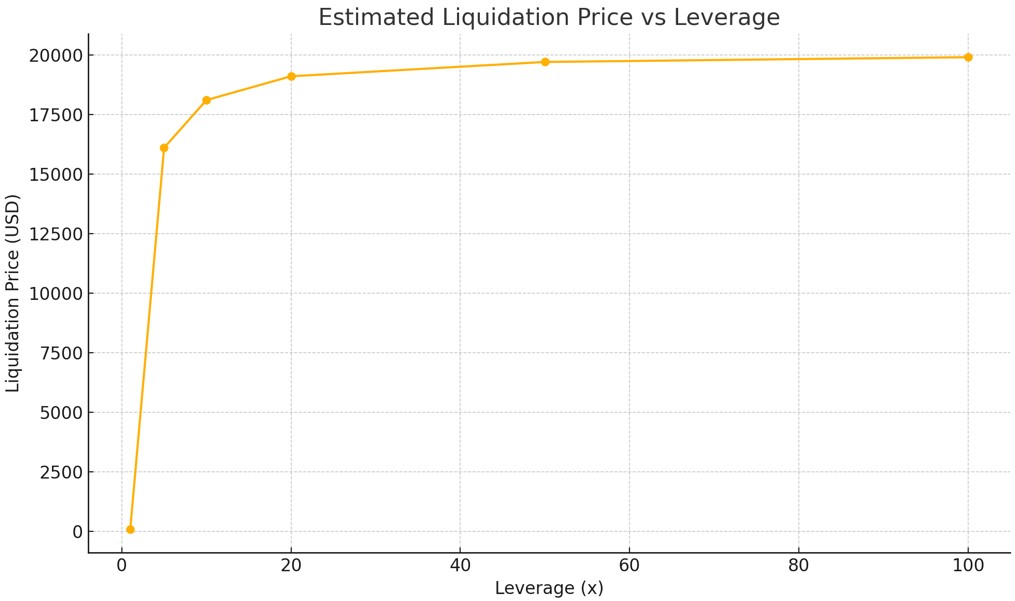
Below is an illustrative chart showing how liquidation price changes with different leverage levels, assuming a $20,000 entry price and 0.5% maintenance margin:
The higher the leverage, the smaller the margin for error. As leverage increases, the liquidation price moves closer to your entry level, which makes positions more sensitive to even small market swings.
The visual clearly demonstrates that increasing leverage quickly lowers the Binance liquidation price threshold. This can become dangerous when volatility spikes because a minor price drop can trigger liquidation.
Binance liquidation fee
When your position is force-closed, Binance applies a liquidation fee, known as the Liquidation Clearance Fee. It is calculated based on the notional value of your liquidated position and is deducted before any leftover margin is returned (if any). Binance uses this fee to cover the costs of automatic liquidation and to support the insurance fund that protects traders from negative balances.
According to Binance’s Futures Liquidation Protocols, the fee is calculated as:
Liquidation Clearance Fee = Notional Value × Fee Rate
For example, for an USDⓈ‑M futures contract you liquidate at $50,000 notional, and the fee rate is 2 % for isolated margin, the fee would amount to $1,000.
Including this fee in your trading plan helps you calculate the real cost of liquidation and manage overall risk more effectively.
Risks that lead to liquidation
Binance Futures traders often face liquidation because of weak margin control or poor planning. The most common reasons include:
using excessive leverage with minimal margin buffer;
unrealistic trade size compared to wallet balance;
not accounting for Binance liquidation data, such as open interest clusters;
relying on cross margin, where losses from one position affect others;
ignoring sudden spikes in funding rates and volatility.
To reduce these risks, every trader should monitor real-time liquidation zones through tools such as Coinglass and Amberdata. Regularly reviewing these indicators helps prevent forced liquidations and keeps positions within safer limits.
Binance isolated margin liquidation price formula
In Isolated Margin mode for Binance Futures, only the margin allocated to a single position is at risk. This separation allows traders to control exposure and prevent one losing trade from affecting the entire wallet balance. Because of this, the liquidation price formula for isolated margin is simpler than for cross margin.
Liquidation Price = Entry Price × [1 - Allocated Margin / (Position Size × Leverage)]
This isolates risk and makes liquidation prediction simpler. It’s especially helpful for traders who manage many positions with different risk profiles.
How to avoid liquidation in Binance futures
Preventing liquidation on Binance Futures starts with disciplined risk management. The following practices help traders keep their margin ratios safe and avoid forced position closures:
Set leverage responsibly. Under 5× is a safer standard for volatile markets.
Use an isolated margin to prevent collateral contamination across positions.
Always calculate and monitor your liquidation price in advance.
Maintain a margin buffer of at least 20% above the maintenance level.
Avoid placing positions within known liquidation clusters. Use Binance liquidation data heatmaps to find them.
Using liquidation data to build smarter trading strategies
Experienced traders use liquidation data not only to prevent losses but also to identify new trading opportunities. Real-time feeds from analytics platforms like Amberdata and Coinglass show clusters of long and short liquidations across the market. A surge in short liquidations, for example, can signal a potential short squeeze, while a wave of long liquidations might indicate the end of a bullish phase. Watching these patterns helps traders predict market direction and act early.
Advanced users also create a liquidation risk score for each position. This score can factor in leverage, total wallet exposure, the distance between the mark price and the liquidation price, volatility levels, and historical liquidation clusters. Combining this data with funding rate and open interest analysis gives a deeper view of crowd behavior. Traders who use this approach can anticipate market reversals, adjust leverage, and avoid forced exits before they happen.
Myths about liquidation on Binance
Many traders misunderstand how liquidation works on Binance Futures, which can lead to unnecessary losses. The following are the most common myths and the real facts behind them:
Myth: low leverage means zero risk;
Reality: even 2× leverage can cause liquidation during high volatility.Myth: a stop-loss guarantees safety;
Reality: during sudden price spikes or flash crashes, slippage can cause liquidation before the stop-loss executes.Myth: liquidation happens at the last price;
Reality: Binance triggers liquidation based on the mark price, not the last trade on the chart.
Top crypto exchanges for leverage and liquidation control
If you're planning to trade crypto with leverage, choosing the right platform is just as important as managing your margin. Below is a comparison of top crypto exchanges offering futures and margin trading, helping you assess how liquidation works in Binance versus other major platforms.
| OKX | Bybit | Bitget | KuCoin | Binance | |
|---|---|---|---|---|---|
|
Futures leverage |
125 | 100 | 100 | 100 | 100 |
|
Min. Deposit, $ |
10 | 1 | 10 EUR | 1 | No |
|
Futures Fee Tier |
No | VIP 0 | VIP 0 | No | Regular User |
|
Futures Taker Fee, % |
0.05 | 0.055 | 0.06 | 0.06 | 0.05 |
|
Spot Maker Fee, % |
0.08 | 0.1 | 0.1 | 0.10 | 0.1 |
|
Alerts |
Yes | Yes | Yes | Yes | Yes |
|
Copy trading |
Yes | Yes | Yes | Yes | Yes |
|
Open an account |
Go to broker Your capital is at risk. |
Go to broker Your capital is at risk.
|
Go to broker Your capital is at risk. |
Go to broker Your capital is at risk. |
Go to broker Your capital is at risk. |
Avoiding liquidation is a profit strategy

I often see traders underestimate how quickly liquidation happens on Binance futures. When I began trading with leverage, I made the same mistake by watching profits instead of my liquidation price. Over time, I learned that liquidation is not about bad luck but about poor preparation. Before opening any position, I check the mark price and use the liquidation price formula for Binance futures to see how much room I really have. That habit has completely changed the way I handle risk.
If I see that my margin is too tight, I lower my leverage or add more funds until the trade feels safe. I prefer steady returns over big wins that disappear overnight. I also think of the Binance liquidation fee as a reminder to plan better next time. Good trading is about control, patience, and respect for your margin. Once you understand how liquidation works, you stop reacting to the market and start managing it with purpose.
Conclusion
Mastering how liquidation works on Binance futures is one of the most important skills for any leveraged trader. Understanding the mark price, the Binance futures liquidation price formula, and the role of maintenance margin helps you manage risk before a trade begins. Traders who monitor these levels and use isolated margin protect their capital better than those who rely on luck or high leverage.
Always calculate your liquidation price, check funding rates, and maintain a safety buffer above the maintenance level. Include the Binance liquidation fee in your cost planning and treat it as a potential loss, not an afterthought. When you use real-time data and sound risk control, you turn futures trading into a strategic process instead of a guessing game.
FAQs
Can I adjust my margin to avoid liquidation Binance risk?
Yes, you can add margin manually to reduce your liquidation risk. Increasing available margin raises your buffer above the maintenance level, which pushes the Binance liquidation price further away from current market prices.
Does trading in volatile pairs increase Binance futures liquidation chances?
Absolutely. Highly volatile trading pairs tend to trigger wider price swings, increasing the likelihood of hitting the liquidation price on Binance sets for your position. Stick to moderate leverage and watch volatility metrics closely.
Is liquidation instant once the threshold is hit?
Not always. There is a brief delay in execution while the system checks the mark price. However, the process is automated and extremely fast. Once triggered, the Binance futures liquidation engine force-closes your position as per protocol.
Are liquidation fees refundable if I recover margin?
No. Once liquidation starts, the Binance liquidation fee applies even if the market briefly recovers. This is why proactive margin management is critical to avoiding losses from forced exits.
Related Articles
Team that worked on the article
Ivan is a financial expert and analyst specializing in Forex, crypto, and stock trading. He prefers conservative trading strategies with low and medium risks, as well as medium-term and long-term investments.
Dan Blystone began his trading career in 1998 as an arbitrage clerk on the floor of the Chicago Mercantile Exchange (CME). He later traded bond and Eurex futures at proprietary firms such as Altea Trading, gaining valuable experience in high-frequency trading and risk management.
Chinmay Soni is a financial analyst with more than 5 years of experience in working with stocks, Forex, derivatives, and other assets. As a founder of a boutique research firm and an active researcher, he covers various industries and fields, providing insights backed by statistical data.
-
 Afghanistan
-
 Albania
-
 Algeria
-
 Angola
-
 Argentina
-
 Armenia
-
 Australia
-
 Austria
-
 Azerbaijan
-
 Bahamas
-
 Bahrain
-
 Bangladesh
-
 Belarus
-
 Belgium
-
 Bolivia
-
 Botswana
-
 Brazil
-
 Brunei
-
 Bulgaria
-
 Cambodia
-
 Cameroon
-
 Canada
-
 Chile
Chile
-
 China
China
-
 Colombia
-
 Congo
Congo
-
 Costa Rica
-
 Cote d'Ivoire
-
 Croatia
-
 Cuba
Cuba
-
 Cyprus
-
 Czechia
-
 DR Congo
-
 Denmark
-
 Dominican Republic
-
 Ecuador
-
 Egypt
Egypt
-
 El Salvador
-
 Estonia
-
 Eswatini
-
 Ethiopia
-
 Finland
-
 France
-
 Georgia
-
 Germany
-
 Ghana
Ghana
-
 Greece
-
 Haiti
Haiti
-
 Hong Kong
-
 Hungary
-
 India
India
-
 Indonesia
-
 Iran, Islamic republic
-
 Iraq
Iraq
-
 Ireland
-
 Israel
-
 Italy
Italy
-
 Jamaica
-
 Japan
Japan
-
 Jordan
-
 Kazakhstan
-
 Kenya
Kenya
-
 Korea
Korea
-
 Kuwait
-
 Kyrgyzstan
-
 Laos
Laos
-
 Latvia
-
 Lebanon
-
 Lesotho
-
 Libya
Libya
-
 Lithuania
-
 Luxembourg
-
 Madagascar
-
 Malaysia
-
 Malta
Malta
-
 Mauritius
-
 Mexico
-
 Moldova
-
 Mongolia
-
 Montenegro
-
 Morocco
-
 Mozambique
-
 Myanmar
-
 Namibia
-
 Nepal
Nepal
-
 Netherlands
-
 New Zealand
-
 Nigeria
-
 North Macedonia
-
 Norway
-
 Oman
Oman
-
 Pakistan
-
 Palestine
-
 Panama
-
 Papua New Guinea
-
 Paraguay
-
 Peru
Peru
-
 Philippines
-
 Poland
-
 Portugal
-
 Puerto Rico
-
 Qatar
Qatar
-
 Reunion
-
 Romania
-
 Rwanda
-
 Saudi Arabia
-
 Serbia
-
 Singapore
-
 Slovakia
-
 Slovenia
-
 Somalia
-
 South Africa
-
 Spain
Spain
-
 Sri Lanka
-
 Sweden
-
 Switzerland
-
 Syria
Syria
-
 Taiwan
-
 Tajikistan
-
 Tanzania
-
 Thailand
-
 Trinidad and Tobago
-
 Tunisia
-
 Turkey
-
 UAE
UAE
-
 Uganda
-
 Ukraine
-
 United Kingdom
-
United States
-
 Uruguay
-
 Uzbekistan
-
 Venezuela
-
 Vietnam
-
 Yemen
Yemen
-
 Zambia
-
 Zimbabwe
- Forex
- Crypto










- What is liquidation in Binance futures
- Liquidation mechanics and mark price
- How to calculate the liquidation price on Binance
- Binance liquidation fee
- Risks that lead to liquidation
- Binance isolated margin liquidation price formula
- How to avoid liquidation in Binance futures
- Using liquidation data to build smarter trading strategies
- Myths about liquidation on Binance
- Top crypto exchanges for leverage and liquidation control
- Expert opinion
- Conclusion
- FAQs


