

eToro Demo Account Review
Trading is a high-risk investment. There is a relatively steep learning curve as well. Before you begin trading, you need to have a deep understanding of how the market works, and all the risks you will be getting yourself into with every decision you make.
Due to all these risks, demo accounts were provided by brokers. The purpose of a demo account is to mimic the trading environment and give you time to get accustomed to the trading tools. Demo accounts help you train your eyes and mind for the real market. They allow you to make all kinds of rookie mistakes with none of the losses.
A demo account can help traders gain experience with a platform, test strategies, and become familiar with market mechanics before risking real capital. In this article, we look at the different types of demo accounts offered by eToro, how to open an eToro demo account (or Virtual Portfolio), and if it is a good demo account for beginners.
Types of eToro demo accounts


Before exploring eToro's Virtual Portfolio, let's look at the different account options available on the platform. eToro offers several account types designed for different investing and trading needs:
Retail Account – the standard account type for most individual traders and investors.
Professional Account – intended for experienced traders who meet specific eligibility requirements.
Islamic Account – a swap-free account designed for clients who require Sharia-compliant trading conditions.
Virtual Portfolio (Demo Account) – a practice account funded with virtual money that allows users to explore the platform and test strategies without risking real capital.
While the Retail Account is the default option for most users, experienced traders may qualify for a Professional Account, and eligible clients can apply for an Islamic Account. Regardless of the account type, users can access eToro's Virtual Portfolio to practice trading and become familiar with the platform before investing real money.
The main differences between Retail and Professional accounts relate to leverage limits, eligibility requirements, and the level of regulatory protections available. The table below highlights the key distinctions between these two account types.
| Retail Account | Professional Account |
|---|---|
Designed for most individual investors | Intended for eligible experienced traders |
Leverage capped by retail regulations | Access to higher leverage limits |
Higher level of investor protection | Reduced regulatory protections |
No professional status requirements | Eligibility criteria apply |
For most beginners, the Retail Account combined with eToro's Virtual Portfolio is the most practical starting point. It allows users to explore the platform, place simulated trades, and become familiar with different markets without risking real money. Professional Accounts are designed for experienced traders who meet specific eligibility requirements and understand the additional risks associated with higher leverage.
The Virtual Portfolio replicates the live trading environment and provides access to most of the platform's key features using virtual funds. This allows users to gain experience with the platform before transitioning to a live account.
Demo accounts are not only useful for beginners. They can also help traders:
Test new trading strategies before applying them in live market conditions.
Explore platform features and compare different brokers without making a deposit.
Whether you are new to investing or already have trading experience, a demo account can be a useful tool for learning, testing, and improving your approach to the markets.
How to Open eToro Demo Account
Here is a step-by-step guide to opening an eToro demo account:
1. Create a Free Account
First, visit the eToro site and open and create a free account. Fill in the username and email details or simply use your Google account. Select a preferred username.
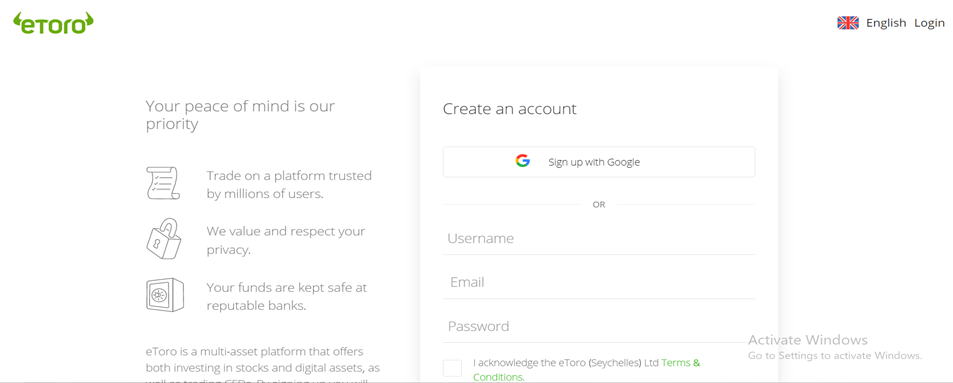
How to open an eToro Demo Account
2. Access Virtual Portfolio
Once you have the account, you will need to make sure you are joining with a demo account. To do this, select the Virtual Portfolio option which will be clearly visible under your username.
3. Start Practicing
Once you switch to the Virtual Portfolio, you can begin trading with virtual funds immediately.
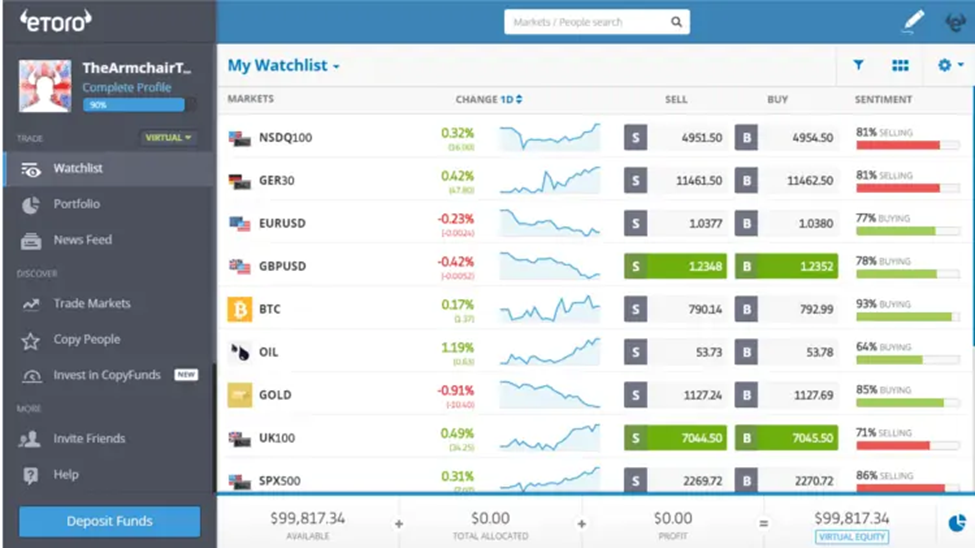
eToro Demo Account
Is eToro demo good for beginners?
Yes, eToro has a good demo account for beginners.
The eToro demo account offers:
Hassle-free sign-up process
User-friendly interface
Easy to learn with minimal jargon and complexities
Has both web and mobile app options
Trading on the account is free
Virtual $100,000 balance for practice trading
Numerous learning resources for beginners
eToro's Virtual Portfolio allows traders to practice at their own pace and gain experience in a simulated market environment. Users can explore platform features, test trading strategies, and become familiar with different asset classes without risking real funds.There is no set period for using a demo account. The transition to live trading should depend on your level of confidence, understanding of the platform, and ability to follow a consistent trading plan.
eToro is a multi-asset platform which offers both investing in stocks and cryptoassets, as well as trading CFDs.
52% of retail investor accounts lose money when trading CFDs with this provider. You should consider whether you can afford to take the high risk of losing your money.
This communication is intended for information and educational purposes only and should not be considered investment advice or investment recommendation. Past performance is not an indication of future results.
Copy Trading does not amount to investment advice. The value of your investments may go up or down. Your capital is at risk.
"Don’t invest unless you’re prepared to lose all the money you invest. This is a high-risk investment and you should not expect to be protected if something goes wrong. Take 2 mins to learn more"
eToro USA LLC does not offer CFDs and makes no representation and assumes no liability as to the accuracy or completeness of the content of this publication, which has been prepared by our partner utilizing publicly available non-entity specific information about eToro.
FAQ
What is an Islamic Account?
An Islamic account does not have any Riba for the duration of the account.
What is Negative Balance Protection?
Both the Retail and eToro accounts have what is known as negative balance protection. This protection is a cover that protects traders in case their accounts go into a negative balance. eToro absorbs the loss and the trader's equity will be reset to zero.
Do Demo Accounts on eToro Allow You to Practice with Leverage?
Yes, eToro demo accounts have all the features of real, live accounts. The demo account also offers CFD trading.
Can I Trade for Less Than 6 Months on My Demo Account?
Yes, you can practice training for less than 6 months on your demo account, however, this could put you at a higher risk for losses. As it is, 78% of retail traders lose money. You probably need all the practice you can get.



Team that worked on the article

Mikhail Vnuchkov joined Traders Union as an author in 2020. He began his professional career as a journalist-observer at a small online financial publication, where he covered global economic events and discussed their impact on the segment of financial investment, including investor income. With five years of experience in finance, Mikhail joined Traders Union team, where he is in charge of forming the pool of latest news for traders, who trade stocks, cryptocurrencies, Forex instruments and fixed income.

Olga Shendetskaya has been a part of the Traders Union team as an author, editor and proofreader since 2017. Since 2020, Shendetskaya has been the assistant chief editor of the website of Traders Union, an international association of traders. She has over 10 years of experience of working with economic and financial texts. In the period of 2017-2020, Olga has worked as a journalist and editor of laftNews news agency, economic and financial news sections. At the moment, Olga is a part of the team of top industry experts involved in creation of educational articles in finance and investment, overseeing their writing and publication on the Traders Union website.

Mirjan Hipolito is a journalist and news editor at Traders Union. She is an expert crypto writer with five years of experience in the financial markets. Her specialties are daily market news, price predictions, and Initial Coin Offerings (ICO).


