
Vantage Academy: Overview Of The Educational Platform


Editorial Note: While we adhere to strict Editorial Integrity, this post may contain references to products from our partners. Here's an explanation for How We Make Money. None of the data and information on this webpage constitutes investment advice according to our Disclaimer.
Vantage Academy is the educational hub of Vantage Markets. It offers trading articles, beginner courses, webinars, eBooks, market analysis, and a full terminology glossary. The platform is designed to help new traders learn step by step, while giving experienced traders structured resources to refresh skills and stay aligned with current market conditions.
The easiest way to evaluate Vantage Academy is to treat it as a curriculum builder rather than a content library. Its real value does not come from consuming everything at once, but from combining courses, articles, terminology, and market analysis into a learning path that supports actual trading decisions.
What you actually get inside Vantage Academy


Vantage Academy is built as a multi-format learning system rather than a single content type. Instead of relying only on articles or videos, it combines structured courses, reference material, live context, and longer-form guides. Each format serves a different stage of a trader’s routine.
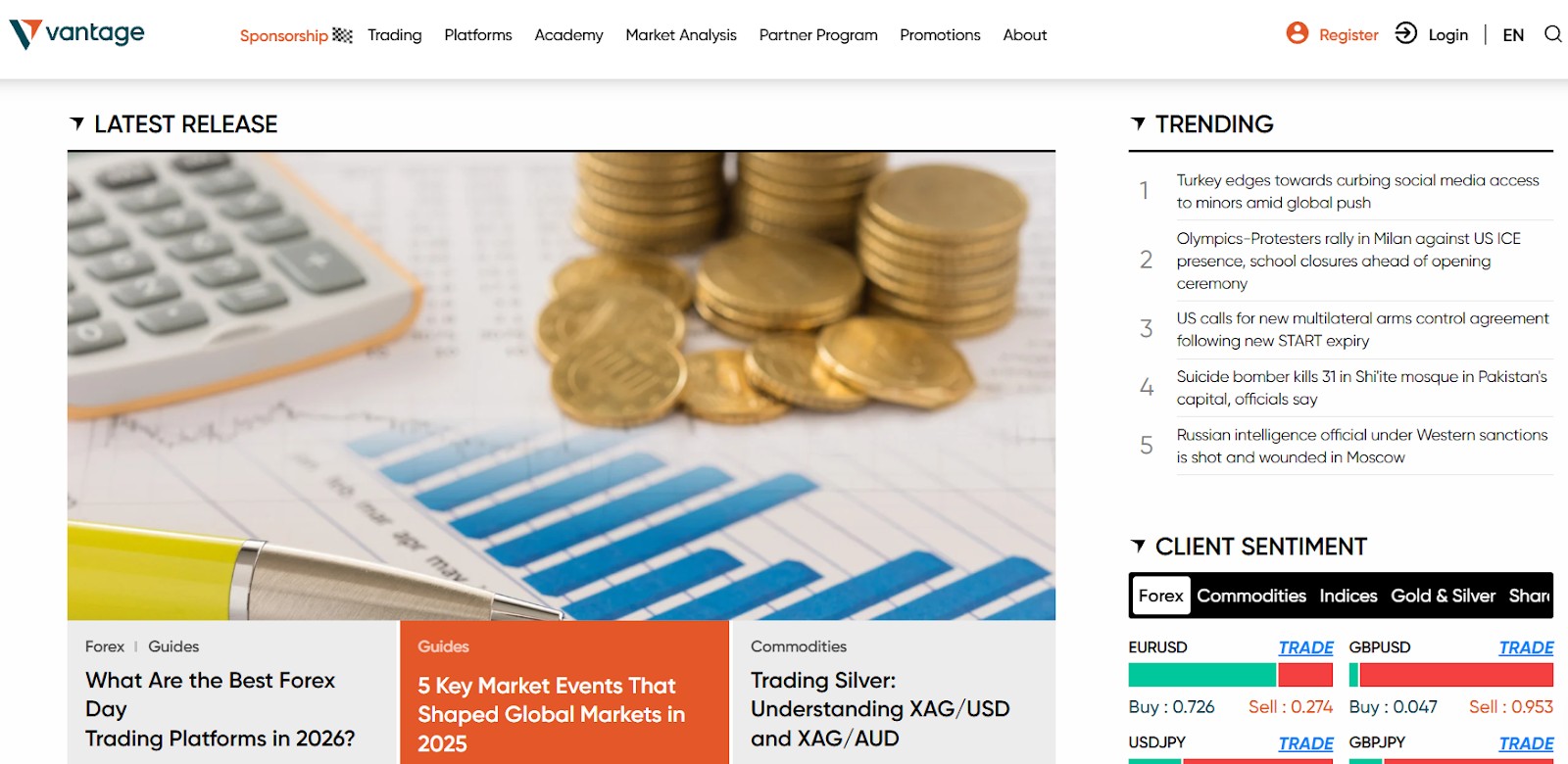
At a high level, the Academy is organized around six main components. Together, they cover both learning fundamentals and staying aligned with active markets.
Articles library: breadth plus filtering
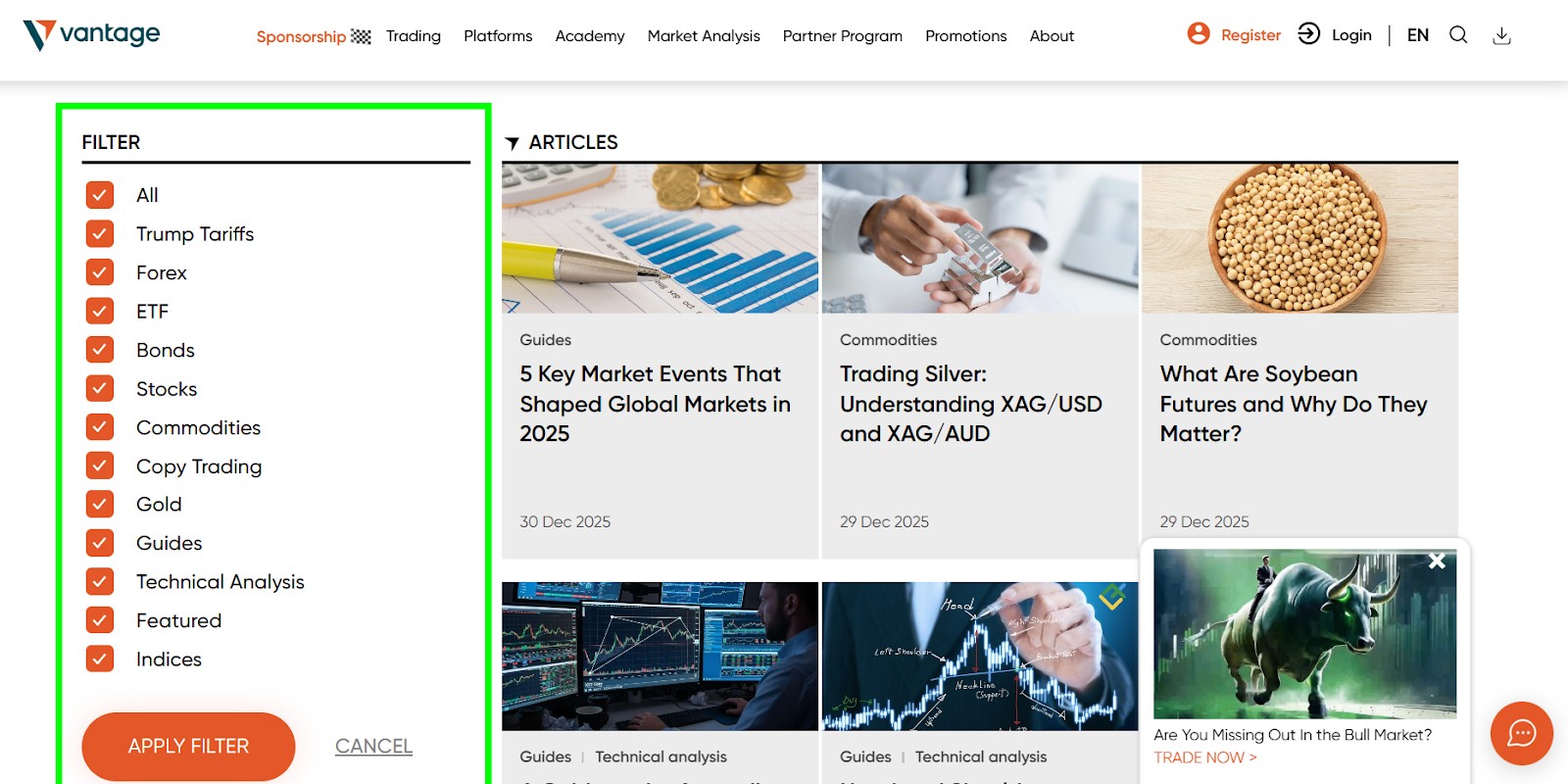
The articles library is the largest content segment inside Vantage Academy. It contains several hundred educational pieces covering different markets and experience levels, which makes it the most commonly used entry point for traders.
Articles are organized by both instrument and topic. Coverage includes Forex, commodities, ETFs, bonds, share CFDs, indices, and precious metals such as gold and silver. Content ranges from introductory trading guides and platform explainers to technical analysis and strategy-focused material.
How the articles library works best in practice depends on experience level:
For beginners. Articles work best as supporting material alongside courses; core guides help explain terminology, order types, and basic analysis concepts before traders move on to structured learning paths.
For experienced traders. The value comes from targeted refreshers; articles are useful for revisiting specific patterns, checking how an instrument is quoted, or reviewing the mechanics of a market that is traded less frequently.
Structured beginner courses: a guided learning path
Structured courses are the clearest “platform” feature inside Vantage Academy. Instead of asking new traders to browse randomly, the Academy offers step-by-step learning tracks designed to build skills in the correct order.
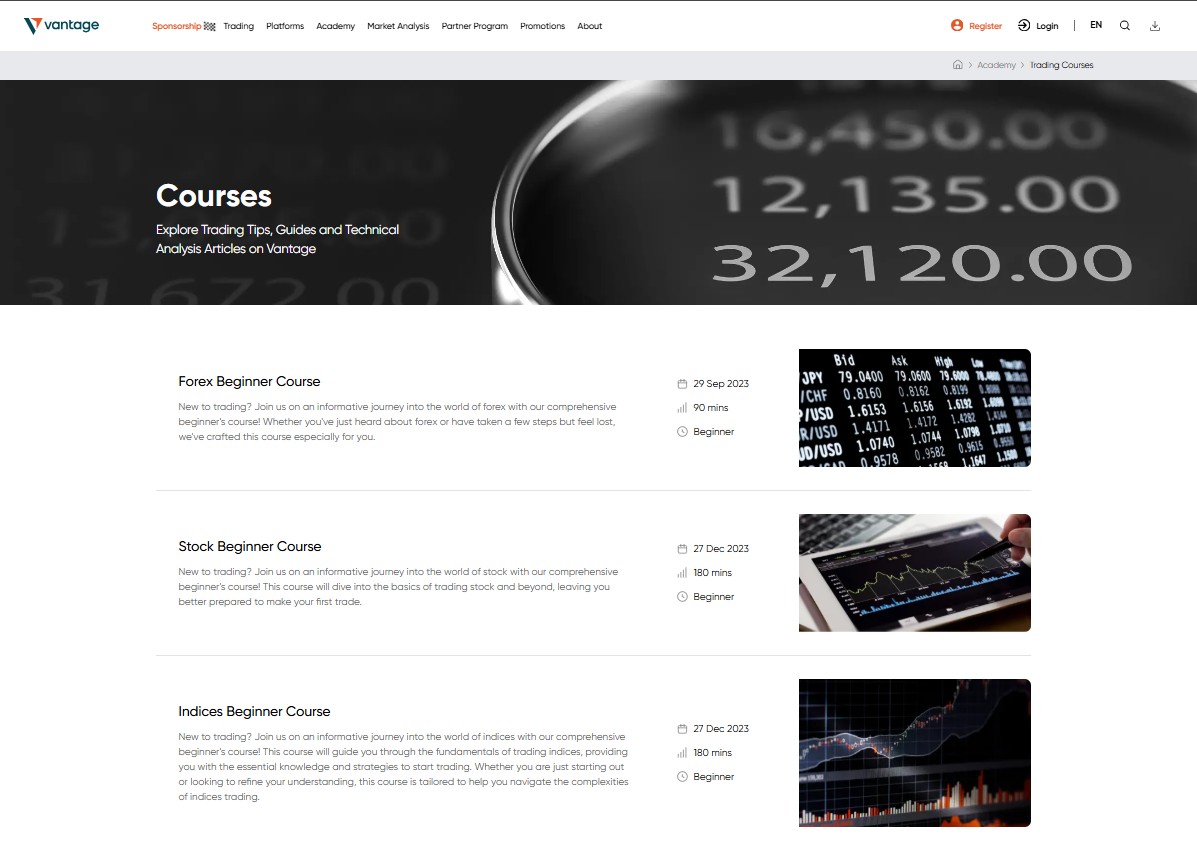
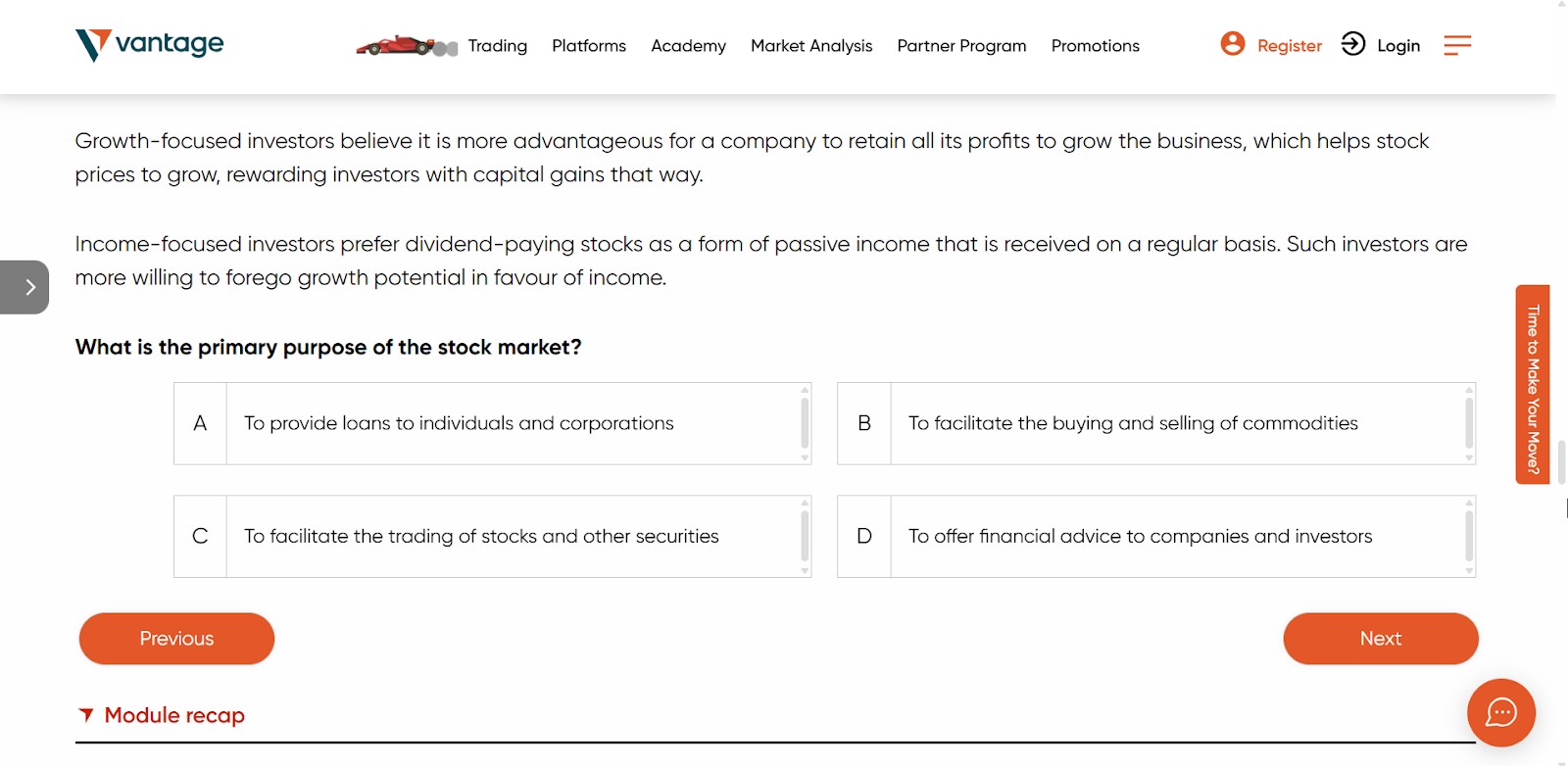
The beginner course lineup focuses on four core markets: Forex, stocks, indices, and gold. These tracks are clearly labeled for beginners and are presented as guided programs rather than standalone lessons. Across all courses, the total learning time runs into several hundred minutes, which reflects a structured approach rather than quick introductions.
What the courses include is consistent across tracks.
Guided lesson structure. Concepts are introduced gradually, starting with basic market understanding and moving toward simple execution logic, which helps beginners avoid jumping ahead too quickly.
Short, focused modules. Lessons are broken into manageable segments, making it easier to learn in short sessions without losing continuity.
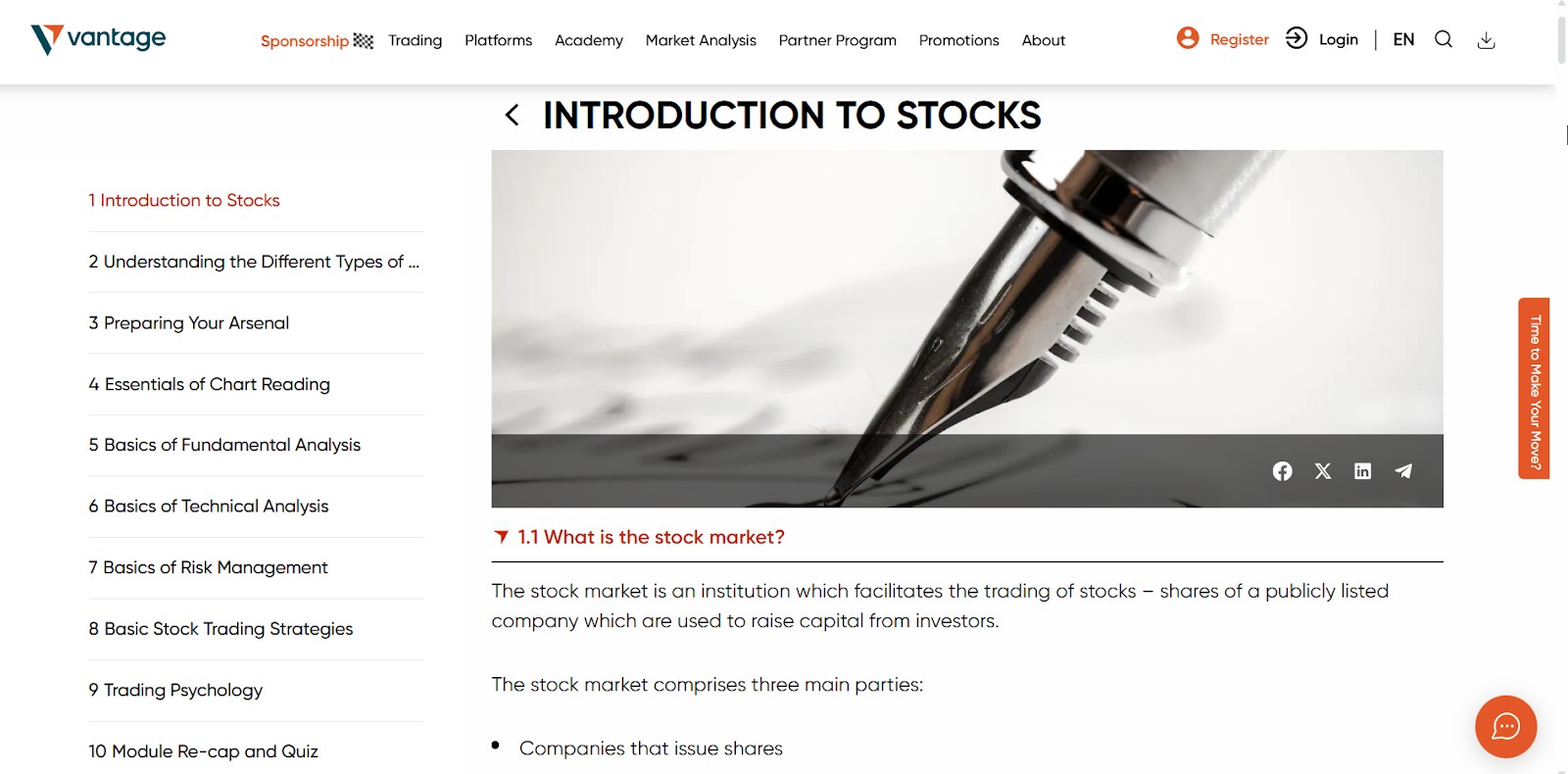
Quizzes for reinforcement. Each course includes quizzes that help traders identify gaps in understanding instead of assuming the material has been absorbed.
Webinars: live context and recorded practice
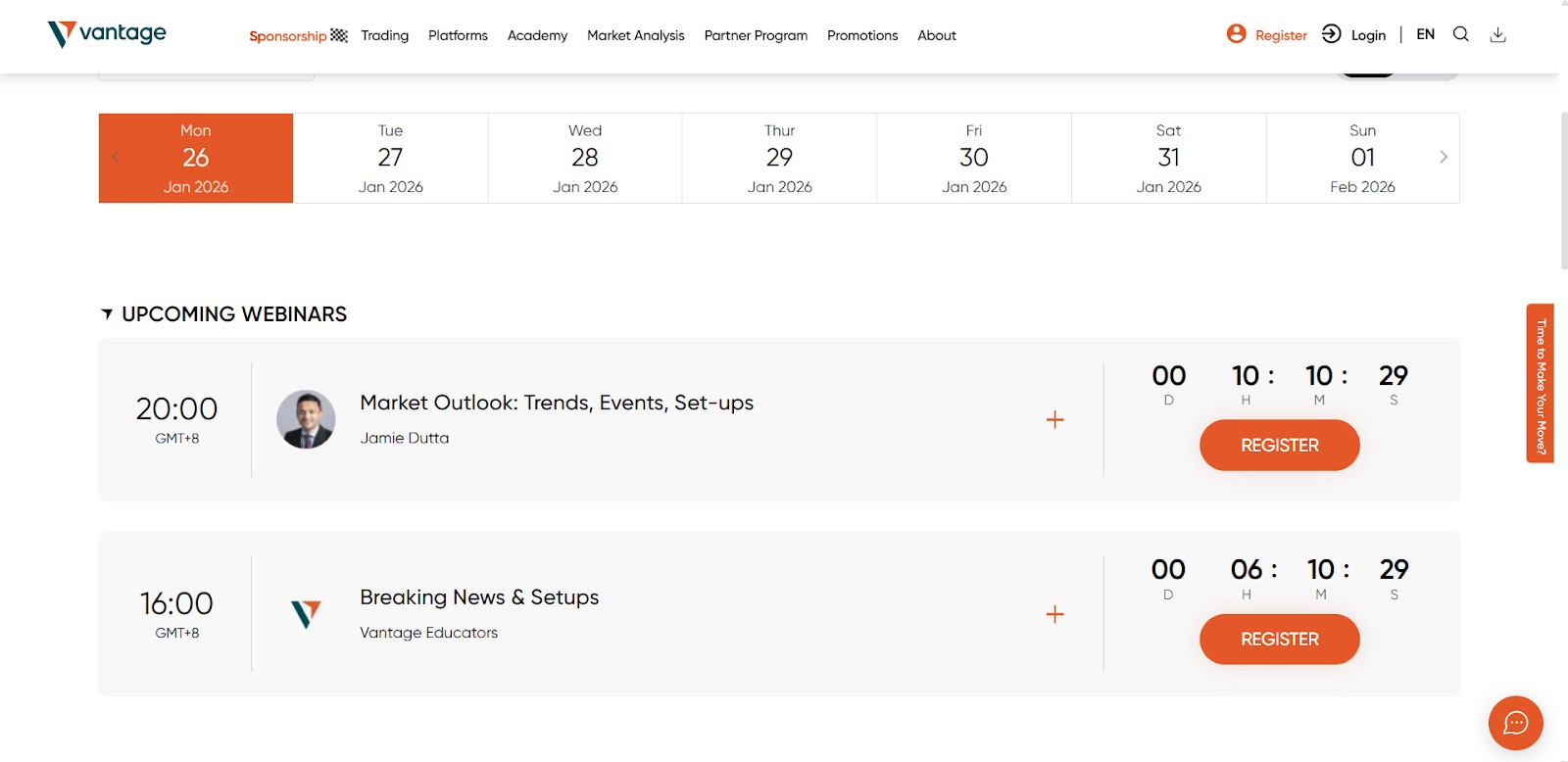
Webinars inside Vantage Academy are designed to bridge the gap between static education and live market conditions. While articles and courses focus on structure, webinars focus on context. They show how ideas are applied when markets are actually moving.
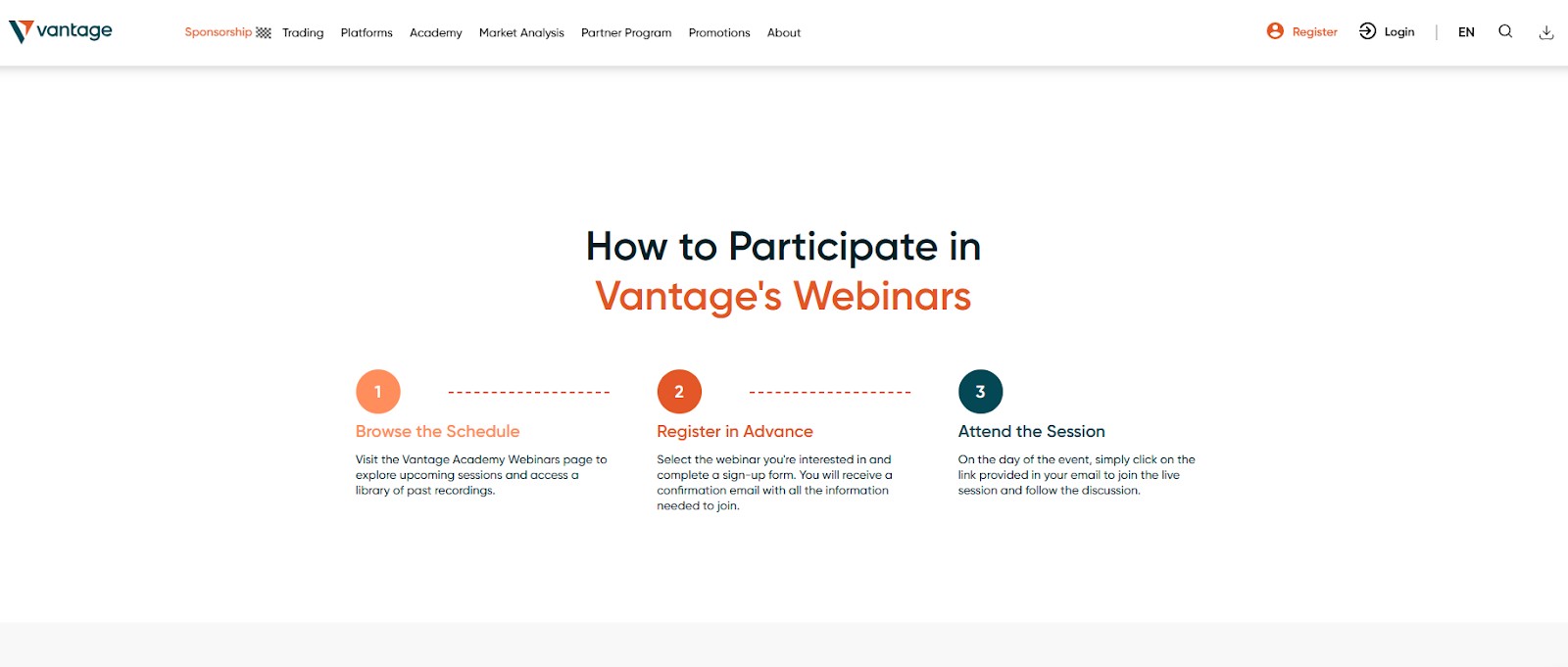
The Academy hosts both live webinars and recorded sessions. Live events allow traders to follow current themes, while recordings let users revisit analysis at their own pace. This makes the webinar section useful even if traders cannot attend sessions in real time.
These webinars typically focus on:
Current market themes. Sessions often center on active macro drivers, key technical levels, or upcoming economic events that are influencing price action.
Technical and fundamental breakdowns. Presenters walk through charts and data step by step, explaining not just what is happening, but why it matters from a trading perspective.
Practical interpretation. Instead of raw headlines, webinars aim to connect market news to potential scenarios traders should be watching next.
How traders get the most value from webinars depends on preparation and follow-up:
Before a webinar. Writing down one question about market direction, one about execution, and one about risk helps keep attention focused during the session.
After a webinar. Turning notes into a short checklist makes the information actionable rather than forgettable.
Using recordings. Replaying sessions with pauses allows traders to predict outcomes and compare their thinking with the presenter’s reasoning.
eBooks: longer-form learning plus the Bloomberg collaboration
The eBooks section inside Vantage Academy is designed for traders who want to go beyond short explanations and build a more complete understanding of how markets work. Unlike articles, eBooks focus on connected decision-making rather than isolated topics.
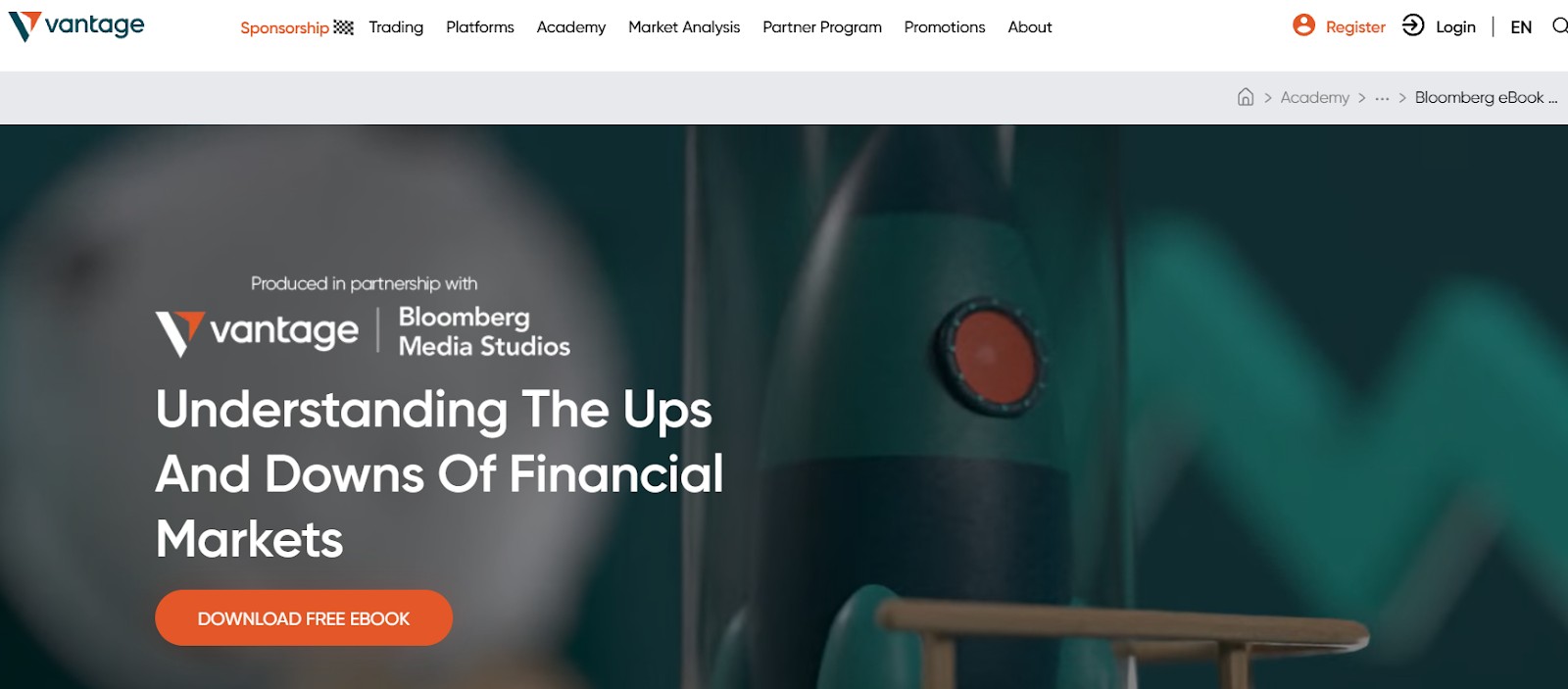
A key credibility point here is the comprehensive trading eBook produced in collaboration with Bloomberg Media Studios. This partnership signals an emphasis on structure and clarity rather than promotional material. The eBook is available as a free download and is positioned as a practical starter guide rather than marketing content.
What the eBooks focus on:
Market foundations. Clear explanations of how different markets function, including pricing logic and key participants.
Trade setup thinking. Step-by-step discussion of how trades are formed, from idea generation to execution planning.
Product understanding. Coverage of CFDs, leverage, and commonly traded instruments, with attention to risks rather than just opportunity.
Safe-haven and macro concepts. Context around assets such as gold and how they behave during periods of uncertainty.
Terminology: quick reference that supports confidence
The Terminology section inside Vantage Academy is a dedicated glossary designed to help traders understand the language of the markets. While it may look basic at first glance, this section plays an important role in reducing early mistakes.
Most beginner errors are not caused by complex strategies, but by misunderstandings. Traders confuse margin with leverage, misinterpret what a pip represents, or misunderstand how CFDs differ from spot products. A clear, accessible glossary helps prevent these issues before they turn into losses.
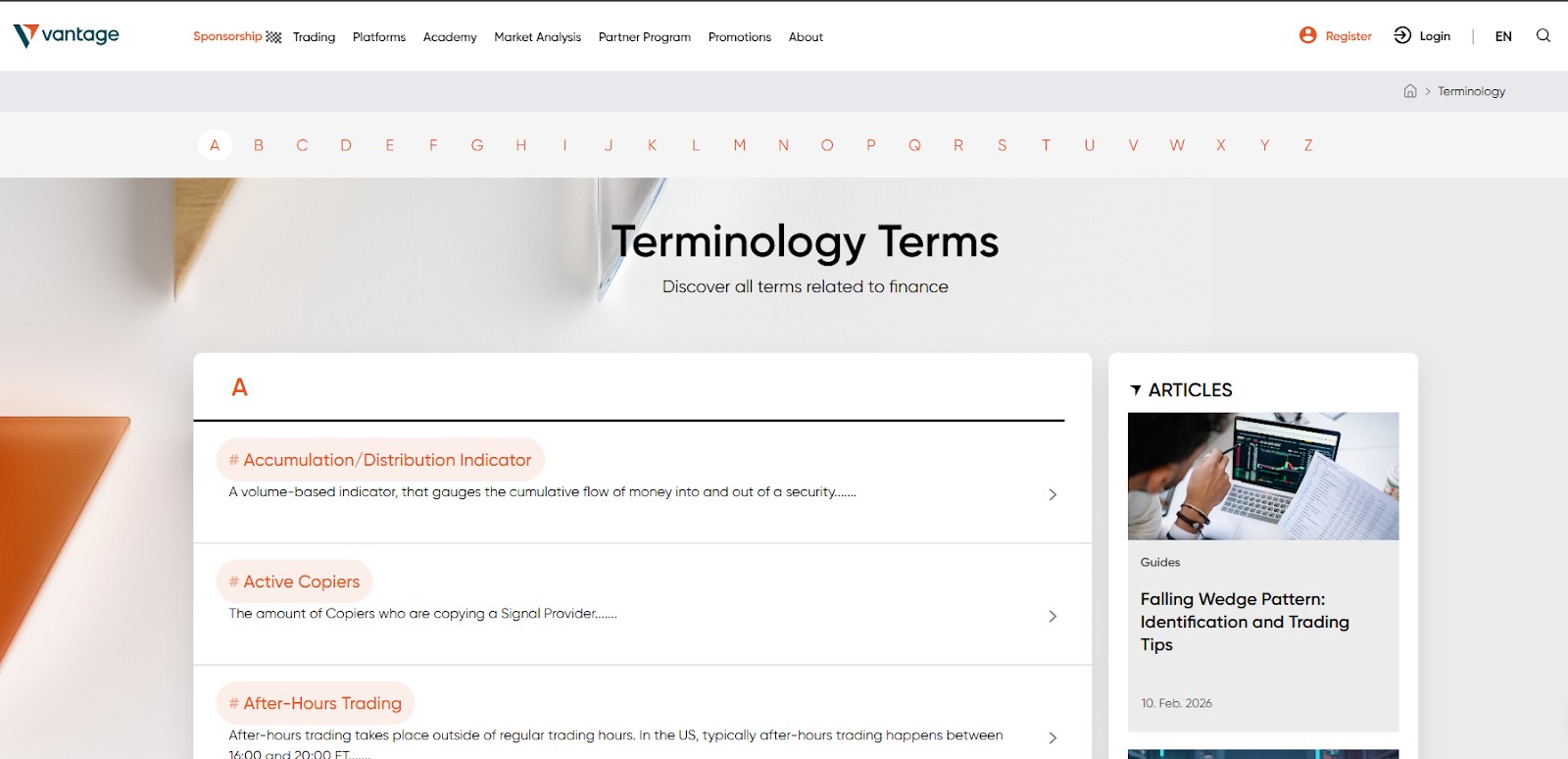
What makes the terminology section useful:
Clear definitions. Terms are explained in simple language, without assuming prior market knowledge.
Broad coverage. The glossary spans core concepts across Forex, CFDs, indices, commodities, and risk management.
Quick reference format. Traders can look up terms quickly without breaking their learning flow.
Market news and analysis: staying aligned with active markets
The Market News and Analysis section inside Vantage Academy is designed to connect education with what is happening in the markets right now. Instead of acting as a raw news feed, it focuses on interpretation and relevance for traders.
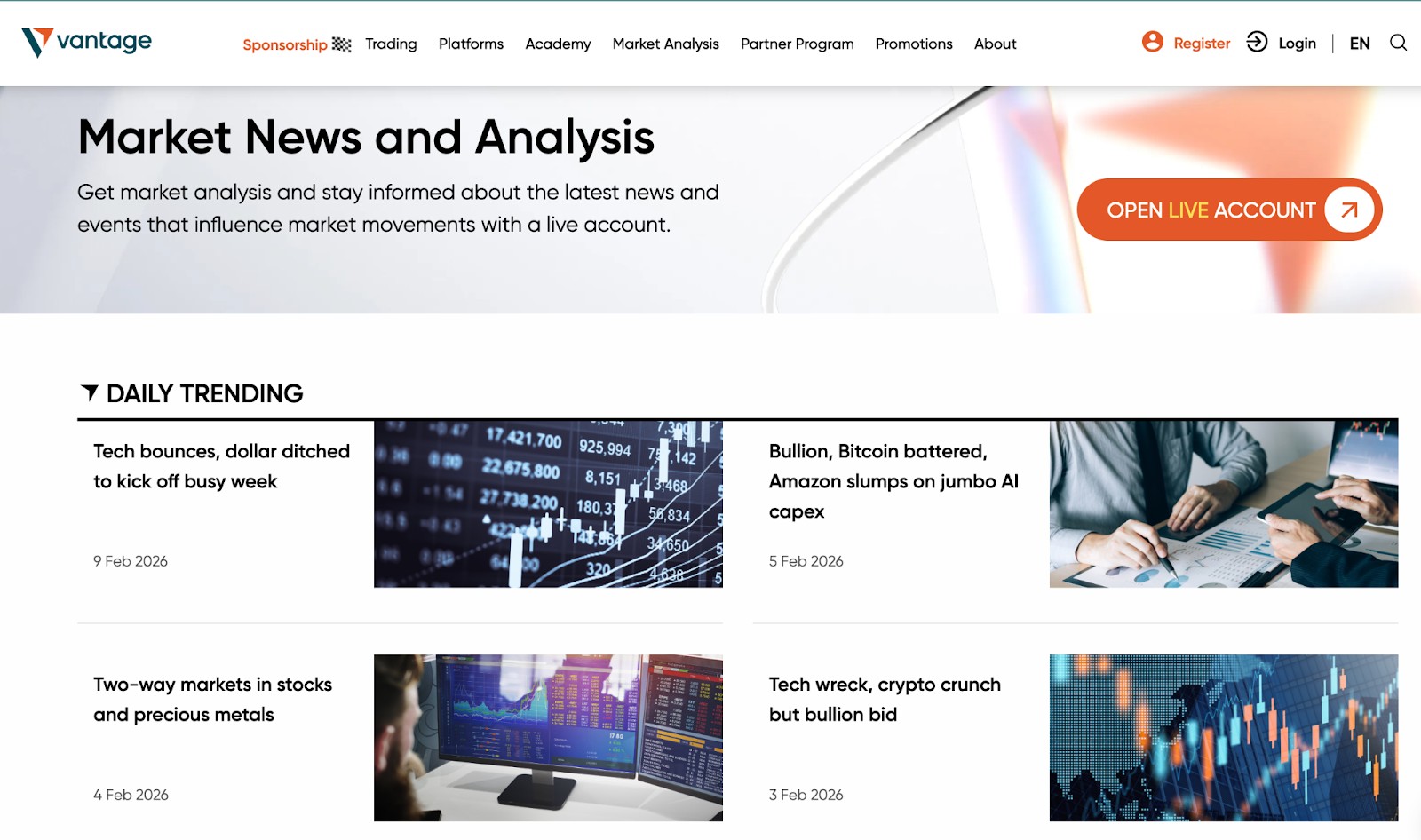
Content is typically organized around daily and weekly themes. This helps traders see which events are driving price movement and which developments are worth monitoring rather than reacting to immediately.
What this section does well.
Context over headlines. Market updates focus on explaining why certain events matter, not just reporting that they happened.
Tradeable framing. Analysis often highlights levels, scenarios, or conditions to watch, helping traders think in terms of preparation rather than prediction.
Regular updates. Daily and weekly trending formats keep content current without overwhelming users with constant alerts.
Who will benefit most from Vantage Academy?
Vantage Academy is particularly well-suited for:
Beginner retail traders. Traders who are new to financial markets will benefit most from the structured courses, glossary support, and step-by-step explanations. The guided tracks help reduce early overwhelm and build foundational confidence.
Traders transitioning from demo to live accounts. Those who understand basic terminology but lack consistency can use the Academy to refine structure, revisit risk management principles, and align their learning with real market context.
Structured learners. Traders who prefer organized curricula rather than scattered content will find value in the Academy’s sequenced courses and categorized materials.
Traders who want ongoing market context. Webinars and regular analysis updates make the platform useful not only for initial learning, but also for staying aligned with macro themes and technical conditions.
How traders should use Vantage Academy
For new traders, the biggest risk is not lack of information, but information overload. Vantage Academy works best for beginners when it is used with a clear sequence rather than explored randomly.
A simple, structured approach helps turn learning into execution.
Start with one market only. Choose a single instrument such as Forex, gold, or indices. Each has its own beginner course, and focusing on one prevents confusion caused by switching between products too early.
Combine three learning tools. A productive beginner routine uses one course track, the terminology glossary, and a small cluster of related articles. This keeps learning focused and reinforces the same concepts from different angles.
Set a realistic weekly rhythm. For most beginners, a good pace is two course lessons, ten to fifteen glossary terms, and two articles that directly support the lessons covered that week.
Learning becomes effective only when it produces output. Beginners should convert education into a simple, testable routine.
Define one entry rule. What condition must be present to consider a trade.
Define one exit rule. When to close the trade, either for profit or loss.
Define one risk rule. How much capital is at risk per trade.
Define one no-trade rule. Situations where trading is avoided entirely.
These rules should be tested in a demo environment first. The goal at this stage is not profit. It is consistency and discipline. Vantage Academy supports this process by helping beginners move from understanding concepts to applying them in a controlled way.
Structured learning beats random consumption

After reviewing Vantage Academy in detail, I see its main strength in structure rather than volume. Many brokers offer educational articles, but fewer provide a guided path that helps beginners move from definitions to decision-making without getting lost. The combination of structured courses, glossary support, and market-linked analysis makes the learning process feel connected rather than fragmented.
That said, the real value depends on how it is used. Traders who follow a sequence, test ideas in demo, and revisit material with intention are likely to benefit the most. Those who browse randomly may feel informed but not necessarily prepared. In my view, Vantage Academy works best as a disciplined learning framework, not a shortcut to faster profits.
Conclusion
Vantage Academy is designed as a structured learning system rather than a simple content library. It combines articles for fast answers, beginner courses for sequencing, webinars for live market context, eBooks for deeper understanding, a terminology section for fluency, and market analysis to keep learning connected to real price movement.
The platform works best when used with intent. Beginners benefit most from guided learning paths that reduce confusion and overload, while experienced traders gain value by using the Academy selectively as a reference and refinement tool. Overall, Vantage Academy is positioned to support disciplined learning, not shortcuts, which makes it most effective for traders focused on long-term skill development.
FAQs
Is Vantage Academy suitable for traders with no financial background at all?
Yes. The material is structured in a way that does not assume prior knowledge. A complete beginner can start from zero and gradually build understanding without needing outside resources.
Does Vantage Academy focus more on theory or practical application?
The platform combines both. Courses and eBooks explain core concepts, while webinars and market analysis demonstrate how those concepts apply to real market conditions.
Can experienced traders still find value in the Academy?
Yes, especially when reviewing unfamiliar instruments or refining specific concepts. It works well as a structured reference library rather than an advanced research hub.
What is the main difference between Vantage Academy and free trading content on YouTube?
The key difference is structure. While free online content may be fragmented or opinion-driven, Vantage Academy organizes learning into a logical sequence designed to reduce confusion and improve consistency.
Related Articles
Team that worked on the article
Andrey Mastykin is an experienced author, editor, and content strategist who has been with Traders Union since 2020. As an editor, he is meticulous about fact-checking and ensuring the accuracy of all information published on the Traders Union platform.
Dan Blystone began his trading career in 1998 as an arbitrage clerk on the floor of the Chicago Mercantile Exchange (CME). He later traded bond and Eurex futures at proprietary firms such as Altea Trading, gaining valuable experience in high-frequency trading and risk management.
Chinmay Soni is a financial analyst with more than 5 years of experience in working with stocks, Forex, derivatives, and other assets. As a founder of a boutique research firm and an active researcher, he covers various industries and fields, providing insights backed by statistical data.
-
 Afghanistan
-
 Albania
-
 Algeria
-
 Angola
-
 Argentina
-
 Armenia
-
 Australia
-
 Austria
-
 Azerbaijan
-
 Bahamas
-
 Bahrain
-
 Bangladesh
-
 Belarus
-
 Belgium
-
 Bolivia
-
 Botswana
-
 Brazil
-
 Brunei
-
 Bulgaria
-
 Cambodia
-
 Cameroon
-
 Canada
-
 Chile
Chile
-
 China
China
-
 Colombia
-
 Congo
Congo
-
 Costa Rica
-
 Cote d'Ivoire
-
 Croatia
-
 Cuba
Cuba
-
 Cyprus
-
 Czechia
-
 DR Congo
-
 Denmark
-
 Dominican Republic
-
 Ecuador
-
 Egypt
Egypt
-
 El Salvador
-
 Estonia
-
 Eswatini
-
 Ethiopia
-
 Finland
-
 France
-
 Georgia
-
 Germany
-
 Ghana
Ghana
-
 Greece
-
 Haiti
Haiti
-
 Hong Kong
-
 Hungary
-
 India
India
-
 Indonesia
-
 Iran, Islamic republic
-
 Iraq
Iraq
-
 Ireland
-
 Israel
-
 Italy
Italy
-
 Jamaica
-
 Japan
Japan
-
 Jordan
-
 Kazakhstan
-
 Kenya
Kenya
-
 Korea
Korea
-
 Kuwait
-
 Kyrgyzstan
-
 Laos
Laos
-
 Latvia
-
 Lebanon
-
 Lesotho
-
 Libya
Libya
-
 Lithuania
-
 Luxembourg
-
 Madagascar
-
 Malaysia
-
 Malta
Malta
-
 Mauritius
-
 Mexico
-
 Moldova
-
 Mongolia
-
 Montenegro
-
 Morocco
-
 Mozambique
-
 Myanmar
-
 Namibia
-
 Nepal
Nepal
-
 Netherlands
-
 New Zealand
-
 Nigeria
-
 North Macedonia
-
 Norway
-
 Oman
Oman
-
 Pakistan
-
 Palestine
-
 Panama
-
 Papua New Guinea
-
 Paraguay
-
 Peru
Peru
-
 Philippines
-
 Poland
-
 Portugal
-
 Puerto Rico
-
 Qatar
Qatar
-
 Reunion
-
 Romania
-
 Rwanda
-
 Saudi Arabia
-
 Serbia
-
 Singapore
-
 Slovakia
-
 Slovenia
-
 Somalia
-
 South Africa
-
 Spain
Spain
-
 Sri Lanka
-
 Sweden
-
 Switzerland
-
 Syria
Syria
-
 Taiwan
-
 Tajikistan
-
 Tanzania
-
 Thailand
-
 Trinidad and Tobago
-
 Tunisia
-
 Turkey
-
 UAE
UAE
-
 Uganda
-
 Ukraine
-
 United Kingdom
-
United States
-
 Uruguay
-
 Uzbekistan
-
 Venezuela
-
 Vietnam
-
 Yemen
Yemen
-
 Zambia
-
 Zimbabwe
- Forex
- Crypto












