How Do You Trade Binary Options With Compounding?


Editorial Note: While we adhere to strict Editorial Integrity, this post may contain references to products from our partners. Here's an explanation for How We Make Money. None of the data and information on this webpage constitutes investment advice according to our Disclaimer.
Here are 5 steps to apply the strategy in your binary options trading:
- Set your trading capital
- Enter a trade with a predetermined percentage of your capital
- Let profits blossom. Reinvest after a winning trade
- Learn from setbacks. Accept losses without increasing your trading capital
- Repeat steps 2-4 for each subsequent trade
The binary options compounding strategy is a sophisticated money management technique seasoned traders use to optimize returns over time. This strategy involves reinvesting a portion of the profits earned from each successful trade back into the market, fostering exponential growth.
To get a comprehensive overview of binary options trading, read this article on different types of binary options trades. It helps novice traders choose the most suitable option for their needs.
How to use the compounding strategy in binary options trading
Implementing the compounding strategy in binary options trading is a meticulous process requiring a structured money management approach.
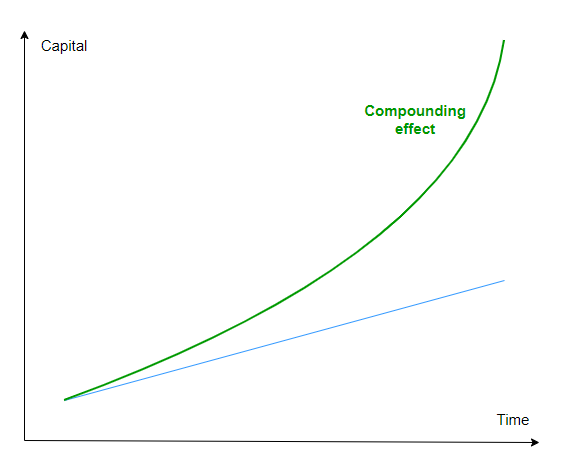 Profitable Strategy + Compounding effect
Let's delve into a comprehensive step-by-step guide on how to apply the compounding strategy in your binary options trading:
Step 1: Establish a fixed trading capital
Before initiating any trades, setting a fixed trading capital is paramount. This serves as the foundation for the entire compounding strategy. By determining an initial amount, traders create a baseline for their investments.Step 2: Enter a trade with a predetermined percentage of your capital
Once the fixed capital is established, calculate a predetermined percentage invested in each trade. This percentage (1-2% is conservative, 5-10% is aggressive) should be chosen thoughtfully, considering potential gains and acceptable risks. This step ensures consistency and prevents overcommitment.Step 3: Reinvest profits after a winning trade
If a trade is successful and profitable, the compounding strategy involves reinvesting up to 100% of the profit into trading capital. This creates a compounding effect, allowing profits to grow exponentially over time. It's a pivotal step in maximizing returns.Step 4: Accept losses without increasing your trading capital
In a losing trade, it's crucial to maintain discipline and adhere to the predetermined plan. Instead of trying to recover losses by increasing the trading capital, accept the loss gracefully. This disciplined approach is fundamental to the long-term success of the compounding strategy.Step 5: Repeat steps 2-4 for each subsequent trade
Consistency is the key to unlocking the full potential of the compounding strategy. Repeat the process for each subsequent trade, adhering to the predetermined percentage and adjusting the trading capital based on the outcomes of previous trades. This repetitive cycle forms the basis of sustained growth.
Following these step-by-step instructions, traders can effectively integrate the compounding strategy into their binary options trading. This systematic approach maximizes potential returns and instills a disciplined and calculated approach to risk management. Remember, success in trading often lies in meticulous planning and adherence to well-defined strategies.
Example
To show you the effect of compounding, here is a table. The more trades are made, the more noticeable this effect becomes.
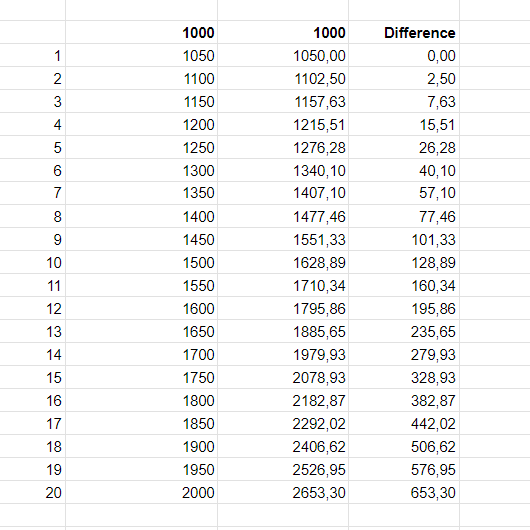 A compounding strategy effect
For demonstration purposes, let's imagine a series of 20 profitable trades in a row (not very realistic, but let's assume). See how the trader's capital changes.
Without the compounding effect. The left column shows how the capital increases by 5% in each trade. This is a consequence of the trader trading a fixed lot
With compounding effect. The right column shows how the equity increases by 5% relative to the previous value. This is a consequence of the fact that the trader invests in each subsequent trade the profit from the previous trade. That is, he trades with increasing lot size
The rightmost column shows the difference between the first and second methods of capital management. In this way, you can realize that by having a winning strategy, the compounding effect can increase your capital more aggressively with each subsequent profitable trade.
Explore our " How To Make Money With Binary Options" article for additional insights and trade wisely.
Best binary options brokers



Benefits of binary options compounding strategy
Increased potential returns
Reinvesting profits leverages the power of compounding, significantly boosting overall returns over time. This compounding effect can lead to substantial wealth accumulationReduced risk
Potential losses are limited by increasing trading capital only after successful trades, safeguarding the initial investment. This risk mitigation strategy is crucial for long-term successImproved money management
The strategy encourages discipline and adherence to a pre-defined risk management plan, streamlining the trading process. Traders following this method are likelier to stay on course and avoid impulsive decisions
Disadvantages of binary options compounding strategy
Increased volatility
While compounding profits can amplify gains, it also heightens the risk of substantial losses, leading to significant account balance fluctuations. Traders must be prepared for the inherent volatility associated with this strategyRequires discipline
Sticking to the strategy is crucial, avoiding emotional decisions, especially after a loss. Discipline is the bedrock of successful compounding, and traders should adhere to the predetermined planLimited risk control
Binary options inherently carry a high risk, and compounding intensifies this risk, emphasizing the importance of caution. Traders must acknowledge and manage these risks effectivelyPsychological impact
The potential for rapid gains can be emotionally taxing, possibly leading to impulsive trading decisions. Traders should recognize the psychological impact and strive for a balanced and rational approach
Tips for implementing the binary options compounding strategy
Comprehensive understanding of risks
Before diving into binary options trading, it's imperative to comprehend the associated risks thoroughly. This knowledge forms the foundation for informed decision-makingBack-test the strategy
Evaluate the effectiveness of the compounding strategy by back-testing it with historical dataSet Realistic Profit and Loss Limits
Establish clear parameters for profit and loss to guide your trading decisions. Realism in setting these limits is essential for effective risk managementStart Small, Grow Gradually
Initiate your binary options journey with a modest initial capital. As experience accrues, gradually increase your investment. This measured approach aligns with the strategy's principlesFinancial Caution
Never invest more than you can afford to lose. Adhering to this fundamental principle ensures responsible financial management
For guidance on starting your binary trading journey, refer to this article - How to Start Binary Options Trading in 7 Simple Steps, for essential insights.
Conclusion
While the compounding strategy offers promising rewards, it should be cautiously approached. This technique best suits experienced traders with a deep understanding of associated risks and a well-defined trading plan. By following these steps diligently, traders can unlock the full potential of binary options compounding strategy.
FAQs
What does compounding mean in trading?
In trading terms, compounding refers to reinvesting a portion of the profits from successful trades back into the trading capital. This establishes a self-sustaining cycle, where the initial capital grows from new investments and previously earned profits. It's a method of letting your money work for you over time.
What is an example of a compounding effect?
Let's say you have a capital of $1,000 and enter a trade with 10% of your capital, that is, an amount of $100. If your trade brought $70 of profit, the capital has increased to $1,070. Applying compounding, you will enter the next trade with an amount of $107, not $100. The effect of compounding is best seen over a long period after a large number of trades, allowing capital to grow faster (assuming, of course, you make more profits than losses).
Can compounding be a good thing?
Certainly, compounding can be a valuable tool for accumulating wealth through trading. The key lies in implementing it with discipline and having a clear plan. When traders stick to a consistent strategy of reinvesting profits and managing risks effectively, compounding maximizes the potential for increased returns. It's a systematic approach to growing one's trading capital in the long run.
What is the best strategy for binary options?
One notable strategy in binary options trading is the compounding strategy, known for its effective money management. Understanding that no strategy can guarantee success is crucial, but compounding shows promise in optimizing returns over time. The concept involves reinvesting a part of the profits back into the trading capital, creating a cycle of potential growth.
Editors' Top Picks and Insights






Related Articles
Team that worked on the article
Upendra Goswami is a full-time digital content creator, marketer, and active investor. As a creator, he loves writing about online trading, blockchain, cryptocurrency, and stock trading.
Dr. BJ Johnson is a PhD in English Language and an editor with over 15 years of experience. He earned his degree in English Language in the U.S and the UK.
Tobi Opeyemi Amure is an editor and expert writer with over 7 years of experience. In 2023, Tobi joined the Traders Union team as an editor and fact checker, making sure to deliver trustworthy and reliable content.
An investor is an individual, who invests money in an asset with the expectation that its value would appreciate in the future. The asset can be anything, including a bond, debenture, mutual fund, equity, gold, silver, exchange-traded funds (ETFs), and real-estate property.
Risk management is a risk management model that involves controlling potential losses while maximizing profits. The main risk management tools are stop loss, take profit, calculation of position volume taking into account leverage and pip value.
Binary options trading is a financial trading method where traders speculate on the price movement of various assets, such as stocks, currencies, or commodities, by predicting whether the price will rise or fall within a specified time frame, often as short as a few minutes. Unlike traditional trading, binary options have only two possible outcomes: a fixed payout if the trader's prediction is correct or a loss of the invested amount if the prediction is wrong.
Options trading is a financial derivative strategy that involves the buying and selling of options contracts, which give traders the right (but not the obligation) to buy or sell an underlying asset at a specified price, known as the strike price, before or on a predetermined expiration date. There are two main types of options: call options, which allow the holder to buy the underlying asset, and put options, which allow the holder to sell the underlying asset.
Volatility refers to the degree of variation or fluctuation in the price or value of a financial asset, such as stocks, bonds, or cryptocurrencies, over a period of time. Higher volatility indicates that an asset's price is experiencing more significant and rapid price swings, while lower volatility suggests relatively stable and gradual price movements.

-
 Afghanistan
-
 Albania
-
 Algeria
-
 Angola
-
 Argentina
-
 Armenia
-
 Australia
-
 Austria
-
 Azerbaijan
-
 Bahamas
-
 Bahrain
-
 Bangladesh
-
 Belarus
-
 Belgium
-
 Bolivia
-
 Botswana
-
 Brazil
-
 Brunei
-
 Bulgaria
-
 Cambodia
-
 Cameroon
-
 Canada
-
 Chile
Chile
-
 China
China
-
 Colombia
-
 Congo
Congo
-
 Costa Rica
-
 Cote d'Ivoire
-
 Croatia
-
 Cuba
Cuba
-
 Cyprus
-
 Czechia
-
 DR Congo
-
 Denmark
-
 Dominican Republic
-
 Ecuador
-
 Egypt
Egypt
-
 El Salvador
-
 Estonia
-
 Eswatini
-
 Ethiopia
-
 Finland
-
 France
-
 Georgia
-
 Germany
-
 Ghana
Ghana
-
 Greece
-
 Haiti
Haiti
-
 Hong Kong
-
 Hungary
-
 India
India
-
 Indonesia
-
 Iran, Islamic republic
-
 Iraq
Iraq
-
 Ireland
-
 Israel
-
 Italy
Italy
-
 Jamaica
-
 Japan
Japan
-
 Jordan
-
 Kazakhstan
-
 Kenya
Kenya
-
 Korea
Korea
-
 Kuwait
-
 Kyrgyzstan
-
 Laos
Laos
-
 Latvia
-
 Lebanon
-
 Lesotho
-
 Libya
Libya
-
 Lithuania
-
 Luxembourg
-
 Madagascar
-
 Malaysia
-
 Malta
Malta
-
 Mauritius
-
 Mexico
-
 Moldova
-
 Mongolia
-
 Montenegro
-
 Morocco
-
 Mozambique
-
 Myanmar
-
 Namibia
-
 Nepal
Nepal
-
 Netherlands
-
 New Zealand
-
 Nigeria
-
 North Macedonia
-
 Norway
-
 Oman
Oman
-
 Pakistan
-
 Palestine
-
 Panama
-
 Papua New Guinea
-
 Paraguay
-
 Peru
Peru
-
 Philippines
-
 Poland
-
 Portugal
-
 Puerto Rico
-
 Qatar
Qatar
-
 Reunion
-
 Romania
-
 Rwanda
-
 Saudi Arabia
-
 Serbia
-
 Singapore
-
 Slovakia
-
 Slovenia
-
 Somalia
-
 South Africa
-
 Spain
Spain
-
 Sri Lanka
-
 Sweden
-
 Switzerland
-
 Syria
Syria
-
 Taiwan
-
 Tajikistan
-
 Tanzania
-
 Thailand
-
 Trinidad and Tobago
-
 Tunisia
-
 Turkey
-
 UAE
UAE
-
 Uganda
-
 Ukraine
-
 United Kingdom
-
United States
-
 Uruguay
-
 Uzbekistan
-
 Venezuela
-
 Vietnam
-
 Yemen
Yemen
-
 Zambia
-
 Zimbabwe
- Forex
- Crypto