
Binary Market Open Time: What Is The Best Time To Trade?


Editorial Note: While we adhere to strict Editorial Integrity, this post may contain references to products from our partners. Here's an explanation for How We Make Money. None of the data and information on this webpage constitutes investment advice according to our Disclaimer.
Best time to trade binary options:
Peak hours: 13:00–17:00 GMT (London/New York overlap).
Forex focus: 08:00–18:00 GMT for EUR/USD, GBP/USD.
Stocks: 09:30–16:00 EST (NYSE, NASDAQ hours).
Crypto: 24/7, but most active 13:00–22:00 GMT.
Avoid: low volume times (22:00–05:00 GMT), just before/after major news.
In the fast-paced world of binary options, binary trading time is not just a detail — it is one of the most critical elements that determine your profitability. Whether you're targeting short-term gains or building a disciplined strategy, understanding the binary market open time is what separates consistent winners from frustrated beginners.
Risk warning: Binary options trading is highly risky and may result in a total loss of funds. These speculative instruments often lack strong regulation, with over 80% of traders losing their capital. Invest only what you can afford to lose and seek professional advice.
Why market timing defines your binary success
Consider this: two traders use the same strategy, risk profile, and asset, yet one sees repeated success while the other struggles. Often, the difference comes down to binary market timing. Trading during high-volume periods, such as when major financial markets overlap, offers increased liquidity and sharper price movements. These conditions improve the accuracy of technical signals and increase the likelihood of securing higher payouts on winning trades.
Take the example of a trader in South Africa who initially traded binary options during late-night hours with little success. After shifting their sessions to align with the London-New York market overlap, their win rate improved significantly. Similarly, a beginner in India reported a higher return on EUR/USD options by moving trades to the early afternoon IST window — matching peak Forex volatility and the most active binary trading sessions.
In binary trading, the market may be open, but that doesn’t mean it’s active. Knowing what time does the binary market open, how volatility affects outcomes, and how to choose the best time for binary trading is key. Timing, in this market, is more than a factor — it’s a core edge.
Understanding binary options trading hours
Binary options trading hours are directly tied to the trading sessions of the underlying assets, such as currencies, stocks, commodities, and cryptocurrencies. These assets follow the operational hours of their respective markets. For example, Forex binary options are available 24 hours a day from Monday to Friday, reflecting the decentralized and global nature of currency markets. In contrast, binary options on stocks depend on the exchange where the stock is listed — such as the NYSE (09:30 AM–4:00 PM EST) or London Stock Exchange (08:00 AM–4:30 PM GMT).
Broker platforms interpret these windows based on real-time market data and liquidity access. Some brokers may offer extended binary options trading times through Over-the-Counter (OTC) markets during weekends or non-peak hours. For example, while traditional assets may stop trading after 5:00 PM GMT, some brokers continue to provide binary options market time for crypto or synthetic indices.
Additionally, different brokers may restrict asset availability based on volatility forecasts, liquidity thresholds, or trading volume. It’s common for platforms to allow trading in major Forex pairs 24/5, while binary options on smaller stocks or exotic pairs might only be accessible for 6–8 hours per day. Understanding these dynamics helps traders plan sessions with optimal access and fewer execution delays.
When does the binary market open and close?
Binary options trading doesn't follow a single schedule; instead, it aligns with the trading hours of the underlying financial assets. Here’s a detailed, fact-based breakdown of opening and closing times by asset category, including key time zones.
Forex binary options
Forex binary options allow traders to speculate on currency pair movements within specific time frames. Available 24 hours a day, five days a week, these options follow the global Forex market, making them one of the most active instruments. Understanding the binary market open time for different regions is essential to optimize your binary trading time. High-volume periods, such as the London-New York overlap, offer the most reliable binary market timing for profitable trades.
Global availability: 24 hours/day, 5 days/week (Monday 00:00 GMT – Friday 22:00 GMT).
Key session opens:
Sydney: 22:00 GMT
Tokyo: 00:00 GMT
London: 08:00 GMT
New York: 13:00 GMT
Time zone conversion: 08:00 GMT = 13:30 IST = 10:00 SAST = 03:00 EST
Fact: ~90% of Forex trading volume happens between the London and New York sessions.
Stock binary options
Stock binary options are tied to the trading hours of major stock exchanges like the NYSE, NASDAQ, and LSE. Unlike Forex, these options are only available during official market hours, making binary options trading times more limited. Knowing what time the binary market opens for specific stocks ensures timely execution and access to peak volatility. Effective binary market timing around opening and closing bells can significantly enhance trading outcomes.
| Market | Open | Close | Time Zone |
|---|---|---|---|
| NYSE | 09:30 | 16:00 | EST |
| LSE | 08:00 | 16:30 | GMT |
| NSE (India) | 09:15 | 15:30 | IST |
Note: Stock binary options are not available outside these hours.
Fact: Over 70% of binary options trading volume in stocks occurs in the first and last trading hours.
Cryptocurrency binary options
Cryptocurrency binary options offer 24/7 trading, making them one of the most flexible assets in terms of availability. However, while the market is always open, not all hours are equal. Traders must understand the binary real market open time and focus on periods of higher liquidity, typically during weekday overlaps with the U.S. or European sessions. Smart binary trading time planning helps avoid low-volume traps and improves execution precision in this volatile asset class.
Availability: 24/7 across most brokers.
Active volume windows:
Weekdays: 13:00–22:00 GMT
Weekends: ~30–40% lower volume than weekdays
Fact: Weekend crypto trading is riskier due to thinner order books and wider bid-ask spreads.
Commodities binary options
Commodities binary options are linked to assets like gold, oil, and agricultural products, and follow the trading hours of exchanges such as the CME and ICE. These markets are not open 24/7, so knowing what time the binary market opens for each commodity is crucial. Active binary trading times typically occur during U.S. and European overlaps, when volume and volatility spike. Effective binary market timing during these windows helps maximize payout potential and reduce execution risks.
| Asset | Open | Close | Time Zone |
|---|---|---|---|
| Crude Oil | 09:00 | 14:30 | EST |
| Gold | 08:20 | 13:30 | EST |
Note: OTC options may extend these hours.
Fact: 60–70% of commodity volume occurs during overlapping US/Europe hours.
Understanding what time the binary market opens and closes for each asset is crucial. Trading during low-activity hours often leads to slippage and poor execution. Knowing the binary real market open time across time zones helps you capitalize on price movement when volume and volatility are at their peak.
| Asset Class | GMT | EST | IST | SAST |
|---|---|---|---|---|
| Forex (London) | 08:00 | 03:00 | 13:30 | 10:00 |
| Forex (NY) | 13:00 | 08:00 | 18:30 | 15:00 |
| Stocks (NYSE) | 14:30 | 09:30 | 20:00 | 16:30 |
| Crypto | 00:00 | 19:00 (prev) | 05:30 | 02:00 |
| Commodities (CME) | 14:00 | 09:00 | 19:30 | 16:00 |
Binary market open time by broker
The trading schedule for binary options can vary depending on the broker, asset class, and time zone. While the binary market operates 24/5 for most Forex and crypto assets, each broker sets its own session timings. Below is a comparison of market open and close times for top binary brokers, including weekend OTC (Over The Counter) availability.
| Broker | Market Open (Mon–Fri) | Close Time | Time Zone | Weekend OTC Availability |
|---|---|---|---|---|
| Quotex | 00:00 Monday | 23:59 Friday | GMT+3 | Yes – Forex & Crypto OTC |
| Pocket Option | 00:00 Monday | 23:59 Friday | GMT | Yes – Synthetic OTC on weekends |
| IQ Option | 00:00 Monday | 23:59 Friday | GMT+2 | Yes – OTC available Sat–Sun |
| Olymp Trade | 01:00 Monday | 23:00 Friday | GMT+3 | Yes – Limited OTC on weekends |
Note: All brokers listed adjust asset availability based on the asset class — for instance, cryptocurrencies are often tradable 24/7, while stock-derived binaries may close earlier.
Most platforms automatically detect your time zone and display local hours. However, for consistency and planning, check your broker’s default server time (usually GMT, GMT+2, or GMT+3) in your account settings.
Choosing the right time to trade is only half the equation — selecting a reliable broker is just as important. Execution speed, asset variety, platform stability, and access to weekend OTC markets can significantly impact your results. To help you make an informed choice, here’s a comparison of the best binary options brokers, based on trading conditions, regulation, features, and user feedback:
| CloseOption | Capitalcore | Nadex | Pocket Option | QUOTEX | |
|---|---|---|---|---|---|
|
Min. deposit |
5 | 10 | 250 | 5 | 10 |
|
Min. trade size |
1 | 1 | 1 | 1 | 1 |
|
Min. Payout (%) |
17 | 60 | No | 50 | 20 |
|
Max. Payout (%) |
95 | 90 | 100 | 128 | 98 |
|
Demo |
Yes | Yes | Yes | Yes | Yes |
|
Withdrawal minimum, $ |
1-500 | 2-5 | No | 10 | 10-50 |
|
Open an account |
Go to broker Your capital is at risk. |
Go to broker Your capital is at risk.
|
Study review | Go to broker Your capital is at risk. |
Go to broker Your capital is at risk. |
Binary trading sessions explained
Binary options trading follows the rhythm of the global market through four main sessions: Pacific, Asian, European, and American. Each session is active during different hours and favors specific assets — depending on the countries trading during that time. Understanding this structure helps identify the best time to trade binary options by country, since local market hours directly influence asset liquidity and volatility.
| Session (GMT) | Top Assets | Countries/Regions Covered |
|---|---|---|
| Pacific (22:00–07:00) | AUD, NZD, gold futures (low volume), minor JPY pairs | Australia, New Zealand, Fiji, Papua New Guinea, Tonga, Solomon Islands |
| Asian (00:00–09:00) | JPY, SGD, HKD, CNY, equities (Nikkei, Hang Seng) | Japan, Singapore, China, South Korea, India, Pakistan, Malaysia, Vietnam, Indonesia, Philippines |
| European (08:00–17:00) | EUR, GBP, CHF, oil (Brent), DAX, FTSE 100 | UK, Germany, France, Switzerland, Nigeria, South Africa, Kenya, Egypt, UAE, Italy, Poland, Spain, Netherlands |
| American (13:00–22:00) | USD pairs, NASDAQ, S&P 500, Dow Jones, crude oil (WTI) | USA, Canada, Brazil, Mexico, Colombia, Argentina, Chile, Peru, Venezuela |
Certain overlaps between sessions generate the highest liquidity and strongest price movement — ideal for binary options traders.
| Overlap (GMT) | Ideal Assets | Best Regions to Trade From |
|---|---|---|
| London/New York (13–17) | All major Forex pairs, indices | Nigeria, Kenya, India, Pakistan, South Africa, UK, Ghana, Bangladesh, Egypt, Saudi Arabia |
| Tokyo/London (07–09) | EUR/JPY, GBP/JPY, gold, DAX | Japan, Singapore, UK, Germany, UAE, South Korea, Thailand, Sri Lanka |
| New York/Asia Pre-open (22–01) | USD/JPY, AUD/USD, crypto pairs | Australia, New Zealand, Malaysia, Indonesia, Argentina, Philippines |
Best time of day to trade binary options
The best time of day to trade binary options depends heavily on asset type, session overlap, and volatility cycles. Generally, traders benefit most during periods of increased market activity and liquidity, where price movements are clearer and more responsive to technical strategies.
Morning sessions (06:00–12:00 GMT)
Strengths. This window includes the tail end of the Asian session and the start of the European session.
Best for. EUR/JPY, GBP/JPY, AUD/USD.
Volatility. Moderate to rising. News releases from Asia and Europe can trigger strong directional moves.
Midday sessions (12:00–16:00 GMT)
Strengths. Overlap of London and New York sessions. Peak trading volume.
Best for. EUR/USD, GBP/USD, USD/CHF, commodities like gold and oil.
Volatility. High. Clear trends and sharp reactions to economic news. Often considered the binary trading best time for most major assets.
Evening sessions (18:00–00:00 GMT)
Strengths. U.S. session slows, but crypto and some OTC assets remain active.
Best for. Cryptocurrencies, synthetic indices, OTC Forex.
Volatility. Lower for traditional markets, but still active for 24/7 instruments.
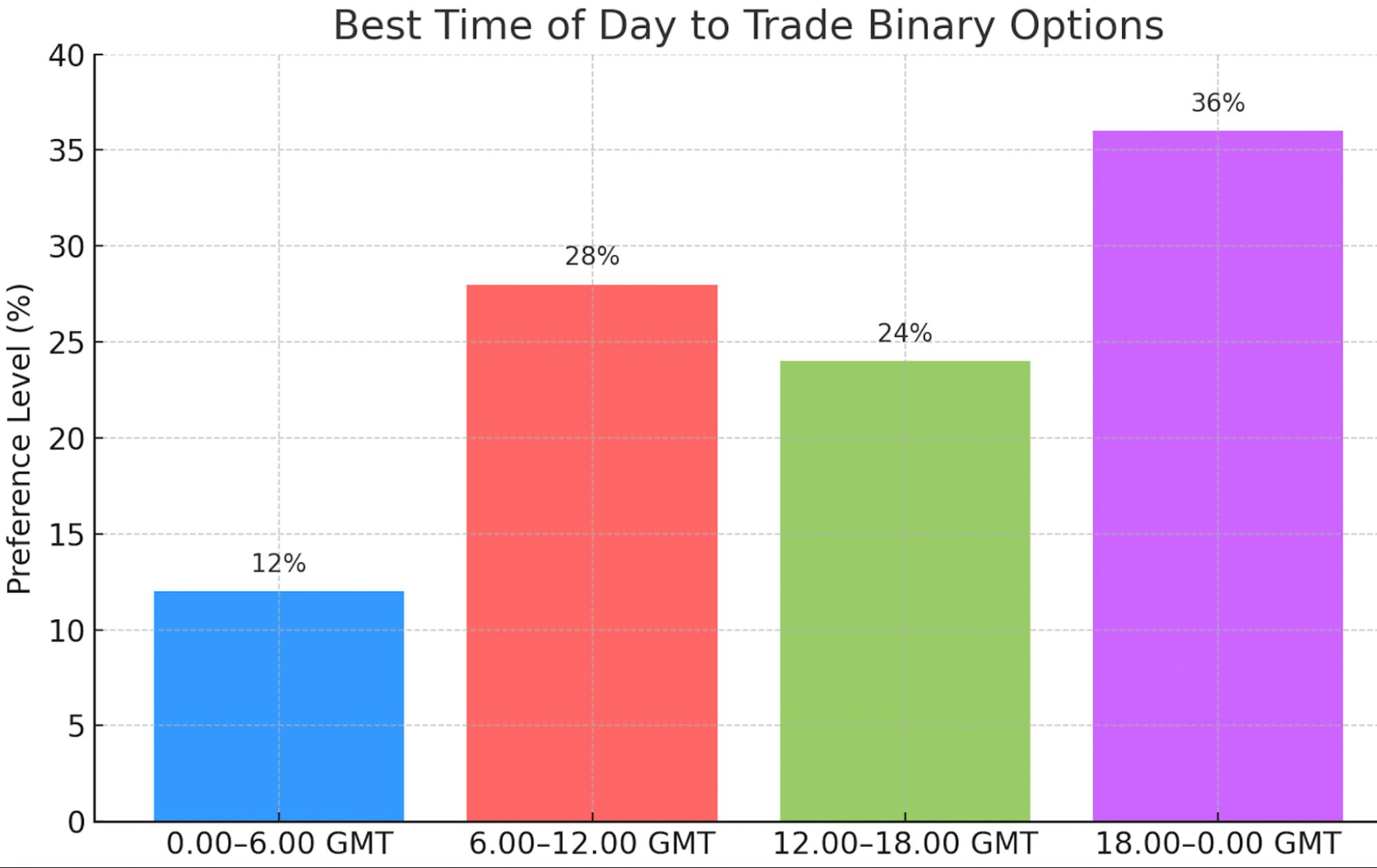
Optimal time zones for binary trading
Understanding how your local time aligns with global trading sessions is essential in time zone binary trading. The effectiveness of your strategy can vary greatly depending on when your active hours overlap with high-volume market sessions.
Why time zones matter
Your geographic location determines when you are most likely to access volatile, high-liquidity markets. Trading outside these hours often results in slower price movement, wider spreads, and lower payout ratios. For example, a trader in India trying to trade U.S. stocks at 2 AM IST may face thin liquidity and poor trade execution.
Time zone matching by asset
AUD/JPY. Best traded between 00:00–04:00 GMT during the Asian session; ideal for traders in Japan, Australia, and Southeast Asia.
EUR/USD. Best from 08:00–17:00 GMT when London and New York markets are open; optimal for traders in Europe and Africa.
USD/CHF or GBP/USD. Prime time between 13:00–17:00 GMT for those in the U.S. or Nigeria.
Using the right time zone binary options trading strategy allows you to operate when markets are most reactive. Whether you're in Asia or Africa, aligning your time zone binary options sessions to the relevant financial centers ensures sharper price action and a stronger edge in binary trading.
Best time frames for binary trading
Choosing the best time frame for binary trading depends on your strategy, market conditions, and asset type. Time frames in binary options refer to the expiration period you select, which could range from 30 seconds to several hours or even days. Each time frame offers unique advantages and challenges.
This table supports a deeper understanding of binary options time frames and helps identify the best time frame for binary options based on asset type and trading goals.
| Time Frame | Duration | Best For | Pros | Cons | Ideal Assets |
|---|---|---|---|---|---|
| Short-Term | 30 sec – 5 min | Scalping, high-frequency trades, news events | Quick results, many setups per day | High noise, frequent false signals | Forex, Crypto, High-volume stocks |
| Medium-Term | 5 min – 30 min | Trend-following, bounce trades, chart patterns | Balanced clarity and frequency, solid reliability | Fewer setups vs scalping | Forex majors, Indices, Commodities |
| Long-Term | 1 hr – 1 day+ | Swing trades, macro news events | More predictable, less noise | Slower trade frequency, longer holding | Stocks, Indices, Gold, Oil |
| OTC Trading | 1 min – 5 min | Weekend/off-hours strategies | 24/7 access, quick decisions | Lower liquidity, fixed payouts | OTC Forex pairs, Synthetic assets |
Best binary trading strategies by time of day
Timing isn't just a factor in binary options — it's the foundation of strategy success. Matching your approach to the market's behavior across the day helps identify high-probability setups and avoid false signals. This section outlines the most effective binary options trading strategies based on the best time of day to trade binary options, offering full alignment with binary trading best time patterns.
Morning session (06:00–12:00 GMT)
Market behavior:
The end of the Asian session transitions into the London open.
Early volatility is moderate, allowing structured setups.
Ideal time to catch fresh daily trends before high-impact news hits.
Top strategies:
Opening range breakout
Trade the breakout above/below the first hour’s high/low.
Best for EUR/USD, GBP/JPY, AUD/JPY.
Expiry: 1–5 min.
Support and resistance bounce
Use RSI or candlestick patterns to confirm reversals near key zones.
Suitable for binary options scalping and short-term pullbacks.
Expiry: 5–10 min.
Midday session (12:00–16:00 GMT)
Market behavior:
Overlap of London and New York — highest liquidity and strongest trends.
News events often fuel fast breakouts and extended moves.
Top strategies:
Trend continuation
Use EMA crossover + MACD confirmation.
Enter on pullbacks during confirmed momentum moves.
Expiry: 5–15 min.
News-based scalping
Target fast moves after economic reports (NFP, CPI, interest rate decisions).
Requires quick execution and short expiries.
Expiry: 1–3 min.
RSI momentum breakouts
Enter when RSI breaks above 50 with volume support.
Ideal for trading binary options on EUR/USD, GBP/USD, Gold.
Expiry: 5–10 min.
Evening session (17:00–00:00 GMT)
Market behavior:
U.S. markets slow down; Tokyo and Sydney prepare to open.
Liquidity drops for traditional assets, but crypto and OTC stay active.
Top strategies:
Range Trading (RSI + Bollinger Bands)
Look for sideways patterns and trade boundary touches.
Assets: Crypto, OTC pairs, synthetic indices.
Expiry: 5–10 min.
OTC Scalping
Use M1 time frame with EMA cross or candle pattern recognition.
Works well for weekend binary trading or late-night sessions.
Expiry: 1–3 min.
Crypto pullback reversals
Combine trendlines + Fibonacci or MACD for late-session entries.
Best for BTC/USD, ETH/USD binary trades.
Expiry: 15–30 min.
When not to trade binary options
While knowing the best time to trade binary options is crucial, understanding when to avoid the market is equally vital. Trading during poor conditions can lead to false signals, slippage, low payouts, and unpredictable price behavior. Here's when binary traders should step away from the screen.
Immediately after a winning streak
Why to avoid. Emotional bias can lead to overconfidence and impulsive decisions.
Impact. Many traders chase profits and deviate from strategy, resulting in unnecessary losses.
Tip. Pause after wins; evaluate calmly before resuming trades.
During sideways or inactive markets
When it happens. Typically during market transition zones (e.g., post-U.S. close, pre-Asia open), holidays, or before news releases.
Why It’s risky. Lack of movement = unpredictable price direction; signals fail more often.
Tip. Look for small candles moving within tight channels — signs of market indecision.
Just before major economic news
Examples. NFP, FOMC meetings, inflation and employment reports.
Why to avoid. Spikes in spread, volatility, and slippage can ruin your setup, especially with short expiries.
Tip. Wait until 5–15 minutes after the event to allow the market to stabilize.
Keywords used. binary trading timing, binary market open time
When you’re tired or distracted
Why It matters. Binary trading demands fast decision-making and precise execution. Fatigue leads to errors.
Solution. Trade only during hours when you're mentally alert and emotionally balanced.
When market liquidity is low
Typical times. Weekends (non-crypto assets), late night sessions without overlap, minor holiday periods.
Risks. Delayed executions, wider spreads, lower payout percentages.
Tip. Use broker tools or third-party volume indicators to confirm market activity.
Don't let convenience cloud strategy

Mastering binary options isn’t just about knowing what to trade — it’s about knowing when to strike. While 24/7 platforms like Deriv and Pocket Option offer flexibility, not every hour is created equal. Traders often fall into the trap of chasing signals during low-volume periods or trading without aligning to session volatility. Don't let convenience cloud strategy.
Peak hours like the London/New York overlap aren’t just hype — they statistically produce the sharpest moves and clearest trends. Whether you're scalping 60-second setups or positioning for a 30-minute expiry, your edge lies in precision timing, not random execution. Smart traders don’t just show up — they synchronize their trades with momentum, market overlap, and global liquidity. For consistent gains, prioritize binary trading best time windows and leave the rest to amateurs.
Conclusion
In summary, mastering the timing of your binary options trades is essential to maximizing your potential returns. By aligning your trading activities with periods of highest market activity—such as overlapping sessions like the London-New York window—you can leverage greater volatility for more precise predictions. For instance, trading EUR/USD during these peak hours often presents richer opportunities than attempting trades during quieter market periods. Ultimately, the most powerful advantage comes from combining an understanding of market hours, global time zones, and the specific behaviors of chosen assets. Remember, in binary options trading, timing isn’t just a detail—it’s the decisive edge.
FAQs
What are the key signs that indicate high-volume periods for trading binary options worldwide?
How do Over-the-Counter (OTC) binary options impact the best trading times globally?
In what ways does local time zone adaptation enhance profitability in binary options trading?
Why is session overlap considered the optimal window for binary options trading worldwide?
Editors' Top Picks and Insights






Related Articles
Team that worked on the article
Anton Kharitonov is an active trader and analyst. He employs both short- and long-term trading strategies, primarily based on fundamental factors, supported by technical indicators and intermarket analysis.
Dan Blystone began his trading career in 1998 as an arbitrage clerk on the floor of the Chicago Mercantile Exchange (CME). He later traded bond and Eurex futures at proprietary firms such as Altea Trading, gaining valuable experience in high-frequency trading and risk management.
Chinmay Soni is a financial analyst with more than 5 years of experience in working with stocks, Forex, derivatives, and other assets. As a founder of a boutique research firm and an active researcher, he covers various industries and fields, providing insights backed by statistical data.
Risk management is a risk management model that involves controlling potential losses while maximizing profits. The main risk management tools are stop loss, take profit, calculation of position volume taking into account leverage and pip value.
CFD is a contract between an investor/trader and seller that demonstrates that the trader will need to pay the price difference between the current value of the asset and its value at the time of contract to the seller.
Index in trading is the measure of the performance of a group of stocks, which can include the assets and securities in it.
Copy trading is an investing tactic where traders replicate the trading strategies of more experienced traders, automatically mirroring their trades in their own accounts to potentially achieve similar results.
Trade execution is knowing how to place and close trades at the right price. This is the key to turning your trading plans into real action and has a direct impact on your profits.

-
 Afghanistan
-
 Albania
-
 Algeria
-
 Angola
-
 Argentina
-
 Armenia
-
 Australia
-
 Austria
-
 Azerbaijan
-
 Bahamas
-
 Bahrain
-
 Bangladesh
-
 Belarus
-
 Belgium
-
 Bolivia
-
 Botswana
-
 Brazil
-
 Brunei
-
 Bulgaria
-
 Cambodia
-
 Cameroon
-
 Canada
-
 Chile
Chile
-
 China
China
-
 Colombia
-
 Congo
Congo
-
 Costa Rica
-
 Cote d'Ivoire
-
 Croatia
-
 Cuba
Cuba
-
 Cyprus
-
 Czechia
-
 DR Congo
-
 Denmark
-
 Dominican Republic
-
 Ecuador
-
 Egypt
Egypt
-
 El Salvador
-
 Estonia
-
 Eswatini
-
 Ethiopia
-
 Finland
-
 France
-
 Georgia
-
 Germany
-
 Ghana
Ghana
-
 Greece
-
 Haiti
Haiti
-
 Hong Kong
-
 Hungary
-
 India
India
-
 Indonesia
-
 Iran, Islamic republic
-
 Iraq
Iraq
-
 Ireland
-
 Israel
-
 Italy
Italy
-
 Jamaica
-
 Japan
Japan
-
 Jordan
-
 Kazakhstan
-
 Kenya
Kenya
-
 Korea
Korea
-
 Kuwait
-
 Kyrgyzstan
-
 Laos
Laos
-
 Latvia
-
 Lebanon
-
 Lesotho
-
 Libya
Libya
-
 Lithuania
-
 Luxembourg
-
 Madagascar
-
 Malaysia
-
 Malta
Malta
-
 Mauritius
-
 Mexico
-
 Moldova
-
 Mongolia
-
 Montenegro
-
 Morocco
-
 Mozambique
-
 Myanmar
-
 Namibia
-
 Nepal
Nepal
-
 Netherlands
-
 New Zealand
-
 Nigeria
-
 North Macedonia
-
 Norway
-
 Oman
Oman
-
 Pakistan
-
 Palestine
-
 Panama
-
 Papua New Guinea
-
 Paraguay
-
 Peru
Peru
-
 Philippines
-
 Poland
-
 Portugal
-
 Puerto Rico
-
 Qatar
Qatar
-
 Reunion
-
 Romania
-
 Rwanda
-
 Saudi Arabia
-
 Serbia
-
 Singapore
-
 Slovakia
-
 Slovenia
-
 Somalia
-
 South Africa
-
 Spain
Spain
-
 Sri Lanka
-
 Sweden
-
 Switzerland
-
 Syria
Syria
-
 Taiwan
-
 Tajikistan
-
 Tanzania
-
 Thailand
-
 Trinidad and Tobago
-
 Tunisia
-
 Turkey
-
 UAE
UAE
-
 Uganda
-
 Ukraine
-
 United Kingdom
-
United States
-
 Uruguay
-
 Uzbekistan
-
 Venezuela
-
 Vietnam
-
 Yemen
Yemen
-
 Zambia
-
 Zimbabwe
- Forex
- Crypto










- Why market timing defines your binary success
- Understanding binary options trading hours
- When does the binary market open and close?
- Binary market open time by broker
- Binary trading sessions explained
- Best time of day to trade binary options
- Optimal time zones for binary trading
- Best time frames for binary trading
- Best binary trading strategies by time of day
- When not to trade binary options
- Expert opinion
- Conclusion
- FAQs


