
Best MACD Indicator Strategies In 2026



Editorial Note: While we adhere to strict Editorial Integrity, this post may contain references to products from our partners. Here's an explanation for How We Make Money. None of the data and information on this webpage constitutes investment advice according to our Disclaimer.
Best MACD indicator strategies:
Strategy 1. The Crossover Strategy
Strategy 2. The Histogram Reversal Strategy
Strategy 3. The Zero Crosses Strategy
Strategy 4. The Divergence Trading Strategy
The MACD indicator helps traders generate signals from moving averages but how does it work? In this article, we’ll explain everything you need to know about trading with MACD and provide you with some of the most successful trading strategies that can help strengthen your trading system.
Top 4 MACD strategies to learn
There are many ways to employ MACD, but most traders will adopt one of the following four, core strategies. These are (a) the crossover strategy (b) the histogram reversal strategy (c) the zero crosses strategy, and (d) the divergence trading strategy.
Strategy 1 – The crossover strategy
The crossover strategy uses the crossover between a MACD line and a signal line to determine buying and selling signals. A buying signal is realised when the MACD line crosses above the signal line. A sell signal is realised when the MACD line crosses below the signal line.
When using the crossover strategy, it is important to be aware that when market trends are weak, prices might already reach a point of reversal by the time a signal has been generated, resulting in a false signal.
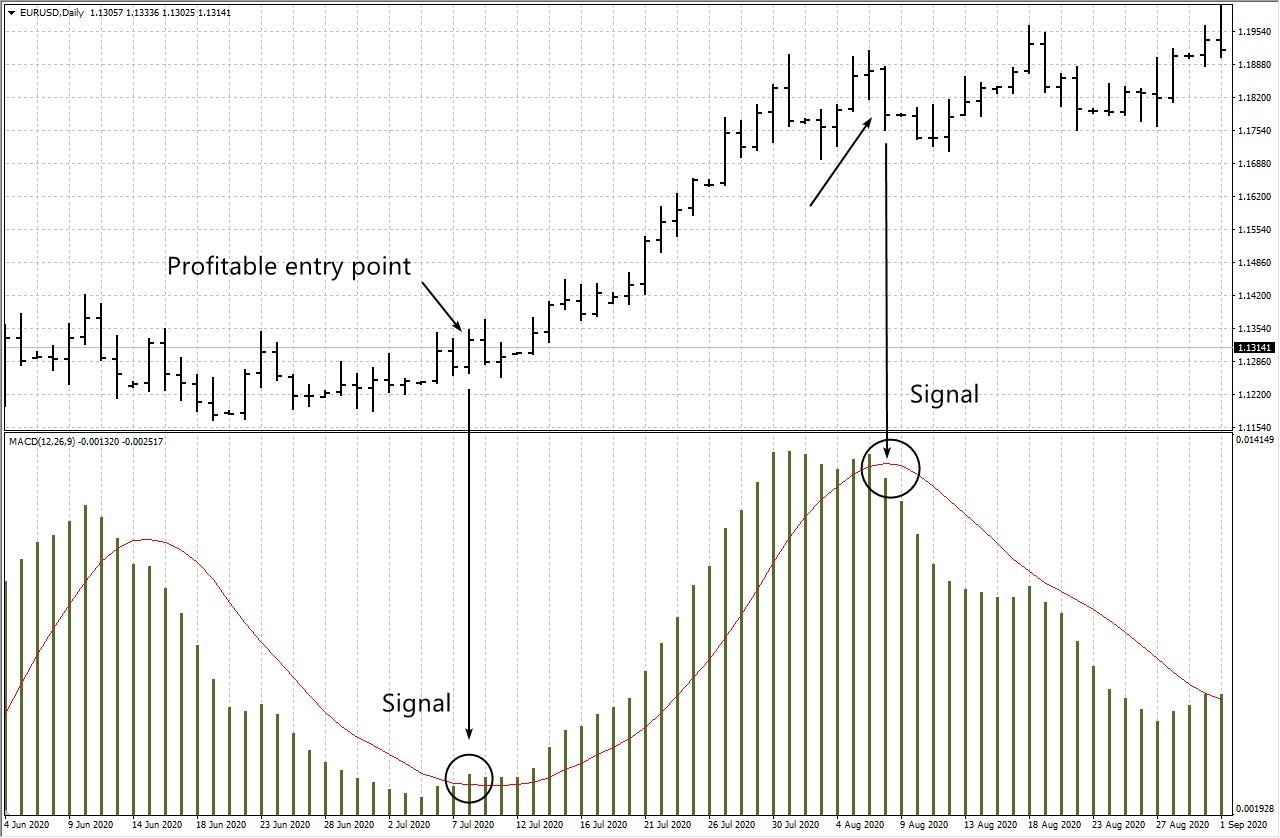
Strategy 2 – The histogram reversal strategy
The histogram reversal strategy is a very popular strategy used by traders. This strategy takes existing trends and then places positions based on those trends. The bars on a histogram represent the difference between the MACD and the signal line.
When the histogram bars shrink, it indicates that the market price is moving slowly. When the bars increase in height it indicates that the market price is moving in a particular direction more strongly. Traders employ this strategy to make more profitable trades and mitigate losing trades.
Strategy 3 – The zero crosses strategy
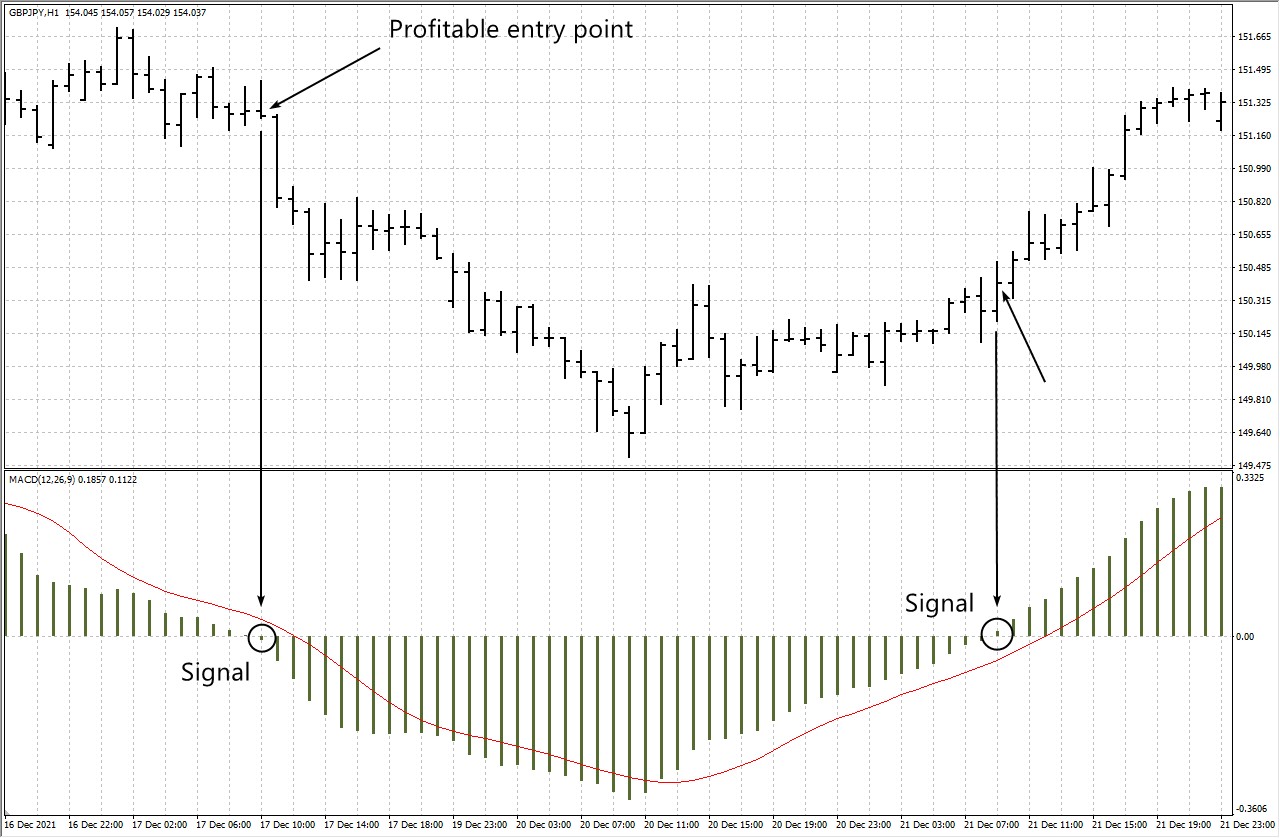
The zero crosses strategy looks at when EMAs cross the zero line to determine the emergence of new uptrends and downtrends. When the MACD crosses the zero line from below it indicates the emergence of an uptrend. When the MACD crosses the zero line from above it indicates the emergence of a downtrend.
Traders use this strategy to buy and close positions at the optimum times. For example, the aim is to buy a short position when the MACD crosses above the zero line and sell a long position when the MACD crosses below the zero line.
Strategy 4 – The divergence trading strategy
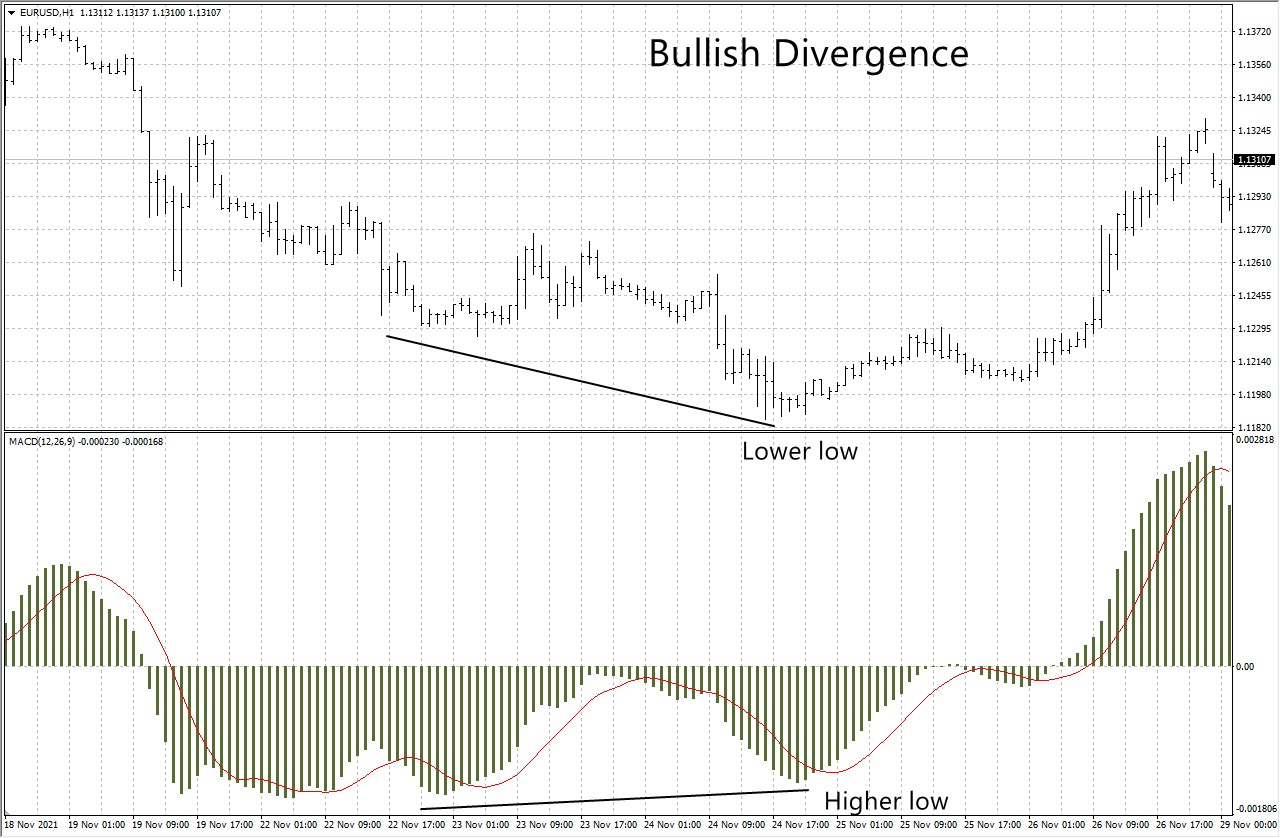
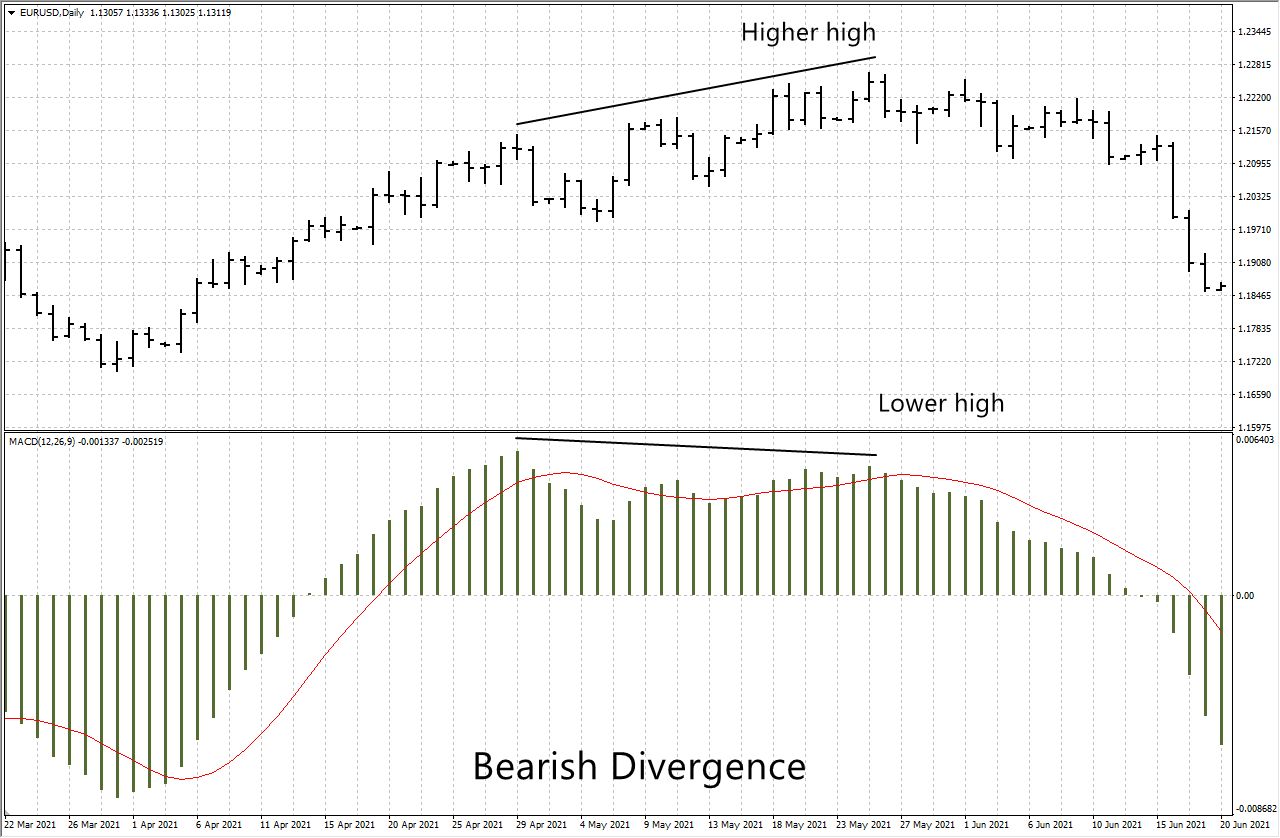
Divergence trading is a very common trading strategy used most commonly for Forex trading. Divergence trading looks at when the price of an asset is moving in the opposite direction of the indicator and takes this signal as an indication that price trends are weakening or heading towards a change in direction. Because of this, the strategy is often used as a way for traders to determine if a trend is getting weaker and heading towards a trend reversal.
There are two principal types of divergence.
Bullish divergence – the price moves lower as the indicator points up.
Bearish divergence – the price moves higher as the indicator points down.
What is a MACD indicator?
MACD, short for Moving Average Convergence Divergence, is a technical trading indicator created in 1979 by Gerald Appel. It is designed to track trends and measure momentum in the markets over time. This indicator shows the relationship between moving averages of stock prices and offers multiple ways to analyze market behavior, such as tracking upward or downward momentum, crossovers, and divergences. On a chart, the MACD appears as two oscillating lines, with trading signals generated when these lines cross each other.
How does MACD work?
The moving average convergence divergence (MACD) is a popular technical analysis tool that helps traders identify changes in trend strength, direction, momentum, and duration. It works by analyzing the relationship between two moving averages of a security’s price.
Key components of MACD:
MACD line. Represents the difference between the 12-period and 26-period exponential moving averages (EMAs).
Signal Line. A 9-period EMA of the MACD line, used to identify potential buy or sell signals.
Histogram. Visualizes the difference between the MACD line and the signal line, helping to track momentum changes.
Interpreting MACD:
Signal line crossovers. When the MACD line crosses above the signal line, it generates a bullish signal, suggesting a potential buying opportunity. If the MACD line crosses below the signal line, it indicates a bearish signal, suggesting a sell.
Zero line crossovers. If the MACD line moves above the zero line, it signals a bullish trend. A move below the zero line indicates a bearish trend.
Divergences. If the price of a security moves in the opposite direction of the MACD, it can signal a trend reversal. For example, rising prices with a falling MACD could indicate a potential downturn.
MACD pros and cons
Below are some pros and cons of the MACD:
- Pros
- Cons
Trend and momentum identification. Helps traders identify market trends and assess momentum effectively.
Buy and sell signals. Provides clear entry and exit signals based on MACD line and signal line crossovers.
Versatility. Can be used across various timeframes and trading strategies.
Enhancement with other indicators. Performs better when combined with other trading tools for confirmation.
Potential for misinterpretation. MACD signals, such as divergence and reversals, may not always indicate actual market movement.
Lagging indicator. As a trend-following tool, it may react slower to rapid price changes, leading to delayed signals.
False signals. In choppy or range-bound markets, MACD can generate misleading buy and sell signals.
How to read MACD signals
There are many MACD signals that can be read to determine market trends. Traders interpret MACD in a few different ways. Principally, MACD is read in terms of buying/selling, market trending (up-trending or down-trending), bullish/bearish, and convergence/divergence.
Let’s take a look at each of these in more detail below.
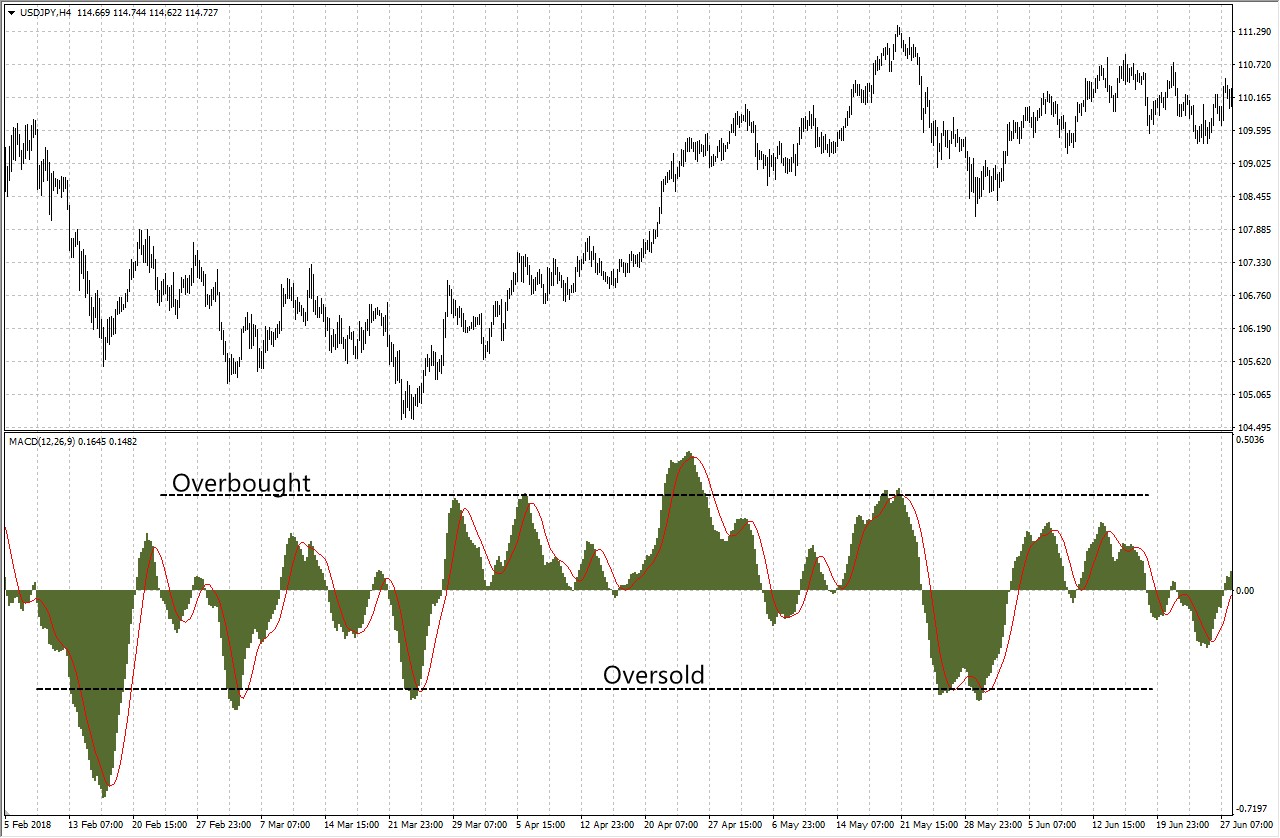
Overbought/oversold
When MACD peaks it indicates that a tradeable asset is in overbought status. When MACD troughs it indicates that the tradeable asset is oversold. This gives traders an indication of when the price of a tradable asset might be due to increase and/or decrease.
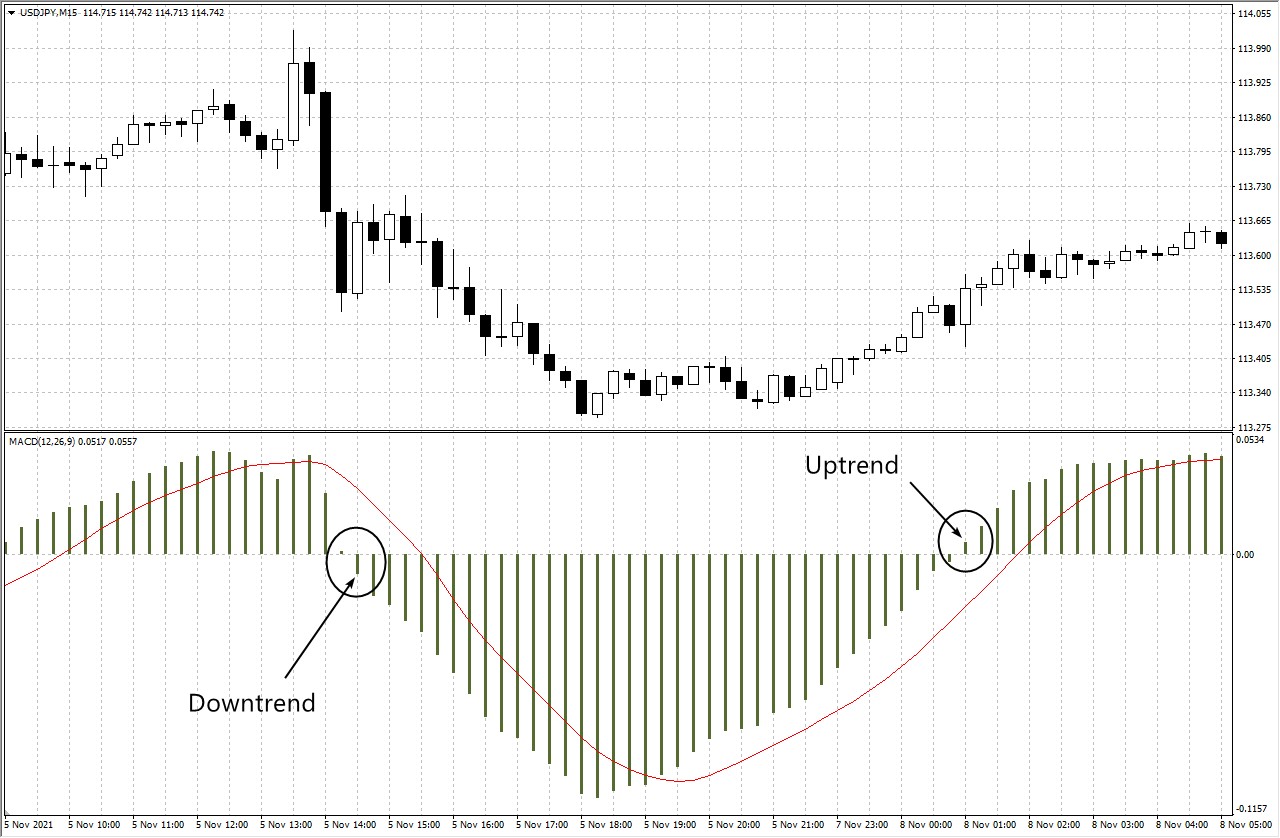
Uptrend/downtrend
When the MACD falls above the zero line it indicates that the price of a tradeable asset is increasing (in an uptrend). When the MACD falls below the zero line, it indicates that the price is decreasing (in a downtrend). This information allows traders to assess the health of the market and buy at optimum times, according to their particular trading strategy.
For example, traders employing a trend following strategy would want to buy when MACD is experiencing an uptrend. Traders employing a mean revision strategy would sell at this time.
Bullish/bearish
When MACD crosses above zero it is generally termed bullish. In trading terms, bullish just refers to an optimistic stock price outlook. When MACD crosses below zero, it is generally considered to be bearish. Bearish is the opposite of bullish. This term refers to a pessimistic stock price outlook (aka a predicted stock price drop).
Convergence/divergence
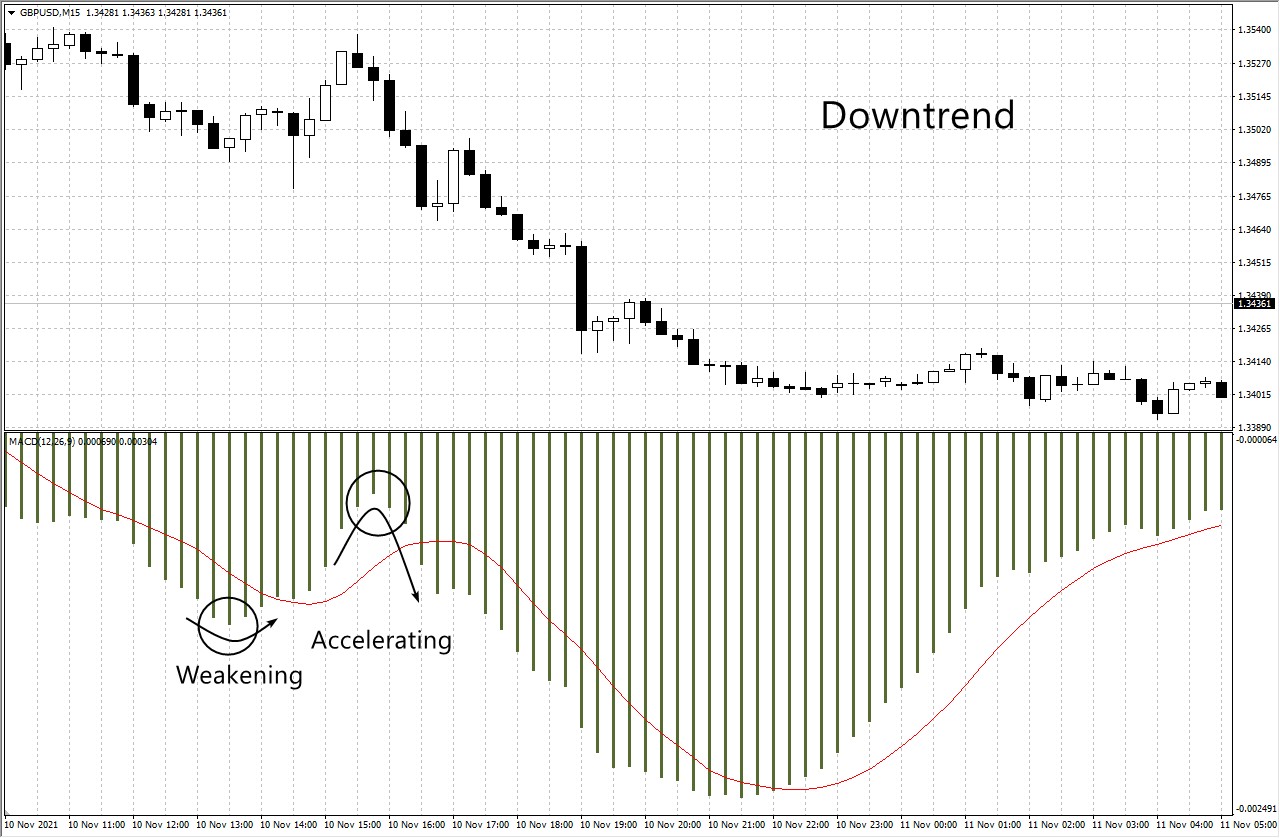
When a MACD histogram shrinks in height it indicates convergence. This means that the futures price and the cash price of the tradable asset are moving closer together over time. Oftentimes this occurs as the result of a slowdown.
On the opposite end of the spectrum, when a MACD histogram expands this indicates a divergence. The MACD is accelerating towards the market trend. This indicates that current price trends are starting to weaken and could signal that those prices will shortly change direction.
How to combine MACD with other signals
While MACD is useful, it has limitations like lagging signals, making it more effective when combined with other indicators. Here are some strategies to enhance MACD:
MACD + Relative Vigor Index (RVI). Combining MACD with the Relative Vigor Index helps identify overbought and oversold conditions more accurately. Traders wait for crossovers to align on both indicators before making buy or sell decisions, improving reliability.
MACD + Money Flow Index (MFI). Pairing MACD with the Money Flow Index, which accounts for volume and price, enhances overbought/oversold signals. For instance, a bearish MACD and an overbought MFI signal a short position, while the opposite signals a long position.
MACD + Triple Exponential Moving Average (TEMA). TEMA incorporates three moving averages to reduce lag. When MACD and TEMA provide conflicting signals, traders interpret it as a sign to exit positions.
MACD + TRIX indicator. Using MACD with TRIX, a momentum oscillator, adds precision. Traders enter the market when the TRIX crosses the zero line and MACD shows a crossover, confirming the trend's strength.
Top 3 tips for using MACD more effectively
Using MACD takes some getting used to but there are some strategies that can be employed to boost performance when using this popular trading indicator.
Follow these basic rules
If you’re new to using MACD, try to start by following these simple guidelines. Using the MACD crossover method is a great place to start. In general, that means taking long MACD signals when prices rise above a 200 period-moving average, buying when the MACD crosses the zero line, and selling when the MACD crosses below the zero line.
Use MACD in combination with other indicators
As we’ve mentioned, MACD isn’t always 100% accurate and can sometimes produce false signals. To overcome this, try to use MACD in tandem with other indicators.
Identify the best MACD settings for day trading
For regular day trading MACD is best employed using the default time settings of 12, 16, and 9 periods.
MACD indicator for day trading
Time and again, day traders find the MACD indicator practical due to its capacity to deliver quick signals for short-term trading. The MACD indicator can help you establish trends and potential entry and exit points. You can use the crossover and zero-cross strategies to identify rapid signals. You can also use shorter timeframes, including 10-minute or 1-hour charts, to make quick decisions according to MACD signals.
MACD limitations
While the MACD indicator is a valuable tool for traders, it has various limitations you should know. These include:
Market choppiness. Crossover signals can lead to whipsaws. Such a situation involves a quick price reversal after a signal is created. It can lead to false signals and trading losses.
Lagging indicator. The MACD signals depend on moving averages and may lag behind the current price. As a result, the indicator can fail to provide signals at the initial point of a trend or reversal, causing traders to miss out on opportunities.
It is not a standalone indicator. The MACD is most efficient when used alongside other indicators and technical analysis tools to reduce false alarms and confirm signals.
Best Forex brokers to use MACD strategy 2026
To maximize the potential of MACD trading strategies, selecting the right broker is crucial. We've compiled a list of trusted brokers that offer advanced charting tools, low spreads, and fast trade execution — features essential for trading with the MACD indicator effectively.
| zForex | Plus500 | OANDA | Trading.com USA | FOREX.com | |
|---|---|---|---|---|---|
|
Demo |
Yes | Yes | Yes | Yes | Yes |
|
Min. deposit, $ |
10 | 100 | No | 50 | 100 |
|
Max. leverage |
1:1000 | 1:300 | 1:200 | 1:50 | 1:50 |
|
Min Spread EUR/USD, pips |
0.1 | 0.5 | 0.1 | 0.9 | 0.7 |
|
Max Spread EUR/USD, pips |
0.4 | 0.9 | 0.5 | No | 1.2 |
|
Withdrawal fee, % |
No | No | No | No | No |
|
Deposit fee, % |
No | No | No | No | No |
|
Open an account |
Go to broker Your capital is at risk.
|
Go to broker 80% of retail CFD accounts lose money. |
Go to broker Your capital is at risk. |
Go to broker Your capital is at risk. |
Study review |
For instance, using a 5-period EMA and a 35-period EMA can provide more tailored insights

To enhance your trading precision with the Moving Average Convergence Divergence (MACD) indicator, consider adjusting the default settings to better align with your specific trading style and the asset's volatility. For instance, using a 5-period EMA and a 35-period EMA can provide more tailored insights, especially in markets with unique behaviors. This customization allows the MACD to reflect the asset's price movements more accurately, offering signals that are more relevant to your trading strategy.
Another advanced approach involves combining the MACD with the Relative Vigor Index (RVI). The RVI measures the strength of a trend by comparing the closing price to the trading range, complementing the MACD's momentum analysis. By aligning signals from both indicators — such as waiting for both to confirm a bullish or bearish crossover — you can filter out false signals and make more informed trading decisions. This dual-indicator strategy enhances the reliability of your trades by ensuring that multiple aspects of market behavior are considered.
Conclusion
Mastering the MACD indicator is essential for traders seeking consistent results, as its strategies like crossovers and histogram reversals provide clear entry and exit signals. By focusing on methods such as the bullish crossover or zero-line cross, traders can anticipate momentum shifts and capitalize on profitable trends. For example, identifying when the MACD line crosses above the signal line often signals a strong buy opportunity, while histogram reversals can help spot early trend changes. Ultimately, the power of the MACD lies in its versatility and reliability—making it a must-have tool in every trader’s arsenal. In today’s fast-paced markets, those who skillfully apply MACD strategies stand poised to gain a significant trading edge.
FAQs
How does the MACD indicator help identify overbought and oversold conditions?
What is the significance of divergence when using MACD strategies?
Why is the MACD considered a lagging indicator, and how does this impact trading decisions?
Which timeframes are most suitable for applying MACD strategies in day trading?
Editors' Top Picks and Insights

Do politicians make the best stock traders?

Crypto test drive: How automakers are exploring digital assets

Lindsey Graham death: U.S. senator’s crypto legacy

Tether under pressure: USDT in Europe, audit questions, and the fight for trust

Lean Ethereum: Why Buterin wants to rebuild the network

SK Hynix debuts on Nasdaq: Largest U.S. offering by foreign company
Related Articles
Team that worked on the article
Alamin Morshed is a contributor at Traders Union. He specializes in writing articles for businesses that want to improve their Google search rankings to compete with their competition.
Dan Blystone began his trading career in 1998 as an arbitrage clerk on the floor of the Chicago Mercantile Exchange (CME). He later traded bond and Eurex futures at proprietary firms such as Altea Trading, gaining valuable experience in high-frequency trading and risk management.
Chinmay Soni is a financial analyst with more than 5 years of experience in working with stocks, Forex, derivatives, and other assets. As a founder of a boutique research firm and an active researcher, he covers various industries and fields, providing insights backed by statistical data.
Ethereum is a decentralized blockchain platform and cryptocurrency that was proposed by Vitalik Buterin in late 2013 and development began in early 2014. It was designed as a versatile platform for creating decentralized applications (DApps) and smart contracts.
A futures contract is a standardized financial agreement between two parties to buy or sell an underlying asset, such as a commodity, currency, or financial instrument, at a predetermined price on a specified future date. Futures contracts are commonly used in financial markets to hedge against price fluctuations, speculate on future price movements, or gain exposure to various assets.
Scalping in trading is a strategy where traders aim to make quick, small profits by executing numerous short-term trades within seconds or minutes, capitalizing on minor price fluctuations.
Divergence serves as a valuable concept for predicting potential shifts in market direction. It happens when the price movement of a currency pair and a particular technical indicator do not conform, but rather go in opposite directions.
Index in trading is the measure of the performance of a group of stocks, which can include the assets and securities in it.

-
 Afghanistan
-
 Albania
-
 Algeria
-
 Angola
-
 Argentina
-
 Armenia
-
 Australia
-
 Austria
-
 Azerbaijan
-
 Bahamas
-
 Bahrain
-
 Bangladesh
-
 Belarus
-
 Belgium
-
 Bolivia
-
 Botswana
-
 Brazil
-
 Brunei
-
 Bulgaria
-
 Cambodia
-
 Cameroon
-
 Canada
-
 Chile
Chile
-
 China
China
-
 Colombia
-
 Congo
Congo
-
 Costa Rica
-
 Cote d'Ivoire
-
 Croatia
-
 Cuba
Cuba
-
 Cyprus
-
 Czechia
-
 DR Congo
-
 Denmark
-
 Dominican Republic
-
 Ecuador
-
 Egypt
Egypt
-
 El Salvador
-
 Estonia
-
 Eswatini
-
 Ethiopia
-
 Finland
-
 France
-
 Georgia
-
 Germany
-
 Ghana
Ghana
-
 Greece
-
 Haiti
Haiti
-
 Hong Kong
-
 Hungary
-
 India
India
-
 Indonesia
-
 Iran, Islamic republic
-
 Iraq
Iraq
-
 Ireland
-
 Israel
-
 Italy
Italy
-
 Jamaica
-
 Japan
Japan
-
 Jordan
-
 Kazakhstan
-
 Kenya
Kenya
-
 Korea
Korea
-
 Kuwait
-
 Kyrgyzstan
-
 Laos
Laos
-
 Latvia
-
 Lebanon
-
 Lesotho
-
 Libya
Libya
-
 Lithuania
-
 Luxembourg
-
 Madagascar
-
 Malaysia
-
 Malta
Malta
-
 Mauritius
-
 Mexico
-
 Moldova
-
 Mongolia
-
 Montenegro
-
 Morocco
-
 Mozambique
-
 Myanmar
-
 Namibia
-
 Nepal
Nepal
-
 Netherlands
-
 New Zealand
-
 Nigeria
-
 North Macedonia
-
 Norway
-
 Oman
Oman
-
 Pakistan
-
 Palestine
-
 Panama
-
 Papua New Guinea
-
 Paraguay
-
 Peru
Peru
-
 Philippines
-
 Poland
-
 Portugal
-
 Puerto Rico
-
 Qatar
Qatar
-
 Reunion
-
 Romania
-
 Rwanda
-
 Saudi Arabia
-
 Serbia
-
 Singapore
-
 Slovakia
-
 Slovenia
-
 Somalia
-
 South Africa
-
 Spain
Spain
-
 Sri Lanka
-
 Sweden
-
 Switzerland
-
 Syria
Syria
-
 Taiwan
-
 Tajikistan
-
 Tanzania
-
 Thailand
-
 Trinidad and Tobago
-
 Tunisia
-
 Turkey
-
 UAE
UAE
-
 Uganda
-
 Ukraine
-
 United Kingdom
-
United States
-
 Uruguay
-
 Uzbekistan
-
 Venezuela
-
 Vietnam
-
 Yemen
Yemen
-
 Zambia
-
 Zimbabwe
- Forex
- Crypto











