
Binary Options vs Digital Options: Key Differences


Editorial Note: While we adhere to strict Editorial Integrity, this post may contain references to products from our partners. Here's an explanation for How We Make Money. None of the data and information on this webpage constitutes investment advice according to our Disclaimer.
Digital options and binary options are both fixed-payout derivatives, but they work differently. Binary options have a fixed strike price and predefined payout, while digital options let traders choose different strike levels with payouts that vary based on the selected price and market conditions. This makes digital options more flexible but also more complex than binary options.
Digital options and binary options both allow traders to speculate on whether an asset's price will rise or fall without owning the underlying asset. Although they share some similarities, they differ in how strike prices, payouts, and risk are structured.
Understanding the difference between digital and binary options can help you choose the product that best matches your trading style, experience, and risk tolerance.
Risk warning: Binary options trading is highly risky and may result in a total loss of funds. These speculative instruments often lack strong regulation, with over 80% of traders losing their capital. Invest only what you can afford to lose and seek professional advice.
Understanding fixed-payout derivatives
Digital and binary options both belong to the category of fixed-payout derivatives. These contracts have a predefined outcome that is determined when the trade expires, based on whether specific market conditions are met.
Unlike traditional options, where profits and losses depend on the size of the price movement, fixed-payout derivatives generally result in one of two outcomes:
a predetermined profit;
loss of the amount invested.
Their straightforward structure contributed to the rapid growth of retail online trading. However, concerns about investor protection later led many regulators to restrict or ban binary options for retail traders in several jurisdictions.
Although digital and binary options share this fixed-payout model, they differ in how trades are structured. Binary options use a single strike price, while digital options allow traders to choose from multiple strike levels, resulting in different payout opportunities and levels of risk.
What are binary options?
Binary options are one of the simplest types of fixed-payout derivatives. A trader predicts whether an asset's price will finish above or below a predefined level at expiration.
Core characteristics
Binary options are defined by three main elements:
entry price;
expiration time;
fixed payout.
Once a trade is opened, its outcome is determined at expiration. If the prediction is correct, the trader receives the predetermined payout. If the prediction is incorrect, the amount invested is lost.
Because positions generally cannot be modified before expiration, binary options appeal to traders looking for a straightforward trading process.
Typical payout structure
Binary option payouts vary by broker, asset, and market conditions, but they are fixed before the trade is opened. This fixed-return model is one of the main differences between binary and digital options, where potential payouts change depending on the selected strike price.
What are digital options?
Digital options build on the binary options model by allowing traders to choose from multiple strike prices. Instead of simply predicting whether the price will finish above or below a single level, traders select a strike price, with the potential payout depending on how likely that level is to be reached before expiration.
Key mechanics
Digital options are characterized by:
multiple strike prices;
variable payout levels;
dynamic contract pricing.
Because contract values can change while a trade is open, some platforms also allow traders to close positions before expiration. This makes digital options more flexible than binary options, but also more complex.
Example of a digital option trade
Assume EUR/USD is trading at 1.1000. A trading platform offers three available strike prices:
| Strike | Illustrative payout* |
|---|---|
| 1.1010 | 120% |
| 1.1020 | 250% |
| 1.1030 | 600% |
*Payouts are for illustrative purposes only and vary by broker, market conditions, and the selected contract.
As the selected strike moves farther away from the current market price, the potential payout increases because the probability of reaching that level before expiration decreases.
Structural comparison: Binary vs digital options
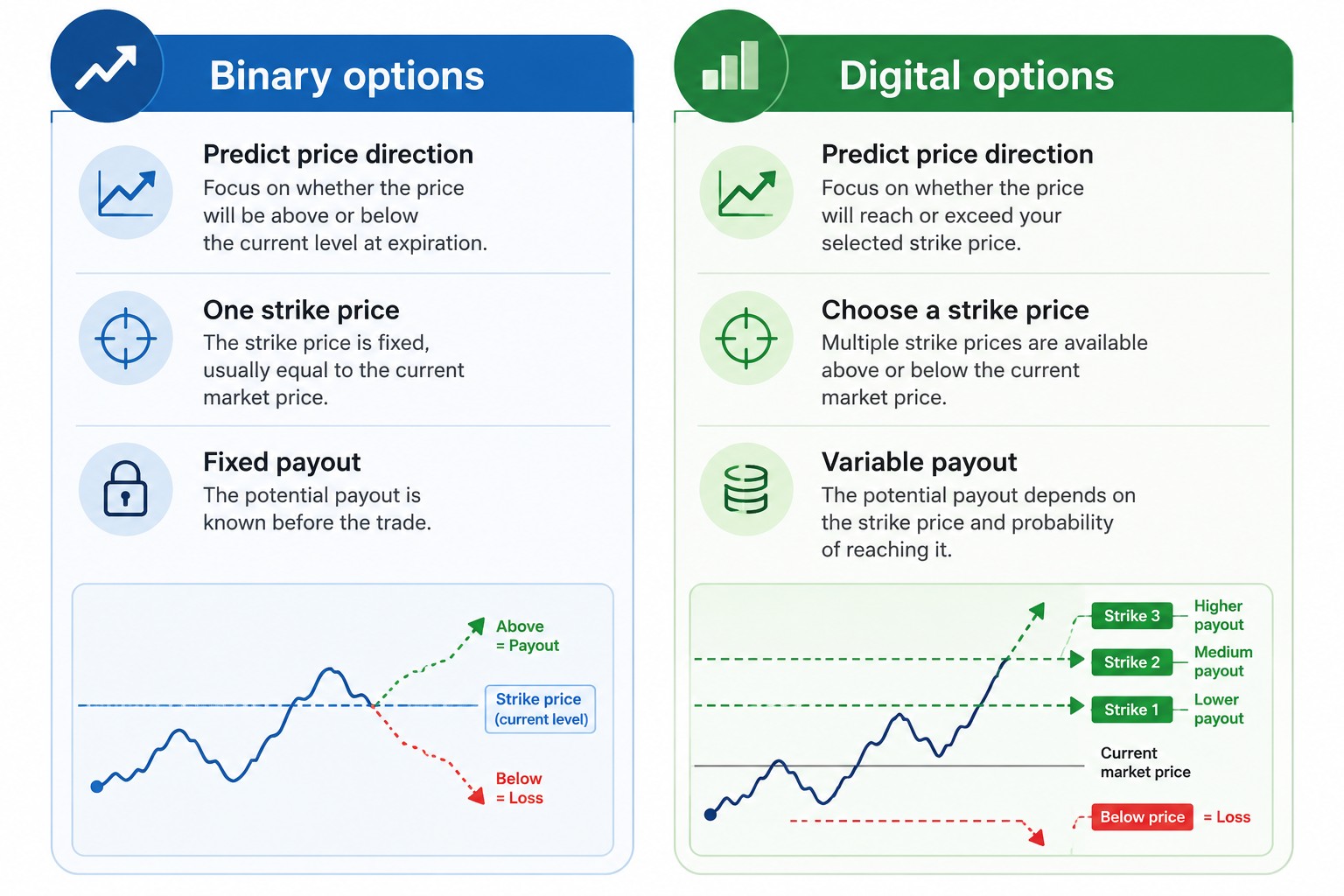
Although binary and digital options are both fixed-payout derivatives, they differ in how trades are structured and managed. The main differences involve strike prices, payout calculations, trade management, and the level of analysis required.
Strike prices
Binary options use a single strike price, typically the current market price. Digital options allow traders to choose from multiple strike levels, making strike selection an important part of the trading decision.
Payouts
Binary options offer a fixed payout that is known before the trade is placed. Digital options use variable payouts, where potential returns depend on the selected strike price and the probability of reaching it before expiration.
Trade management
Binary options generally remain open until expiration. Depending on the platform, digital options may allow traders to close positions early or exit a trade before it expires.
The table below summarizes the main differences between binary and digital options, making it easier to compare their contract structure, payouts, risk, and trading features.
| Feature | Binary Options | Digital Options |
|---|---|---|
| Contract structure | Fixed-outcome contract based on price direction | Multi-strike contract with payouts based on the selected strike |
| Strike price | Single strike price | Multiple selectable strike prices |
| Payout model | Fixed payout determined before the trade | Variable payout based on strike price and market conditions |
| Profit potential | Fixed before the trade | Increases with more distant strike prices, but so does risk |
| Position management | Usually held until expiration | May allow early closure, depending on the platform |
| Trading approach | Directional price prediction | Combines direction with strike-price selection |
| Risk profile | Fixed risk and fixed reward | Fixed risk with variable potential reward |
How digital option payouts work
Unlike binary options, digital option payouts are not fixed. They depend on several factors, including the selected strike price, the time remaining until expiration, and current market volatility.
In general, strike prices that are farther from the current market price offer higher potential payouts because they are less likely to be reached before the trade expires. Closer strike prices usually provide lower payouts but have a higher probability of success.
Understanding this relationship is one of the main differences between digital vs binary options and helps explain why digital options offer greater flexibility, but also require more careful trade planning.
Digital vs binary options: Managing risk
Both digital and binary options involve a high level of risk, as traders can lose the full amount invested in a single trade. However, the way risk is managed differs between the two products.
Risk in binary options
Binary options have a fixed risk and fixed payout, so traders know the maximum possible profit and loss before opening a position. However, positions usually cannot be adjusted before expiration, making accurate market timing essential.
Risk in digital options
Digital options also limit losses to the amount invested, but they offer more flexibility through multiple strike prices and, on some platforms, early position closure. Higher potential payouts usually come with a lower probability of success, requiring traders to carefully balance risk and reward when selecting a strike price.
Strategy differences between binary and digital options
Although both instruments rely on market analysis, the way traders approach them differs. Binary options focus on predicting price direction, while digital options require traders to consider both market direction and strike selection.
Binary options
Binary option strategies are generally built around identifying whether an asset's price is likely to move up or down before expiration. Common approaches include:
support and resistance trading;
trend-following strategies;
trading around economic news releases.
Because the outcome depends only on the final price relative to a single strike level, trading decisions are generally more straightforward.
Digital options
Digital option strategies require traders to evaluate both the direction of the market and the likelihood of reaching a selected strike price. In addition to technical analysis, traders often consider:
the distance between the current price and the selected strike;
expected market volatility;
time remaining until expiration.
This additional layer of analysis makes digital options more flexible, but also more complex than binary options.
If you're considering trading binary or digital options, comparing brokers is an important first step. The table below highlights the leading binary brokers and their key trading conditions.
| CloseOption | Capitalcore | Nadex | Pocket Option | QUOTEX | |
|---|---|---|---|---|---|
|
Foundation year |
2013 | 2019 | 2009 | 2017 | 2019 |
|
Min. deposit |
5 | 10 | 250 | 5 | 10 |
|
Min. trade size |
1 | 1 | 1 | 1 | 1 |
|
Min. Payout (%) |
17 | 60 | No | 50 | 20 |
|
Max. Payout (%) |
95 | 90 | 100 | 128 | 98 |
|
Bots or copy trading |
No | No | No | Yes | No |
|
Open an account |
Go to broker Your capital is at risk. |
Go to broker Your capital is at risk.
|
Study review | Go to broker Your capital is at risk. |
Go to broker Your capital is at risk. |
Regulation and platform safety
The regulatory status of binary and digital options varies by jurisdiction. Binary options are restricted or banned for retail traders in many regions because of concerns about investor protection and fraudulent brokerage practices.
Digital options are typically offered through proprietary trading platforms rather than traditional exchanges. Before opening an account, it's important to verify that the broker is regulated and that these products are available in your jurisdiction.
Which option type may suit you?
Neither binary nor digital options are inherently better. The right choice depends on how you approach trading and how much flexibility you want when managing a position.
If you prefer a straightforward trading process with fixed payouts and a single strike price, binary options may be the better fit. Digital options are generally more suitable for traders who are comfortable evaluating different strike prices and balancing higher potential payouts against a lower probability of success.
Don't let high payouts drive your decisions

One of the biggest mistakes traders make is choosing a trade based on the highest advertised payout. In digital options, a larger potential return usually means the selected strike price is less likely to be reached before expiration. Focusing only on the payout can lead to unrealistic expectations and inconsistent results.
When comparing digital options vs binary options, think about how much flexibility you actually need. Binary options offer a simpler trading process with a fixed strike price, while digital options require more planning because both the strike level and the payout influence the trade. Choosing the product that matches your experience and decision-making style is often more important than chasing the highest possible return.
Conclusion
In summary, the choice between binary options and digital options centers on the level of control and complexity you seek in your trading approach. Binary options offer fixed payouts and straightforward decisions, making them ideal for those who value simplicity and clearly defined risk. In contrast, digital options provide greater flexibility with various strike prices and dynamic payouts, but require more advanced analysis and strategic planning—an example being the decision to select a farther strike for a higher potential return, balanced against a lower chance of success. Ultimately, the most important factor is aligning your trading style and experience with the product rather than chasing the highest advertised payout. Remember: consistent results come from smart risk management and self-awareness, not from being lured by headline numbers.
FAQs
How does the choice of strike price affect potential payouts in digital options?
Are there differences in position management between digital options and binary options?
What should traders consider when choosing between digital options and binary options?
What are the main regulatory considerations for trading digital and binary options?
Editors' Top Picks and Insights






Related Articles
Team that worked on the article
Aleksandra Chaikina has been a contributor to Traders Union since 2021. With over 15 years of experience in copywriting and more than 5 years focused on financial content, she specializes in producing detailed guides, analytics, and comparative reviews across various sectors, including cryptocurrencies, Forex, investment strategies, and financial technologies.
Dan Blystone began his trading career in 1998 as an arbitrage clerk on the floor of the Chicago Mercantile Exchange (CME). He later traded bond and Eurex futures at proprietary firms such as Altea Trading, gaining valuable experience in high-frequency trading and risk management.
Chinmay Soni is a financial analyst with more than 5 years of experience in working with stocks, Forex, derivatives, and other assets. As a founder of a boutique research firm and an active researcher, he covers various industries and fields, providing insights backed by statistical data.
Ethereum is a decentralized blockchain platform and cryptocurrency that was proposed by Vitalik Buterin in late 2013 and development began in early 2014. It was designed as a versatile platform for creating decentralized applications (DApps) and smart contracts.
Volatility refers to the degree of variation or fluctuation in the price or value of a financial asset, such as stocks, bonds, or cryptocurrencies, over a period of time. Higher volatility indicates that an asset's price is experiencing more significant and rapid price swings, while lower volatility suggests relatively stable and gradual price movements.
CFD is a contract between an investor/trader and seller that demonstrates that the trader will need to pay the price difference between the current value of the asset and its value at the time of contract to the seller.
An investor is an individual, who invests money in an asset with the expectation that its value would appreciate in the future. The asset can be anything, including a bond, debenture, mutual fund, equity, gold, silver, exchange-traded funds (ETFs), and real-estate property.
The strike price in binary options is the price at which the underlying asset is valued at the expiration of the option.

-
 Afghanistan
-
 Albania
-
 Algeria
-
 Angola
-
 Argentina
-
 Armenia
-
 Australia
-
 Austria
-
 Azerbaijan
-
 Bahamas
-
 Bahrain
-
 Bangladesh
-
 Belarus
-
 Belgium
-
 Bolivia
-
 Botswana
-
 Brazil
-
 Brunei
-
 Bulgaria
-
 Cambodia
-
 Cameroon
-
 Canada
-
 Chile
-
 China
-
 Colombia
-
 Congo
-
 Costa Rica
-
 Cote d'Ivoire
-
 Croatia
-
 Cuba
-
 Cyprus
-
 Czechia
-
 DR Congo
-
 Denmark
-
 Dominican Republic
-
 Ecuador
-
 Egypt
-
 El Salvador
-
 Estonia
-
 Eswatini
-
 Ethiopia
-
 Finland
-
 France
-
 Georgia
-
 Germany
-
 Ghana
-
 Greece
-
 Haiti
-
 Hong Kong
-
 Hungary
-
 India
-
 Indonesia
-
 Iran, Islamic republic
-
 Iraq
-
 Ireland
-
 Israel
-
 Italy
-
 Jamaica
-
 Japan
-
 Jordan
-
 Kazakhstan
-
 Kenya
-
 Korea
-
 Kuwait
-
 Kyrgyzstan
-
 Laos
-
 Latvia
-
 Lebanon
-
 Lesotho
-
 Libya
-
 Lithuania
-
 Luxembourg
-
 Madagascar
-
 Malaysia
-
 Malta
-
 Mauritius
-
 Mexico
-
 Moldova
-
 Mongolia
-
 Montenegro
-
 Morocco
-
 Mozambique
-
 Myanmar
-
 Namibia
-
 Nepal
-
 Netherlands
-
 New Zealand
-
 Nigeria
-
 North Macedonia
-
 Norway
-
 Oman
-
 Pakistan
-
 Palestine
-
 Panama
-
 Papua New Guinea
-
 Paraguay
-
 Peru
-
 Philippines
-
 Poland
-
 Portugal
-
 Puerto Rico
-
 Qatar
-
 Reunion
-
 Romania
-
 Rwanda
-
 Saudi Arabia
-
 Serbia
-
 Singapore
-
 Slovakia
-
 Slovenia
-
 Somalia
-
 South Africa
-
 Spain
-
 Sri Lanka
-
 Sweden
-
 Switzerland
-
 Syria
-
 Taiwan
-
 Tajikistan
-
 Tanzania
-
 Thailand
-
 Trinidad and Tobago
-
 Tunisia
-
 Turkey
-
 UAE
-
 Uganda
-
 Ukraine
-
 United Kingdom
-
United States
-
 Uruguay
-
 Uzbekistan
-
 Venezuela
-
 Vietnam
-
 Yemen
-
 Zambia
-
 Zimbabwe
- Forex
- Crypto










- Understanding fixed-payout derivatives
- What are binary options?
- What are digital options?
- Structural comparison: Binary vs digital options
- How digital option payouts work
- Digital vs binary options: Managing risk
- Strategy differences between binary and digital options
- Regulation and platform safety
- Which option type may suit you?
- Expert opinion
- Conclusion
- FAQs


