
Binary Options Success Stories - Are They Possible?


Editorial Note: While we adhere to strict Editorial Integrity, this post may contain references to products from our partners. Here's an explanation for How We Make Money. None of the data and information on this webpage constitutes investment advice according to our Disclaimer.
Binary options success is possible, but a trader must be able to assess risks, have an algorithm of actions, be patient and be able to learn from mistakes.
A genuine success story will not be about some ordinary person who, on a whim, decided to put $400 in a binary option and made a 900% profit in one minute. It's also not going to be about some person who decided to try binary options and turned $400 into $40,000 in a month, allowing them to quit their day job. There's nothing wrong with setting lofty objectives, but you should enter binary options trading with the understanding that the route to financial success is lengthy, especially if you plan to trade for a living as a day trader.
It is difficult to achieve success in binaries, so success stories can be very helpful. In this guide, we’ll explore how binary options work, if success in binary options is possible, how to become successful in binary options, and some great success stories from real traders. We'll also break down some tips for success, our top picks for binary options brokers, and whether binary options are better than forex.
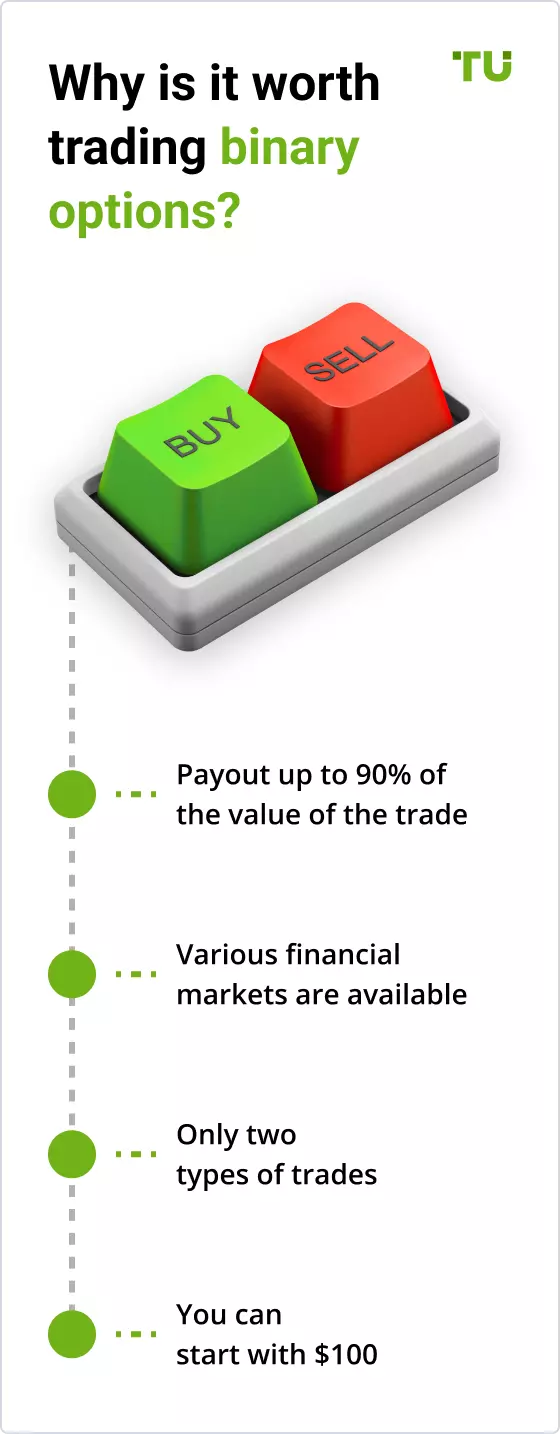
How Do Binary Options Work?
Binary options allow traders to profit from price swings in a variety of worldwide marketplaces, but it's crucial to grasp the dangers and advantages of these divisive and sometimes misunderstood financial tools. Binary options vary from standard options in that they have a distinct payout structure, costs, and risks, as well as a different liquidity structure and investing method.
Binary options are a popular choice for low-skilled traders since they are deceptively simple to grasp. A high-low or fixed-return option that gives access to equities, commodities, foreign currency, and indices is the most widely traded instrument.
The expiration date, time, and strike price of these options are all plainly indicated. If a trader successfully predicts the market's direction and price at expiry, they will get a fixed return regardless of how much the instrument has changed since the transaction. However, an erroneous wager would result in the loss of the initial investment.
Is Binary Success Possible?
The risk/reward ratio that traders are exposed to while trading binary options is commonly cited by skeptics of the market's validity. Traders may earn up to 90% on deals they make in the market. This is one of the industry's top returns. With such a return, a trader who makes a $200 deal stands to profit $180 if he is correct. He will, however, lose $200 if he is incorrect. His potential profit is substantially higher than his danger. This is why most detractors view binary options as a gambling derivative.
What the detractors of binary options fail to see is how simple it is to trade binary options and how profitable they can be in a short period of time. If the asset price closes higher or lower (even fractionally) than the strike price, traders will book certain profits. The amount of profit in other markets, such as forex, is determined by how far the asset price deviates from the strike price. Traders in such a market must do a more extensive and in-depth study than they would in binary options. Traders in less volatile markets will have worse risk/reward ratios than those in the binary options market. It is possible to generate regular gains in the binary options market by trading financial assets, but traders must work hard and adhere to a strong trading plan that will limit their trading risks while increasing their potential profitability.
To put it simply: Binary options success is possible, but it is only successful with research, skill, and minimal risked capital.
How to Become Successful Binary Trader
In order to become a successful (though realistic) binary options trader, consider the following steps:
Study the market, opportunities, your chosen asset, and risks. This research will be long-term and should continue throughout your day trading career.
Choose a reliable broker. We recommend Pocket Option and Binary.com.
Work on your strategy and test your strategy with a demo account. A demo account is a “mock” trading account that mimics the real movements of assets and the market, without having to risk your capital. Many binary options brokers offer demo accounts for free with around $100,00 to $1,000,000 in fake money to play with.
After a few months of learning, researching, strategizing, and testing methods for trading via a demo account, open your real account.
Only risk a maximum of 5% of your total capital when trading binary options. Top traders usually only risk about 1% to 3% of their capital. This is because binary options trading is very risky.
After developing a basic strategy and understanding risk management, the next step is choosing the right trading environment. The platform you use can directly affect execution speed, available tools, and overall trading experience. Below is a comparison of some of the most reliable binary options brokers to help you make an informed decision.
| CloseOption | Capitalcore | Nadex | Pocket Option | QUOTEX | Binarium | |
|---|---|---|---|---|---|---|
|
Foundation year |
2013 | 2019 | 2009 | 2017 | 2019 | 2012 |
|
Min. deposit |
5 | 10 | 250 | 5 | 10 | 5 |
|
Min. trade size |
1 | 1 | 1 | 1 | 1 | 1 |
|
Min. Payout (%) |
17 | 60 | No | 50 | 20 | 80 |
|
Max. Payout (%) |
95 | 90 | 100 | 128 | 98 | 95 |
|
Bots or copy trading |
No | No | No | Yes | No | Yes |
|
Open an account |
Go to broker Your capital is at risk. |
Go to broker Your capital is at risk.
|
Study review | Go to broker Your capital is at risk. |
Go to broker Your capital is at risk. |
Go to broker Your capital is at risk. |
Binary Options Success Stories
Let’s consider a fictional success story that could be possible for binary options trading.
Craig is fed up with working in a dead-end job and is ready to move on with his life and achieve true success on his own terms. Craig has heard about binary options trading and is considering it because he just has a few hundred dollars to invest. But, because Craig isn't wealthy, he understands better than to risk his meager funds by trading haphazardly based only on his instincts.
Craig devotes many months to in-depth study into the financial markets and reads about other traders' trading tactics. He discovers a trading system that he believes would help him profit regularly, and he backtests it on hundreds of deals using historical data. He spends the following several months demo testing with a binary options broker that allows him to do so after achieving great statistics. Craig doesn't get the great results he hoped for the demo, so he goes back to the drawing board and spends the next several months honing and tweaking his process. When he's done with that, he demo tests again, and this time he makes a profit.
Craig recognizes that he needs to trade cautiously in order to protect his capital, so he waits until he has $500 to deposit with a binary options site before opening a legitimate account. On each one deal, he only invests roughly 5% of his whole account. He gradually increases his capital by trading more and more money over time. After a few years, he becomes a successful dealer. He retains his day work and, when he gets the opportunity, contributes to his trading account. He eventually makes enough money trading to be able to trade full-time and leave his day job. This process may take several years, but he will finally achieve financial independence and be able to enjoy life on his own terms.
Professional Tips for Binary Success
Consider the following tips for success in binary options:
Do not risk large sums. Only risk a maximum of 5% of your total capital. Many professional binary options traders only risk 1-3%.
Choose one asset to focus on instead of multiple assets. Study that asset religiously.
Study the news as it relates to your asset. Use multiple sources, such as the internet, newspapers, news channels, etc.
Diversify your trades with various types of binary options.
Use trading bots and signals to help you, but don’t rely on them entirely.
Binary Options vs Forex - Which is Better?
Binary options and Forex trading are two distinct forms of financial markets, each with their unique characteristics and appeal to different types of traders. Here's a comprehensive comparison of both to help you understand which might be better suited for your trading style and goals.
Forex Trading
Forex (Foreign Exchange) trading involves the simultaneous buying of one currency while selling another, hoping to profit from changes in exchange rates.
- Pros
- Cons
- High Liquidity: As the largest financial market, Forex offers high liquidity, resulting in tight spreads and less price manipulation.
- 24/5 Market: It operates 24 hours a day, five days a week, offering flexibility to traders.
- Leverage: Significant leverage is available, allowing traders to amplify their trading profits.
- Profit from Market Movements: Potential to profit from both rising and falling currency values.
- Low Costs: Mainly profits from spreads; no commission fees.
- Leverage Risks: High leverage can lead to large losses.
- Market Volatility: Rapid fluctuations in currency values can lead to significant trading losses.
- Complex Price Determination: Rates influenced by numerous economic and political factors.
- Operational Risks: Includes technological issues and broker-related risks.
Binary Options
Trading binary options involves speculating on the price movement of an asset within a predetermined period. It's a simple 'yes' or 'no' proposition.
- Pros
- Cons
- High Potential Returns: Can offer high returns on successful trades.
- Accessibility: Suitable for a wide range of traders, including beginners.
- Variety of Assets: Tradable on various assets like commodities, currencies, stocks, and indices.
- Short Trade Duration: Often suited for short-term trading.
- High Risk of Losses: Potential to lose the entire investment on incorrect predictions.
- Regulatory Challenges: Less regulated, leading to potential fraudulent practices.
- Limited Trading Instruments: Compared to other markets, fewer contracts are available.
- No Asset Ownership: Purely speculative, without buying or selling the actual asset.
Comparison Table
| Feature | Forex Trading | Binary Options |
|---|---|---|
| Strategy | Speculate on price movements of currency pairs | Fixed payout based on win/lose outcome |
| Access | 24/5 trading hours | Restricted to asset market hours |
| Costs | Broker spreads/commissions | Costs factored into payout |
| Risks | High and unpredictable | Capped at initial investment |
| Time Period | Flexible, can close anytime | Fixed expiry time |
| Leverage | Available | Not available |
| Volatility | High | Low |
| Profitability | Variable, can be high | Fixed, generally lower but less risky |
Use a mandatory pause after every losing trade

In my experience, consistency in binary options comes less from finding perfect setups and more from controlling decision quality. One practical rule I follow is implementing a mandatory pause after any losing trade – even 15–30 minutes. This helps reset emotional bias and prevents impulsive entries, which are often the real source of losses, not the strategy itself.
In my experience, consistency in binary options comes less from finding perfect setups and more from controlling decision quality. One practical rule I follow is implementing a mandatory pause after any losing trade – even 15–30 minutes. This helps reset emotional bias and prevents impulsive entries, which are often the real source of losses, not the strategy itself.Another overlooked aspect is session structure. I recommend defining a fixed number of trades per session or a daily risk cap in advance. Once that limit is reached, the session ends regardless of outcomes. This creates discipline and protects capital during periods when market conditions are not aligned with your strategy. Over time, this kind of structured approach tends to outperform aggressive trading, even with a simpler system.
Conclusion
Achieving real success with binary options is possible, but it demands discipline, rigorous risk management, and a strong commitment to ongoing learning rather than chasing get-rich-quick illusions. For example, the fictional story of Craig illustrates how patience, research, and cautious trading strategies can eventually lead to financial independence, even if the road is long and challenging. Success in binary options comes from understanding the risks, using strategies like only risking a small percentage per trade, and knowing when to pause to avoid emotional decisions. Ultimately, the most powerful takeaway is that consistency and disciplined decision-making will always outweigh impulsive speculation in the pursuit of trading success.
FAQs
What common mistakes prevent traders from achieving binary options success stories?
How important is psychological discipline in creating a binary options success story?
What role does continuous learning play in long-term binary options trading success?
How do demo accounts contribute to developing a successful binary options strategy?
Editors' Top Picks and Insights






Related Articles
Team that worked on the article
Mikhail Vnuchkov joined Traders Union as an author in 2020. He began his professional career as a journalist-observer at a small online financial publication, where he covered global economic events and discussed their impact on the segment of financial investment, including investor income.
Dan Blystone began his trading career in 1998 as an arbitrage clerk on the floor of the Chicago Mercantile Exchange (CME). He later traded bond and Eurex futures at proprietary firms such as Altea Trading, gaining valuable experience in high-frequency trading and risk management.
Chinmay Soni is a financial analyst with more than 5 years of experience in working with stocks, Forex, derivatives, and other assets. As a founder of a boutique research firm and an active researcher, he covers various industries and fields, providing insights backed by statistical data.
A day trader is an individual who engages in buying and selling financial assets within the same trading day, seeking to profit from short-term price movements.
A trading system is a set of rules and algorithms that a trader uses to make trading decisions. It can be based on fundamental analysis, technical analysis, or a combination of both.
Forex leverage is a tool enabling traders to control larger positions with a relatively small amount of capital, amplifying potential profits and losses based on the chosen leverage ratio.
An investor is an individual, who invests money in an asset with the expectation that its value would appreciate in the future. The asset can be anything, including a bond, debenture, mutual fund, equity, gold, silver, exchange-traded funds (ETFs), and real-estate property.
Volatility refers to the degree of variation or fluctuation in the price or value of a financial asset, such as stocks, bonds, or cryptocurrencies, over a period of time. Higher volatility indicates that an asset's price is experiencing more significant and rapid price swings, while lower volatility suggests relatively stable and gradual price movements.

-
 Afghanistan
-
 Albania
-
 Algeria
-
 Angola
-
 Argentina
-
 Armenia
-
 Australia
-
 Austria
-
 Azerbaijan
-
 Bahamas
-
 Bahrain
-
 Bangladesh
-
 Belarus
-
 Belgium
-
 Bolivia
-
 Botswana
-
 Brazil
-
 Brunei
-
 Bulgaria
-
 Cambodia
-
 Cameroon
-
 Canada
-
 Chile
Chile
-
 China
China
-
 Colombia
-
 Congo
Congo
-
 Costa Rica
-
 Cote d'Ivoire
-
 Croatia
-
 Cuba
Cuba
-
 Cyprus
-
 Czechia
-
 DR Congo
-
 Denmark
-
 Dominican Republic
-
 Ecuador
-
 Egypt
Egypt
-
 El Salvador
-
 Estonia
-
 Eswatini
-
 Ethiopia
-
 Finland
-
 France
-
 Georgia
-
 Germany
-
 Ghana
Ghana
-
 Greece
-
 Haiti
Haiti
-
 Hong Kong
-
 Hungary
-
 India
India
-
 Indonesia
-
 Iran, Islamic republic
-
 Iraq
Iraq
-
 Ireland
-
 Israel
-
 Italy
Italy
-
 Jamaica
-
 Japan
Japan
-
 Jordan
-
 Kazakhstan
-
 Kenya
Kenya
-
 Korea
Korea
-
 Kuwait
-
 Kyrgyzstan
-
 Laos
Laos
-
 Latvia
-
 Lebanon
-
 Lesotho
-
 Libya
Libya
-
 Lithuania
-
 Luxembourg
-
 Madagascar
-
 Malaysia
-
 Malta
Malta
-
 Mauritius
-
 Mexico
-
 Moldova
-
 Mongolia
-
 Montenegro
-
 Morocco
-
 Mozambique
-
 Myanmar
-
 Namibia
-
 Nepal
Nepal
-
 Netherlands
-
 New Zealand
-
 Nigeria
-
 North Macedonia
-
 Norway
-
 Oman
Oman
-
 Pakistan
-
 Palestine
-
 Panama
-
 Papua New Guinea
-
 Paraguay
-
 Peru
Peru
-
 Philippines
-
 Poland
-
 Portugal
-
 Puerto Rico
-
 Qatar
Qatar
-
 Reunion
-
 Romania
-
 Rwanda
-
 Saudi Arabia
-
 Serbia
-
 Singapore
-
 Slovakia
-
 Slovenia
-
 Somalia
-
 South Africa
-
 Spain
Spain
-
 Sri Lanka
-
 Sweden
-
 Switzerland
-
 Syria
Syria
-
 Taiwan
-
 Tajikistan
-
 Tanzania
-
 Thailand
-
 Trinidad and Tobago
-
 Tunisia
-
 Turkey
-
 UAE
UAE
-
 Uganda
-
 Ukraine
-
 United Kingdom
-
United States
-
 Uruguay
-
 Uzbekistan
-
 Venezuela
-
 Vietnam
-
 Yemen
Yemen
-
 Zambia
-
 Zimbabwe
- Forex
- Crypto












