
How to Learn Binary Trading - Binary Options for Beginners



Editorial Note: While we adhere to strict Editorial Integrity, this post may contain references to products from our partners. Here's an explanation for How We Make Money. None of the data and information on this webpage constitutes investment advice according to our Disclaimer.

CloseOption - Best binary options broker for 2026 (United States)

Binary option trading for beginners is a simplified version of trading in which you need to make a forecast as to where the price will be at the time of option expiration relative to the opening price - higher or lower. If your prediction is correct, you will receive a reward.
Are you curious about trading but find the complex world of stocks, Forex and options a bit intimidating? Binary options may provide a simpler entry point into investing. In binary options, you make short-term forecasts as to whether an asset's price will rise or fall within a set time period. While binary trading carries risk, it can generate substantial returns.
For those interested in dipping their toe in binary waters, this beginner's guide aims to break down the basics in plain terms. We'll explain how binary options work, common terminology, and types of trades. More importantly, we'll share tips from experienced traders on choosing a reputable broker, using demo accounts to practice, and strategies to help manage risk.
How Do Binary Options Work?
Binary options involve contracts that result in a fixed payout or nothing at all. They are called "binary" because there are only two potential outcomes for the trader - receive the predetermined profit or lose their full investment.
In essence, the trader predicts whether the price of an underlying asset, such as a stock, currency, or commodity, will rise or fall over a specified timeframe. To place a trade, they select the asset, forecast the price direction, and set an expiration time.
Payouts for accurate binary option predictions typically range from 65-75% of the investment amount, allowing traders to earn substantial returns on small market movements in their favor. However, incorrect forecasts result in the full loss of the amount wagered.
This fixed risk-reward structure provides a straightforward way for traders to capitalize on short-term asset price fluctuations. While binary options introduce an accessible path to participate in financial markets, traders must carefully manage their risk exposure given the potential to lose their entire investment on a single trade.
Step 1. Learn Binary Options Basics
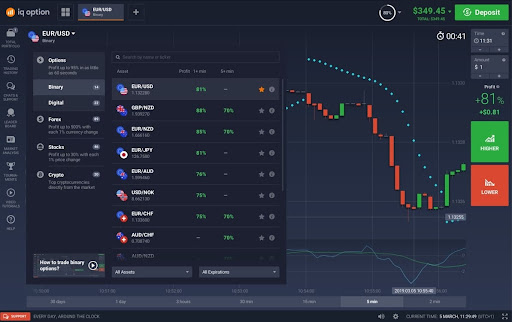 Binary Options on IQ Option
To piggyback off our previous definition, let’s examine an example of a binary options trade in motion.
Let’s say that you have predicted that the price of silver will rise from its current price of $1,000 in exactly one hour. The winning trade will provide a return of about 85%. You choose to place a $100 trade on this scenario. An hour later, the option contract expires and silver has risen to $1,250. You receive your $100 back in addition to an 85% return, totaling $185. It doesn’t matter how much the price of silver rose – if it rose at all, you won the trade. It’s very simple when compared to other forms of trading.
Asset – The underlying currency, commodity, stock, or index that the binary option is based on.
Broker – A person or company that allows traders to trade binary options on the options markets.
Current rate – The currency cost of an asset.
Range option – The limit that an organization will specify for various zones.
In-the-money – A term used to describe the scenario in which a trader predicts the movement of an asset correctly, thus making the binary option worth money.
Out-of-the-money – The opposite of in-the-money. This term describes the scenario in which you predict the asset price incorrectly and thus lose.
Rate of profit – The overall percentage of income that a trader receives after a trade expires, thus showing how profitable the trader’s choices have been in the market.
There are a number of different types of options.
Call/put options are common in binary options trading. Essentially, a put is a contract that provides the right to sell the asset at the strike price at any point up until the contract expires. A call is a contract that provides the right to buy the asset at any point up until the contract expires. These are derivative investments, which means that the price of the assets is based specifically on the movements of another product. Puts and calls can be written and sold off to other traders, which generates income.
One-touch options are very different. Essentially, this type of option pays out a premium to the person who holds the option if the spot rate climbs to the strike price at any point in time before the option expires. One-touch options are usually quite inexpensive, though they are not usually traded by smaller investors.
It’s also important to understand trading range. Trading range occurs when a specific security trades between high and low prices for a certain amount of time. The top of that security’s trading range will create price resistance, and the bottom will provide price support. Traders will often use a variety of different types of technical indicators to enter into or exit out of a trading range.
It’s also important to understand expiration dates. The expiration of a binary option is the exact date and time when that option will be settled into cash. It’s important to think very critically about whether your asset of choice will go up or down by the expiration date set.
Step 2. Consider Binary Opportunities and Risks
Because binary trading is very much an all-or-nothing process, there is incredible risk involved. The only way to successfully predict the changing value of an asset is if you do a ton of research on that asset and recent changes. Even then, you’re not guaranteed to win. And if you lose, you lose the entirety of what you bet.
Still, with this big risk comes big opportunities. Traders can make a lot of money trading binary options, as the returns tend to sit somewhere between 70% and 85% or even more. Find out what is the highest risk in binary options in the TU article.
Step 3. Choose Your Binary Broker
There are a few different excellent brokers out there for trading binary options. All three brokers have a fairly high trust level on Traders Union and also offer some unique bonuses.
| Foundation year | Min. deposit | Min. trade size | Min. Payout (%) | Max. Payout (%) | Demo | Open an account | |
|---|---|---|---|---|---|---|---|
| 2013 | 5 | 1 | 17 | 95 | Yes | Go to broker Your capital is at risk. |
|
| 2019 | 10 | 1 | 60 | 90 | Yes | Go to broker Your capital is at risk.
|
|
| 2009 | 250 | 1 | No | 100 | Yes | Study review | |
| 2017 | 5 | 1 | 50 | 128 | Yes | Go to broker Your capital is at risk. |
|
| 2019 | 10 | 1 | 20 | 98 | Yes | Go to broker Your capital is at risk. |
Step 4. Try Binary’s Demo
Binary.com offers a top up virtual demo account. Most brokers offer demo accounts, in fact. If you walk away from this guide with only one piece of advice, it should be to try a demo account.
A binary options demo account is essentially a “fake” trading account. Users use fake money to practice trading on the platform of their choice. The demo account will simulate the motions of the market to provide a true, legitimate trading experience. Using demo accounts is risk-free and is vital in learning how to trade. How else can you learn to trade binary options unless you get some hands-on experience? With a demo account, you can get this experience without having to risk any of your capital. Just as well, most demo accounts are 100% free to use, and some don’t even require you to make an account at all.
Step 5. Best Binary Trading Strategies For Beginners
As binary options trading becomes more popular, more and more people are looking into potential trading strategies for success. There are many different types of strategies out there, many of which are quite useful. However, there is no binary options trading strategy that will guarantee that you will be successful. So much of this type of trading relies on risk and taking chances, so there really isn’t a strategy that can guarantee success. Still, using a strategy can make trading a bit easier. Specifically, the following strategies are used by many successful traders in binary options.
Follow the Trends
No matter market you’re involved in or what specific asset you’re trying to trade, one of the best ways to make money with binary options is to follow a trend. It’s probably the best strategy a beginner can use when getting into binary options. Asset prices usually move in conjunction with trends. The price of an asset will go up or down along with relevant assets because the market is always speculating in real time. If you are interested in learning about Trend Reversal Patterns In Binary Options, read the Traders Union article.
Beginner traders need to remember that a trend almost never follows a straight line. Traders will usually see an asset’s price navigate in a sort of zig-zag path, which usually follows a general direction. Identifying the pattern will make it possible for traders to estimate if an option’s price will be higher or lower when it expires. When it comes to trading with trends, one can trade with overall trends or trade on swings.
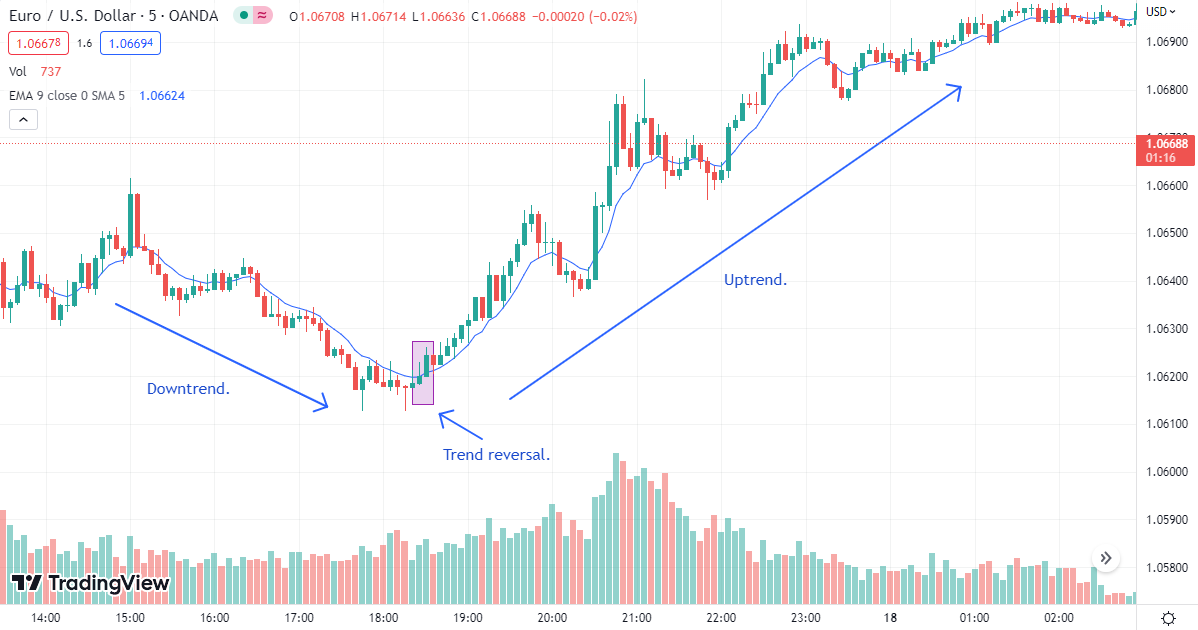 Follow the Trends
Follow the News
Following the news is a very basic but effective strategy that can result in good profits. It’s a lot easier to do in lieu of technical analysis, all while forcing you to read the news and stay in the loop throughout the day. Start with online news, but also take the time to navigate to the newspaper, listen to news radio, watch news channels on television. The goal is to get as much information from as many sources as possible, so you can understand your asset right down to its core in order to predict whether it will rise or fall in price.
Mean Reversion Strategy
The essence of the mean reversion strategy lies in the notion that asset prices and trends that diverge significantly from typical or average prices will often correct back toward the norm over time. This approach is well-suited for markets characterized by stable, sideways movement around a central price level.
Successful implementation involves first identifying the baseline or "mean" price based on historical data analysis. The trader then assesses any recent extremes, determining if the asset is unusually above or below average using tools such as Bollinger Bands.
If the current price lies significantly under the mean, calls are purchased on the assumption of an impending uptick. Conversely, puts are bought when the price exceeds the norm on expectations of a pullback.
Time horizons for these trades are kept short since mean reversion dynamics typically play out quickly in confined markets. Technical indicators like RSI further aid in spotting overbought/oversold conditions primed for a trend reversal.
Step 6. Don’t be greedy
Binary options are very high-risk instruments. It’s absolutely vital to follow the rules. It’s also vital to never trade with leveraged funds – always start small and use margin. The most successful binary options traders typically risk about 1% or less of their total capital. For example, if a trader has a $1,000 account, they should keep their risk to around $10-20. In general, it is not advised to risk more than 5%, though 1-2% is the sweet spot for successful traders with a solid risk management technique.
Is Binary Trading Profitable?
Binary options trading can be quite profitable. You can, for example, turn $100 into $1000 or even more. However, the risks are also very, very high. So much of a trader’s success comes down to the quality of their trading strategy, the brokers’ conditions, the acceptability of risk, and the overall state of the market. In general, we wouldn’t recommend binary options trading as a day job, but rather as a way to generate some extra income on the side.
Psychology of Trading
Trading the markets involves not just analysis and strategies, but also dealing with human emotions. Psychological factors like fear, greed, and impatience can sabotage even the best-laid plans. Here are some tips to help binary options traders maintain discipline:
Control impulse decisions: Don't chase losses or become overly optimistic when winning. Reacting to short-term fluctuations rather than sticking to analyzed scenarios often ends badly.
Avoid performance pressure: Comparing results to others adds unnecessary stress. Each trader's journey is unique. Focus on improving your own performance over time through learning.
Don't fall for market noise: Rumors and hype on social media aim to fuel reactions. Filter signals carefully from dispassionate analyses instead of random tips.
Learn from mistakes: We all make errors while gaining experience. Acknowledge slip-ups graciously and mine lessons from what went wrong to strengthen your skills.
Take breaks when needed: Step back from trading screens during stressful periods to relax and regain perspective. Emotions run high when tired.
Conclusion
Mastering binary trading begins with understanding both its potential rewards and inherent risks. By carefully selecting a reliable broker and employing proven trading strategies, beginners can navigate the market with greater confidence. For example, practicing with a demo account or sticking to straightforward call/put options can help build foundational skills without unnecessary exposure. Ultimately, the key to long-term success lies in disciplined learning and strategic decision-making. Remember, informed action is your best ally in turning binary trading opportunities into sustainable gains.
FAQs
What types of assets can you trade with binary options?
How important is using a demo account when starting with binary trading?
How do emotions influence decision making in binary options trading?
What basic strategies can beginners use to improve their chances in binary options?
Editors' Top Picks and Insights

Gold and silver: Why to buy in July

AI push hits Apple: MacBook and iPad prices rise as shares fall

Where World Cup 2026 stars invest: Football clubs, technology and crypto
CBDC ban: Why the U.S. does not need a digital dollar

Bitcoin price prediction and Bollinger Bands: Can BTC recover after falling to $63,000?

FIFA World Cup on blockchain: Where football meets crypto
Related Articles
Team that worked on the article
Mikhail Vnuchkov joined Traders Union as an author in 2020. He began his professional career as a journalist-observer at a small online financial publication, where he covered global economic events and discussed their impact on the segment of financial investment, including investor income.
Chinmay Soni is a financial analyst with more than 5 years of experience in working with stocks, Forex, derivatives, and other assets. As a founder of a boutique research firm and an active researcher, he covers various industries and fields, providing insights backed by statistical data.
Mirjan Hipolito is a journalist and news editor at Traders Union. She is an expert crypto writer with five years of experience in the financial markets.
Risk management is a risk management model that involves controlling potential losses while maximizing profits. The main risk management tools are stop loss, take profit, calculation of position volume taking into account leverage and pip value.
An investor is an individual, who invests money in an asset with the expectation that its value would appreciate in the future. The asset can be anything, including a bond, debenture, mutual fund, equity, gold, silver, exchange-traded funds (ETFs), and real-estate property.
Cryptocurrency is a type of digital or virtual currency that relies on cryptography for security. Unlike traditional currencies issued by governments (fiat currencies), cryptocurrencies operate on decentralized networks, typically based on blockchain technology.
Bitcoin is a decentralized digital cryptocurrency that was created in 2009 by an anonymous individual or group using the pseudonym Satoshi Nakamoto. It operates on a technology called blockchain, which is a distributed ledger that records all transactions across a network of computers.
Index in trading is the measure of the performance of a group of stocks, which can include the assets and securities in it.
-
 Afghanistan
-
 Albania
-
 Algeria
-
 Angola
-
 Argentina
-
 Armenia
-
 Australia
-
 Austria
-
 Azerbaijan
-
 Bahamas
-
 Bahrain
-
 Bangladesh
-
 Belarus
-
 Belgium
-
 Bolivia
-
 Botswana
-
 Brazil
-
 Brunei
-
 Bulgaria
-
 Cambodia
-
 Cameroon
-
 Canada
-
 Chile
Chile
-
 China
China
-
 Colombia
-
 Congo
Congo
-
 Costa Rica
-
 Cote d'Ivoire
-
 Croatia
-
 Cuba
Cuba
-
 Cyprus
-
 Czechia
-
 DR Congo
-
 Denmark
-
 Dominican Republic
-
 Ecuador
-
 Egypt
Egypt
-
 El Salvador
-
 Estonia
-
 Eswatini
-
 Ethiopia
-
 Finland
-
 France
-
 Georgia
-
 Germany
-
 Ghana
Ghana
-
 Greece
-
 Haiti
Haiti
-
 Hong Kong
-
 Hungary
-
 India
India
-
 Indonesia
-
 Iran, Islamic republic
-
 Iraq
Iraq
-
 Ireland
-
 Israel
-
 Italy
Italy
-
 Jamaica
-
 Japan
Japan
-
 Jordan
-
 Kazakhstan
-
 Kenya
Kenya
-
 Korea
Korea
-
 Kuwait
-
 Kyrgyzstan
-
 Laos
Laos
-
 Latvia
-
 Lebanon
-
 Lesotho
-
 Libya
Libya
-
 Lithuania
-
 Luxembourg
-
 Madagascar
-
 Malaysia
-
 Malta
Malta
-
 Mauritius
-
 Mexico
-
 Moldova
-
 Mongolia
-
 Montenegro
-
 Morocco
-
 Mozambique
-
 Myanmar
-
 Namibia
-
 Nepal
Nepal
-
 Netherlands
-
 New Zealand
-
 Nigeria
-
 North Macedonia
-
 Norway
-
 Oman
Oman
-
 Pakistan
-
 Palestine
-
 Panama
-
 Papua New Guinea
-
 Paraguay
-
 Peru
Peru
-
 Philippines
-
 Poland
-
 Portugal
-
 Puerto Rico
-
 Qatar
Qatar
-
 Reunion
-
 Romania
-
 Rwanda
-
 Saudi Arabia
-
 Serbia
-
 Singapore
-
 Slovakia
-
 Slovenia
-
 Somalia
-
 South Africa
-
 Spain
Spain
-
 Sri Lanka
-
 Sweden
-
 Switzerland
-
 Syria
Syria
-
 Taiwan
-
 Tajikistan
-
 Tanzania
-
 Thailand
-
 Trinidad and Tobago
-
 Tunisia
-
 Turkey
-
 UAE
UAE
-
 Uganda
-
 Ukraine
-
 United Kingdom
-
United States
-
 Uruguay
-
 Uzbekistan
-
 Venezuela
-
 Vietnam
-
 Yemen
Yemen
-
 Zambia
-
 Zimbabwe
- Forex
- Crypto











