
The tweet was deleted by the author.
But we saved everything 🙂.
Bitcoin fell below $63,000 after analysts pointed to a possible major price move. BTC is now at a level that could determine the market’s next short-term direction. If buyers fail to defend this area, the decline could become much more serious.
Just a few days ago, Bitcoin was trading around $64,000–$65,000. However, on June 21, analysts drew attention to a Bollinger Bands squeeze. In simple terms, the price was moving in a narrower range, while sharp swings were becoming less frequent.
One of these signals was shared by trader Titan. He noted that Bitcoin’s Bollinger Bands continued to tighten while volatility was declining. According to him, this kind of squeeze rarely lasts long, meaning the market could be preparing for a major move.
Another analyst, Seth, looked at the situation through the Bollinger Bands middle line. At the time, Bitcoin was trying to reclaim the area around $64,150. He also pointed to a possible double bottom, a sweep of a local low, and volume spikes that can appear during moments of seller capitulation.
After these signals, some market participants expected upside, but Bitcoin moved below $63,000. As a result, the price shifted from an attempted recovery to a test of the lower part of the range, where buyers now need to show strength again.
Bollinger Bands do not provide an exact price prediction. They help show how far an asset has moved away from its average value. The indicator has three lines: the middle line, the upper band, and the lower band.
The middle line shows an approximate price benchmark for the past 20 days. The upper band helps show when the market may be overheated. The lower band, in contrast, shows an area where selling pressure has already become noticeable.
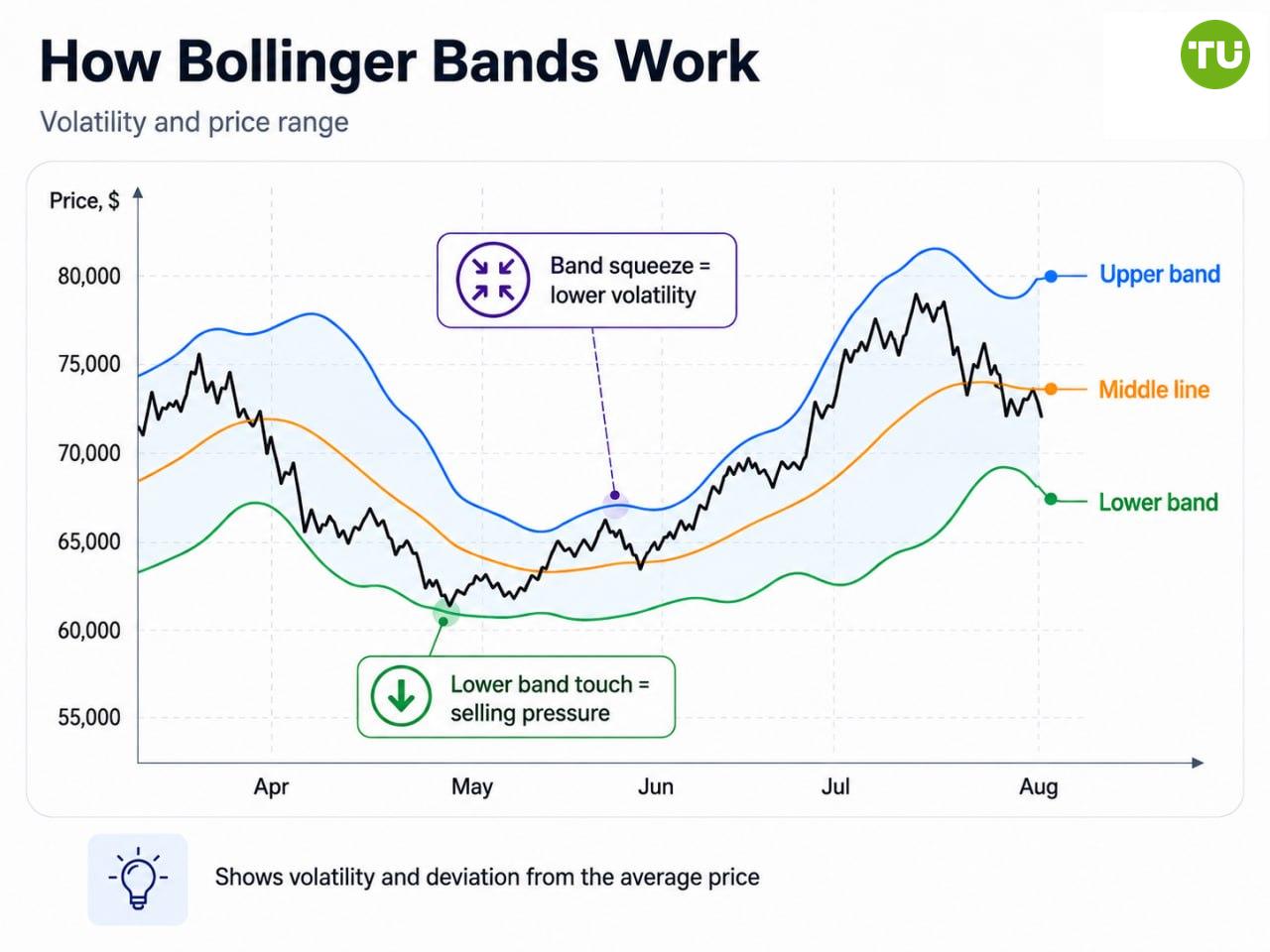
That is why a move toward the lower band does not always mean the sell-off will continue. Sometimes the price rebounds after such a move because some sellers have already closed their positions, while buyers begin entering at lower levels. However, this signal alone does not guarantee a reversal.
The key point in the current situation is that the band squeeze did not signal guaranteed upside. It showed that the market was preparing for a stronger move. Now it is clear that the first such move was to the downside.
For a bullish scenario, Bitcoin needs to reclaim the $63,000–$64,000 zone and stay above it. In that case, the move below $63,000 could look like a false breakout: sellers briefly pushed the price lower but failed to hold it there.
If buyers continue to apply pressure after that, the next target will be the $67,000–$68,000 area. BTC needs to return there to show that the decline has not turned into a deeper correction. A stronger scenario would open only if the price moves toward $71,000, where the nearest resistance area was previously located.
The negative scenario will strengthen if Bitcoin stays below $63,000 and fails to recover quickly. In this case, sellers may get more room to push lower, while the market starts pricing in the risk of another decline.
That means the near-term outlook depends on one question: will the move to the lower Bollinger Band become a reversal point or the start of the next wave down?

 Afghanistan
 Albania
 Algeria
 Angola
 Argentina
 Armenia
 Australia
 Austria
 Azerbaijan
 Bahamas
 Bahrain
 Bangladesh
 Belarus
 Belgium
 Bolivia
 Botswana
 Brazil
 Brunei
 Bulgaria
 Cambodia
 Cameroon
 Canada
 Chile
Chile
 China
China
 Colombia
 Congo
Congo
 Costa Rica
 Cote d'Ivoire
 Croatia
 Cuba
Cuba
 Cyprus
 Czechia
 DR Congo
 Denmark
 Dominican Republic
 Ecuador
 Egypt
Egypt
 El Salvador
 Estonia
 Eswatini
 Ethiopia
 Finland
 France
 Georgia
 Germany
 Ghana
Ghana
 Greece
 Haiti
Haiti
 Hong Kong
 Hungary
 India
India
 Indonesia
 Iran, Islamic republic
 Iraq
Iraq
 Ireland
 Israel
 Italy
Italy
 Jamaica
 Japan
Japan
 Jordan
 Kazakhstan
 Kenya
Kenya
 Korea
Korea
 Kuwait
 Kyrgyzstan
 Laos
Laos
 Latvia
 Lebanon
 Lesotho
 Libya
Libya
 Lithuania
 Luxembourg
 Madagascar
 Malaysia
 Malta
Malta
 Mauritius
 Mexico
 Moldova
 Mongolia
 Montenegro
 Morocco
 Mozambique
 Myanmar
 Namibia
 Nepal
Nepal
 Netherlands
 New Zealand
 Nigeria
 North Macedonia
 Norway
 Oman
Oman
 Pakistan
 Palestine
 Panama
 Papua New Guinea
 Paraguay
 Peru
Peru
 Philippines
 Poland
 Portugal
 Puerto Rico
 Qatar
Qatar
 Reunion
 Romania
 Rwanda
 Saudi Arabia
 Serbia
 Singapore
 Slovakia
 Slovenia
 Somalia
 South Africa
 Spain
Spain
 Sri Lanka
 Sweden
 Switzerland
 Syria
Syria
 Taiwan
 Tajikistan
 Tanzania
 Thailand
 Trinidad and Tobago
 Tunisia
 Turkey
 UAE
UAE
 Uganda
 Ukraine
 United Kingdom
United States
United Kingdom
United States
 Uruguay
 Uzbekistan
 Venezuela
 Vietnam
 Yemen
Yemen
 Zambia
 Zimbabwe