
How to make money with binary options


Editorial Note: While we adhere to strict Editorial Integrity, this post may contain references to products from our partners. Here's an explanation for How We Make Money. None of the data and information on this webpage constitutes investment advice according to our Disclaimer.
Making money with binary options depends on correctly predicting whether an asset's price will rise or fall within a fixed timeframe. Successful trades typically pay 70-95% of the amount invested, but consistent profits require maintaining a win rate above 55-60%, choosing liquid assets, and limiting risk to about 1-2% of trading capital per position. Long-term success depends on following a structured trading strategy and disciplined risk management.
Binary options attract traders because they offer a simple way to speculate on short-term price movements with fixed payouts. Many beginners wonder how to make money with binary options, but consistent results require far more than correctly predicting market direction. Success depends on choosing the right assets, trading during favorable market conditions, and following a disciplined trading plan.
This guide explains how experienced traders approach binary options trading and the factors that can improve long-term profitability.
Risk warning: Binary options trading is highly risky and may result in a total loss of funds. These speculative instruments often lack strong regulation, with over 80% of traders losing their capital. Invest only what you can afford to lose and seek professional advice.
Start with the venue, not the strategy
One of the biggest risks in binary options trading may come from the platform itself rather than the market. Many traders researching how to make money on binary options focus on trading strategies first, but choosing a reputable broker should be the starting point.
According to the CFTC and SEC, complaints against some online platforms have included blocked withdrawals, manipulated software, and identity theft. Problems like these can prevent traders from accessing their funds, regardless of how successful their trading strategy is.
Before analyzing charts or placing trades, check the following:
verify that the broker operates legally in your jurisdiction;
review its regulatory status and disciplinary history;
read the withdrawal policy and fee structure;
compare payout ratios for the same asset and expiry.
A reliable broker provides transparent trading conditions and reduces operational risks, allowing traders to focus on market analysis rather than platform-related issues.
Choose assets that behave clearly
The best trading opportunities often appear in highly liquid markets that respond consistently to macroeconomic events. Traders looking to make money with binary options usually focus on assets with well-established price patterns instead of constantly switching between unrelated markets.
Major Forex pairs, gold, and leading stock indices are popular choices because they react predictably to scheduled economic releases and institutional trading activity. This makes it easier to analyze price movements and develop a repeatable trading strategy.
For beginners, a practical shortlist includes:
EUR/USD for its deep liquidity and consistent reaction to economic data;
USD/JPY for its sensitivity to interest rate expectations and shifts in market sentiment;
gold for price movements driven by inflation expectations and geopolitical events;
major stock indices for strong momentum during the opening hours of major exchanges.
Focusing on a small group of familiar assets helps traders recognize recurring market patterns and make more informed trading decisions instead of relying on random speculation.
Match the trade to the session
Market activity changes throughout the day, and those changes can significantly affect trading results. Many traders researching how to make money on binary options focus on strategies but overlook the importance of trading during periods of higher market activity.
The overlap between the London and New York trading sessions usually produces the highest liquidity and volatility for major Forex pairs. This often creates favorable conditions for traders learning how to trade binary options profitably, as institutional participation is strongest and price movements are more sustained.
Gold tends to react sharply to major U.S. economic releases, particularly inflation reports and interest rate decisions. Major stock indices, meanwhile, often experience strong directional moves during the opening hours of their respective exchanges.
Trading when markets have a clear catalyst increases the likelihood of meaningful price movements and can help traders make money with binary options more consistently over time.
However, market timing is only part of the equation. Even a well-timed trade can produce disappointing results if the broker offers low payouts, poor execution, or unreliable withdrawal procedures. Choosing a reputable platform with competitive trading conditions is just as important as selecting the right asset or trading session.
The comparison below highlights some of the leading binary options brokers, allowing you to evaluate their features, trading conditions, and minimum deposit requirements before opening an account.
| Foundation year | Min. deposit | Min. Payout (%) | Max. Payout (%) | Withdrawal fee | Demo | Regulation | TU overall score | Open an account | |
|---|---|---|---|---|---|---|---|---|---|
| 2013 | 5 | 17 | 95 | 0-100 | Yes | No | 7.83 | Go to broker Your capital is at risk. |
|
| 2019 | 10 | 60 | 90 | Different | Yes | IFSA | 6.51 | Go to broker Your capital is at risk.
|
|
| 2009 | 250 | No | 100 | 0-25 USD | Yes | No | 3.84 | Study review | |
| 2017 | 5 | 50 | 128 | 0-0,5 | Yes | MISA | 9 | Go to broker Your capital is at risk. |
|
| 2019 | 10 | 20 | 98 | No | Yes | No | 8.6 | Go to broker Your capital is at risk. |
Build one setup before building a system
Many trading guides present dozens of strategies. In practice, however, consistent results usually come from mastering one trading setup instead of constantly switching between methods.
Traders learning how to trade binary options profitably often begin with a single repeatable approach and evaluate its performance over dozens of trades. This allows them to refine a strategy based on measurable results rather than random speculation.
Three trading setups are commonly used by experienced traders.
Trend continuation
This strategy follows the prevailing market trend after a brief consolidation or pullback. It works because momentum is already moving in the anticipated direction.
Typical characteristics include:
higher highs and higher lows in an uptrend;
lower highs and lower lows in a downtrend;
pullbacks toward support or resistance levels;
an expiry time that allows the trend to continue.
Many traders learning how to make money with binary options begin with this approach because it follows existing market momentum instead of trying to predict reversals.
News reaction
Major economic announcements often trigger sharp price movements. Rather than predicting the outcome before a release, experienced traders wait for the initial reaction and consider entering a trade only if the new direction remains stable.
This approach is commonly used when trading around macroeconomic events, where volatility creates short-term opportunities.
Exhaustion and reversal
This setup looks for price moves that appear overextended and may be ready to reverse. It generally requires more experience because traders are attempting to trade against the prevailing momentum.
When used selectively, it can complement a broader trading strategy by identifying potential turning points after strong directional moves.
Use expiry as part of the setup
Choosing the right expiry time is just as important as predicting the correct market direction. Even a well-analyzed trade can end in a loss if the option expires before the expected price move develops.
Traders learning how to trade binary options profitably evaluate expiry together with market conditions and their trading setup. Short expiries are more sensitive to random market fluctuations, while very long expiries may allow the original trading signal to lose momentum.
For example:
momentum breakouts on a one-minute chart often work better with expiries of several minutes;
trades based on major economic news may require longer expiries to give the trend time to develop.
Matching the expiry to your trading setup helps improve consistency and supports a more disciplined approach to making money with binary options.
A demo account is one of the best tools for learning how to make money with binary options, but only if every trade is reviewed afterward. Simply placing practice trades without analyzing the results does little to improve long-term performance.
A trading journal should include:
asset traded;
trading session;
setup used;
expiry time;
payout ratio;
reason for entering the trade;
final outcome.
Reviewing this information over dozens of trades helps traders identify which strategies perform consistently and which rely on luck. It also provides a practical framework for anyone learning how to trade binary options profitably.
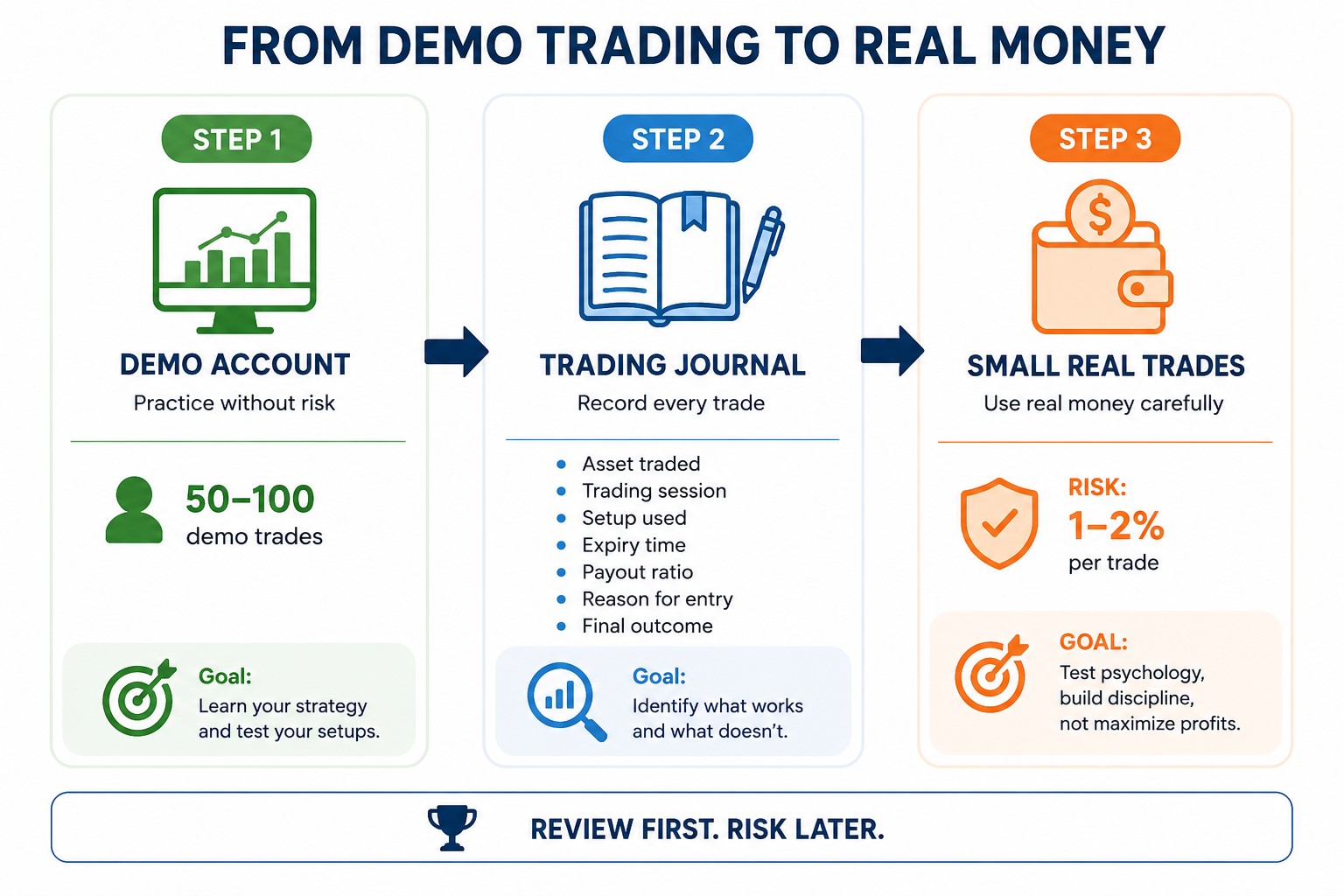
Once a strategy produces consistent results on a demo account, traders can begin testing it with small real-money positions. This step helps build discipline and prepare for the emotional challenges of trading with real capital.
Why most traders struggle
The market looks attractive because brokers display potential payouts upfront, often ranging from 70% to 95% of the amount invested. At first glance, this may suggest that making money with binary options is straightforward. In reality, profitability depends on the relationship between payout ratios and the percentage of winning trades.
For example, if a contract pays 70%, the break-even win rate is about 58.8%. At an 80% payout, it falls to 55.6%, while a 90% payout requires a win rate of about 52.6%. Many traders underestimate these mathematical requirements when learning how to trade binary options profitably.
Many beginners focus on making frequent trades instead of developing a consistent strategy. As a result, short-term speculation often leads to unstable performance and losses over time rather than sustainable profits.
According to the European Securities and Markets Authority (ESMA), regulators found that retail clients consistently lost money when trading binary options. These findings contributed to restrictions on the marketing, distribution, and sale of binary options to retail investors across the European Union.
| Payout | Break-even win rate |
|---|---|
| 70% | 58.8% |
| 75% | 57.1% |
| 80% | 55.6% |
| 85% | 54.1% |
| 90% | 52.6% |
| 95% | 51.3% |
Risk management that actually works
Risk management is often mentioned in trading guides, but it is one of the main factors that determines whether traders can make money with binary options over the long term. Even a profitable strategy can fail if losses are not kept under control.
Binary options have fixed payouts and fixed losses, so the maximum amount at risk is known before each trade. Traders learning how to trade binary options profitably typically risk only a small percentage of their trading capital on any single position.
Common risk management rules include:
risk no more than 1% of your account per trade while testing a strategy;
limit your total daily loss to around 3% of your account;
pause trading after several consecutive losses;
avoid increasing position size to recover previous losses.
Following these rules helps preserve trading capital, reduces emotional decision-making, and allows traders to improve their strategies without exposing their accounts to large drawdowns.
Measure consistency, not individual wins
One profitable trade does not prove that a strategy works, just as one losing trade does not mean it has failed. Traders learning how to make money with binary options should evaluate their performance over dozens of trades rather than focusing on individual outcomes.
When reviewing results, pay attention to:
win rate;
average payout;
average loss;
trade frequency;
market conditions.
Experienced traders typically assess a strategy after at least 50-100 trades before deciding whether it has a statistical edge. This approach helps separate consistent performance from short-term luck and is an important part of how to trade binary options profitably.
Common mistakes to avoid
Many beginners focus on making quick profits instead of building a consistent trading process. As a result, the same mistakes tend to appear repeatedly, regardless of the strategy being used.
One common mistake is constantly switching between different assets. Traders trying to make money with binary options often jump from one market to another instead of learning how a small number of assets behave under different market conditions.
Another frequent error is relying exclusively on very short expiry times. Although short-term trades may seem attractive to those learning how to make money on binary options, they are also more vulnerable to random price fluctuations and market noise.
Other common mistakes include:
ignoring payout differences between brokers;
trading during periods of low liquidity;
increasing position size after losing trades;
placing too many trades in a short period.
Avoiding these mistakes helps traders build more consistent habits and improve their long-term trading performance.
Build consistency before increasing risk

One of the biggest mistakes beginners make is trying to trade too many assets or strategies at once. If your goal is to make money with binary options, focus on one or two liquid markets, trade them during the same sessions, and use a single setup until you understand how it performs in different market conditions. A consistent routine makes it much easier to recognize high-quality trading opportunities and avoid impulsive decisions.
Risk management is just as important as finding good entry points. Keep your position size consistent, maintain a detailed trading journal, and review your performance regularly to identify what works and what needs improvement. Traders who follow a structured process instead of chasing quick wins are far more likely to trade binary options profitably over time.
Conclusion
Ultimately, the most powerful takeaway from learning how to make money with binary options is that long-term profitability depends far more on disciplined process and risk management than on chasing quick wins or complex strategies. Traders who focus on a single, well-understood setup—such as trend continuation during high-liquidity sessions—while maintaining strict controls over position size and emotional impulses, consistently outperform those who trade impulsively or constantly switch approaches. By building a strong trading routine, keeping detailed records, and evaluating performance over many trades, traders can separate skill from luck and steadily improve results. Remember, in the binary options market, consistency and structure are your greatest allies—success comes to those who treat it like a business, not a gamble.
FAQs
How important is choosing the right expiry time when trading binary options?
What role does maintaining a trading journal play in binary options success?
Why is it recommended to master a single trading setup before trying multiple strategies in binary options?
How do payout ratios affect break-even win rates in binary options trading?
Editors' Top Picks and Insights






Related Articles
Team that worked on the article
Aleksandra Chaikina has been a contributor to Traders Union since 2021. With over 15 years of experience in copywriting and more than 5 years focused on financial content, she specializes in producing detailed guides, analytics, and comparative reviews across various sectors, including cryptocurrencies, Forex, investment strategies, and financial technologies.
Ciaran Ryan is a veteran financial journalist based in South Africa, where he covers cryptocurrency, mining, stock markets, and governance for Moneyweb. He also hosts the weekly Moneyweb Crypto Podcast.
Chinmay Soni is a financial analyst with more than 5 years of experience in working with stocks, Forex, derivatives, and other assets. As a founder of a boutique research firm and an active researcher, he covers various industries and fields, providing insights backed by statistical data.
Index in trading is the measure of the performance of a group of stocks, which can include the assets and securities in it.
Options trading is a financial derivative strategy that involves the buying and selling of options contracts, which give traders the right (but not the obligation) to buy or sell an underlying asset at a specified price, known as the strike price, before or on a predetermined expiration date. There are two main types of options: call options, which allow the holder to buy the underlying asset, and put options, which allow the holder to sell the underlying asset.
Binary options trading is a financial trading method where traders speculate on the price movement of various assets, such as stocks, currencies, or commodities, by predicting whether the price will rise or fall within a specified time frame, often as short as a few minutes. Unlike traditional trading, binary options have only two possible outcomes: a fixed payout if the trader's prediction is correct or a loss of the invested amount if the prediction is wrong.
Bitcoin is a decentralized digital cryptocurrency that was created in 2009 by an anonymous individual or group using the pseudonym Satoshi Nakamoto. It operates on a technology called blockchain, which is a distributed ledger that records all transactions across a network of computers.
An investor is an individual, who invests money in an asset with the expectation that its value would appreciate in the future. The asset can be anything, including a bond, debenture, mutual fund, equity, gold, silver, exchange-traded funds (ETFs), and real-estate property.

-
 Afghanistan
-
 Albania
-
 Algeria
-
 Angola
-
 Argentina
-
 Armenia
-
 Australia
-
 Austria
-
 Azerbaijan
-
 Bahamas
-
 Bahrain
-
 Bangladesh
-
 Belarus
-
 Belgium
-
 Bolivia
-
 Botswana
-
 Brazil
-
 Brunei
-
 Bulgaria
-
 Cambodia
-
 Cameroon
-
 Canada
-
 Chile
Chile
-
 China
China
-
 Colombia
-
 Congo
Congo
-
 Costa Rica
-
 Cote d'Ivoire
-
 Croatia
-
 Cuba
Cuba
-
 Cyprus
-
 Czechia
-
 DR Congo
-
 Denmark
-
 Dominican Republic
-
 Ecuador
-
 Egypt
Egypt
-
 El Salvador
-
 Estonia
-
 Eswatini
-
 Ethiopia
-
 Finland
-
 France
-
 Georgia
-
 Germany
-
 Ghana
Ghana
-
 Greece
-
 Haiti
Haiti
-
 Hong Kong
-
 Hungary
-
 India
India
-
 Indonesia
-
 Iran, Islamic republic
-
 Iraq
Iraq
-
 Ireland
-
 Israel
-
 Italy
Italy
-
 Jamaica
-
 Japan
Japan
-
 Jordan
-
 Kazakhstan
-
 Kenya
Kenya
-
 Korea
Korea
-
 Kuwait
-
 Kyrgyzstan
-
 Laos
Laos
-
 Latvia
-
 Lebanon
-
 Lesotho
-
 Libya
Libya
-
 Lithuania
-
 Luxembourg
-
 Madagascar
-
 Malaysia
-
 Malta
Malta
-
 Mauritius
-
 Mexico
-
 Moldova
-
 Mongolia
-
 Montenegro
-
 Morocco
-
 Mozambique
-
 Myanmar
-
 Namibia
-
 Nepal
Nepal
-
 Netherlands
-
 New Zealand
-
 Nigeria
-
 North Macedonia
-
 Norway
-
 Oman
Oman
-
 Pakistan
-
 Palestine
-
 Panama
-
 Papua New Guinea
-
 Paraguay
-
 Peru
Peru
-
 Philippines
-
 Poland
-
 Portugal
-
 Puerto Rico
-
 Qatar
Qatar
-
 Reunion
-
 Romania
-
 Rwanda
-
 Saudi Arabia
-
 Serbia
-
 Singapore
-
 Slovakia
-
 Slovenia
-
 Somalia
-
 South Africa
-
 Spain
Spain
-
 Sri Lanka
-
 Sweden
-
 Switzerland
-
 Syria
Syria
-
 Taiwan
-
 Tajikistan
-
 Tanzania
-
 Thailand
-
 Trinidad and Tobago
-
 Tunisia
-
 Turkey
-
 UAE
UAE
-
 Uganda
-
 Ukraine
-
 United Kingdom
-
United States
-
 Uruguay
-
 Uzbekistan
-
 Venezuela
-
 Vietnam
-
 Yemen
Yemen
-
 Zambia
-
 Zimbabwe
- Forex
- Crypto










- Start with the venue, not the strategy
- Choose assets that behave clearly
- Match the trade to the session
- Build one setup before building a system
- Use expiry as part of the setup
- Why most traders struggle
- Risk management that actually works
- Measure consistency, not individual wins
- Common mistakes to avoid
- Expert opinion
- Conclusion
- FAQs


