
Best Currency Pairs To Trade At Night In 2026



Editorial Note: While we adhere to strict Editorial Integrity, this post may contain references to products from our partners. Here's an explanation for How We Make Money. None of the data and information on this webpage constitutes investment advice according to our Disclaimer.
Best currency pairs to trade at night in 2026:
USD/JPY: high liquidity and volatility during the Asian session make this pair popular for night trading.
AUD/USD: active during the Australian market hours, this pair often reflects regional economic events.
NZD/USD: similar to AUD/USD, it provides opportunities based on New Zealand's market activities.
EUR/JPY: a mix of European and Asian market activity ensures moderate volatility at night.
GBP/JPY: often sees movement during overlapping European and Asian session hours.
Are you looking for the best Forex pairs to trade at night? In this article, a team of experts will provide you with valuable insights on how to enhance your trading performance during nighttime trading sessions. Designed specifically to assist traders, the experts at TU will unveil the top Forex currency pairs that offer lucrative opportunities during the night hours.
What are the best currency pairs to trade at night?
The best currency pairs to trade for night trading depend on your strategy and risk tolerance. During overnight sessions, Asian and Oceanian pairs like AUD/NZD, AUD/JPY, and NZD/JPY often show increased volatility, offering opportunities for active traders. Align your choice with market analysis and your trading goals for the best results.
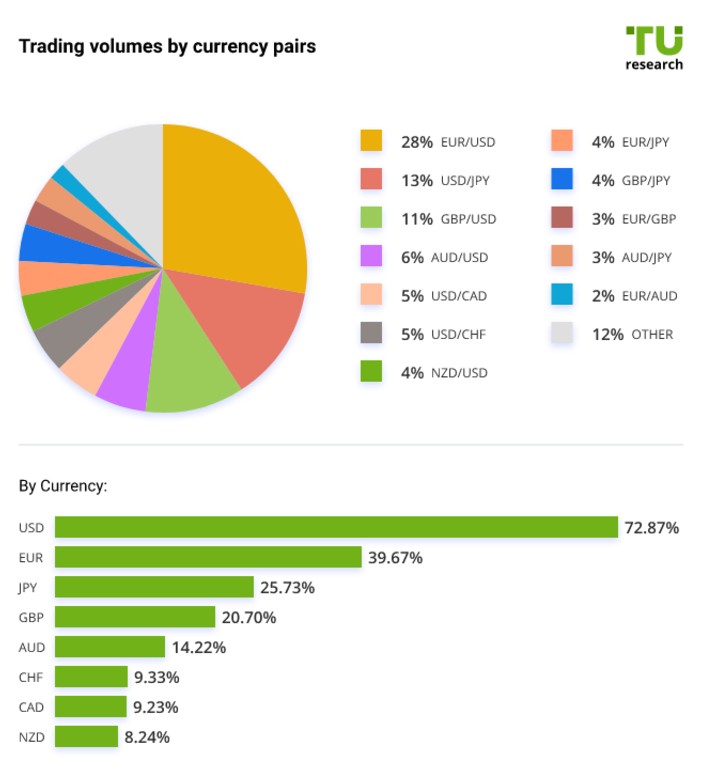
Here’s an expanded explanation of the currency pairs best suited for night trading:
USD/JPY
Known for its high liquidity and volatility during the Asian trading session, USD/JPY is a go-to pair for nighttime traders. Japan’s economic activity and announcements often influence this pair, making it responsive to macroeconomic data such as interest rates and trade balances. Additionally, the pair benefits from the U.S. dollar's status as a global reserve currency, ensuring consistent market activity.AUD/USD
This pair becomes active during the Australian market hours, reflecting economic trends in the region. Factors like commodity prices (particularly gold and iron ore) and Reserve Bank of Australia (RBA) policy decisions heavily impact its movement. Traders often use AUD/USD to capture price actions tied to Australia’s economic data releases and global risk sentiment.NZD/USD
Similar to AUD/USD, this pair thrives on economic events specific to New Zealand, such as agricultural export performance and Reserve Bank of New Zealand (RBNZ) policy updates. It is popular among night traders due to its predictable reaction to market news and its correlation with the AUD/USD pair, offering diversification with regional insights.EUR/JPY
As a cross pair involving two major economies, EUR/JPY provides unique opportunities during the overlap of European and Asian sessions. Moderate volatility at night makes it suitable for traders seeking stable trends influenced by events in Europe, such as ECB policies, alongside Japanese market activities.GBP/JPY
This pair is known for its significant price movements during the Asian-European overlap, making it attractive for experienced traders. The GBP/JPY pair is influenced by both the UK economy and Japan’s financial policies, offering a balance of volatility and liquidity. It is particularly appealing for traders looking to profit from breakout strategies during active market hours.
Key tips for Forex night trading
Forex night trading occurs outside regular exchange hours, allowing traders to react to global events and economic changes. These hours vary by exchange and provide opportunities to trade during session overlaps, such as the Asian and European markets, which increase activity and liquidity. Understanding night trading schedules, available currency pairs, and market conditions helps traders plan strategies, adapt to price fluctuations, and seize opportunities effectively.
Key tips for Forex night trading:
Focus on low-volatility strategies. At night, markets move slower, so it’s a good time to trade between clear high and low points on the chart. This way, you can make safer moves and reduce your chances of losing money.
Capitalize on regional currency pairs. Asian currencies like the Japanese yen or Australian dollar often see some activity at night. Learn their patterns to spot easy opportunities when the rest of the market is quiet.
Use pending orders strategically. Instead of watching your screen endlessly, set buy or sell orders at key points on the chart. If the price hits those levels, your trade will trigger automatically, saving you time.
Avoid news-driven pairs. Pairs like EUR/USD can act up due to random news, even late at night. Stick to quieter pairs to keep things predictable.
Implement automated systems with caution. Trading bots are handy, but many don’t work well when the market is sleepy. Test your tools to make sure they’re not giving you useless signals.
Track institutional movements in futures markets. Check reports like COT to see what big players are doing. Their decisions often hint at what’s coming, even during quieter hours.
Is overnight trading a good idea?
Overnight trading can enable the following:
Flexibility. Overnight trading offers the flexibility to trade at your convenience, not limited to regular market hours. This is advantageous for individuals with busy schedules who struggle to find time for trading during the day
Market analysis. Analyzing market performance during the day allows for informed trading decisions during overnight sessions. Utilizing market trends and analysis can lead to more strategic decision-making
Order modification. It allows for the modification or cancellation of orders during non-trading hours, providing the freedom to adjust positions based on changing market conditions or personal preferences
Global event impact. Overnight trading also enables traders to capitalize on global events that occur outside of regular trading hours, such as economic releases or political decisions. This allows for timely actions, such as selling stocks affected by negative events or investing in companies likely to benefit from positive developments
Lower competition. Generally, night hour trading has less competition due to fewer active traders in the market. This can create opportunities to exploit market inefficiencies and potentially generate profits
Diversification. Including overnight trading as part of a diversified trading strategy helps manage risks and spread investments across different timeframes and market conditions
Reduced emotional stress. Trading during regular market hours can be emotionally taxing with rapid price fluctuations and the need for quick decisions. Overnight trading provides a more relaxed environment, allowing for a thorough market analysis and informed decision-making
Access to multiple markets. Overnight trading allows access to markets that operate 24 hours a day, such as Forex and futures markets. This expands trading opportunities and the ability to benefit from different market trends and conditions
Where can I trade the best Forex pairs
Choosing the right platform is crucial for trading top Forex pairs effectively. Below is a comparison of the best brokers offering competitive features, tight spreads, and a wide range of currency pairs to suit both beginners and advanced traders.
| zForex | Plus500 | OANDA | Trading.com USA | FOREX.com | |
|---|---|---|---|---|---|
|
Demo |
Yes | Yes | Yes | Yes | Yes |
|
Min. deposit, $ |
10 | 100 | No | 50 | 100 |
|
Max. leverage |
1:1000 | 1:300 | 1:200 | 1:50 | 1:50 |
|
Min Spread EUR/USD, pips |
0.1 | 0.5 | 0.1 | 0.9 | 0.7 |
|
Max Spread EUR/USD, pips |
0.4 | 0.9 | 0.5 | No | 1.2 |
|
Scalping |
Yes | No | Yes | Yes | Yes |
|
Max. Regulation Level |
Not regulated | Tier-1 | Tier-1 | Tier-1 | Tier-1 |
|
Open an account |
Go to broker Your capital is at risk.
|
Go to broker 80% of retail CFD accounts lose money. |
Go to broker Your capital is at risk. |
Go to broker Your capital is at risk. |
Study review |
It’s important to recognize how quieter hours impact specific currencies

During night trading, it’s important to recognize how quieter hours impact specific currencies and use that to your advantage. A top pick is AUD/NZD, a pair that often moves in sync and doesn’t experience major price shocks. This makes it beginner-friendly and less stressful to trade. Keep an eye on Australia’s commodity news or New Zealand’s dairy updates — small changes here can create big opportunities. Instead of relying on generic indicators, try using real-time tools that show how many buyers and sellers are active. This way, you’ll have a better sense of when to jump in or hold back.
Another great option is USD/JPY, particularly when the Tokyo and Sydney markets overlap. The yen tends to move based on global risk trends, so following news about bonds or safe-haven investments can give you an edge. Big players often try to trigger common stop-loss levels, so instead of placing your stops in obvious spots, base them on how much the market is fluctuating. Watch out for clues from Japan’s central bank too — they sometimes drop hints about their next moves if you read between the lines.
Conclusion
In conclusion, night trading in the Forex market can be highly effective when you focus on the currency pairs with consistent liquidity and lower volatility, such as AUD/JPY and NZD/USD. By understanding night trading hours and adapting your strategies to these quieter market conditions, traders can capture opportunities while managing risk more effectively. The key takeaway is that success at night comes from embracing pairs that align with the active sessions and being disciplined with risk management. Ultimately, mastering night trading isn’t just about staying awake—it’s about staying smart and selective with every position you take.
FAQs
Which currency pairs are considered most stable for night trading sessions?
How does the timing of economic releases impact night trading strategies?
What role do automated trading systems play in Forex night trading?
How can traders take advantage of lower market competition during night hours?
Editors' Top Picks and Insights

U.S. Bitcoin reserve: Trump’s unrealized crypto promise

Aiming for leadership: Payment giants prepare a new stablecoin

Proof of Reserves: the new standard for cryptocurrency exchanges

Three trends that could reshape the crypto market over the next decade

Trump financial disclosure: How the president's crypto income became a U.S. ethics issue

Code red: What's behind Bitcoin’s sharp selloff?
Related Articles
Team that worked on the article
Oleg Tkachenko is an economic analyst and risk manager having more than 14 years of experience in working with systemically important banks, investment companies, and analytical platforms. He has been a Traders Union analyst since 2018.
Dan Blystone began his trading career in 1998 as an arbitrage clerk on the floor of the Chicago Mercantile Exchange (CME). He later traded bond and Eurex futures at proprietary firms such as Altea Trading, gaining valuable experience in high-frequency trading and risk management.
Chinmay Soni is a financial analyst with more than 5 years of experience in working with stocks, Forex, derivatives, and other assets. As a founder of a boutique research firm and an active researcher, he covers various industries and fields, providing insights backed by statistical data.
Copy trading is an investing tactic where traders replicate the trading strategies of more experienced traders, automatically mirroring their trades in their own accounts to potentially achieve similar results.
Volatility refers to the degree of variation or fluctuation in the price or value of a financial asset, such as stocks, bonds, or cryptocurrencies, over a period of time. Higher volatility indicates that an asset's price is experiencing more significant and rapid price swings, while lower volatility suggests relatively stable and gradual price movements.
Diversification is an investment strategy that involves spreading investments across different asset classes, industries, and geographic regions to reduce overall risk.
CFD is a contract between an investor/trader and seller that demonstrates that the trader will need to pay the price difference between the current value of the asset and its value at the time of contract to the seller.
Bitcoin is a decentralized digital cryptocurrency that was created in 2009 by an anonymous individual or group using the pseudonym Satoshi Nakamoto. It operates on a technology called blockchain, which is a distributed ledger that records all transactions across a network of computers.

-
 Afghanistan
-
 Albania
-
 Algeria
-
 Angola
-
 Argentina
-
 Armenia
-
 Australia
-
 Austria
-
 Azerbaijan
-
 Bahamas
-
 Bahrain
-
 Bangladesh
-
 Belarus
-
 Belgium
-
 Bolivia
-
 Botswana
-
 Brazil
-
 Brunei
-
 Bulgaria
-
 Cambodia
-
 Cameroon
-
 Canada
-
 Chile
Chile
-
 China
China
-
 Colombia
-
 Congo
Congo
-
 Costa Rica
-
 Cote d'Ivoire
-
 Croatia
-
 Cuba
Cuba
-
 Cyprus
-
 Czechia
-
 DR Congo
-
 Denmark
-
 Dominican Republic
-
 Ecuador
-
 Egypt
Egypt
-
 El Salvador
-
 Estonia
-
 Eswatini
-
 Ethiopia
-
 Finland
-
 France
-
 Georgia
-
 Germany
-
 Ghana
Ghana
-
 Greece
-
 Haiti
Haiti
-
 Hong Kong
-
 Hungary
-
 India
India
-
 Indonesia
-
 Iran, Islamic republic
-
 Iraq
Iraq
-
 Ireland
-
 Israel
-
 Italy
Italy
-
 Jamaica
-
 Japan
Japan
-
 Jordan
-
 Kazakhstan
-
 Kenya
Kenya
-
 Korea
Korea
-
 Kuwait
-
 Kyrgyzstan
-
 Laos
Laos
-
 Latvia
-
 Lebanon
-
 Lesotho
-
 Libya
Libya
-
 Lithuania
-
 Luxembourg
-
 Madagascar
-
 Malaysia
-
 Malta
Malta
-
 Mauritius
-
 Mexico
-
 Moldova
-
 Mongolia
-
 Montenegro
-
 Morocco
-
 Mozambique
-
 Myanmar
-
 Namibia
-
 Nepal
Nepal
-
 Netherlands
-
 New Zealand
-
 Nigeria
-
 North Macedonia
-
 Norway
-
 Oman
Oman
-
 Pakistan
-
 Palestine
-
 Panama
-
 Papua New Guinea
-
 Paraguay
-
 Peru
Peru
-
 Philippines
-
 Poland
-
 Portugal
-
 Puerto Rico
-
 Qatar
Qatar
-
 Reunion
-
 Romania
-
 Rwanda
-
 Saudi Arabia
-
 Serbia
-
 Singapore
-
 Slovakia
-
 Slovenia
-
 Somalia
-
 South Africa
-
 Spain
Spain
-
 Sri Lanka
-
 Sweden
-
 Switzerland
-
 Syria
Syria
-
 Taiwan
-
 Tajikistan
-
 Tanzania
-
 Thailand
-
 Trinidad and Tobago
-
 Tunisia
-
 Turkey
-
 UAE
UAE
-
 Uganda
-
 Ukraine
-
 United Kingdom
-
United States
-
 Uruguay
-
 Uzbekistan
-
 Venezuela
-
 Vietnam
-
 Yemen
Yemen
-
 Zambia
-
 Zimbabwe
- Forex
- Crypto











