
Best Forex brokers to trade on the weekends



Editorial Note: While we adhere to strict Editorial Integrity, this post may contain references to products from our partners. Here's an explanation for How We Make Money. None of the data and information on this webpage constitutes investment advice according to our Disclaimer.
Top 5 Best Forex brokers:
- zForex - High transaction speeds, automatic tracking system of clients’ risks..
- Plus500 - Best premium client support (personal manager, exclusive analysis, webinars)
- OANDA - Best for trading with advanced technical analysis tools (TradingView charts support)
- Trading.com USA - A broker registered with the CFTC and NFA that focuses on spot Forex trading through MT5 and proprietary platforms.
- FOREX.com - Diverse range of tradable assets (80+ currency pairs)
Even on weekends when other markets close, Forex traders still have the ability to make trades. For active traders or those who use algorithmic trading, having a broker that allows weekend access can be extremely beneficial. However, not all Forex brokers offer trading services over the weekend. The availability of weekend trading depends on the broker and the markets they provide access to.
In this article, we review some of the top Forex brokers that enable weekend trading, including services for other assets like cryptocurrencies.
Do Forex brokers work on weekends?
It's common practice for the Forex markets to close on weekends. Trading normally begins from 5 pm on Sunday to 5 pm on Friday, New York time, making the regular trading period 24/5. Understanding these sessions is essential when determining the best time to trade Forex, as liquidity and volatility vary depending on market overlap. Although most major markets are officially closed on weekends, differences in global time zones can occasionally create limited trading activity. For example, when it's Friday at 5 p.m. in New York, it's already Saturday at 4 a.m. in Japan.
Despite the closure of traditional Forex markets over the weekend, many brokers also provide access to cryptocurrency trading alongside Forex and stock instruments. Unlike standard Forex sessions, the crypto CFD (contract for difference) market operates 24/7, offering traders continuous opportunities even outside the best time to trade Forex during the regular trading week.
Below is a chart showing Forex market trading hours and the time overlap.
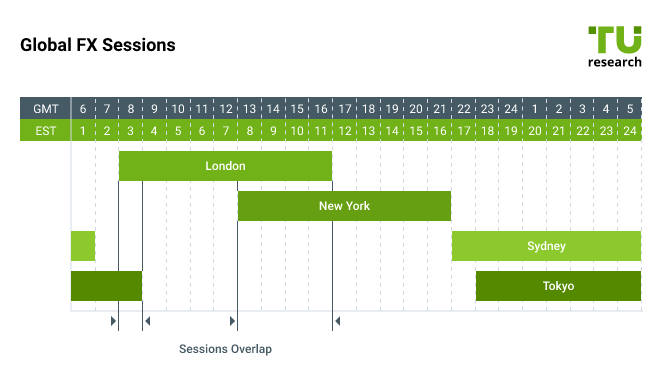 Forex trading hours
What Are Crypto Trading Hours?
Because crypto trading remains open 24/7, the cryptocurrency market offers the opportunity to trade on weekends and throughout the week. Something also worth noting is that in contrast to Forex markets, Crypto CFD trading is more stable over the weekend, allowing traders to maximize their profits. Cryptocurrency market trading is one of the top 3 markets to trade on weekends.
Best Forex brokers for trading on the weekends
The primary opportunity for weekend trading is the cryptocurrency market. Brokers from this list support cryptocurrency trading on weekends.
| zForex | IG Markets | Blackbird | XPro Markets | iBroker | |
|---|---|---|---|---|---|
|
Weekend trading |
Yes | Yes | Yes | Yes | Yes |
|
Min. deposit, $ |
10 | 1 | 1 | 250 | 1 |
|
Crypto Trading |
Yes | Yes | Yes | Yes | Yes |
|
EUR/USD Spread |
0.1 | 0.8 | 0.10 | No | 0.10 |
|
TU overall score |
7.95 | 6.83 | 6.13 | 5.57 | 5.46 |
|
Regulation |
No | FCA, BaFin, ASIC, MAS, CySec, FINMA, BMA, CFTC, NFA | CNMV, FINRA, SIPC | FSCA, CySEC | CNMV |
|
Open account |
Go to broker Your capital is at risk.
|
Study review | Study review | Study review | Study review |
Top 3 markets to trade on the weekends
We have mentioned a lot about specific markets that remain open over the weekend, but which markets are they? Here are some markets to consider for weekend trading:
Cryptocurrency Market
The first market you should consider is the cryptocurrency market. It remains open 24/7 so you can consistently trade on this market without having to switch over the weekend. It is also the most rational option as this market is easy to access.
In addition, sometimes on weekends, there is normal liquidity. Unlike the forex and stock markets, the cryptocurrency market can be more stable over weekends. Continuous availability means that traders can maximize their profits as well.
Tel-Aviv Stock Exchange
The Tel-Aviv Stock Exchange is open every day of the year except for select holidays. This market also has numerous assets and securities available for traders.
Traders have the option of choosing from:
Convertible securities
Corporate and government bonds
Short-term certificates
There are several companies to consider in this market, but the most promising are:
Bank Leumi
Solar Edge Technologies
Tadawul Index – Saudi Arabia
Tawadul market is open on all days of the week except for select holidays that change from year to year. You can confirm and keep track of them here. You can trade on all major assets, and with all major instruments on this market.
The best companies to consider in this market are:
Saudi Aramco
Saudi Basic Industries
Saudi Telecom Companies
Is it a good idea to trade on the weekends?
Most traders avoid trading on weekends because the majority of markets are closed. Weekends also have the lowest liquidity, among other reasons.
However, there are advantages to trading on the weekend too.
Pros
Traders have more time to analyze markets.
Most traders are hard at work during the week and need more time to monitor charts and keep up with market news. Not all retail traders can hire someone to handle their trades. As a result, weekends allow traders to spend more time on trend analysis and, as such, trade more.
Opportunity to practice trading strategies.
During the weekend, the open markets are slower, and there are fewer activities, making it the perfect time to put your methods to the test. You won't need to test strategies on live accounts, but it makes it easier to spot trends and draw conclusions.
Get a head start on trading during the weekend.
Most traders use the points mentioned earlier to prepare for weekday trading, analyze markets and fine-tune strategies, which is vital in getting a headstart on the coming week.
Cons
Less market liquidity
Market trading on weekends is less liquid because weekend markets have fewer active managers and participants. Another contributing factor is the scarcity of economic and geopolitical news, forcing market prices to move slowly. As such, the market is less volatile and offers fewer profit opportunities.
Fewer Markets and trading assets
On weekends, most major markets are closed. Traders must therefore make do with fewer, less popular markets they would not typically trade, making trading inconvenient.
Weekends also provide fewer trading instruments and assets, regardless of market conditions. Trading thus becomes less flexible than it is during the week.
Odd trading hours
If a trader wants to stick to the major markets, they must trade at odd hours. In the example given at the start of this post, traders who wish to work into the weekend would only have the first four hours of the day.
Choose a Forex broker that treats weekend access as a controlled environment
Weekend trading should be approached as a strategic extension of your weekday plan, not as a separate opportunity to increase risk. I recommend choosing a Forex broker that treats weekend access as a controlled environment – with stable execution, predictable spreads, and clear rules – rather than one that simply “keeps markets open” without sufficient liquidity safeguards.
My key advice is to use weekends primarily for selective trades and preparation, especially when working with crypto CFDs or instruments that remain active outside standard Forex hours. Brokers that offer reliable infrastructure, fast execution, and flexible asset access allow traders to stay engaged without forcing unnecessary exposure during thin market conditions.
I also recommend avoiding overtrading on weekends. Lower liquidity can distort price behavior, so position sizing and risk limits matter even more than during the week. A broker that supports precise order handling and transparent conditions helps traders stay disciplined when markets are slower and spreads behave differently.
Ultimately, the best Forex brokers for weekend trading are those that prioritize execution quality, platform stability, and risk control. When used correctly, weekend trading can enhance analysis and continuity – but only if the broker supports a measured, professional trading approach rather than encouraging impulsive activity.
Conclusion
When it comes to weekend trading, choosing a broker that combines reliability and robust platform features is essential for success. Brokers like RoboForex and eToro stand out for their seamless execution and broad asset coverage, allowing traders to capitalize on weekend market movements efficiently. Ultimately, the right broker empowers traders to stay active and seize opportunities beyond traditional trading hours. For those serious about trading on weekends, opting for a top-tier broker can make all the difference. In the dynamic world of forex, the weekend doesn’t have to mean a pause—it can be a competitive edge.
FAQs
How should traders approach position sizing and risk control with weekend trading brokers?
What technological features benefit traders using weekend trading platforms?
Which markets besides cryptocurrencies remain accessible for trading through weekend brokers?
Is weekend trading recommended for all experience levels, or should it be reserved for certain traders?
Editors' Top Picks and Insights

Three trends that could reshape the crypto market over the next decade

Trump financial disclosure: How the president's crypto income became a U.S. ethics issue

Code red: What's behind Bitcoin’s sharp selloff?

MiCA is live: How EU new rules are changing crypto market

Bitcoin price prediction based on MVRV: Indicator points to BTC undervaluation

Amazon flooded with AI books: Crisis of trust in literature market
Related Articles
Team that worked on the article
Oleg Tkachenko is an economic analyst and risk manager having more than 14 years of experience in working with systemically important banks, investment companies, and analytical platforms. He has been a Traders Union analyst since 2018.
Olga Shendetskaya has been a part of the Traders Union team as an author, editor and proofreader since 2017. Since 2020, Shendetskaya has been the assistant chief editor of the website of Traders Union, an international association of traders.
Chinmay Soni is a financial analyst with more than 5 years of experience in working with stocks, Forex, derivatives, and other assets. As a founder of a boutique research firm and an active researcher, he covers various industries and fields, providing insights backed by statistical data.
Index in trading is the measure of the performance of a group of stocks, which can include the assets and securities in it.
Volatility refers to the degree of variation or fluctuation in the price or value of a financial asset, such as stocks, bonds, or cryptocurrencies, over a period of time. Higher volatility indicates that an asset's price is experiencing more significant and rapid price swings, while lower volatility suggests relatively stable and gradual price movements.
Cryptocurrency is a type of digital or virtual currency that relies on cryptography for security. Unlike traditional currencies issued by governments (fiat currencies), cryptocurrencies operate on decentralized networks, typically based on blockchain technology.
Forex trading, short for foreign exchange trading, is the practice of buying and selling currencies in the global foreign exchange market with the aim of profiting from fluctuations in exchange rates. Traders speculate on whether one currency will rise or fall in value relative to another currency and make trading decisions accordingly. However, beware that trading carries risks, and you can lose your whole capital.
Crypto trading involves the buying and selling of cryptocurrencies, such as Bitcoin, Ethereum, or other digital assets, with the aim of making a profit from price fluctuations.

-
 Afghanistan
-
 Albania
-
 Algeria
-
 Angola
-
 Argentina
-
 Armenia
-
 Australia
-
 Austria
-
 Azerbaijan
-
 Bahamas
-
 Bahrain
-
 Bangladesh
-
 Belarus
-
 Belgium
-
 Bolivia
-
 Botswana
-
 Brazil
-
 Brunei
-
 Bulgaria
-
 Cambodia
-
 Cameroon
-
 Canada
-
 Chile
Chile
-
 China
China
-
 Colombia
-
 Congo
Congo
-
 Costa Rica
-
 Cote d'Ivoire
-
 Croatia
-
 Cuba
Cuba
-
 Cyprus
-
 Czechia
-
 DR Congo
-
 Denmark
-
 Dominican Republic
-
 Ecuador
-
 Egypt
Egypt
-
 El Salvador
-
 Estonia
-
 Eswatini
-
 Ethiopia
-
 Finland
-
 France
-
 Georgia
-
 Germany
-
 Ghana
Ghana
-
 Greece
-
 Haiti
Haiti
-
 Hong Kong
-
 Hungary
-
 India
India
-
 Indonesia
-
 Iran, Islamic republic
-
 Iraq
Iraq
-
 Ireland
-
 Israel
-
 Italy
Italy
-
 Jamaica
-
 Japan
Japan
-
 Jordan
-
 Kazakhstan
-
 Kenya
Kenya
-
 Korea
Korea
-
 Kuwait
-
 Kyrgyzstan
-
 Laos
Laos
-
 Latvia
-
 Lebanon
-
 Lesotho
-
 Libya
Libya
-
 Lithuania
-
 Luxembourg
-
 Madagascar
-
 Malaysia
-
 Malta
Malta
-
 Mauritius
-
 Mexico
-
 Moldova
-
 Mongolia
-
 Montenegro
-
 Morocco
-
 Mozambique
-
 Myanmar
-
 Namibia
-
 Nepal
Nepal
-
 Netherlands
-
 New Zealand
-
 Nigeria
-
 North Macedonia
-
 Norway
-
 Oman
Oman
-
 Pakistan
-
 Palestine
-
 Panama
-
 Papua New Guinea
-
 Paraguay
-
 Peru
Peru
-
 Philippines
-
 Poland
-
 Portugal
-
 Puerto Rico
-
 Qatar
Qatar
-
 Reunion
-
 Romania
-
 Rwanda
-
 Saudi Arabia
-
 Serbia
-
 Singapore
-
 Slovakia
-
 Slovenia
-
 Somalia
-
 South Africa
-
 Spain
Spain
-
 Sri Lanka
-
 Sweden
-
 Switzerland
-
 Syria
Syria
-
 Taiwan
-
 Tajikistan
-
 Tanzania
-
 Thailand
-
 Trinidad and Tobago
-
 Tunisia
-
 Turkey
-
 UAE
UAE
-
 Uganda
-
 Ukraine
-
 United Kingdom
-
United States
-
 Uruguay
-
 Uzbekistan
-
 Venezuela
-
 Vietnam
-
 Yemen
Yemen
-
 Zambia
-
 Zimbabwe
- Forex
- Crypto











