
How To Short Crypto | Comprehensive Guide



Editorial Note: While we adhere to strict Editorial Integrity, this post may contain references to products from our partners. Here's an explanation for How We Make Money. None of the data and information on this webpage constitutes investment advice according to our Disclaimer.
The main ways to short sell crypto are:
- Contracts for Difference (CFDs)
- Options
- Futures
- Binary options
- Borrowed assets
Imagine that you can make money on the fact that the price of cryptocurrency is falling. Sounds amazing, doesn't it? In reality, this can be done through something called short selling. In this article, we'll break down what shorting cryptocurrencies is, what methods exist, how to start shorting cryptocurrency and what risks are associated with it. We will also look at strategies that will help you successfully make money on a market downturn.
How to short cryptocurrency: step-by-step guide
Short selling, or “shorting cryptocurrencies,” is a way to make money on a decline in the price of an asset. Imagine this as borrowing an item from a friend, selling it now, expecting to be able to buy the same item cheaper and return it to your friend. You keep the difference in price as profit.
Choosing a short selling platform. Find an exchange or broker that offers cryptocurrency shorting. Pay attention to commissions and trading conditions.
Register and set up an account. Register on the chosen platform and go through the verification procedure.
Selecting a cryptocurrency to short sell. Select a cryptocurrency or token to trade down.
Analyse the market and determine when to enter. Use chart and news analysis to choose the best time to enter a short position.
Opening a short position. On the platform, select the desired instrument (CFDs, options, futures, etc.) and open a short position.
Monitoring and position management. Monitor the market and adjust your position if necessary.
Closing a short position. When the price falls to the desired level or when a loss occurs, close the position.
The main ways to short sell crypto
Short positions in cryptocurrency came to us from traditional financial markets, but with the development of cryptocurrencies and digital technology, this method has become available to crypto traders as well. Shorting cryptocurrencies is used to protect assets from falling prices and to speculate in bear markets .
CFDs (Contracts for Difference) - allow you to speculate on the price movement of a cryptocurrency without actually buying it . You enter into a contract with a broker, and if the price falls, you profit from the difference between the initial and final price. Unlike buying cryptocurrency directly, CFDs allow you to use leverage . This means you can borrow money from a broker to increase the volume of the trade, potentially increasing your profits. However, it's worth remembering that as potential profits increase, so do the risks;
Options - give you the right, but not the obligation, to buy or sell cryptocurrency at a certain price in the future . You can use put options to make money on falling prices. For example, if you believe that the price of Bitcoin will fall, you can buy a put option. If the price does fall, you can sell the Bitcoin at the higher price specified in the option and make a profit. Options provide flexibility because you are not obligated to exercise the contract if the market moves against you;
Binary Options - you are forecast on whether the price of a cryptocurrency will be above or below a certain level at a given time . If you guess right, you get a fixed payout. Binary options are easy to use, but they carry high risks. You either receive a fixed amount of profit or lose your entire bet. This instrument is more suitable for those who want to make quick money on short-term price changes;
Futures - commit you to buy or sell cryptocurrency in the future at a pre-agreed price . This method requires more knowledge and experience, but can be very lucrative. When you enter into a futures contract, you are committing to buy or sell a cryptocurrency at a certain date in the future at a predetermined price. If the price of the asset falls and you contract to sell, you make a profit. Futures allow you to accurately plan your actions in the market and use sophisticated hedging strategies;
Cryptocurrency margin trading - allows you to borrow money to trade cryptocurrency, increasing your potential profits and risks. You borrow from a broker to increase your positions, which can lead to significant profits if you correctly predict market movements ;
Asset borrowing (lending) - some platforms allow you to borrow cryptocurrency for short sales. You borrow assets, sell them at the current price, and then buy them back at a lower price, paying back the debt and keeping the difference.
Risks and opportunities of shorting crypto
Shorting cryptocurrencies carries both opportunities and significant risks.
The main risks include volatility in the cryptocurrency market , which can lead to significant losses;
The potential losses can be unlimited as the asset price can continue to rise ;
Shorting often requires the use of borrowed funds, which can result in margin calls and the need to quickly replenish your deposit ;
Regulatory risks also play a role, as regulatory changes could affect the ability to short sell .
Profit opportunities include the benefits of margin utilisation , which increases potential leveraged returns;
Arbitrage opportunities allow the utilisation of price differences on different exchanges;
The use of hedging helps protect the portfolio from falling prices.
How to choose the entry point to short crypto
Analyzing the market and determining the entry point for shorting cryptocurrency requires the use of various sophisticated analytical methods. Here are the key steps that can help in this process:
Technical Analysis
Charts and Patterns
Look for reversal patterns such as " head and shoulders" " double top" "bearish flag":
Head and Shoulders. This pattern consists of three peaks: a central peak (head) above two side peaks (shoulders). The lines drawn through the shoulder peaks are marked with red dashed lines. This signals a possible downward trend reversal.
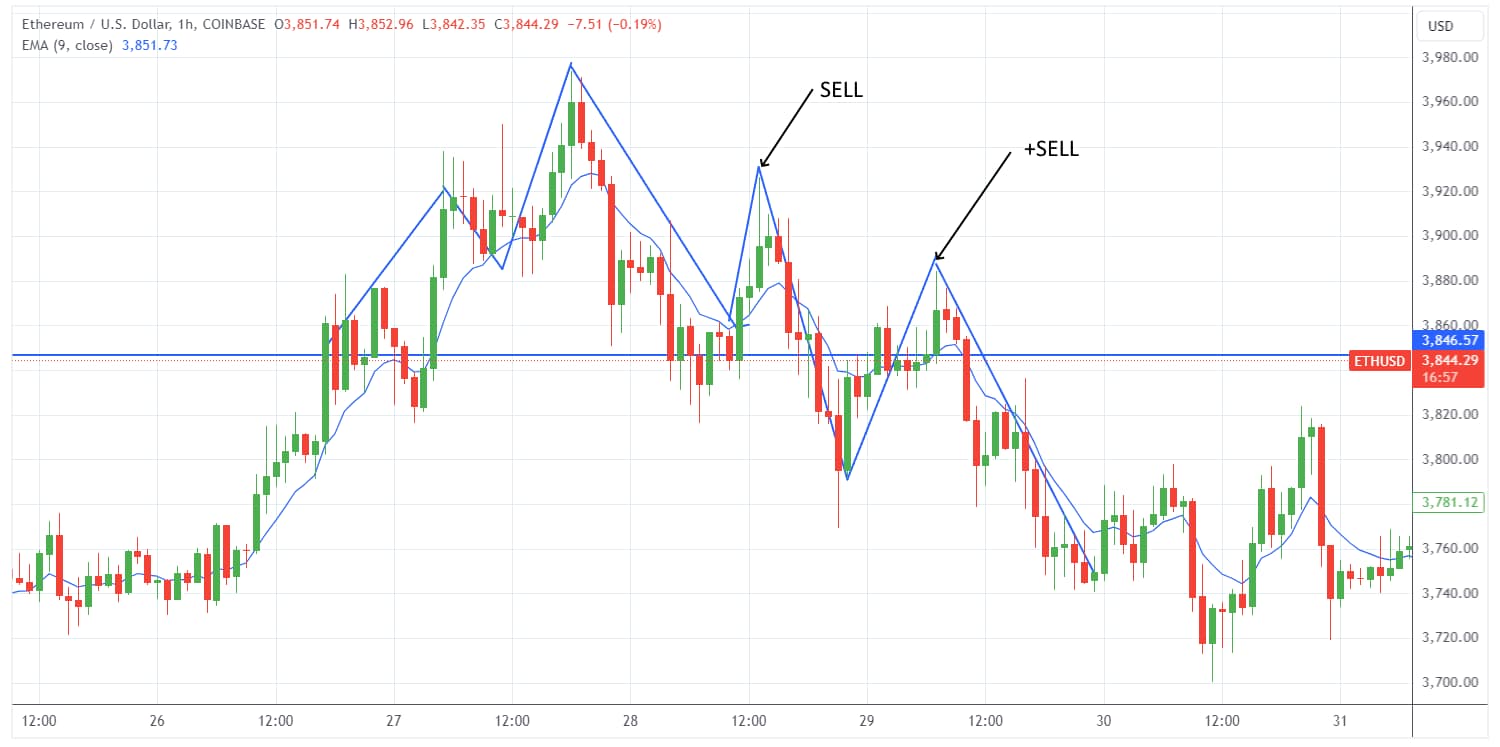 Head and Shoulders llustration
Double Top. This pattern is characterised by two consecutive peaks at the same level with an intermediate trough. The red dotted lines mark the peak levels. This indicates a possible reversal of the downtrend.
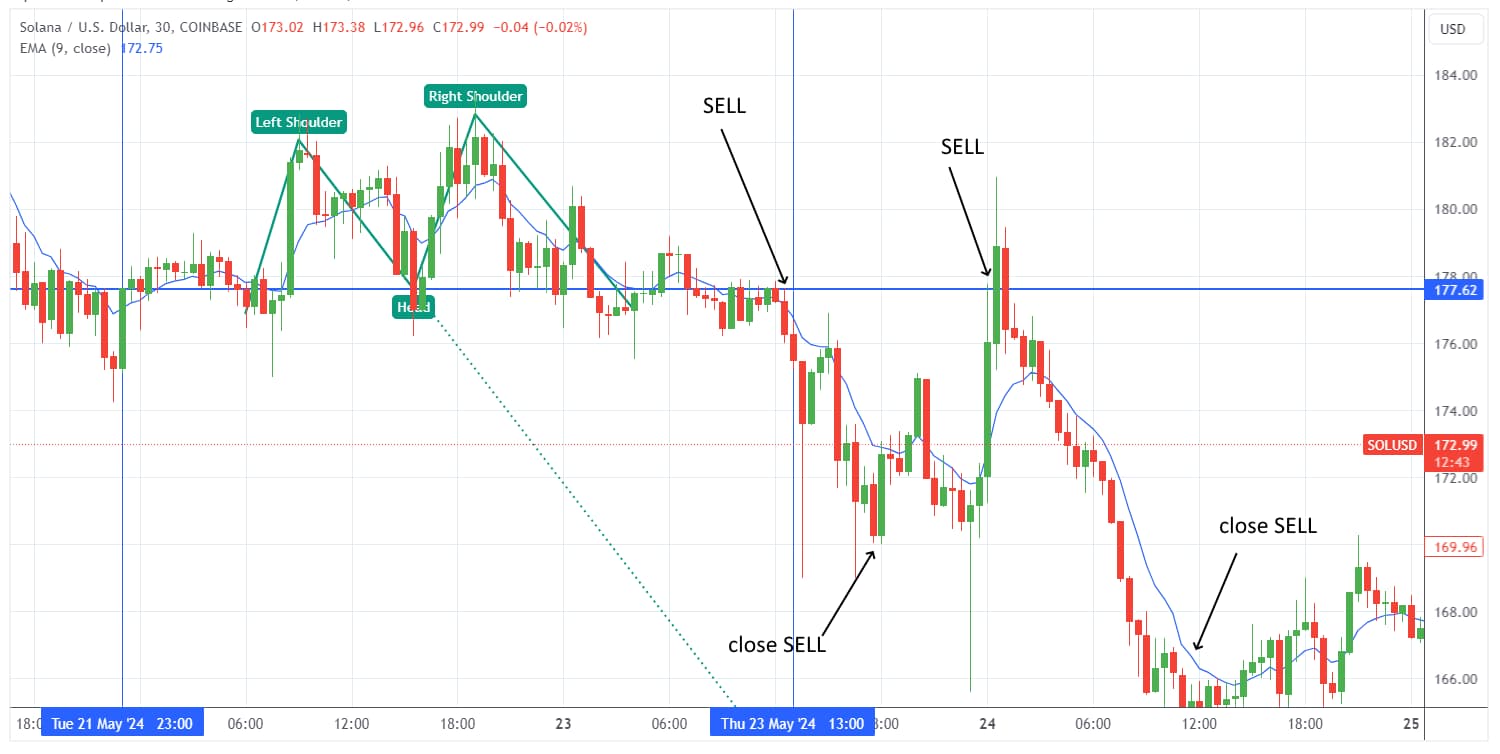 Double Top llustration
Bearish Flag. This pattern consists of a sharp decline in price, followed by a short period of upward correction (flag), after which the decline is expected to continue. The red dashed line shows the flag.
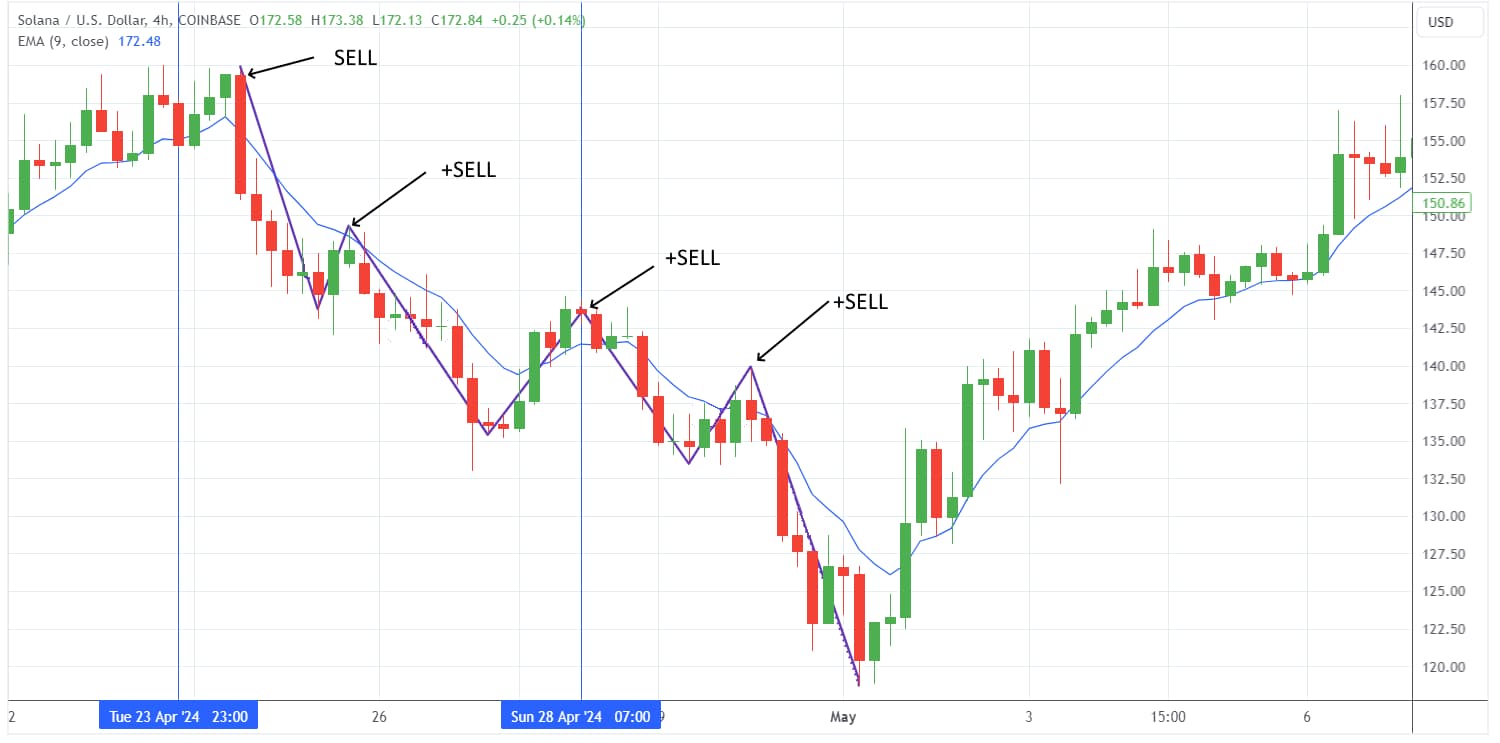 Bearish Flag llustration
Indicators
Moving Averages (MA): When a short-term moving average crosses above a long-term moving average, it can be a signal for going long. Conversely, when a short-term moving average crosses below a long-term moving average, it can be a signal for shorting.
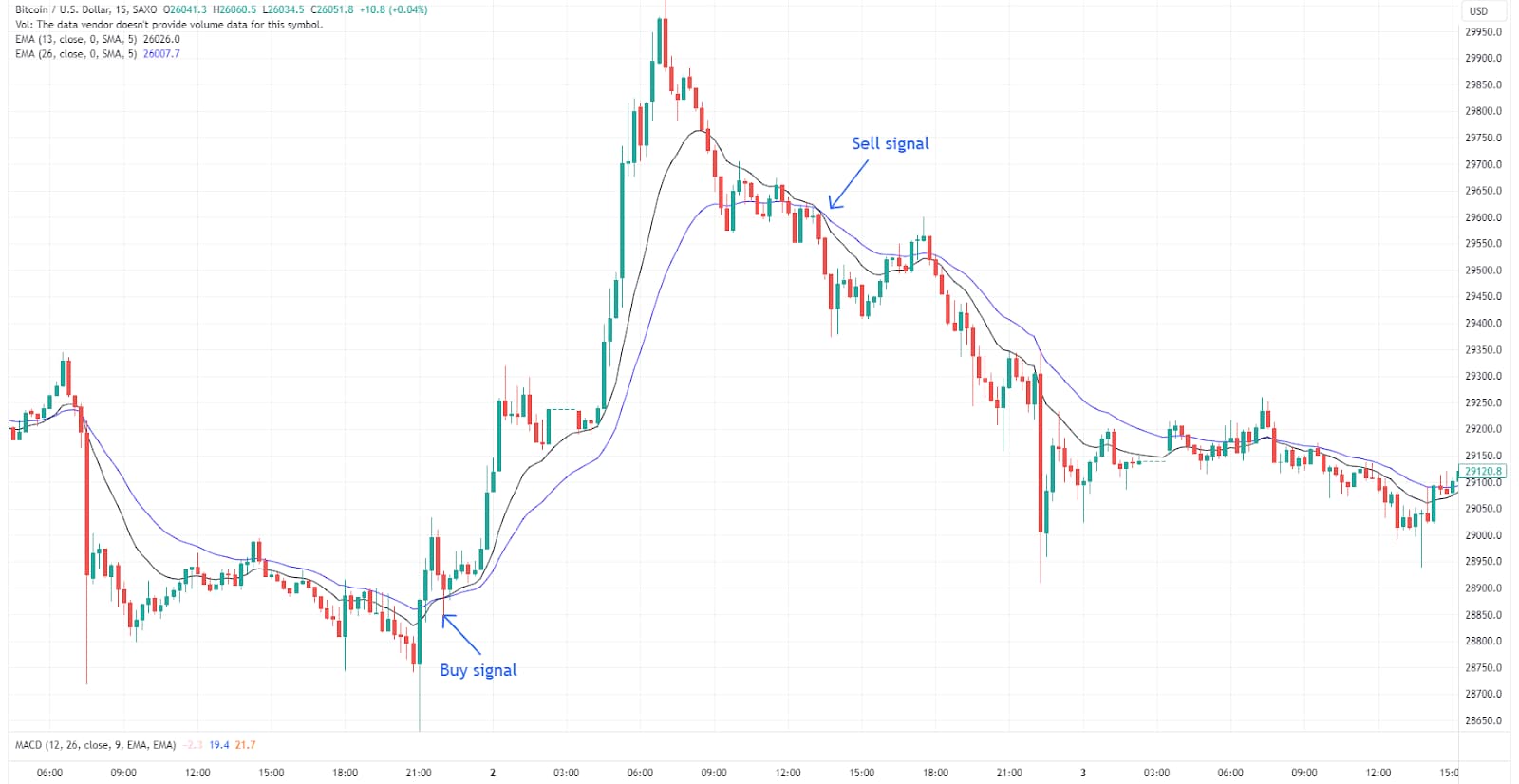 Moving Average Illustration
Relative Strength Index (RSI): Values above 70 may indicate overbought conditions and a potential downward reversal while values below 30 may indicate oversold conditions and a potential upward reversal.
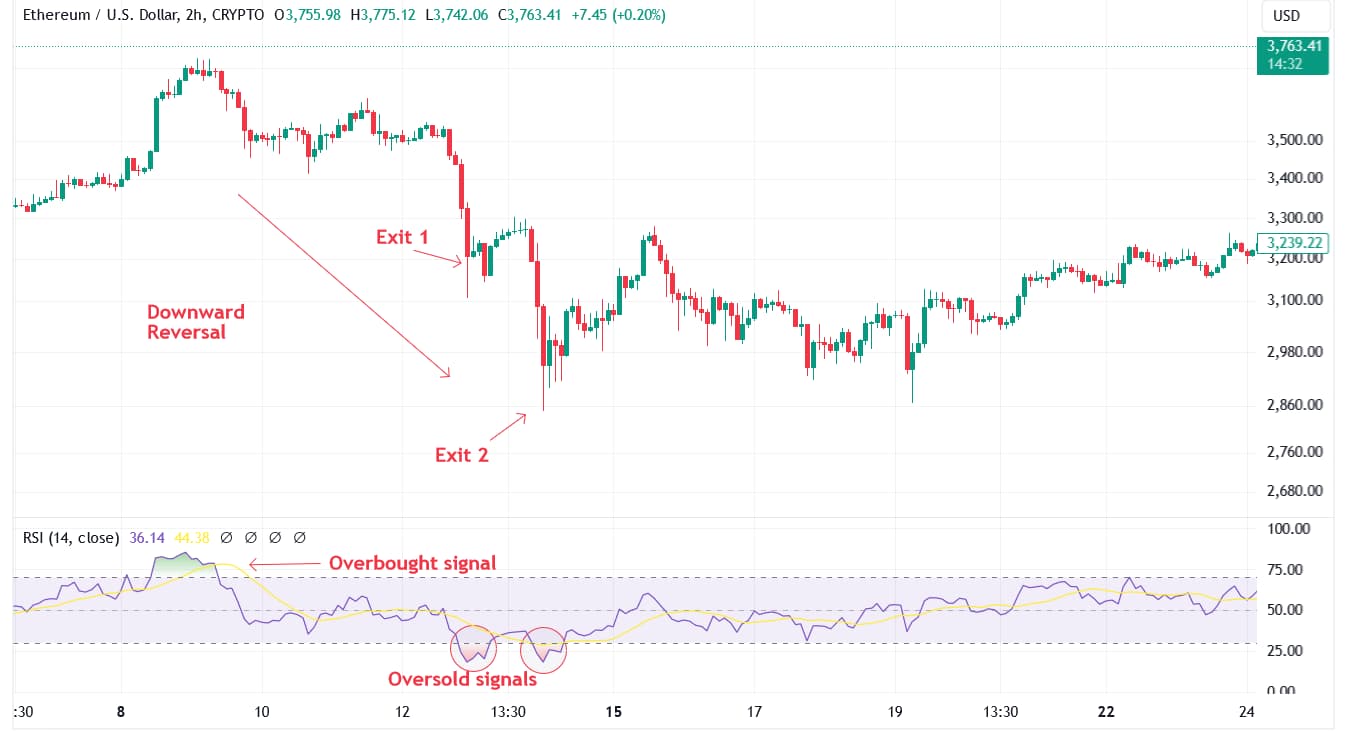 RSI Illustration
MACD Indicator: When the MACD line crosses below the signal line, it can be a signal to short and vice versa.
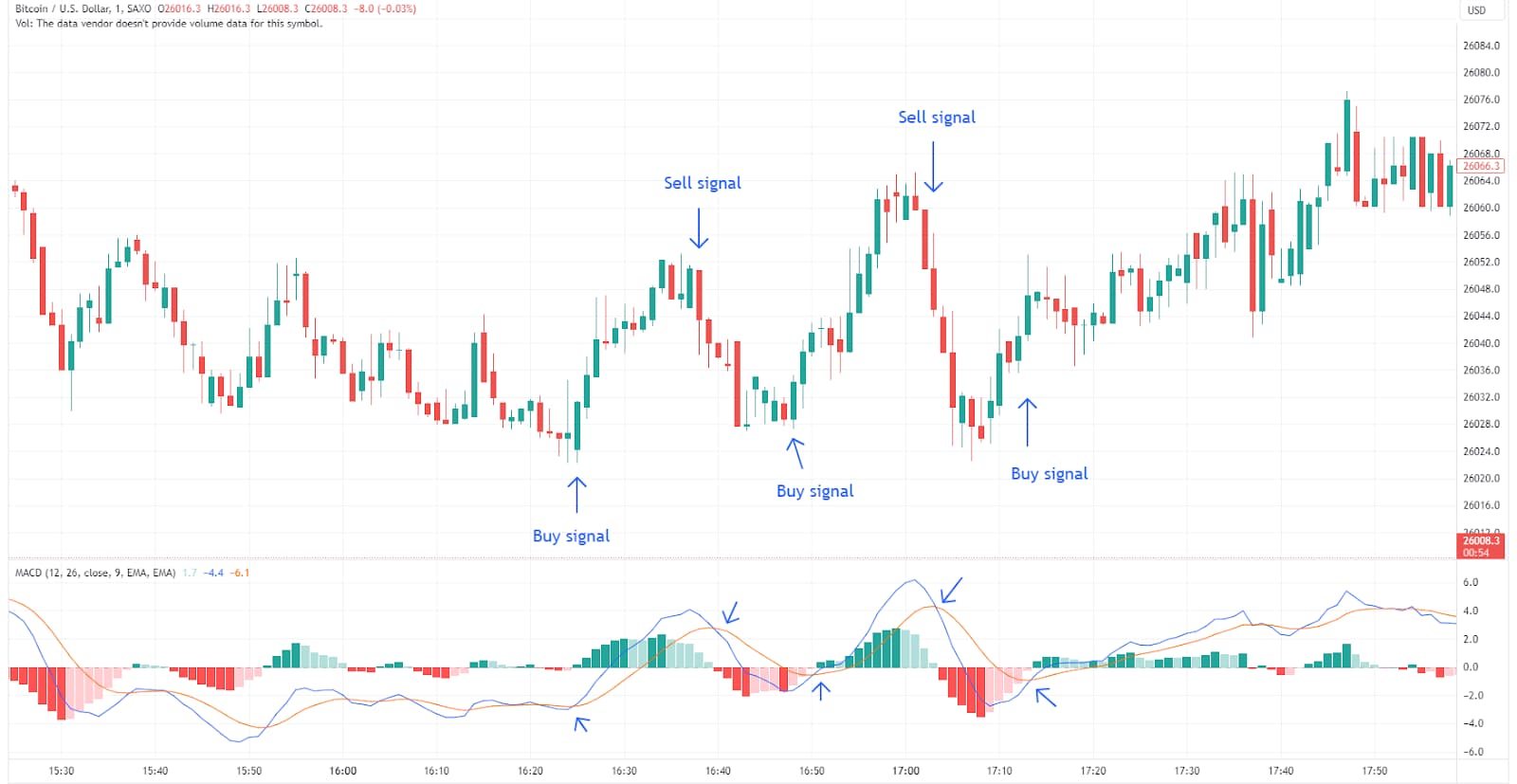 MACD Illustration
Fundamental Analysis
News and Events
Regulatory Changes: News about potential bans or restrictions on cryptocurrencies can trigger price drops;
Project Announcements: Unsuccessful releases or negative news about major projects can affect the market.
Economic Indicators
Institutional Investor Movements: Capital outflows from cryptocurrency funds can indicate a decline in market confidence;
Trading Volumes: A sharp decline in trading volumes can signal an upcoming price drop.
Psychological Analysis
Crowd Behavior: Excessive optimism and FOMO (Fear of Missing Out) can be signals to prepare for shorting.
General tips for shorting crypto
Choose reliable сrypto exchanges
These platforms allow you to directly buy, sell, and exchange cryptocurrencies. They offer high liquidity, a wide selection of trading pairs, and advanced features for traders. These exchanges ensure the security of assets and offer various tools for convenient and effective trading.
We have studied the conditions of top exchanges and suggest that you familiarize yourself with their offers.
| Kraken | Coinbase | OKX | Nebeus | Crypto.com | |
|---|---|---|---|---|---|
|
Demo account |
No | No | Yes | No | No |
|
Coins Supported |
278 | 249 | 329 | 30 | 250 |
|
Min. Deposit, $ |
10 | 10 | 10 | 5 | 1 |
|
Spot leverage |
1:5 | 1:3 | 1:10 | 1:Not available | 1:3 |
|
Spot Maker Fee, % |
0.25 | 0.5 | 0.08 | Not available | 0.25 |
|
Spot Taker fee, % |
0.4 | 0.5 | 0.1 | Not available | 0.5 |
|
TU overall score |
8.7 | 8.46 | 8.44 | 7.84 | 7.24 |
|
Open an account |
Go to broker Your capital is at risk. |
Go to broker Your capital is at risk. |
Go to broker Your capital is at risk. |
Go to broker Your capital is at risk.
|
Go to broker Your capital is at risk. |
Use risk management
Always use stop-losses to limit potential losses. Also do not risk more than 1-2% of your capital on a single trade.
Market Monitoring
Regularly review your trading strategy and adapt it according to market changes. Analyze the market on different time intervals to get a more complete picture of trends.
To short cryptocurrencies, carefully analyze the market

Shorting cryptocurrencies is a powerful tool for those looking to profit from a declining market. However, it requires deep knowledge, experience, and market understanding. It's important to remember that with great opportunities come great risks. Regardless of which strategy you choose, whether it's margin trading, using derivatives, or borrowing cryptocurrencies, always approach it with caution and thoroughly analyze the market. A prudent approach and well-considered decisions will help you not only minimize risks but also effectively leverage the opportunities that shorting cryptocurrencies provides.
Conclusion
Mastering the art of shorting crypto empowers traders to leverage market downturns for potential profit, transforming risk into opportunity. By utilizing platforms that support tools like futures contracts and margin trading, investors can strategically bet against coins such as Bitcoin or Ethereum when trends reverse. However, it's crucial to approach shorting with caution, as rapid price swings can quickly amplify losses. Ultimately, those who invest time in understanding different shorting mechanisms gain a decisive edge in volatile markets—because in crypto, playing both sides isn't just possible; it's often essential for survival.
FAQs
Can shorting crypto be used as a hedging strategy during market downturns?
What are the typical market conditions that favor successful short selling in cryptocurrency?
How do regulatory changes impact the ability to short cryptocurrencies?
What role does psychological analysis play in making shorting decisions in crypto trading?
Editors' Top Picks and Insights

How precious-metals mining revival is reshaping portfolios in 2026

Bitcoin price prediction after CPI rise: Is BTC headed for deeper losses?

Five years with Bitcoin: How El Salvador changed after legalizing BTC

Crypto on the court: How NBA Finals became a showcase for Ledger

How to build wealth from scratch in 3 practical steps

Kospi Index crash: Why South Korean market fell alongside AI stocks
Related Articles
Team that worked on the article
Ivan is a financial expert and analyst specializing in Forex, crypto, and stock trading. He prefers conservative trading strategies with low and medium risks, as well as medium-term and long-term investments.
Dr. BJ Johnson is a PhD in English Language and an editor with over 15 years of experience. He earned his degree in English Language in the U.S and the UK.
Chinmay Soni is a financial analyst with more than 5 years of experience in working with stocks, Forex, derivatives, and other assets. As a founder of a boutique research firm and an active researcher, he covers various industries and fields, providing insights backed by statistical data.
Risk management is a risk management model that involves controlling potential losses while maximizing profits. The main risk management tools are stop loss, take profit, calculation of position volume taking into account leverage and pip value.
Fundamental analysis is a method or tool that investors use that seeks to determine the intrinsic value of a security by examining economic and financial factors. It considers macroeconomic factors such as the state of the economy and industry conditions.
A futures contract is a standardized financial agreement between two parties to buy or sell an underlying asset, such as a commodity, currency, or financial instrument, at a predetermined price on a specified future date. Futures contracts are commonly used in financial markets to hedge against price fluctuations, speculate on future price movements, or gain exposure to various assets.
An investor is an individual, who invests money in an asset with the expectation that its value would appreciate in the future. The asset can be anything, including a bond, debenture, mutual fund, equity, gold, silver, exchange-traded funds (ETFs), and real-estate property.
FOMO in trading refers to the fear that traders or investors experience when they worry about missing out on a potentially profitable trading opportunity in the financial markets.

-
 Afghanistan
-
 Albania
-
 Algeria
-
 Angola
-
 Argentina
-
 Armenia
-
 Australia
-
 Austria
-
 Azerbaijan
-
 Bahamas
-
 Bahrain
-
 Bangladesh
-
 Belarus
-
 Belgium
-
 Bolivia
-
 Botswana
-
 Brazil
-
 Brunei
-
 Bulgaria
-
 Cambodia
-
 Cameroon
-
 Canada
-
 Chile
Chile
-
 China
China
-
 Colombia
-
 Congo
Congo
-
 Costa Rica
-
 Cote d'Ivoire
-
 Croatia
-
 Cuba
Cuba
-
 Cyprus
-
 Czechia
-
 DR Congo
-
 Denmark
-
 Dominican Republic
-
 Ecuador
-
 Egypt
Egypt
-
 El Salvador
-
 Estonia
-
 Eswatini
-
 Ethiopia
-
 Finland
-
 France
-
 Georgia
-
 Germany
-
 Ghana
Ghana
-
 Greece
-
 Haiti
Haiti
-
 Hong Kong
-
 Hungary
-
 India
India
-
 Indonesia
-
 Iran, Islamic republic
-
 Iraq
Iraq
-
 Ireland
-
 Israel
-
 Italy
Italy
-
 Jamaica
-
 Japan
Japan
-
 Jordan
-
 Kazakhstan
-
 Kenya
Kenya
-
 Korea
Korea
-
 Kuwait
-
 Kyrgyzstan
-
 Laos
Laos
-
 Latvia
-
 Lebanon
-
 Lesotho
-
 Libya
Libya
-
 Lithuania
-
 Luxembourg
-
 Madagascar
-
 Malaysia
-
 Malta
Malta
-
 Mauritius
-
 Mexico
-
 Moldova
-
 Mongolia
-
 Montenegro
-
 Morocco
-
 Mozambique
-
 Myanmar
-
 Namibia
-
 Nepal
Nepal
-
 Netherlands
-
 New Zealand
-
 Nigeria
-
 North Macedonia
-
 Norway
-
 Oman
Oman
-
 Pakistan
-
 Palestine
-
 Panama
-
 Papua New Guinea
-
 Paraguay
-
 Peru
Peru
-
 Philippines
-
 Poland
-
 Portugal
-
 Puerto Rico
-
 Qatar
Qatar
-
 Reunion
-
 Romania
-
 Rwanda
-
 Saudi Arabia
-
 Serbia
-
 Singapore
-
 Slovakia
-
 Slovenia
-
 Somalia
-
 South Africa
-
 Spain
Spain
-
 Sri Lanka
-
 Sweden
-
 Switzerland
-
 Syria
Syria
-
 Taiwan
-
 Tajikistan
-
 Tanzania
-
 Thailand
-
 Trinidad and Tobago
-
 Tunisia
-
 Turkey
-
 UAE
UAE
-
 Uganda
-
 Ukraine
-
 United Kingdom
-
United States
-
 Uruguay
-
 Uzbekistan
-
 Venezuela
-
 Vietnam
-
 Yemen
Yemen
-
 Zambia
-
 Zimbabwe
- Forex
- Crypto












