
What Are Goldbacks | Complete Guide


Editorial Note: While we adhere to strict Editorial Integrity, this post may contain references to products from our partners. Here's an explanation for How We Make Money. None of the data and information on this webpage constitutes investment advice according to our Disclaimer.
Goldbacks are banknotes resembling ordinary currency notes, such as dollar bills, but they are overlaid with pure 24-karat gold. This gold “sheeting” is protected by two layers of polymer, which is also used to add artistic elements to the Goldback currency.
There’s an exciting new way to own and invest in gold: an actual gold currency, known as Goldbacks. Goldbacks, created by Goldback Inc. in 2019, are touted as the first practical gold currency. On its website, Goldback.com, the company describes Goldbacks as “the world’s first physical, interchangeable, gold money designed to accommodate even small transactions”.
How can I use Goldbacks
One-ounce gold coins, such as the popular American Gold Eagles, can be used as currency. However, with the price of gold sitting around $2,000 per ounce, it’s rather difficult to use Gold Eagles to, for example, pay for $25 worth of groceries. To solve that problem, Goldback Inc. set out to create a form of gold that would exist in small enough quantities that it could easily be used for everyday transactions.
What the creative minds at Goldback came up with was both a very original, and very aesthetically attractive, gold asset – Goldback notes.
Goldbacks are produced by the private mint, Valaurum, a certified gold minter that services a number of governments.
The proprietary minting process used to create the Goldback “sheets” of gold involves an extremely complex, patented vacuuming procedure to ensure that each Goldback note contains the precisely correct amount of gold. 1 Goldback contains 1/1000th of one troy ounce of pure 24-karat gold.
Every minting of Goldbacks has the gold content of each note precisely verified, using:
X-rays
Fire assay of the gold content
Third-party measurements

With the current US paper dollar exchange rate for Goldbacks at approximately $4.00 for 1 Goldback, Goldbacks can easily be used to make ordinary, everyday purchases.
The paper dollar exchange rate for any type of gold, as reflected on the world’s currency exchange markets, varies based on multiple economic factors. Goldback Inc. publishes the current Goldback/US dollar exchange rate daily on its website, by averaging the dollar exchange rate for 1 Goldback currently being offered by several online gold dealers.
All denominations of Goldbacks are exchanged at the same proportionate rates. In other words, if 1 Goldback notes are going for $5 US, then 50 Goldback notes would be selling for $250.
Are Goldbacks a good investment?
“Goldbacks are not a promise to pay in gold - they are the gold!” (Benjamin Shaffer, Head of Merchant Services at Goldback Inc.).
Since their creation in 2019, Goldbacks have proven to be one of the best-performing gold investment assets. When Goldbacks first debuted, the US dollar exchange rate was $2.25 for 1 Goldback. With the current 1 Goldback exchange rate at approximately $4.16, in terms of purchasing power, Goldbacks have nearly doubled in just four years. In contrast, over that same time frame, the per ounce price of gold has only increased by about 10% (from approximately $1,800 per ounce to $1,980 per ounce).
Additionally, Goldback Inc. has created a Goldback Leasing Program that offers investors the opportunity to earn interest on their Goldbacks. This leasing program gives holders of Goldbacks the rare opportunity to earn interest on their gold investments - a heretofore virtually unheard of benefit in the world of investing.
The leasing program currently pays 2% to 3.5% annual interest (loaning out larger amounts of Goldbacks gets you a higher interest rate), with interest paid out monthly in the form of Goldbacks. That’s an interest rate that’s considerably higher than what you can expect with most bank savings accounts. And while other ways of owning gold typically involve vault storage fees and insurance premiums, there’s none of that with Goldback Leasing.
Gold has always been the favored “safe haven” investment during times of high inflation and economic uncertainty. But with just a one-ounce gold coin selling for thousands of dollars, opportunities to invest in gold have been rather limited for the average small investor. Goldbacks, which cost as little as just a few dollars, bring gold investing much more easily within the reach of regular people.
For investors who want to gain exposure to gold beyond Goldbacks – through CFDs, ETFs, or physical gold trading – choosing the right broker is essential. Below is a comparison of trusted, regulated brokers that offer competitive conditions for gold trading, including spreads, minimum deposits, and trading platforms.
| Plus500 | OANDA | FOREX.com | IG Markets | Interactive Brokers | |
|---|---|---|---|---|---|
|
Gold |
Yes | Yes | Yes | Yes | Yes |
|
ETFs |
Yes | No | Yes | Yes | Yes |
|
XAU/USD commission, $ |
3 | 3 | 2.5 | No | 2 |
|
XAU/USD spread, pips |
45 | 30 | 35 | 30 | 15 |
|
Min. deposit, $ |
100 | No | 100 | 1 | No |
|
Max. Regulation Level |
Tier-1 | Tier-1 | Tier-1 | Tier-1 | Tier-1 |
|
TU overall score |
6.67 | 6.63 | 6.47 | 6.38 | 6.37 |
|
Open an account |
Go to broker 81% of retail CFD accounts lose money. |
Go to broker Your capital is at risk. |
Study review | Study review | Study review |
Goldbacks: collectible art
Part of what has made Goldbacks such a high-performing gold investment stems from the work of the very talented artists at Goldback Inc. There are a few gold coins – such as the famous Saint Gaudens Double Eagle $20 coin – that are highly sought after for their design. However, every individual denomination note of Goldbacks, in each Goldback series, is a unique work of art. This has made the collectible value of Goldbacks extremely high.
The creators of Goldbacks decided to go with the Lady Virtues (e.g., Justice, Truth, Prudence, Wisdom) as the theme for the artwork that adorns Goldback notes. Different virtues are featured for each of the five State series of Goldbacks.
Who’s the chief artist responsible for creating the breathtaking Goldback artwork? – Cheri Jensen, co-founder Chris Jensen’s mom.
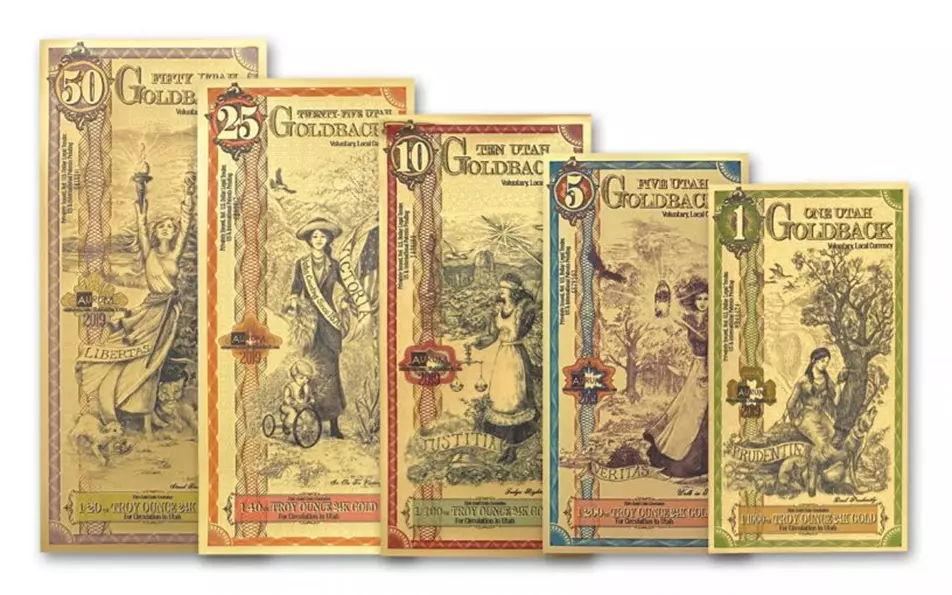 The Utah Goldbacks Series
Another interesting design feature of Goldbacks is the size and shape of each note. Each higher denomination note is larger in size than smaller denomination notes. Thus, a 5 Goldback note is larger than the 1 Goldback note, but smaller than the 10 Goldback note, which is, in turn, smaller than the 25 Goldback note. Note shapes and sizes also have historical characteristics. The 1 Goldback note is approximately the same shape and size of many early American currency notes. The 25 Goldback denomination mirrors the size and shape of Federal Reserve notes. Finally, the 50 Goldback note is the same size and shape as the Gold Certificates that were in circulation in the US from 1865 until 1933.
The collectible desirability of Goldbacks is attested to by the fact that every state series is often sold in sets that include one note in each of the available denominations – 1, 5, 10, 25, and 50 – and many investors seek to own a complete set of Goldback notes in all of the available series. Demand soars for each new Goldback series as it is unveiled.
Goldbacks quickly became a very popular and widespread way of owning gold, and their popularity has continued to increase exponentially. Average monthly retail sales of Goldbacks have grown from just over $100,000 to more than $1,000,000. In all, there is currently more than $25 million worth of Goldbacks in circulation. And Goldbacks, which started out as a local mint product in the state of Utah, are now bought and sold all around the world. Goldback Inc. and minter Valaurum readily admit that they have a difficult time maintaining production levels sufficient to meet the demand for Goldbacks.
Goldbacks can be purchased at dozens of precious metals dealers’ websites, such as JM Bullion and APMEX. Alpine Gold is one of the few dealers that manages to always keep in stock each denomination of all five currently existing Goldback series – Nevada, New Hampshire, Utah, Wyoming, and South Dakota.
Goldbacks are currently accepted at a rapidly growing list of thousands of businesses in the five US states that have a Goldback note series. The original Utah Goldback series followed passage of the Utah Legal Tender Act, which recognized gold and silver as legal tender in the state.
Goldbacks: the bottom line
There is something that’s just kind of fundamentally cool about holding in your hand what looks like a regular $5 or $10 bill – some denomination of currency – but that is actually a sheet of solid gold. Just think: If you bought a few thousand dollars’ worth, you could wallpaper your bedroom in Goldbacks.
Goldbacks have several characteristics that make them an attractive gold investment:
They are easily affordable - anyone can start investing in Goldbacks with just a few dollars
The unique artwork of Goldback notes make them a prized collectible
Goldbacks are a proven high-performing gold investment – nearly doubling in value in less than five years
Starting to invest in Goldbacks is one excellent way you can diversify your investment portfolio with precious metals, and protect your purchasing power in the current economic environment of high inflation.
Goldbacks work best as a small complementary holding within a diversified portfolio

I view Goldbacks as an intriguing bridge between physical gold ownership and collectible value, but they should be approached strategically. For most investors, Goldbacks work best as a small complementary holding within a diversified portfolio rather than a primary vehicle for gold exposure. I generally recommend allocating no more than a few percent of total assets to them, as their liquidity depends not only on the gold price but also on collector demand and dealer availability.
Before purchasing, it’s worth monitoring the premium over spot gold, since this can vary widely among dealers. Entering the market when premiums are moderate helps reduce long-term downside risk. I also suggest researching buyback options in advance – understanding how easily and at what price you can resell is just as important as finding a good entry point.
For investors drawn to the artistic and collectible side, newer or high-demand state series can carry additional value, though these premiums may compress over time. Those focused purely on gold exposure might prefer standard bullion or fractional coins for greater liquidity.
Overall, Goldbacks can serve as an innovative hedge against inflation and a tangible form of portable wealth. However, their true advantage lies in disciplined purchasing, patient holding, and treating them as a niche diversification tool rather than a substitute for conventional gold investments.
Conclusion
Goldbacks represent a significant evolution in the way individuals can access and use gold as currency. Unlike traditional gold coins or bars, Goldbacks are flexible, durable, and designed for everyday transactions, empowering people to hold real gold in spendable amounts. This innovation not only democratizes gold ownership but also reintroduces tangible value into daily commerce, as seen in communities and businesses willing to accept Goldbacks for goods and services. Ultimately, Goldbacks bridge the gap between ancient stores of wealth and modern economic needs, reminding us that the future of currency may well be rooted in the enduring value of gold.
FAQs
How is the value of Goldbacks determined and what factors influence their exchange rate?
What verification processes ensure the authenticity and gold content of Goldbacks?
Are there any additional benefits to owning Goldbacks beyond their gold value?
How do Goldbacks fit within a diversified investment portfolio?
Editors' Top Picks and Insights






Related Articles
Team that worked on the article
Johnathan M. is a U.S.-based writer and investor, a contributor to the Traders Union website.
Dr. BJ Johnson is a PhD in English Language and an editor with over 15 years of experience. He earned his degree in English Language in the U.S and the UK.
Mirjan Hipolito is a journalist and news editor at Traders Union. She is an expert crypto writer with five years of experience in the financial markets.
CFD is a contract between an investor/trader and seller that demonstrates that the trader will need to pay the price difference between the current value of the asset and its value at the time of contract to the seller.
Index in trading is the measure of the performance of a group of stocks, which can include the assets and securities in it.
Goldbacks are banknotes resembling ordinary currency notes, such as dollar bills, but they are overlaid with pure 24-karat gold. This gold “sheeting” is protected by two layers of polymer, which is also used to add artistic elements to the Goldback currency.
Cryptocurrency is a type of digital or virtual currency that relies on cryptography for security. Unlike traditional currencies issued by governments (fiat currencies), cryptocurrencies operate on decentralized networks, typically based on blockchain technology.
Ethereum is a decentralized blockchain platform and cryptocurrency that was proposed by Vitalik Buterin in late 2013 and development began in early 2014. It was designed as a versatile platform for creating decentralized applications (DApps) and smart contracts.

-
 Afghanistan
-
 Albania
-
 Algeria
-
 Angola
-
 Argentina
-
 Armenia
-
 Australia
-
 Austria
-
 Azerbaijan
-
 Bahamas
-
 Bahrain
-
 Bangladesh
-
 Belarus
-
 Belgium
-
 Bolivia
-
 Botswana
-
 Brazil
-
 Brunei
-
 Bulgaria
-
 Cambodia
-
 Cameroon
-
 Canada
-
 Chile
Chile
-
 China
China
-
 Colombia
-
 Congo
Congo
-
 Costa Rica
-
 Cote d'Ivoire
-
 Croatia
-
 Cuba
Cuba
-
 Cyprus
-
 Czechia
-
 DR Congo
-
 Denmark
-
 Dominican Republic
-
 Ecuador
-
 Egypt
Egypt
-
 El Salvador
-
 Estonia
-
 Eswatini
-
 Ethiopia
-
 Finland
-
 France
-
 Georgia
-
 Germany
-
 Ghana
Ghana
-
 Greece
-
 Haiti
Haiti
-
 Hong Kong
-
 Hungary
-
 India
India
-
 Indonesia
-
 Iran, Islamic republic
-
 Iraq
Iraq
-
 Ireland
-
 Israel
-
 Italy
Italy
-
 Jamaica
-
 Japan
Japan
-
 Jordan
-
 Kazakhstan
-
 Kenya
Kenya
-
 Korea
Korea
-
 Kuwait
-
 Kyrgyzstan
-
 Laos
Laos
-
 Latvia
-
 Lebanon
-
 Lesotho
-
 Libya
Libya
-
 Lithuania
-
 Luxembourg
-
 Madagascar
-
 Malaysia
-
 Malta
Malta
-
 Mauritius
-
 Mexico
-
 Moldova
-
 Mongolia
-
 Montenegro
-
 Morocco
-
 Mozambique
-
 Myanmar
-
 Namibia
-
 Nepal
Nepal
-
 Netherlands
-
 New Zealand
-
 Nigeria
-
 North Macedonia
-
 Norway
-
 Oman
Oman
-
 Pakistan
-
 Palestine
-
 Panama
-
 Papua New Guinea
-
 Paraguay
-
 Peru
Peru
-
 Philippines
-
 Poland
-
 Portugal
-
 Puerto Rico
-
 Qatar
Qatar
-
 Reunion
-
 Romania
-
 Rwanda
-
 Saudi Arabia
-
 Serbia
-
 Singapore
-
 Slovakia
-
 Slovenia
-
 Somalia
-
 South Africa
-
 Spain
Spain
-
 Sri Lanka
-
 Sweden
-
 Switzerland
-
 Syria
Syria
-
 Taiwan
-
 Tajikistan
-
 Tanzania
-
 Thailand
-
 Trinidad and Tobago
-
 Tunisia
-
 Turkey
-
 UAE
UAE
-
 Uganda
-
 Ukraine
-
 United Kingdom
-
United States
-
 Uruguay
-
 Uzbekistan
-
 Venezuela
-
 Vietnam
-
 Yemen
Yemen
-
 Zambia
-
 Zimbabwe
- Forex
- Crypto












