
Binance Fees In 2026: Cut Costs And Trade Smarter



Editorial Note: While we adhere to strict Editorial Integrity, this post may contain references to products from our partners. Here's an explanation for How We Make Money. None of the data and information on this webpage constitutes investment advice according to our Disclaimer.
Binance trading fees in 2026 vary by product type. Spot trading starts at 0.1%, while futures trading at 0.02% for maker and 0.05% for taker orders. The Binance BTC withdrawal fee is about 0.0002 BTC, depending on network activity. Traders can lower costs by paying with BNB or advancing to higher VIP tiers. Binance offers a competitive edge over other exchanges by combining low base rates, volume-based discounts, and fee-saving programs across all services.
When trading on Binance, fees are a key part of every strategy. They don’t just affect your profit, but also shape your trade timing and style. In this guide, you’ll learn about all major Binance fees, including spot, futures, deposits, and withdrawals, with clear steps to reduce each one.
Understanding Binance’s fee system


The first step to managing your trading costs is understanding how the Binance fee system works. Binance categorizes users by volume and asset holdings (VIP tiers) and uses a maker vs taker model for most trades. Regular users pay about 0.1% for both maker and taker orders in spot markets. Holding the BNB token and reaching higher VIP levels unlocks lower rates. Knowing this structure helps traders see how trading fees on Binance can drop as their activity grows.
Binance spot trading fees in 2026
The base Binance spot trading fees maker-taker in 2026 is about 0.1%. In some cases, such as trading pairs with USDC, the taker rate may drop to 0.095% before discounts. At higher VIP levels, Binance spot fees can fall sharply, reaching around 0.00825% for maker and 0.01725% for taker orders.
When you model your trades, remember that Binance spot trading fees at 0.1% may look small, but on large volume or high‑frequency trading, they compound quickly.

In 2026, Binance spot trading fees remain stable at the base rate, but traders can still unlock extra value through discount programs, token promotions, and BNB fee payments.
Binance futures fees
When moving to derivatives, Binance futures trading fees are generally lower than spot fees. The standard maker fee starts at 0.02%, while the taker fee begins at 0.05% for regular users.
Traders can lower these costs by paying fees in BNB or climbing VIP tiers. Since Binance fees for futures involve leverage, even a small fee has a larger effect on profit and loss. Using a Binance futures fees calculator to multiply trade volume by the percentage rate helps you measure your real cost before opening or closing positions.

Margin, funding & other derivative costs
Trading on margin involves not only Binance trading fees but also borrowing costs. The funding fee for perpetual futures in Binance is a cost that arises every 8 hours and depends on the relative demand for long vs short positions. For instance, the hourly interest rate for Bitcoin is approximately 0.00014629%, while Ethereum’s rate tends to be slightly higher. As with trading fees, higher VIP tiers offer reduced interest rates, and paying interest with BNB provides an additional 5% discount.
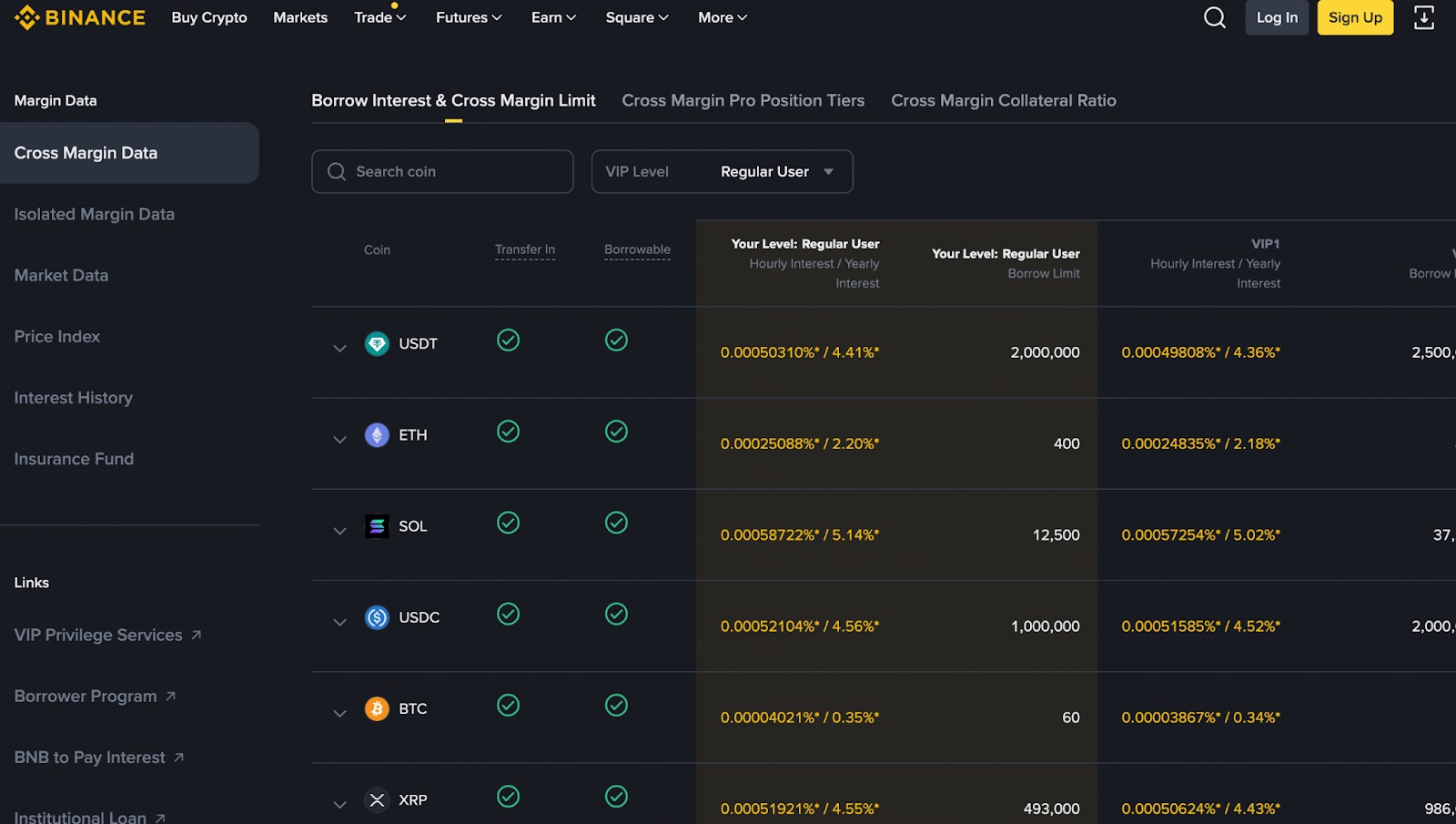
Understanding this cost separates experienced traders from beginners. Even if the trading commission looks small, funding fees or Binance margin fees can increase your total expense over time. Monitoring the funding fee on Binance applies to your contracts helps you protect your profit margin.
Deposit and withdrawal fees
Even if you manage trading fees efficiently, deposits and withdrawals can still affect your total cost. Most crypto deposits on Binance are free, but withdrawal fees vary by asset and blockchain network. For example, the Binance BTC withdrawal fee often changes with network activity and can differ from the 0.0002 BTC average marketed generally.
For fiat transfers, costs depend on the currency and payment method. A typical example is an EUR bank transfer that may cost about €1 or 0.12%. Before transferring funds, check the Binance withdrawal fee on its official page to confirm the current rate.
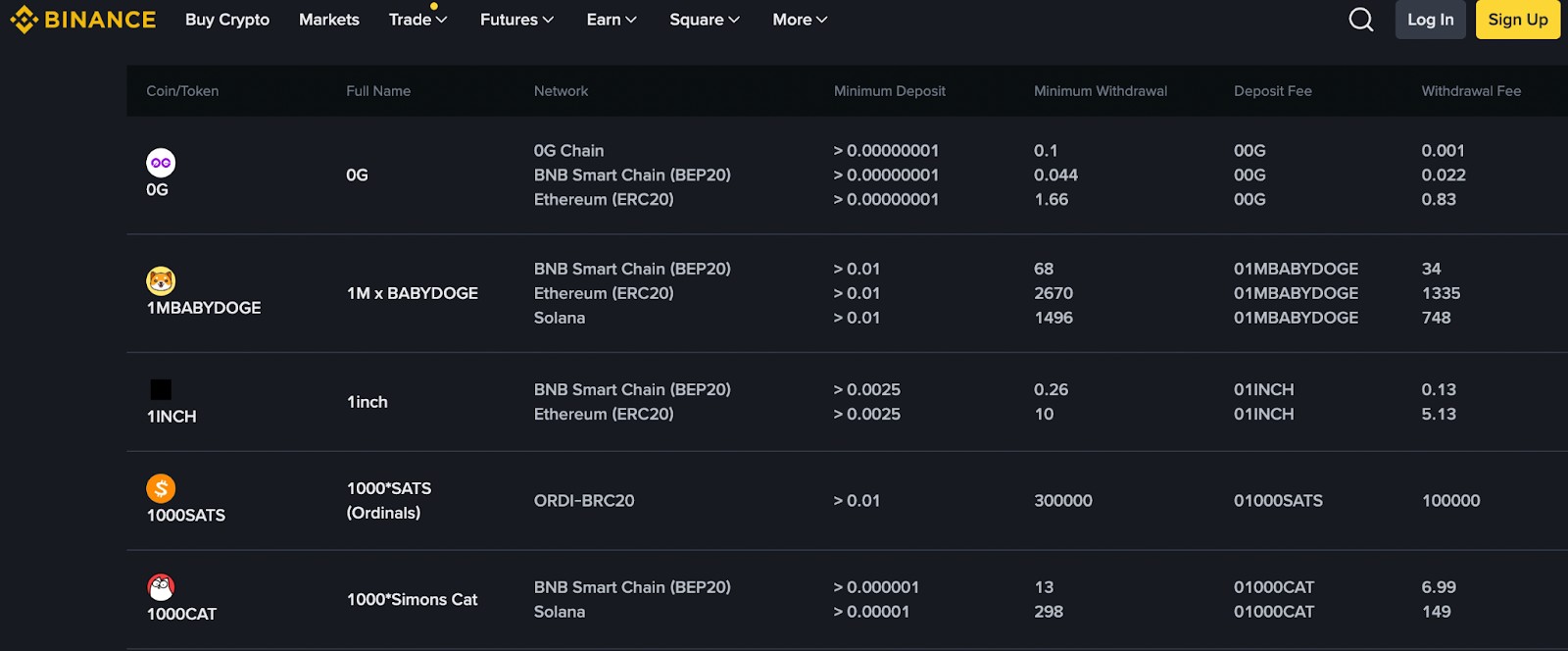
If you transfer funds frequently, check the current Binance BTC withdrawal fee or Binance USDT TRC20 withdrawal fee before each transaction, as network costs often change. To assess your total costs, make sure to include every element such as trading fees, deposits, withdrawals, and funding charges.

Binance P2P fees
Beyond regular trading and withdrawals, Binance also applies a few additional charges. These include token listing services, P2P trading fees, conversion fees, and staking-related costs.
On Binance P2P, some advertisers can offer zero-fee deals, which may reduce your total cost when trading directly with other users. Understanding Binance P2P fees and comparing them with standard transfers can be useful, especially for traders in emerging markets.
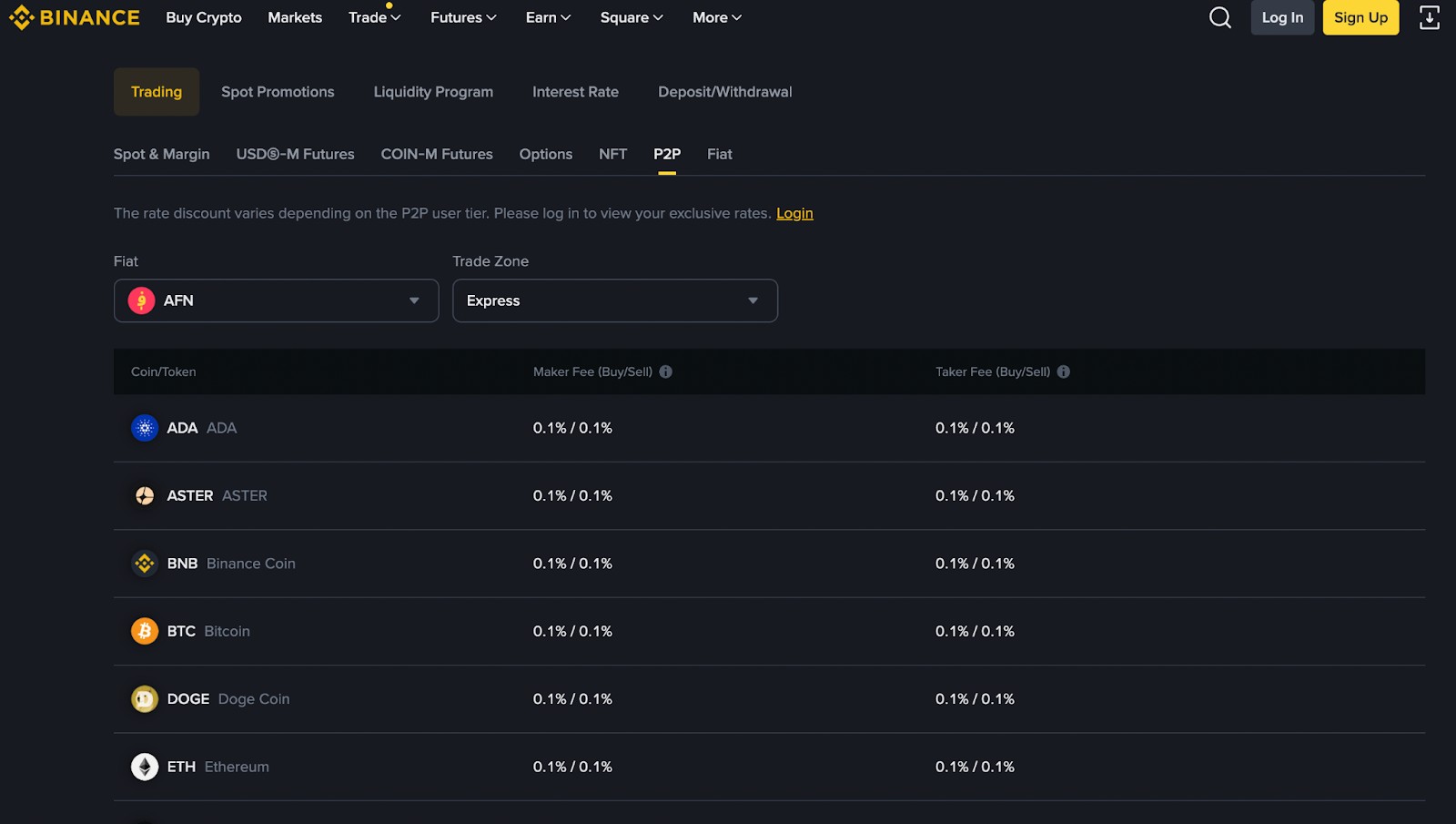
The cost for new token listings is not publicly detailed, but it works as an indirect listing fee paid by projects that want to list their tokens on Binance. These additional costs may not affect everyday users but are part of Binance’s wider fee structure.
How to minimize fees on Binance
We have researched and listed some proven ways to reduce your Binance trading fees:
Hold and use BNB to pay trading fees. Binance offers a clear discount for users who pay fees with BNB, which can make a noticeable difference over time.
Use limit (maker) orders instead of market (taker) orders. Maker orders help you qualify for lower spot trading fees.
Increase your trading volume. As your volume grows, Binance automatically adjusts your VIP level, which unlocks lower fees and better rewards.
Choose the right withdrawal network. Binance withdrawal fees vary across networks like TRC20 or ERC20. Selecting the cheaper network can reduce your total transfer cost.
Compare with other platforms. Binance generally offers lower base rates, but checking other platforms helps ensure you get the best total cost for your specific payment method and currency.
Fee comparison with other exchanges
It is always useful to compare the trading fees charged by the top exchanges. Binance’s spot maker and taker fees start at 0.10%, which is below the industry average of about 0.15% for maker and 0.19% for taker orders.
For active or high-volume traders, this difference can lead to major savings over time. Checking the Binance trading fees calculator and comparing with other platforms can help you choose where your trades cost less overall.
It is also smart to compare other cost areas, such as withdrawal fees, deposit charges, and funding rates, not just trading commissions. These factors can change your real trading cost more than you might expect.
| Kraken | OKX | BTCC | Coinbase | Nebeus | |
|---|---|---|---|---|---|
|
Crypto |
Yes | Yes | Yes | Yes | Yes |
|
Foundation year |
2011 | 2017 | 2011 | 2012 | 2014 |
|
P2P Maker Fee, % |
Not supported | 0 | Not supported | 0 - 0.40 | Not available |
|
P2P Taker Fee, % |
Not supported | 0 | Not supported | 0.05 - 0.60 | Not available |
|
Spot Taker fee, % |
0.4 | 0.1 | 0.3 | 0.5 | Not available |
|
Spot Maker Fee, % |
0.25 | 0.08 | 0.2 | 0.5 | Not available |
|
Deposit fee |
No | No | No | No | No |
|
Withdrawal fee |
0.0005 BTC | 0.0004 BTC 2.6 USDT | 0.0004 BTC 0.005 ETH 6%. if there was no futures trading | Fixed fee - 25 USD PayPal - 1.5% USDC - 10 USD | Varies |
|
Min. Deposit, $ |
10 | 10 | 10 | 10 | 5 |
|
TU overall score |
9.2 | 8.9 | 7.84 | 7.68 | 7.6 |
|
Open an account |
Go to broker Your capital is at risk. |
Go to broker Your capital is at risk. |
Go to broker Your capital is at risk.
|
Go to broker Your capital is at risk. |
Go to broker Your capital is at risk.
|
How does your trading behavior affect the fees you pay to Binance?
Your actual Binance trading cost depends on more than just your VIP tier. It also changes with how often you trade, the time of day, and the instruments you use. For example, Binance futures trading fees can vary in effective cost because of funding rate changes during high-volatility periods.
In contrast, Binance spot trading fee structures remain stable, although liquidity depth can slightly affect spreads and order fills. By reviewing your trading patterns and checking how much each trade costs, you can identify inefficiencies and adjust your strategy to save more.
Hidden costs behind Binance trading fees
Even though Binance lists its main fees clearly, traders can still face hidden costs that affect real returns. For example, using the convert feature may include a small spread that replaces a direct Binance transaction fee, which can change the final execution price.
The deposit fees for fiat payments through third-party processors do not appear on Binance’s main fee schedule but may show as deductions from your bank. Being aware of these indirect costs helps you maintain full control of your trading budget.
Keep your Binance fees in check

Binance remains a leading exchange in 2026, but traders should approach its fee system with strategy, not assumption. While Binance trading fees are among the lowest at 0.1% for spot and 0.02% for futures for base users, they can still cut into margins if you're an active trader. The real advantage comes from optimization. Use BNB to cover trading costs, move up through the VIP levels, and place more maker orders to get better rates. Check network fees before each withdrawal, especially when moving BTC or USDT.
Use a Binance fee calculator to understand real impact by product and adjust trading volume and instruments accordingly. High-volume users benefit most when they diversify across spot, futures, and P2P to access all available discounts. Binance rewards structured volume and efficiency rather than just raw trade frequency. The more aware you are of how your activity affects your costs, the easier it becomes to trade smarter and keep more profit.
Conclusion
Binance continues to offer some of the lowest and most flexible trading fees in the crypto market, and it can drop further when you pay fees using BNB or advance through VIP levels. Binance also provides free crypto deposits and competitive withdrawal rates that change based on the network used. To trade smarter, focus on small but effective steps. Choose cheaper networks for withdrawals, use limit orders to qualify for lower fees, and increase trading volume to reach higher VIP levels. Checking the Binance fee schedule before each trade helps you avoid surprises and manage your costs efficiently. By combining smart fee management with regular activity reviews, you can trade more profitably while keeping expenses under control.
FAQs
What is the easiest way to lower Binance trading fees?
Paying fees with BNB gives you an instant discount, helping you save money on every trade without changing your trading style.
Are Binance withdrawal fees fixed?
No. Withdrawal fees vary depending on the coin and blockchain network. It is best to check the live fee before each withdrawal.
Does Binance charge for deposits?
Most crypto deposits on Binance are free. However, fiat deposits may include small fees depending on your bank or payment method.
How can I estimate my total Binance trading cost?
Use the Binance fee calculator. Enter your trading pair, volume, and order type to see your exact fee before confirming a trade.
Related Articles
Team that worked on the article
Andrey Mastykin is an experienced author, editor, and content strategist who has been with Traders Union since 2020. As an editor, he is meticulous about fact-checking and ensuring the accuracy of all information published on the Traders Union platform.
Dan Blystone began his trading career in 1998 as an arbitrage clerk on the floor of the Chicago Mercantile Exchange (CME). He later traded bond and Eurex futures at proprietary firms such as Altea Trading, gaining valuable experience in high-frequency trading and risk management.
Chinmay Soni is a financial analyst with more than 5 years of experience in working with stocks, Forex, derivatives, and other assets. As a founder of a boutique research firm and an active researcher, he covers various industries and fields, providing insights backed by statistical data.
-
 Afghanistan
-
 Albania
-
 Algeria
-
 Angola
-
 Argentina
-
 Armenia
-
 Australia
-
 Austria
-
 Azerbaijan
-
 Bahamas
-
 Bahrain
-
 Bangladesh
-
 Belarus
-
 Belgium
-
 Bolivia
-
 Botswana
-
 Brazil
-
 Brunei
-
 Bulgaria
-
 Cambodia
-
 Cameroon
-
 Canada
-
 Chile
Chile
-
 China
China
-
 Colombia
-
 Congo
Congo
-
 Costa Rica
-
 Cote d'Ivoire
-
 Croatia
-
 Cuba
Cuba
-
 Cyprus
-
 Czechia
-
 DR Congo
-
 Denmark
-
 Dominican Republic
-
 Ecuador
-
 Egypt
Egypt
-
 El Salvador
-
 Estonia
-
 Eswatini
-
 Ethiopia
-
 Finland
-
 France
-
 Georgia
-
 Germany
-
 Ghana
Ghana
-
 Greece
-
 Haiti
Haiti
-
 Hong Kong
-
 Hungary
-
 India
India
-
 Indonesia
-
 Iran, Islamic republic
-
 Iraq
Iraq
-
 Ireland
-
 Israel
-
 Italy
Italy
-
 Jamaica
-
 Japan
Japan
-
 Jordan
-
 Kazakhstan
-
 Kenya
Kenya
-
 Korea
Korea
-
 Kuwait
-
 Kyrgyzstan
-
 Laos
Laos
-
 Latvia
-
 Lebanon
-
 Lesotho
-
 Libya
Libya
-
 Lithuania
-
 Luxembourg
-
 Madagascar
-
 Malaysia
-
 Malta
Malta
-
 Mauritius
-
 Mexico
-
 Moldova
-
 Mongolia
-
 Montenegro
-
 Morocco
-
 Mozambique
-
 Myanmar
-
 Namibia
-
 Nepal
Nepal
-
 Netherlands
-
 New Zealand
-
 Nigeria
-
 North Macedonia
-
 Norway
-
 Oman
Oman
-
 Pakistan
-
 Palestine
-
 Panama
-
 Papua New Guinea
-
 Paraguay
-
 Peru
Peru
-
 Philippines
-
 Poland
-
 Portugal
-
 Puerto Rico
-
 Qatar
Qatar
-
 Reunion
-
 Romania
-
 Rwanda
-
 Saudi Arabia
-
 Serbia
-
 Singapore
-
 Slovakia
-
 Slovenia
-
 Somalia
-
 South Africa
-
 Spain
Spain
-
 Sri Lanka
-
 Sweden
-
 Switzerland
-
 Syria
Syria
-
 Taiwan
-
 Tajikistan
-
 Tanzania
-
 Thailand
-
 Trinidad and Tobago
-
 Tunisia
-
 Turkey
-
 UAE
UAE
-
 Uganda
-
 Ukraine
-
 United Kingdom
-
United States
-
 Uruguay
-
 Uzbekistan
-
 Venezuela
-
 Vietnam
-
 Yemen
Yemen
-
 Zambia
-
 Zimbabwe
- Forex
- Crypto










- Understanding Binance’s fee system
- Margin, funding & other derivative costs
- Deposit and withdrawal fees
- Binance P2P fees
- How to minimize fees on Binance
- Fee comparison with other exchanges
- How does your trading behavior affect the fees you pay to Binance?
- Hidden costs behind Binance trading fees
- Expert opinion
- Conclusion
- FAQs


