
Best Institutional Trading Strategies


Editorial Note: While we adhere to strict Editorial Integrity, this post may contain references to products from our partners. Here's an explanation for How We Make Money. None of the data and information on this webpage constitutes investment advice according to our Disclaimer.
Top institutional trading strategies:
Liquidity Sweep Strategy – wait for price to sweep liquidity before entering instead of chasing breakouts.
Order Block Trading – identify institutional buying and selling zones to find potential support and resistance.
Break of Structure (BOS) – confirm trend changes through structural breaks supported by volume and liquidity.
VWAP Execution – use VWAP to improve trade execution and reduce costs on large positions.
Smart Money Concepts (SMC) – combine liquidity, market structure, and order blocks to analyze institutional market behavior.
Understanding institutional trading strategies doesn't mean copying billion-dollar portfolios. Instead, it means learning the principles that professional market participants use to identify liquidity, analyze market structure, and execute trades efficiently. Many concepts that have become popular among retail traders – such as Smart Money Concepts (SMC), order blocks, and liquidity sweeps – originate from institutional trading behavior, although they are often simplified for educational purposes.
In this guide, we'll explore how institutional traders approach the markets, examine the most widely used institutional trading strategies, and explain how these methods are applied across Forex, stocks, and futures.
Risk warning: Forex trading carries high risks, with potential losses including your entire deposit. Market fluctuations, economic instability, and geopolitical factors impact outcomes. Studies show that 70-80% of traders lose money. Consult a financial advisor before trading.
Top institutional trading strategies
While every institution develops proprietary models, several concepts are widely used across professional trading desks.
1. Liquidity sweep strategy
A liquidity sweep occurs when price temporarily moves beyond a well-established support or resistance level to access concentrated pools of resting orders. These areas typically contain stop-loss orders, breakout entries, and limit orders that provide the liquidity needed to execute large positions with lower market impact.

Unlike retail traders, institutional participants rarely interpret every breakout as the beginning of a new trend. Instead, they monitor whether the move is accepted above the level or quickly rejected back into the previous range. A failed breakout often indicates that available liquidity has been absorbed rather than that a new directional move has begun.
Academic research on market microstructure also shows that institutional execution focuses on minimizing market impact – the price movement caused by large orders. Instead of placing one large order, execution algorithms split trades into smaller transactions and seek liquidity across multiple venues, reducing slippage and execution costs.
For retail traders, the practical takeaway is not to assume that every liquidity sweep signals an immediate reversal. Professional desks typically combine liquidity analysis with market structure, order flow, and volume before initiating a position, making liquidity sweeps only one element of a broader execution framework.
2. Order block trading
An order block is generally defined as a price zone where significant buying or selling interest was previously absorbed before a strong directional move. While the concept is widely associated with Smart Money Concepts (SMC), it should not be interpreted as direct evidence of institutional activity, since the underlying order book is not visible in most retail trading platforms.
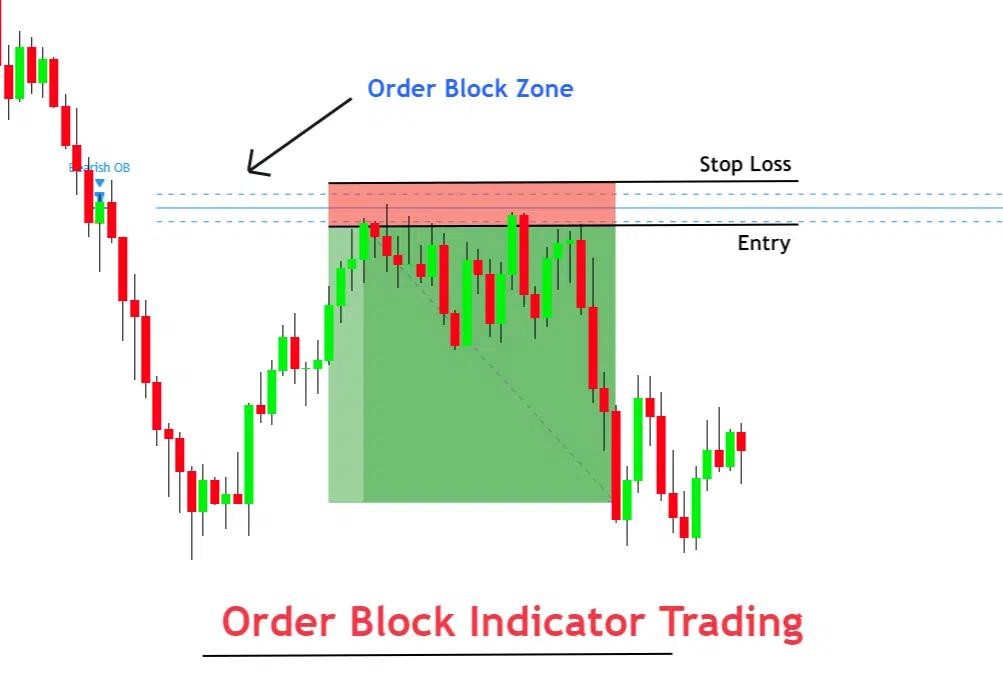
Professional traders view order blocks as areas of potential supply or demand imbalance rather than fixed entry levels. Instead of drawing precise rectangles around individual candles, they evaluate whether the zone aligns with broader market structure, liquidity conditions, trading volume, and the overall execution context.
This approach is consistent with research in market microstructure showing that large institutional orders are typically executed incrementally to reduce market impact. Rather than entering a position with a single transaction, institutions split large "meta-orders" into smaller executions, which can leave persistent price reactions around accumulation or distribution areas.
For this reason, experienced traders rarely use order blocks as standalone signals. The highest-probability setups occur when an order block coincides with a liquidity sweep, a break of market structure, and increasing participation, making it one component of a broader institutional Forex trading strategy rather than a complete trading system.
3. Break of Structure (BOS)
A Break of Structure (BOS) occurs when price closes beyond a significant swing high or swing low in the direction of the prevailing trend, confirming that the existing market structure remains intact. Unlike a simple breakout, a valid BOS is based on meaningful structural levels rather than minor intraday fluctuations.
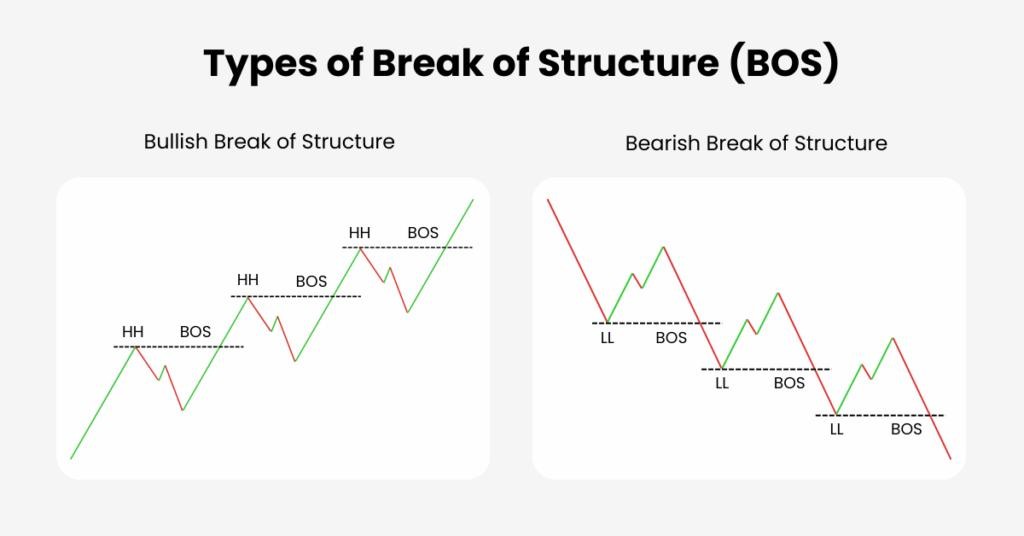
Professional traders use BOS as a confirmation signal, not as a standalone entry trigger. A structural break becomes more reliable when it is supported by expanding trading volume, sustained momentum, increasing market participation, or a successful retest of the broken level. This helps distinguish genuine trend continuation from temporary volatility or false breakouts.
In institutional trading, market structure is evaluated across multiple timeframes. A bullish BOS on a 5-minute chart, for example, carries greater significance if it aligns with the prevailing trend on the 1-hour or daily timeframe. This multi-timeframe approach allows traders to filter out market noise and focus on higher-probability opportunities.
Rather than predicting reversals, institutional traders use BOS to confirm directional bias before combining it with liquidity analysis, order blocks, and disciplined risk management as part of a broader institutional trading strategy.
4. VWAP and institutional execution
Volume Weighted Average Price (VWAP) is one of the most widely used execution benchmarks in institutional trading. Unlike traditional technical indicators designed to forecast price direction, VWAP measures the average price of an asset throughout the trading session, weighted by trading volume. This allows traders to evaluate whether an order was executed efficiently relative to overall market activity.
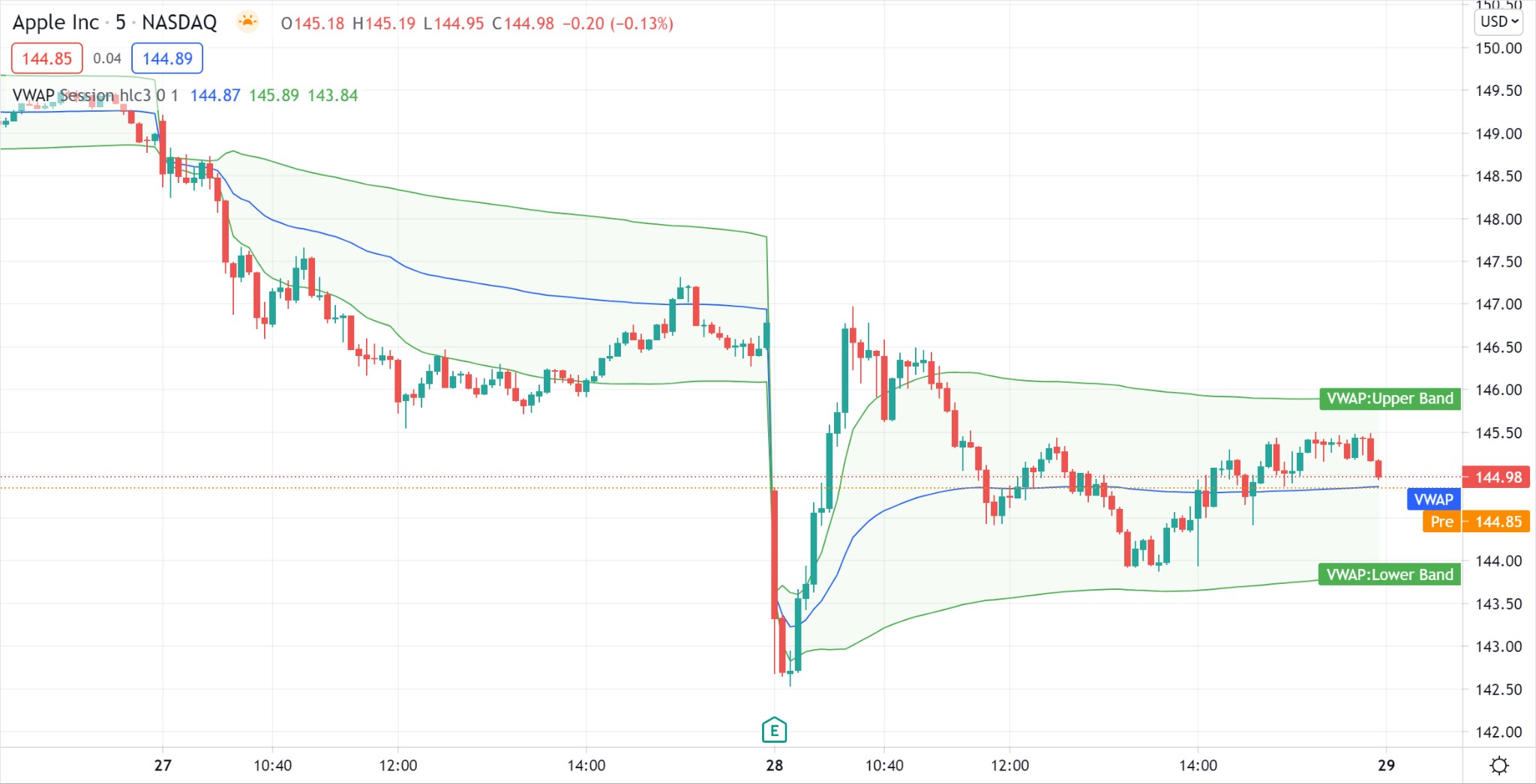
For asset managers and hedge funds, execution quality is often just as important as investment selection. A portfolio manager responsible for purchasing millions of dollars' worth of shares cannot simply place a market order without significantly affecting the price. Instead, institutional desks typically split large positions into smaller orders and execute them gradually throughout the session, often using VWAP-based algorithms to minimize market impact and reduce slippage.
According to the CFA Institute, implementation costs – including bid-ask spreads, commissions, and market impact – can materially reduce portfolio performance, particularly for large institutional investors. Execution benchmarks such as VWAP help measure these costs and compare trading performance against objective market standards.
Although many retail traders use VWAP as an intraday support or resistance indicator, its primary institutional role is execution optimization rather than signal generation. As a result, VWAP remains a core component of many institutional trading strategies in 2026.
5. Smart Money Concepts (SMC)
Smart Money Concepts (SMC) is a trading framework that has gained significant popularity among retail Forex traders over the past decade. The methodology combines several market structure concepts – including liquidity, order blocks, Break of Structure (BOS), Fair Value Gaps (FVGs), and premium/discount pricing – to explain how large market participants may influence price movements.
Despite its widespread use, SMC should not be viewed as an official institutional trading methodology. Banks, hedge funds, and proprietary trading firms do not publicly disclose using Smart Money Concepts as a standardized framework. Instead, many SMC principles are derived from established market microstructure concepts such as liquidity provision, order execution, and supply-demand imbalances, which have long been studied in academic finance.
The practical value of SMC lies in organizing these concepts into a structured decision-making process. Rather than relying on isolated chart patterns, traders evaluate how liquidity, market structure, and price imbalances interact before identifying potential trading opportunities. When combined with sound risk management and multi-timeframe analysis, this approach can provide additional market context instead of acting as a standalone trading system.
For traders interested in "smart money" institutional Forex trading, SMC is best understood as an educational framework that adapts institutional trading principles for retail market participants – not as a blueprint for replicating the proprietary strategies used by banks or hedge funds.
What are institutional trading strategies?
Institutional strategies are systematic approaches used by banks, hedge funds, pension funds, insurance companies, and other large financial organizations to execute significant market positions while controlling costs and risk.
Unlike retail traders, institutions cannot simply place a large buy or sell order without affecting the market. Executing millions – or even billions – of dollars in a single transaction can move prices against them. As a result, institutional trading focuses on liquidity, execution quality, and portfolio management rather than isolated trade setups.
Key characteristics of institutional trading strategies:
Liquidity-driven execution to minimize market impact on large orders.
Advanced risk management through position sizing, diversification, and exposure limits.
Data-driven decision-making using macroeconomic, fundamental, and quantitative analysis.
Algorithmic execution with tools such as VWAP, TWAP, and smart order routing.
Multi-timeframe market structure analysis to identify high-probability trading opportunities.

An effective institutional trading strategy also incorporates quantitative research, macroeconomic analysis, and continuous risk monitoring. Rather than relying solely on technical indicators, institutions combine multiple data sources – including economic releases, derivatives positioning, market depth, and cross-asset correlations – to make informed decisions.
Institutional trading across different markets
Institutional principles remain consistent across markets, but their application varies depending on the asset class.
| Market | Main institutional participants | Primary focus |
|---|---|---|
| Forex | Central banks, commercial banks, multinational corporations, hedge funds | Liquidity, macroeconomic data, interest rates, interbank order flow |
| Stocks | Asset managers, pension funds, investment banks, mutual funds | Earnings reports, valuation models, sector rotation, portfolio allocation |
| Futures | Hedge funds, banks, commodity firms, institutional investors | Hedging, speculation, portfolio management |
| Cryptocurrency | Crypto funds, ETFs, institutional investors, regulated exchanges | Growing institutional adoption, liquidity, digital asset exposure |
Institutional brokers used by professional traders
Institutional trading strategies rely not only on sophisticated analysis but also on access to professional-grade execution infrastructure. Large financial institutions typically trade through prime brokers, investment banks, and electronic communication networks (ECNs) that provide deep liquidity, advanced execution algorithms, and direct market access (DMA). While most retail traders cannot access these services directly, understanding the institutional ecosystem helps explain how large market participants execute orders with minimal market impact.
| OANDA | Interactive Brokers | Pepperstone | Saxo Bank | CMC Markets | Swissquote Bank SA | |
|---|---|---|---|---|---|---|
|
ECN |
Yes | Yes | Yes | No | Yes | Yes |
|
Tradable assets |
129 | 30000 | 1200 | 71000 | 12000 | 3000000 |
|
Tier-1 regulation |
Yes | Yes | Yes | Yes | Yes | Yes |
|
TU overall score |
6.63 | 6.37 | 9.3 | 6.55 | 6.42 | 6.28 |
|
Open an account |
Go to broker Your capital is at risk. |
Study review | Go to broker Your capital is at risk.
|
Go to broker Your capital is at risk. |
Go to broker Your capital is at risk. |
Go to broker Between 70 and 80%
of retail investors are losing money when trading forex instruments and CFDs. |
It's important to note that access to institutional brokers alone does not provide an investment edge. Professional performance comes from combining high-quality execution with robust risk management, quantitative research, and disciplined trading processes. This is also why institutions rarely disclose their proprietary trading models, making educational resources and academic research the best starting point for understanding institutional trading principles.
Where to find institutional trading strategies PDF resources
Many traders search for an institutional trading strategies PDF or an institutional Forex trading strategies PDF hoping to find a complete trading system. In reality, professional institutions rarely publish their proprietary models.
However, there are several reliable sources for learning institutional concepts:
research papers from the Bank for International Settlements (BIS);
publications by central banks and financial regulators;
CME Group educational materials;
academic journals on quantitative finance;
books on market microstructure and institutional investing.
You can also find educational institutional traders' trading strategies PDF guides from universities, broker research departments, and financial education providers. While these resources won't reveal proprietary hedge fund algorithms, they offer valuable insights into execution, liquidity, and professional risk management.
Institutional trading is about process, not prediction

In my experience, the biggest shift in trading performance comes when you stop viewing institutional concepts as isolated signals and start treating them as part of a structured decision-making process. Professional market participants do not base their decisions on a single order block or liquidity sweep. They evaluate how liquidity, market structure, execution quality, macroeconomic conditions, and risk management interact before committing capital.
This is why I recommend studying institutional trading principles rather than searching for a ready-made strategy. Concepts such as liquidity sweeps, Break of Structure (BOS), VWAP, and order blocks are most effective when they reinforce one another within a broader analytical framework. Used independently, they often provide incomplete information; combined, they offer valuable context for evaluating market conditions.
Over the years, I've found that consistency comes not from predicting every market move but from following a repeatable process. The traders who achieve sustainable results are typically those who focus on disciplined execution, objective analysis, and capital preservation. In the long run, these principles create a far stronger edge than any individual trading setup or technical indicator.
Conclusion
The most powerful insight from understanding institutional trading strategies is that true trading edge lies in process, not prediction. Instead of relying on isolated signals like order blocks or liquidity sweeps, successful institutional traders integrate multiple concepts—such as VWAP, Break of Structure, and liquidity analysis—within a disciplined, structured framework. For example, professional desks combine liquidity sweeps with market structure and volume before entering a trade, while execution is optimized with benchmarks like VWAP to minimize costs. Retail traders can enhance their performance by focusing on these principles of liquidity-driven execution, risk management, and multi-factor analysis, rather than searching for shortcuts or ready-made strategies. Ultimately, consistency and capital preservation come from systematic decision-making and a holistic approach, setting institutional methods apart from common retail tactics.
FAQs
How do institutional trading strategies help manage large order execution risks?
What role does multi-timeframe analysis play in institutional trading strategies?
Why do institutional traders prioritize liquidity when developing trading strategies?
Are institutional trading concepts like liquidity sweeps and order blocks useful for retail traders?
Editors' Top Picks and Insights






Related Articles
Team that worked on the article
Aleksandra Chaikina has been a contributor to Traders Union since 2021. With over 15 years of experience in copywriting and more than 5 years focused on financial content, she specializes in producing detailed guides, analytics, and comparative reviews across various sectors, including cryptocurrencies, Forex, investment strategies, and financial technologies.
Dan Blystone began his trading career in 1998 as an arbitrage clerk on the floor of the Chicago Mercantile Exchange (CME). He later traded bond and Eurex futures at proprietary firms such as Altea Trading, gaining valuable experience in high-frequency trading and risk management.
Chinmay Soni is a financial analyst with more than 5 years of experience in working with stocks, Forex, derivatives, and other assets. As a founder of a boutique research firm and an active researcher, he covers various industries and fields, providing insights backed by statistical data.
Cryptocurrency is a type of digital or virtual currency that relies on cryptography for security. Unlike traditional currencies issued by governments (fiat currencies), cryptocurrencies operate on decentralized networks, typically based on blockchain technology.
Index in trading is the measure of the performance of a group of stocks, which can include the assets and securities in it.
A limit order is a type of order used in trading where an investor specifies a particular price at which they want to buy or sell a financial asset. The order will only be executed if the market price reaches or exceeds the specified limit price, ensuring that the trader gets the desired price or better when the trade is executed.
An investor is an individual, who invests money in an asset with the expectation that its value would appreciate in the future. The asset can be anything, including a bond, debenture, mutual fund, equity, gold, silver, exchange-traded funds (ETFs), and real-estate property.
A trading system is a set of rules and algorithms that a trader uses to make trading decisions. It can be based on fundamental analysis, technical analysis, or a combination of both.

-
 Afghanistan
-
 Albania
-
 Algeria
-
 Angola
-
 Argentina
-
 Armenia
-
 Australia
-
 Austria
-
 Azerbaijan
-
 Bahamas
-
 Bahrain
-
 Bangladesh
-
 Belarus
-
 Belgium
-
 Bolivia
-
 Botswana
-
 Brazil
-
 Brunei
-
 Bulgaria
-
 Cambodia
-
 Cameroon
-
 Canada
-
 Chile
-
 China
-
 Colombia
-
 Congo
-
 Costa Rica
-
 Cote d'Ivoire
-
 Croatia
-
 Cuba
-
 Cyprus
-
 Czechia
-
 DR Congo
-
 Denmark
-
 Dominican Republic
-
 Ecuador
-
 Egypt
-
 El Salvador
-
 Estonia
-
 Eswatini
-
 Ethiopia
-
 Finland
-
 France
-
 Georgia
-
 Germany
-
 Ghana
-
 Greece
-
 Haiti
-
 Hong Kong
-
 Hungary
-
 India
-
 Indonesia
-
 Iran, Islamic republic
-
 Iraq
-
 Ireland
-
 Israel
-
 Italy
-
 Jamaica
-
 Japan
-
 Jordan
-
 Kazakhstan
-
 Kenya
-
 Korea
-
 Kuwait
-
 Kyrgyzstan
-
 Laos
-
 Latvia
-
 Lebanon
-
 Lesotho
-
 Libya
-
 Lithuania
-
 Luxembourg
-
 Madagascar
-
 Malaysia
-
 Malta
-
 Mauritius
-
 Mexico
-
 Moldova
-
 Mongolia
-
 Montenegro
-
 Morocco
-
 Mozambique
-
 Myanmar
-
 Namibia
-
 Nepal
-
 Netherlands
-
 New Zealand
-
 Nigeria
-
 North Macedonia
-
 Norway
-
 Oman
-
 Pakistan
-
 Palestine
-
 Panama
-
 Papua New Guinea
-
 Paraguay
-
 Peru
-
 Philippines
-
 Poland
-
 Portugal
-
 Puerto Rico
-
 Qatar
-
 Reunion
-
 Romania
-
 Rwanda
-
 Saudi Arabia
-
 Serbia
-
 Singapore
-
 Slovakia
-
 Slovenia
-
 Somalia
-
 South Africa
-
 Spain
-
 Sri Lanka
-
 Sweden
-
 Switzerland
-
 Syria
-
 Taiwan
-
 Tajikistan
-
 Tanzania
-
 Thailand
-
 Trinidad and Tobago
-
 Tunisia
-
 Turkey
-
 UAE
-
 Uganda
-
 Ukraine
-
 United Kingdom
-
United States
-
 Uruguay
-
 Uzbekistan
-
 Venezuela
-
 Vietnam
-
 Yemen
-
 Zambia
-
 Zimbabwe
- Forex
- Crypto












