
Prop Firms for the Indian Stock Market: What Traders Should Know


Editorial Note: While we adhere to strict Editorial Integrity, this post may contain references to products from our partners. Here's an explanation for How We Make Money. None of the data and information on this webpage constitutes investment advice according to our Disclaimer.
Best stock prop trading firms in India:
- Gerchik & Co - A brokerage firm licensed by VFSC and FSC, offering prop trading with capital up to $200,000, educational support, and access to trading on MetaTrader platforms.
- Plutus Trade Base - A proprietary trading firm, offering profit split up to 95%, and multiple evaluation models for Forex and CFD trading.
- FXIFY - Diverse trading plans (1,2, and 3 phases, with 10k-400k funding)
- 4PropTrader - A UAE-based firm offering accounts of up to $250,000 for trading futures and CFDs with profit payouts ranging from 95% to 100%.
- The5ers - Great selection of plans for different needs (no-time limit and free evaluation account)
- The Trading Pit - Free extras for futures trading (various platforms licences, L1 and L2 data)
Retail participation in India's financial markets has grown rapidly, driven by digital brokerage platforms, lower trading costs, and the expansion of derivatives trading. As more traders enter the market, access to larger amounts of capital becomes a key challenge. This has increased interest in a prop firm for Indian stock market trading, where traders can access firm capital after demonstrating consistent performance. In return, they trade within defined risk limits and share a portion of their profits with the firm.
Risk warning: Proprietary trading involves substantial financial risk. Using firm capital can lead to gains or losses, and failure to meet targets may result in account closure. Over 85% of prop traders do not achieve long-term profitability. Understand the risks and seek professional guidance.
Top prop firms for the Indian stock market
The number of proprietary trading firms available to Indian traders has grown as funded trading programs continue to expand worldwide. While some companies offer remote evaluation challenges that provide access to funded accounts, others operate as institutional proprietary trading desks with direct access to financial markets.
For traders considering a prop firm for Indian stock market trading, comparing funding limits, profit splits, trading platforms, evaluation requirements, and supported instruments is essential. The table below compares several well-known firms available to traders in India, highlighting their key features and trading conditions.
| Gerchik & Co | Plutus Trade Base | FXIFY | 4PropTrader | The5ers | The Trading Pit | |
|---|---|---|---|---|---|---|
|
Stocks |
Yes | Yes | Yes | Yes | Yes | Yes |
|
Funding Up To, $ |
200 000 | 500 000 | 4 000 000 | 250 000 | 4 000 000 | 5 000 000 |
|
Profit split up to, % |
80 | 95 | 90 | 95 | 80 | 80 |
|
Min Trade Days |
4 | No | 5 | 1 | 3 | 5 |
|
Trading period |
180 | 7 | Unlimited | Unlimited | Unlimited | Unlimited |
|
No-Evaluation |
No | No | No | No | No | No |
|
Free Evaluation |
No | Yes | No | No | Yes | No |
|
Open an account |
Go to broker Your capital is at risk. |
Go to broker Your capital is at risk. |
Go to broker Your capital is at risk.
|
Go to broker Your capital is at risk.
|
Go to broker Your capital is at risk. |
Go to broker Your capital is at risk. |





Why trust us
15+ years of independent market analysis
140+ evaluation criteria, reviewed by 50+ experts
Data-driven reviews of 200+ platforms, updated regularly
20+ industry awards & a wide network of global media partners
Learn more about our methodology and editorial policies.


Prop firms in India: Structure and operating models
Proprietary trading firms have evolved from institutional trading desks operated by banks and hedge funds. Today, many independent companies offer funded trading programs that allow traders to qualify for capital by passing evaluation challenges.
Demand for prop firms for Indian stock market trading has grown alongside India's expanding retail investor base and highly liquid derivatives market. Although trading volumes declined in 2025 after regulatory changes aimed at curbing speculative options trading, India remains one of the world's largest equity derivatives markets. The NIFTY 50, which tracks the country's largest listed companies, and BANKNIFTY, which follows the banking sector, continue to rank among the world's most actively traded index derivatives.
This liquidity continues to support the growth of prop firms in India for Indian stock market strategies, particularly those focused on index derivatives and short-term trading.
| Firm model | Capital access | Structure | Markets traded | Typical participants |
|---|---|---|---|---|
| Global evaluation firms | $10K-$500K funded accounts | Remote funding challenges | Forex, indices, some equities | Independent traders |
| Institutional proprietary desks | Internal capital allocation | Office-based trading teams | Equities, futures, options | Professional traders |
| Hybrid funding platforms | Evaluation plus brokerage integration | Remote or hybrid structure | Index derivatives and equities | Experienced retail traders |
Some firms operate similarly to a distributed prop fund for Indian stock market trading, where multiple traders manage capital under centralized risk controls. In this model, an Indian stock market prop firm allocates capital across traders while monitoring portfolio exposure and individual performance in real time.
The depth and liquidity of India's derivatives market continue to support the expansion of India prop firms for stock trading, particularly those specializing in NIFTY and BANKNIFTY strategies.
Why the Indian market attracts proprietary trading firms
Rapid growth of retail participation
India has experienced a dramatic increase in retail investors as digital brokerage platforms have expanded access to financial markets. Data published by the Reserve Bank of India shows a sharp rise in retail participation, with millions of new trading and demat accounts opened in recent years. This expanding investor base has created greater demand for funded trading opportunities and encouraged the growth of prop firms in India for Indian stock market trading.
Liquidity in index derivatives
India's derivatives market is centered on NIFTY 50, which tracks the country's largest listed companies, and BANKNIFTY, an index of leading banking stocks. Their high liquidity, tight spreads, and strong trading volumes make them well suited to active trading strategies.
For proprietary trading companies, these characteristics support efficient execution and risk management. An Indian stock market prop firm can allocate capital to traders specializing in short-term index futures and options strategies.
Technological infrastructure
India's financial markets are supported by modern trading technology, real-time market data, and sophisticated brokerage platforms. Many traders also use algorithmic trading tools and advanced charting software to develop and execute their strategies.
This well-developed infrastructure continues to support the growth of India prop firms for stock trading, enabling both domestic and international firms to offer funded trading programs to Indian traders.
How proprietary funding programs operate
Most modern proprietary trading firms use a structured evaluation process to assess traders before providing access to funded accounts. The goal is to identify traders who can generate consistent returns while following strict risk management rules.
Evaluation phase
The first stage typically involves trading on a simulated account to assess profitability, consistency, and risk discipline.
Common evaluation requirements include:
profit targets of 8% to 10%;
daily loss limits;
maximum drawdown thresholds;
minimum trading days.
The objective is to determine whether a trader can consistently perform within the risk parameters required by a top prop firm for Indian stock market trading.
Verification phase
After meeting the initial profit target, traders often complete a second evaluation designed to confirm the consistency of their performance. Firms assess whether profits were generated through disciplined trading rather than excessive risk-taking or overleveraging.
Funded account
Traders who successfully complete the evaluation process receive access to a funded account and begin trading the firm's capital. Profit splits typically range from 70% to 90%, depending on the firm's funding model and account type.
Many firms manage capital across multiple funded traders while monitoring overall portfolio risk and individual performance. This model resembles a prop fund for Indian stock market trading, although each trader remains responsible for managing their own positions.
Instruments commonly traded by funded traders in India
Although proprietary trading firms offer access to a wide range of markets, traders focused on India typically specialize in a handful of highly liquid instruments.
NIFTY futures and options
NIFTY futures and options are among the most actively traded derivatives in Asia. The NIFTY 50 index tracks the performance of 50 of the largest companies listed on the National Stock Exchange (NSE), making it a benchmark for the broader Indian equity market.
Many funded traders develop strategies around weekly options expiries, intraday volatility, and short-term market trends. For a typical prop firm for Indian stock market trading, NIFTY derivatives account for a significant share of trading activity.
BANKNIFTY futures and options
BANKNIFTY contracts track India's leading banking stocks and are known for their high liquidity and intraday price swings. These characteristics make them popular with active traders using momentum, breakout, and mean-reversion strategies.
Because of their volatility, BANKNIFTY contracts are widely traded by participants working with an Indian stock market prop firm.
Single-stock trading
Some proprietary firms also allow traders to trade individual stocks listed on the National Stock Exchange (NSE) or the Bombay Stock Exchange (BSE). These strategies often focus on liquid large-cap shares, earnings announcements, and company-specific news rather than broad market movements.
Access to individual equities is more common among prop firms in India for Indian stock market trading that are integrated with brokerage services or offer direct market access.
The structure of proprietary trading firms operating in India
Several types of proprietary trading firms operate in or serve the Indian market, each with a different approach to capital allocation, trading infrastructure, and trader support.
Global evaluation-based prop firms
Many international proprietary trading firms offer remote funding programs that are accessible to traders worldwide, including those in India. Traders complete an evaluation challenge and, if successful, receive access to a funded account without joining a physical trading desk.
These firms are often the first choice for traders seeking opportunities with a prop firm for Indian stock market trading, although the range of supported instruments varies by provider.
Domestic proprietary trading desks
India also has traditional proprietary trading firms that operate within an institutional environment. Traders typically work with the firm's capital while using professional trading infrastructure and direct access to domestic exchanges.
These firms often provide:
direct exchange connectivity;
institutional trading infrastructure;
salary or profit-sharing compensation.
Many operate within regulated brokerage ecosystems, making them an important part of the landscape for India prop firms for stock trading.
Hybrid funding platforms
A third category combines remote funding models with brokerage integration. These firms allow traders to complete online evaluations while providing access to instruments listed on Indian exchanges through affiliated brokerage services.
This approach combines the flexibility of remote funded trading with access to local markets and, in some cases, resembles a distributed prop fund for Indian stock market trading.
Risk management rules in proprietary trading
Risk management is the foundation of every proprietary trading program. Firms protect their capital through rules that govern position sizing, drawdowns, and overall trading behavior.
Daily drawdown limits
Most proprietary firms set a maximum loss that traders can incur during a single trading day. These daily loss limits typically range from 3% to 5% of the account balance.
Maximum drawdown rules
Overall drawdown limits are commonly set between 8% and 12%. Once this threshold is breached, the funded account or evaluation is usually terminated. These rules help proprietary firms manage risk across funded accounts offered by prop firms for Indian stock market trading.
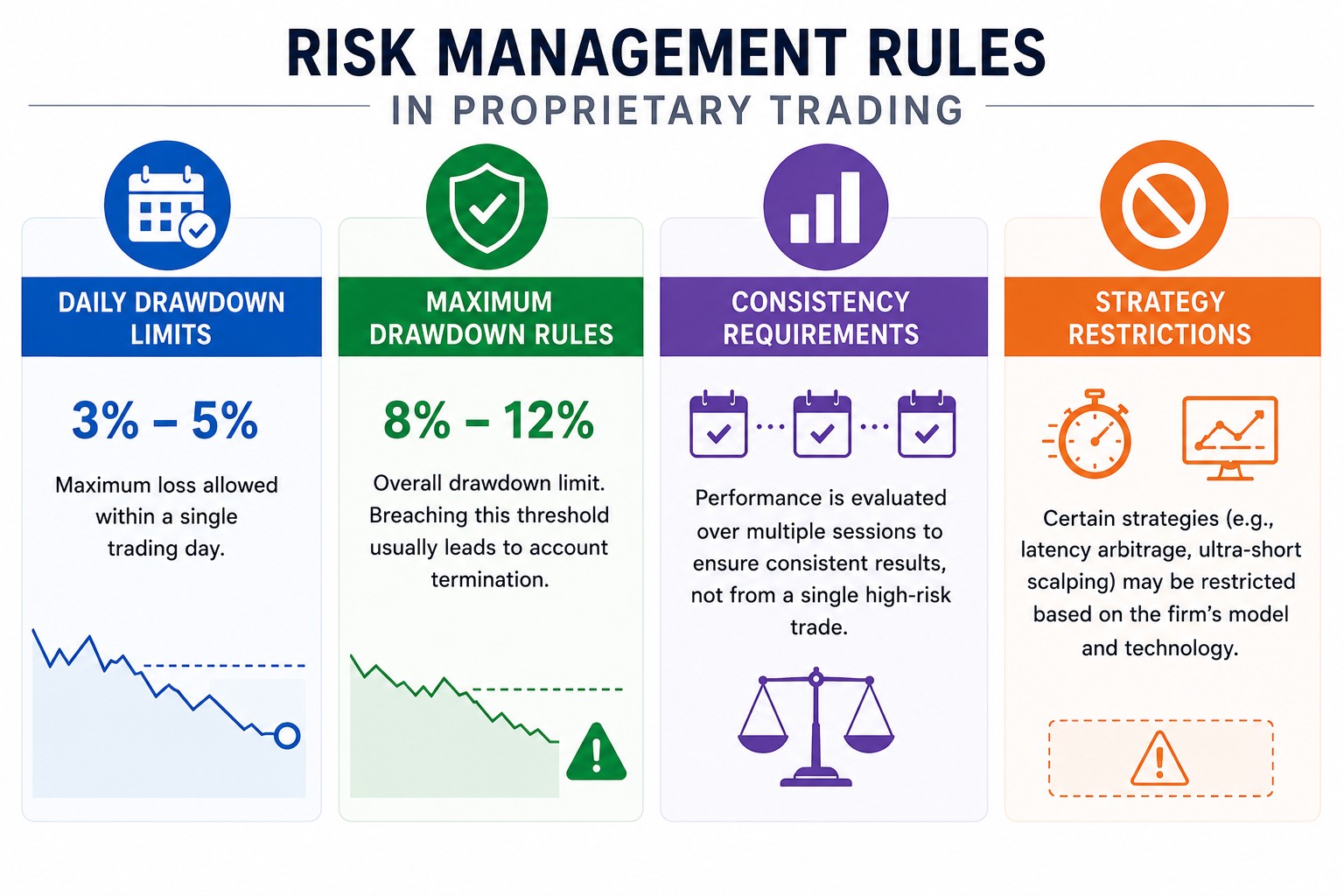
Consistency requirements
Some firms evaluate trading performance over multiple sessions to ensure profits are generated consistently rather than through a single high-risk trade. Large gains from one position followed by limited trading activity may be flagged for additional review or fail consistency requirements.
Strategy restrictions
Certain strategies, such as latency arbitrage or ultra-short-term scalping, may be restricted depending on a firm's trading model and technology. These policies help firms manage operational risk and ensure fair use of capital across a top prop firm for Indian stock market trading.
Funded trading programs offer several benefits for traders who meet a firm's evaluation requirements. Instead of relying solely on personal capital, successful traders can access larger funded accounts while following predefined risk management rules.
Key advantages include:
access to larger trading capital without increasing personal investment;
opportunities to scale account size based on consistent performance;
structured risk management through drawdown and loss limits;
professional trading platforms, analytics, and performance monitoring tools.
This delivers the same value in about half the space and avoids repeating information the reader has already seen.
Limitations and risks of proprietary funding
Despite the advantages, proprietary trading models also involve several limitations.
Evaluation costs. Many firms charge fees for participation in evaluation programs. These fees cover operational costs and risk management infrastructure.
Strict rule enforcement. Even profitable traders may lose accounts if risk rules are violated.
Market limitations. Some global proprietary firms do not yet offer direct access to Indian exchange instruments. This limitation means not every prop firm for indian stock market strategy can be implemented in all funded programs.
Regulatory uncertainty. The regulatory status of evaluation-based proprietary firms remains under discussion in several jurisdictions. Future regulation may influence how prop firms in India for the Indian stock market operate.
Focus on consistency, not quick profits

One of the biggest mistakes traders make when choosing a prop firm is focusing almost entirely on account size or the advertised profit split. Those figures matter, but they should not outweigh practical considerations such as drawdown rules, payout reliability, platform stability, and the range of tradable instruments. A firm with transparent rules and realistic risk limits is often a better long-term choice than one offering more aggressive terms.
Passing an evaluation is only the first step. Long-term success depends on disciplined execution, consistent position sizing, and effective risk management rather than achieving a profit target as quickly as possible. Traders who build repeatable strategies and focus on liquid instruments such as the NIFTY 50 and BANKNIFTY are generally better positioned to deliver consistent results and retain access to funded capital.
Methodology for compiling our ratings of prop firms
Traders Union applies a rigorous methodology to evaluate prop companies using over 100 quantitative and qualitative criteria. Multiple parameters are given individual scores that feed into an overall rating.
Key aspects of the assessment include:
-
Trader testimonials and reviews. Collecting and analyzing feedback from existing and past traders to understand their experiences with the firm.
-
Trading instruments. Companies are evaluated on the range of assets offered, as well as the breadth and depth of available markets.
-
Challenges and evaluation process. Analyzing the firm's challenge system, account types, evaluation criteria, and the process for granting funding.
-
Profit split. Reviewing the profit split structure and terms, scaling plans, and how the firm handles profit distributions.
-
Trading conditions. Examining leverage, execution speeds, commissions, and other trading costs associated with the firm.
-
Platform and technology. Assessing the firm's proprietary trading platform or third-party platforms it supports, including ease of use, functionality, and stability.
-
Education and support. Quality and availability of training materials, webinars, and one-on-one coaching.
Conclusion
Prop trading firms offer Indian traders the unique opportunity to scale their strategies by providing access to significant trading capital under structured risk management. With India's robust market liquidity, especially in NIFTY and BANKNIFTY derivatives, and advanced trading technology, disciplined traders can thrive by focusing on consistency over quick profits. Success with these firms hinges not just on passing evaluations, but on maintaining disciplined execution and adhering to risk rules—violations can quickly end a funded trading journey regardless of profitability. The most powerful takeaway is that long-term success in proprietary trading comes from steady, repeatable performance and strict risk management, rather than chasing high returns or superficial account sizes. In the dynamic Indian market, it’s the trader who treats every funded account like a business, not a lottery ticket, who stands out and secures enduring capital backing.
FAQs
What types of traders are best suited for prop firms in the Indian stock market?
How do hybrid funding platforms differ from traditional prop trading models in India?
What are some common reasons traders fail to progress in prop firm evaluation programs?
How do regulatory changes impact prop firms and traders in the Indian stock market?
Editors' Top Picks and Insights






Related Articles
Team that worked on the article
Aleksandra Chaikina has been a contributor to Traders Union since 2021. With over 15 years of experience in copywriting and more than 5 years focused on financial content, she specializes in producing detailed guides, analytics, and comparative reviews across various sectors, including cryptocurrencies, Forex, investment strategies, and financial technologies.
Ciaran Ryan is a veteran financial journalist based in South Africa, where he covers cryptocurrency, mining, stock markets, and governance for Moneyweb. He also hosts the weekly Moneyweb Crypto Podcast.
Chinmay Soni is a financial analyst with more than 5 years of experience in working with stocks, Forex, derivatives, and other assets. As a founder of a boutique research firm and an active researcher, he covers various industries and fields, providing insights backed by statistical data.


