
Is the Yuan Stronger Than the US Dollar In Long-Term?


Editorial Note: While we adhere to strict Editorial Integrity, this post may contain references to products from our partners. Here's an explanation for How We Make Money. None of the data and information on this webpage constitutes investment advice according to our Disclaimer.
Goldman Sachs - 7.15 - 7.30 in 2024
Standard Chartered Bank - 7.00 - 7.20 in 2024
Societe Generale - 7.30 - 7.50 in 2024
Panda Forecast - 7.16 - 7.30 in 2024 and 7.30 - 7.65 in 2025
UBS - 7.20 in 2024
In global finance, the dance between currencies reflects not just economic health but geopolitical climate. Of particular intrigue is the relationship between the U.S. Dollar and the Chinese Yuan — a dynamic that encapsulates the ebb and flow of trade, investment, and policy.
As we peer into 2024, questions arise: Can the Yuan maintain its strength against the Dollar? Is the tide of economic power shifting? The answers hinge on a complex interplay of market forces and policy decisions, a theme we shall unravel to discern whether the Yuan’s vigor is a transient gust or a prevailing wind.
What is the prediction for the Yuan to USD?
Forex markets whisper tales of anticipation and foretell the narratives of economies. The USD/CNYpair is no stranger to this drama, with every tick echoing the profound influence of central bank policies and the pervasive specter of inflation. As 2024 unfolds, the Yuan’s stance against the Dollar will likely be sculpted by the hands of these financial titans, their monetary strategies shaping the canvas of exchange rates.
Yet, the plot thickens beyond the corridors of central banks. The forthcoming U.S. election looms large, promising to imprint its mark on the USD/CNY story. The political compass of the world’s largest economy can sway investor sentiment and trigger ripples across the Pacific, potentially altering the course of the Yuan’s voyage. What else lurks on the horizon to sway the balance? Supply chain adjustments, technological advancements, and even energy policies could all cast their shadows on the Forex stage.
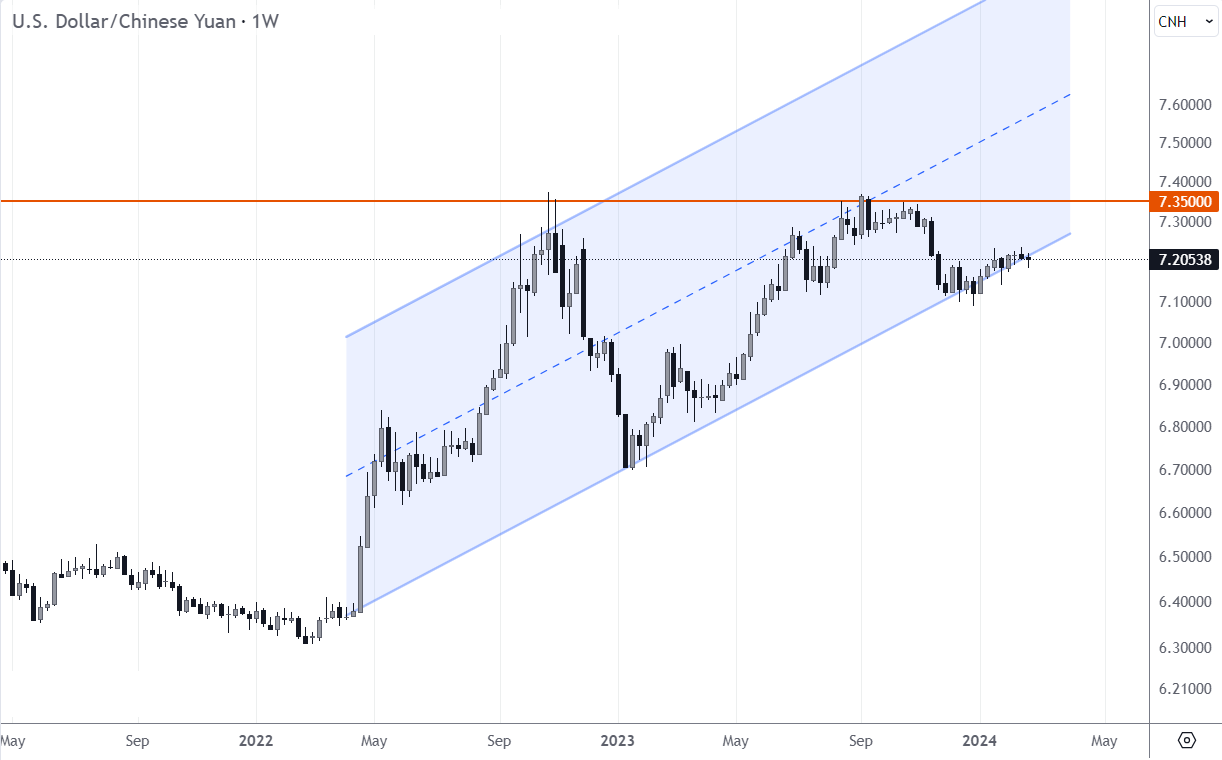 USD/CNY Long-term chart
Peering at the long-term chart (as shown in the image above), we observe the Yuan’s trajectory within a defined channel, a visual narrative of resilience and resistance. Starting from 2022, US dollar has gained a lot of strength against the Chinese Yuan, and continues to be on an upward trajectory. However, 2024 may show that the 7.35 resistance level will prove to be an insurmountable obstacle for the bulls.
For a deeper understanding of the complexities of the Chinese Yuan, you may find an excellent resource available in our article How to Trade Yuan in Forex?
Best Forex brokers in 2026


Forecast for the USD to Yuan for 2024 and 2025
As we sail into the future of currency exchange, the USD to Yuan forecast remains a hot topic among financial institutions and market observers. With 2024 and 2025 on the horizon, we delve into the predictions of esteemed financial entities and analytics groups to gauge the path of this pivotal exchange rate.
Goldman Sachs: A Calculated Ascendancy to 7.3
Goldman Sachs, a bellwether in financial prognostication, envisions the USDCNY exchange rate being between 7.3 and 7.15 ranges by the close of 2024. Their analysis suggests that while the Chinese authorities have been actively managing the yuan's value to curb depreciation expectations, the real impetus for a stronger CNY would necessitate a robust recovery in Chinese growth and a relative outperformance of its asset markets.
However, Goldman Sachs expresses skepticism about such a scenario materializing in the near term, given the mixed economic indicators, the ongoing decline in property prices, and a subdued inflationary environment within China.
First, the ongoing recalibration of global supply chains may be a key driver, affecting trade volumes and, consequently, currency demand
Second, the contrasting monetary policies of the Federal Reserve and the People's Bank of China, especially in response to global inflationary pressures, could significantly influence the exchange rate
Political undertones, including trade negotiations and policy shifts spurred by the U.S. elections, may also play a crucial role
Standard Chartered Bank: A Nuanced Perspective
Standard Chartered Bank offers a nuanced perspective on the yuan's trajectory, anticipating initial support for the CNY leading into the Lunar New Year, traditionally a period of positive seasonality for the currency. However, they warn of potential headwinds thereafter, particularly in the first half of 2024. The forecast by Standard Chartered suggests that the yuan may confront challenges that could see it testing levels between 7.15 and 7.35 against the dollar, but that it will ultimately settle around 7 by the end of 2024.
This outlook is predicated on the persistent rate differential that is expected to remain wide, as rates in developed markets are likely to stay elevated while China maintains lower rates. The bank also highlights the structural differences in inflation rates between China and developed markets, which will likely contribute to a persistent policy rate difference. Despite the possibility of rate cuts from the Federal Reserve by the end of 2024, Standard Chartered maintains that U.S. rates will remain significantly higher than those in China, exerting pressure on the CNY.
Societe Generale: Positive Outlook for USD
Societe Generale forecasts the rate of 7.5 all throughout the first half of 2024, with a slight recovery by Yuan to 7.3 ranges by the end of the year.
Societe Generale underscores the strategic measures taken by the People's Bank of China (PBOC) to mitigate CNY depreciation, noting that such efforts have become a steadfast component of the bank's policy toolkit. However, Societe Generale forecasts that the divergence in monetary policy, especially with a steadfast U.S. Federal Reserve, will continue to exert upward pressure on the USD/CNY pair until there is a discernible shift in the Fed's stance.
The bank posits that the PBOC might slightly favor lower local interest rates, potentially leading to a marginally higher USD/CNY exchange rate. This stance suggests a delicate balancing act by the Chinese central bank as it navigates between supporting local economic growth through accommodative monetary policy and managing the exchange rate.
Panda Forecast: A Subtle Shift to 7.4 in 2025
Looking further ahead, Panda Forecast projects a subtle appreciation of the Yuan, with a weighted average target level of 7.329 for the USD/CNY currency pair by 2025. This suggests an anticipation of strengthening Chinese currency over the two-year span, a hypothesis potentially rooted in China’s robust economic growth, technological advancements, and an expanding role in international trade.
While explicit reasons for this projection are not detailed, it's plausible that the forecast incorporates expectations of China's continued economic reforms, further integration into global financial systems, and its strategic initiatives like the Belt and Road. These factors, combined with a potential easing of tensions with the U.S. post-election, could foster a favorable climate for the Yuan.
UBS: A Spectrum of Possibilities
In contrast, UBS presents a more nuanced view, predicting the USD/CNY pair to oscillate between 7 to 7.2 in the end of 2023 and beginning of 2024, while also acknowledging that rates surpassing 8 are within the realm of possibility for 2024. Such variability underscores the inherent uncertainties and the impact of short-term market sentiments influenced by immediate economic data releases and geopolitical events.
It's imperative to acknowledge that these forecasts are sophisticated estimates based on current knowledge and do not serve as financial advice. The future is painted with strokes of uncertainty, and as such, these predictions should be viewed as expert opinions that carry the inherent risk of deviation from actual future events.
Conclusion
In synthesizing the varied insights from leading financial institutions, the trajectory of the USD/CNY exchange rate in 2024 and 2025 emerges as a multifaceted narrative. Predictions oscillate from cautious restraint to moderate optimism, each underpinned by China's economic health, policy decisions from central banks, and global market dynamics.
While some forecast a resilient yuan bolstered by economic stimuli and potential easing of U.S. rates, others point to structural challenges and policy divergences that may cap the CNY's strength. The consensus leans towards a narrative of measured appreciation or stability for the yuan, with the caveat that in the fluid theater of global Forex, certainties are as elusive as the winds of trade and policy that shape them.
FAQs
Is China trying to weaken the dollar?
China does not actively pursue a policy to weaken the dollar; rather, it focuses on maintaining a stable and controlled exchange rate for the yuan to support its economic objectives and international trade competitiveness.
Is 1000 yuan a lot of money in China?
In China, the value of 1000 yuan can be considered a moderate amount of money, sufficient for everyday expenses and some discretionary purchases, but not a large sum in the context of major expenses or urban living costs.
Can yuan overtake the US dollar?
The yuan overtaking the US dollar as the world's primary reserve currency is a long-term possibility but currently remains unlikely due to the dollar's entrenched position and the yuan's limited convertibility on international markets.
What is the prediction for USD to CNY?
The prediction for USD to CNY varies among financial institutions, but the general expectation for 2024 and 2025 suggests a range of fluctuations with a possible moderate appreciation of the yuan against the dollar, influenced by economic policies and market conditions.
Editors' Top Picks and Insights






Related Articles
Team that worked on the article
Vuk stands at the forefront of financial journalism, blending over six years of crypto investing experience with profound insights gained from navigating two bull/bear cycles. A dedicated content writer, Vuk has contributed to a myriad of publications and projects.
Dr. BJ Johnson is a PhD in English Language and an editor with over 15 years of experience. He earned his degree in English Language in the U.S and the UK.
Mirjan Hipolito is a journalist and news editor at Traders Union. She is an expert crypto writer with five years of experience in the financial markets.
The CFTC protects the public from fraud, manipulation, and abusive practices related to the sale of commodity and financial futures and options, and to fosters open, competitive, and financially sound futures and option markets.
CFD is a contract between an investor/trader and seller that demonstrates that the trader will need to pay the price difference between the current value of the asset and its value at the time of contract to the seller.
A margin call is a demand made by a broker or a financial institution to a trader or investor who is using margin (borrowed funds) to cover potential losses in a trading account. It occurs when the value of the securities or assets held in the account falls below a certain threshold, known as the maintenance margin or margin requirement, as specified by the broker.
The yuan (CNY) is the official currency of the People's Republic of China. The yuan is divided into 10 jiao, which are further divided into 10 fen.
Bitcoin is a decentralized digital cryptocurrency that was created in 2009 by an anonymous individual or group using the pseudonym Satoshi Nakamoto. It operates on a technology called blockchain, which is a distributed ledger that records all transactions across a network of computers.

-
 Afghanistan
-
 Albania
-
 Algeria
-
 Angola
-
 Argentina
-
 Armenia
-
 Australia
-
 Austria
-
 Azerbaijan
-
 Bahamas
-
 Bahrain
-
 Bangladesh
-
 Belarus
-
 Belgium
-
 Bolivia
-
 Botswana
-
 Brazil
-
 Brunei
-
 Bulgaria
-
 Cambodia
-
 Cameroon
-
 Canada
-
 Chile
Chile
-
 China
China
-
 Colombia
-
 Congo
Congo
-
 Costa Rica
-
 Cote d'Ivoire
-
 Croatia
-
 Cuba
Cuba
-
 Cyprus
-
 Czechia
-
 DR Congo
-
 Denmark
-
 Dominican Republic
-
 Ecuador
-
 Egypt
Egypt
-
 El Salvador
-
 Estonia
-
 Eswatini
-
 Ethiopia
-
 Finland
-
 France
-
 Georgia
-
 Germany
-
 Ghana
Ghana
-
 Greece
-
 Haiti
Haiti
-
 Hong Kong
-
 Hungary
-
 India
India
-
 Indonesia
-
 Iran, Islamic republic
-
 Iraq
Iraq
-
 Ireland
-
 Israel
-
 Italy
Italy
-
 Jamaica
-
 Japan
Japan
-
 Jordan
-
 Kazakhstan
-
 Kenya
Kenya
-
 Korea
Korea
-
 Kuwait
-
 Kyrgyzstan
-
 Laos
Laos
-
 Latvia
-
 Lebanon
-
 Lesotho
-
 Libya
Libya
-
 Lithuania
-
 Luxembourg
-
 Madagascar
-
 Malaysia
-
 Malta
Malta
-
 Mauritius
-
 Mexico
-
 Moldova
-
 Mongolia
-
 Montenegro
-
 Morocco
-
 Mozambique
-
 Myanmar
-
 Namibia
-
 Nepal
Nepal
-
 Netherlands
-
 New Zealand
-
 Nigeria
-
 North Macedonia
-
 Norway
-
 Oman
Oman
-
 Pakistan
-
 Palestine
-
 Panama
-
 Papua New Guinea
-
 Paraguay
-
 Peru
Peru
-
 Philippines
-
 Poland
-
 Portugal
-
 Puerto Rico
-
 Qatar
Qatar
-
 Reunion
-
 Romania
-
 Rwanda
-
 Saudi Arabia
-
 Serbia
-
 Singapore
-
 Slovakia
-
 Slovenia
-
 Somalia
-
 South Africa
-
 Spain
Spain
-
 Sri Lanka
-
 Sweden
-
 Switzerland
-
 Syria
Syria
-
 Taiwan
-
 Tajikistan
-
 Tanzania
-
 Thailand
-
 Trinidad and Tobago
-
 Tunisia
-
 Turkey
-
 UAE
UAE
-
 Uganda
-
 Ukraine
-
 United Kingdom
-
United States
-
 Uruguay
-
 Uzbekistan
-
 Venezuela
-
 Vietnam
-
 Yemen
Yemen
-
 Zambia
-
 Zimbabwe
- Forex
- Crypto










