
Bitget Copy Trading: How Trade Copying Works on the Exchange


Editorial Note: While we adhere to strict Editorial Integrity, this post may contain references to products from our partners. Here's an explanation for How We Make Money. None of the data and information on this webpage constitutes investment advice according to our Disclaimer.
Bitget copy trading is a service that automatically replicates trades made by other cryptocurrency exchange users. Users select a lead trader, allocate funds, and configure copy trading settings. Bitget supports spot and futures copy trading. The minimum amount to start standard copy trading is 50 USDT, though individual traders may set a higher threshold. Profits are not guaranteed: results depend on the trader’s strategy, market conditions, fees, and execution settings.
Copy trading on Bitget lets users participate in cryptocurrency trading without having to analyze the market or open every position themselves. The platform automatically replicates eligible trades made by the selected trader, while users decide how much capital to allocate and what level of risk they are willing to accept. We examine the service’s terms, the differences between spot and futures copy trading, fees, and how to choose traders. The article also provides step-by-step instructions for setting up Bitget copy trading and recommendations for managing funds.
How Bitget Copy Trading Works
Bitget copy trading works through interaction between two participants: a lead trader who places trades and a follower who copies them. Once connected, the system automatically opens corresponding positions in the user’s separate account. Trade size depends on the selected copy mode, available funds, and configured limits.
For example, a lead trader with 1 000 USDT allocates 10% of their funds to buy BTC. If a follower allocates 500 USDT and selects proportional copying, the system may use around 50 USDT for a similar trade. The actual amount depends on execution settings. Bitget offers two main copy trading modes:
| Mode | How It Works | Features |
|---|---|---|
| Fixed Amount | A set amount in USDT is allocated to each new trade | Allows you to cap the amount allocated to each trade |
| Fixed ratio | Position size is calculated in proportion to the capital and trades of the lead trader | Helps maintain similar position proportions |
With a fixed amount, a follower may use up their allocated capital more quickly if the lead trader opens many positions. In proportional mode, trade size depends on the ratio of funds held by the two participants.
On Bitget, copy trading funds are held in separate subaccounts. This makes it possible to track the performance of each strategy independently of the main trading balance. The lead trader does not have direct access to the follower’s funds.
In spot copy trading, positions are closed in proportion to the trader’s actions. For example, if the trader sells half of their position, the system attempts to sell the corresponding share of the follower’s asset.
Important: Copy trading does not guarantee the same execution price. Slippage, insufficient balance, or trading restrictions may cause individual trades placed for a follower to differ from the lead trader’s trades or remain unfilled.
Bitget spot vs. futures copy trading: which should you choose?
Bitget supports automatically copying trades on the spot and futures markets. The main difference lies in the types of trading instruments and whether leverage is used.
| Criterion | Spot | Futures |
|---|---|---|
| Instruments | Cryptocurrency pairs | Futures contracts |
| Leverage | Not used | Can be used |
| Liquidation due to leverage | No | Possible |
| Main risk | Decline in cryptocurrency value | Market losses, margin risks, and liquidation |
| Minimum amount | 50 USDT | 50 USDT |
| Who it's for | Users who prefer trading without leverage | Traders who understand the risks of derivatives |
Spot copy trading involves replicating cryptocurrency purchases and sales. For example, if a lead trader buys ETH, the system purchases the corresponding asset using the follower’s allocated funds. If the price of ETH falls, the position’s value decreases, but a regular spot trade is not liquidated due to insufficient margin.
If a user wants to know how to copy trades in spot trading on Bitget, they need to open Spot Copy Trading and choose a suitable lead trader. They do not need to place each order manually to start copying automatically.
Futures copy trading works differently. Users mirror positions in derivatives, which may involve leverage. For example, with 1:10 leverage, a 5% price move against a position is equivalent to approximately 50% of the initial margin, excluding fees and other factors.
In Bitget’s updated futures copy trading system, you can follow the lead trader’s leverage or set a fixed value from 1:1 to 1:10. You can also set limits on margin per order, maximum position size, and acceptable slippage. The new system uses cross margin.
Bitget Copy Trading: How to Use It
To start copy trading on Bitget, you need to register an account, complete the required verification, and fund your balance. Let’s look at how to start copying trades through the exchange interface. The availability of certain products depends on the user’s region of residence.
Step 1. Open the copy trading section
Go to the official Bitget website and sign in. Open Copy Trading from the trading menu and select Spot Copy Trading or Futures Copy Trading. The first option is for copying spot trades, while the second is for futures contracts.
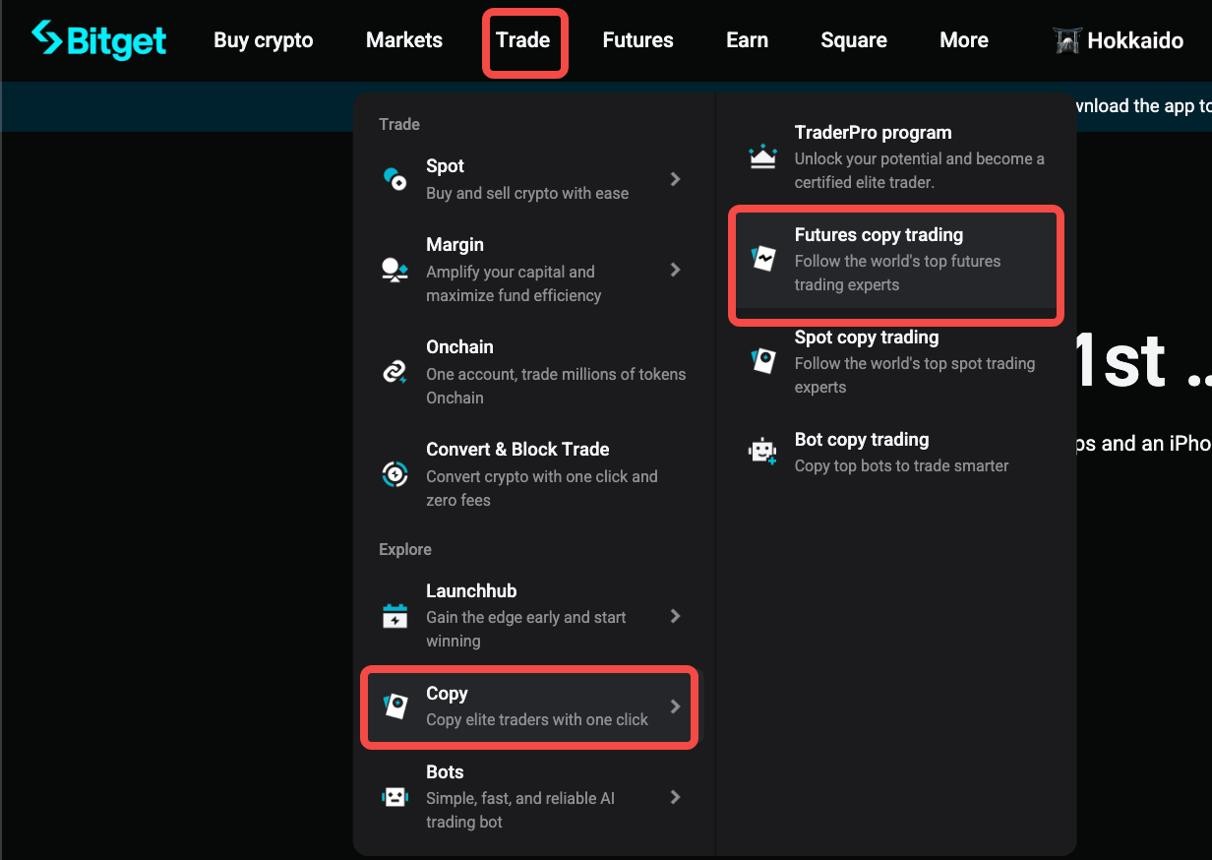
In the mobile app, following the update on October 22, 2026, open the Trade tab and select Copy Trading from the top menu. The page provides access to the trader rankings, asset information, and copy trading management center. You need to install the latest version of the app to use the updated interface.
Step 2. Choose a lead trader
Open the trader directory and review the available metrics. On the spot market, you can compare returns over 7, 30, 90, and 180 days, and sort traders by ROI, profit, and assets under management (AUM) being copied. On the futures market, also pay attention to the win rate and followers' profits.
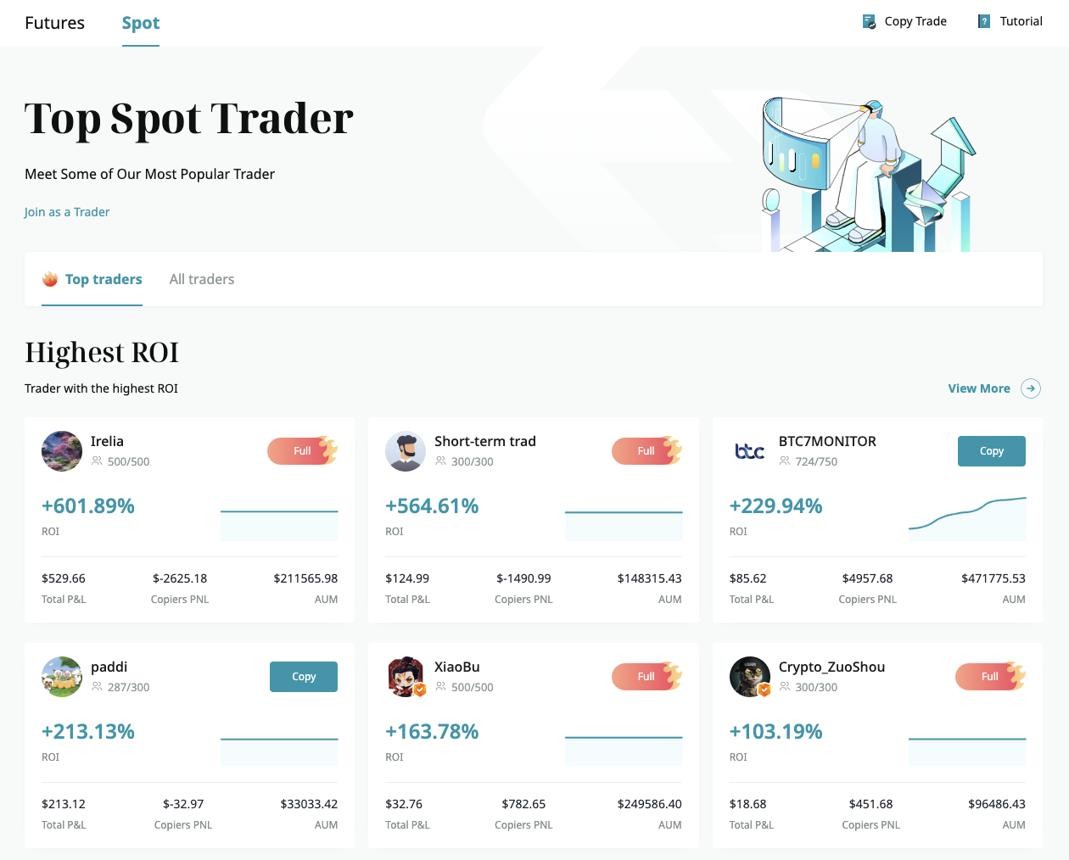
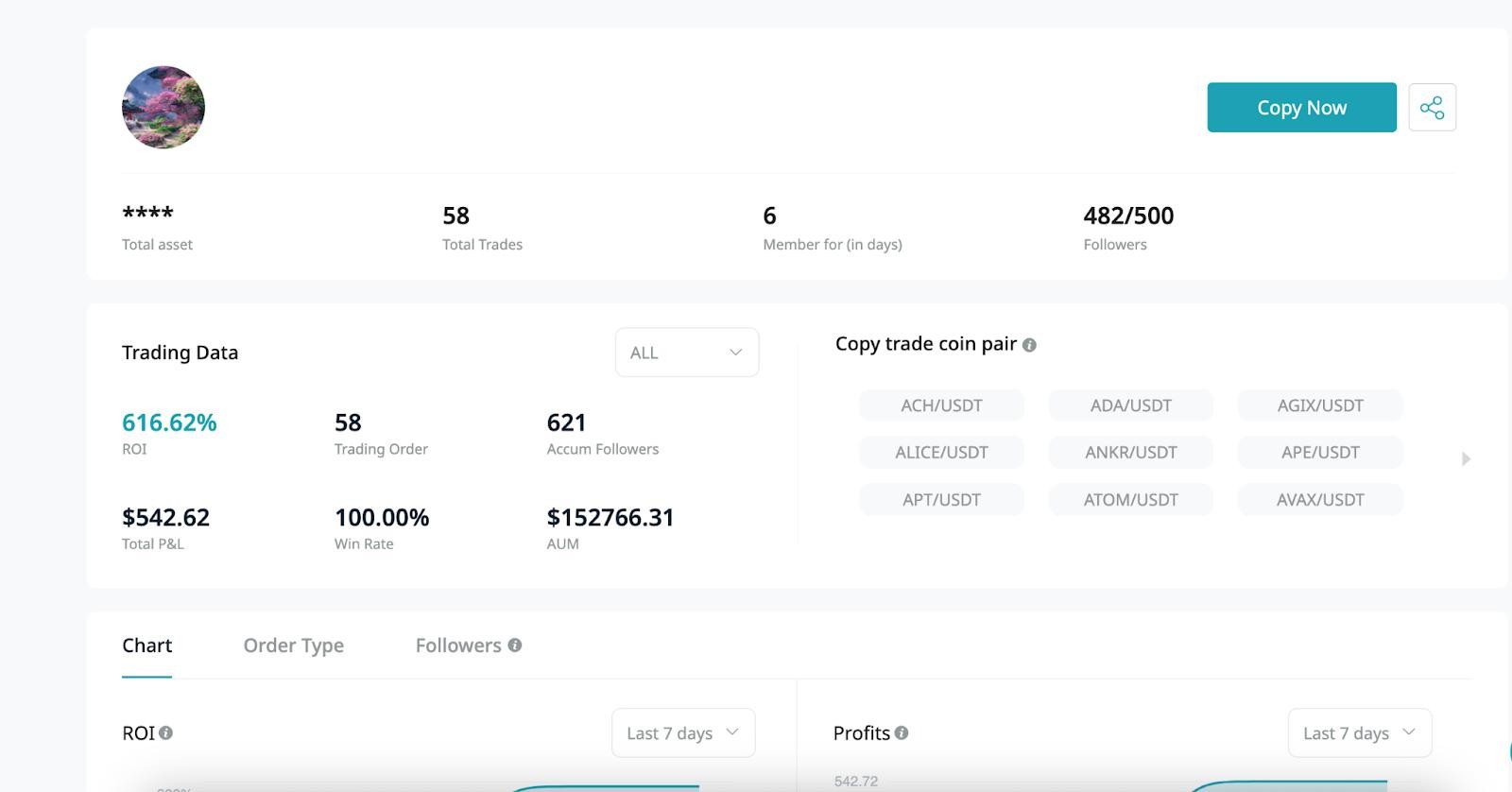
Open the profile of a trader you’re interested in to review detailed statistics and trading history. Don’t choose a trader solely based on the highest weekly return: consider performance over a longer period and the size of the drawdown. Once you’ve made your choice, click Copy.
Step 3. Configure copy trading settings
Review the service terms and choose a copy trading mode. Bitget offers a fixed amount per trade or proportional position copying.
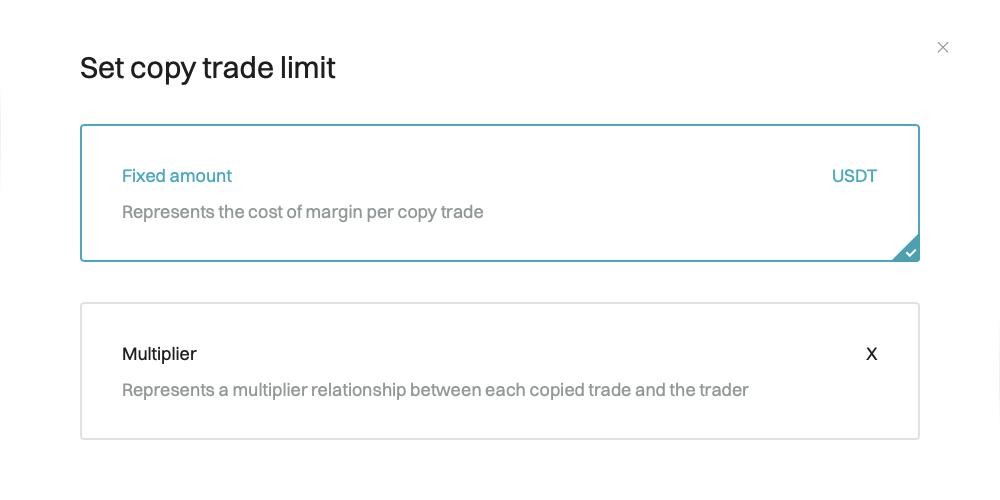
Set the basic parameters:
the amount of capital to allocate for copy trading;
the position sizing calculation mode;
the trading pairs whose trades can be copied;
available risk limits.
For futures, also check the leverage, maximum margin per order, and permitted slippage. For new futures copy trading, the default slippage limit is 0.5%. Users can set a value from 0.1% to 3%. If the price deviation exceeds the selected threshold, the system will not copy the order.
Step 4. Specify the amount and confirm the connection
Allocate at least 50 USDT to copy trading, or a higher amount if required by the selected lead trader. Before confirming, check your trading settings and profit-sharing terms.

Once confirmed, the funds are transferred to a separate copy trading account. A separate sub-account is created for each connected trader. The system then automatically starts copying eligible new trades.
Step 5. Monitor your results
Open Copy Trading Center to track asset value, available balance, realized and unrealized profits, and profit share accrued to the lead trader.
If needed, users can add funds to their account, withdraw available funds, or stop copying. In spot trading, when a strategy is stopped, any remaining assets are sold at market price. In futures copy trading, users can choose to close positions immediately or follow the lead trader’s closing strategy.
Before stopping, check open positions and the terms for final profit-sharing settlement.
How to choose a trader to copy
A lead trader’s performance should be evaluated holistically. High historical returns do not show how risky the strategy was or whether followers can achieve comparable results.
| Metric | What to look for |
|---|---|
| ROI | Returns over multiple periods, not just recent days |
| Maximum drawdown (MDD) | How much the portfolio value declined |
| Win Rate | Share of profitable trades; a high rate does not rule out significant losses |
| Copy traders’ PnL | The results users achieve by copying trades |
| AUM | Assets allocated to copy trading; this figure alone does not indicate strategy quality |
| Trading history | Length of the observed track record |
| Leverage | How aggressively the trader increases market exposure |
Consider a hypothetical example. Trader A achieved a 70% return over 90 days, but their maximum drawdown was 45%. Trader B earned 20% with a drawdown of 8%. The second option may be preferable for a user seeking to limit risk, despite the lower historical return.
It is also important to examine trading behavior. Repeatedly increasing losing positions, concentrating a large share of capital in a single asset, and sharp swings in returns may indicate an aggressive strategy.
Subscriber profitability deserves special attention. Their actual results may differ from the lead trader’s statistics due to slippage, trading fees, and differences in capital size.
Bitget copy trading minimum deposit and fees
At least 50 USDT is required to start standard spot copy trading and the new futures copy trading on Bitget. However, a lead trader may set a higher entry threshold.
The spot account must maintain a balance of at least 50 USDT, excluding reserved profit-sharing funds. When funds are withdrawn, the system takes into account the available balance and profit-sharing obligations. Futures copy trading is subject to additional margin and position management requirements.
| Fee type | Conditions |
|---|---|
| Spot trading | Standard rate: 0.1% for makers and takers |
| Spot trading with fees paid in BGB | Typically 0.08% when discount conditions are met |
| Futures trading | Typically 0.02% for makers and 0.06% for takers |
| Lead trader reward | Usually 10–20% of profits, depending on the strategy terms |
| Perpetual futures funding | May be credited or debited depending on the market and position |
| Slippage | Not a separate fee, but it affects the execution price |
Standard trading fees may be reduced depending on the user's VIP tier. The lead trader's reward is charged separately and depends on the selected strategy. Check the specific rate before connecting.
The updated copy trading system applies the High-Water Mark principle. This means rewards are calculated based on previously achieved results, so recovering past losses alone does not result in the profit share being charged again.
For the new futures copy trading feature, standard settlement takes place daily at 00:00 (UTC+8) if all positions are closed. Additional settlement may take place when copying is stopped.
Risks of Bitget copy trading
Automation eliminates the need to manually copy every order, but it does not eliminate trading risks:
Market risk. Even experienced traders can make mistakes, and sharp price movements can lead to significant losses.
Slippage. Followers' trades may be executed at less favorable prices, especially during periods of high volatility.
Leverage risk. In futures trading, losses increase with the position size relative to the margin. Liquidation is possible.
Incomplete copying. Some orders may not be copied due to insufficient funds, trading restrictions, or user settings.
Strategy changes. A lead trader may take on more risk after a period of successful cryptocurrency trading.
Liquidity risk. Trading less liquid tokens may lead to significant price deviations and difficulties executing orders.
Bitget uses slippage limits that can prevent trades from being executed when the price deviation is excessive. However, these limits do not guarantee that a follower’s results will fully match those of the lead trader.
To reduce risks, it is helpful to set an acceptable drawdown in advance, avoid allocating all your capital to a single trader, and regularly review your strategy settings. When copying futures trades, pay particular attention to leverage and available margin. A stop-loss also does not guarantee that a position will close at the specified price during sharp market movements.
Pros and cons of Bitget copy trading
- Pros
- Cons
Automatic replication of trades made by selected traders.
Availability of spot and futures copy trading.
Separate accounts for tracking copied strategies.
Statistics on returns, trading history, and follower results.
Position sizing and risk limit settings.
The ability to monitor capital and performance through the copy trading center.
No guaranteed profits.
Risk of liquidation when trading futures with leverage.
Past trader performance does not guarantee future returns.
Potential slippage and failure to execute individual trades.
Trading fees and the need to share profits with the lead trader.
Evaluate not only a trader’s returns, but also their followers’ results

When choosing a trader to copy on Bitget, I recommend first examining how they behave during periods of losses. High returns alone do not show how resilient a strategy is. For example, if a trader constantly increases losing positions or uses high leverage, attractive ROI figures may conceal significant risk.
I would also pay attention to followers’ results. These can differ significantly from the lead trader’s returns due to slippage, fees, and order execution. That is why it is important to assess not only the trader’s own statistics, but also the actual profits or losses of users who copy their trades.
It is best to start copying with a small amount that you can afford to lose without significantly affecting your personal finances. Before connecting, you should also decide when to stop copying—for example, if the maximum acceptable drawdown is exceeded or the trading approach changes noticeably. In my view, dropping an unsuitable strategy in time is just as important as choosing a trader in the first place.
Conclusion
Bitget copy trading is a crypto trading automation tool that lets you mirror the strategies of other market participants. The platform supports spot and futures copy trading, provides lead trader statistics, and offers risk management tools. The minimum amount for standard copy trading is 50 USDT, although some strategies may require more capital.
The service’s main advantage is the ability to participate in trading without manually opening every trade. However, copy trading should not be viewed as a guaranteed source of passive income. Results depend on the lead trader’s actions, market conditions, copy trading settings, and costs. Before connecting, assess the drawdown history, profit-sharing terms, and acceptable level of risk.
FAQs
Why aren’t all lead trader trades copied on Bitget?
Some orders may not be copied due to insufficient balance, the slippage limit being exceeded, or trading restrictions. For example, if the asset’s price changes by more than the set limit, the system won’t copy the trade. There may also be limits on how often positions can be opened and on the minimum order size.
Can I withdraw funds without stopping Bitget copy trading?
Yes. Users can withdraw available funds while remaining connected to a trader. However, they must maintain the required minimum balance. With futures copy trading, a withdrawal may also temporarily lock some funds to cover any unpaid profit share owed to the lead trader.
What happens to open positions after copy trading is stopped?
On the Bitget spot market, remaining assets are sold at market price, and funds are transferred after settlement. In the new futures copy trading, users can choose to close positions immediately or follow the lead trader’s closing strategy. In the latter case, no new positions are opened, but existing ones remain active until they are closed.
Can copy trading settings be changed after connecting?
Yes. Users can adjust the available strategy parameters, including allocated capital and individual trading limits. In the futures market, changes may affect the size of subsequent positions. However, new settings do not automatically eliminate losses on trades that are already open.
Related Articles
Team that worked on the article
Anastasiia has 17 years of experience in finance and content marketing. She believes that the support of information and expert opinion is very important for the success of investors and new traders.
Olga Shendetskaya has been a part of the Traders Union team as an author, editor and proofreader since 2017. Since 2020, Shendetskaya has been the assistant chief editor of the website of Traders Union, an international association of traders.
Chinmay Soni is a financial analyst with more than 5 years of experience in working with stocks, Forex, derivatives, and other assets. As a founder of a boutique research firm and an active researcher, he covers various industries and fields, providing insights backed by statistical data.

-
 Afghanistan
-
 Albania
-
 Algeria
-
 Angola
-
 Argentina
-
 Armenia
-
 Australia
-
 Austria
-
 Azerbaijan
-
 Bahamas
-
 Bahrain
-
 Bangladesh
-
 Belarus
-
 Belgium
-
 Bolivia
-
 Botswana
-
 Brazil
-
 Brunei
-
 Bulgaria
-
 Cambodia
-
 Cameroon
-
 Canada
-
 Chile
-
 China
-
 Colombia
-
 Congo
-
 Costa Rica
-
 Cote d'Ivoire
-
 Croatia
-
 Cuba
-
 Cyprus
-
 Czechia
-
 DR Congo
-
 Denmark
-
 Dominican Republic
-
 Ecuador
-
 Egypt
-
 El Salvador
-
 Estonia
-
 Eswatini
-
 Ethiopia
-
 Finland
-
 France
-
 Georgia
-
 Germany
-
 Ghana
-
 Greece
-
 Haiti
-
 Hong Kong
-
 Hungary
-
 India
-
 Indonesia
-
 Iran, Islamic republic
-
 Iraq
-
 Ireland
-
 Israel
-
 Italy
-
 Jamaica
-
 Japan
-
 Jordan
-
 Kazakhstan
-
 Kenya
-
 Korea
-
 Kuwait
-
 Kyrgyzstan
-
 Laos
-
 Latvia
-
 Lebanon
-
 Lesotho
-
 Libya
-
 Lithuania
-
 Luxembourg
-
 Madagascar
-
 Malaysia
-
 Malta
-
 Mauritius
-
 Mexico
-
 Moldova
-
 Mongolia
-
 Montenegro
-
 Morocco
-
 Mozambique
-
 Myanmar
-
 Namibia
-
 Nepal
-
 Netherlands
-
 New Zealand
-
 Nigeria
-
 North Macedonia
-
 Norway
-
 Oman
-
 Pakistan
-
 Palestine
-
 Panama
-
 Papua New Guinea
-
 Paraguay
-
 Peru
-
 Philippines
-
 Poland
-
 Portugal
-
 Puerto Rico
-
 Qatar
-
 Reunion
-
 Romania
-
 Rwanda
-
 Saudi Arabia
-
 Serbia
-
 Singapore
-
 Slovakia
-
 Slovenia
-
 Somalia
-
 South Africa
-
 Spain
-
 Sri Lanka
-
 Sweden
-
 Switzerland
-
 Syria
-
 Taiwan
-
 Tajikistan
-
 Tanzania
-
 Thailand
-
 Trinidad and Tobago
-
 Tunisia
-
 Turkey
-
 UAE
-
 Uganda
-
 Ukraine
-
 United Kingdom
-
United States
-
 Uruguay
-
 Uzbekistan
-
 Venezuela
-
 Vietnam
-
 Yemen
-
 Zambia
-
 Zimbabwe
- Forex
- Crypto












