
Exploring Bybit Islamic Account: Is Trading With Bybit Halal Or Haram?


Editorial Note: While we adhere to strict Editorial Integrity, this post may contain references to products from our partners. Here's an explanation for How We Make Money. None of the data and information on this webpage constitutes investment advice according to our Disclaimer.
Bybit has launched an Islamic trading account tailored specifically for Muslim traders who seek to participate in crypto markets without compromising on religious principles. Built on Shariah guidelines, this account is interest-free, certified halal, and supports over 75 approved cryptocurrencies. Traders are required to open a separate subaccount to activate this feature. What sets the Bybit Islamic Account apart is its integration with CryptoHalal, ensuring all trading activity avoids riba and remains fully compliant with Islamic finance ethics.
As one of the world’s leading crypto exchanges, Bybit has responded to growing demand by offering this ethical alternative to conventional accounts. For Muslims wondering whether Bybit is halal, the platform’s dedicated Islamic offering addresses common concerns around speculation, interest, and ambiguity in contracts. This article walks through how Bybit ensures Shariah compliance, outlines the key features of the account, and highlights what users should evaluate before opening one.
Understanding islamic finance principles

Before judging any trading platform, it’s essential to revisit the foundations of Shariah‑compliant finance. Islamic law is built on the premise that money itself is not a commodity but a medium of exchange. That philosophy gives rise to several prohibitions and obligations:
Prohibition of riba (interest). Islam forbids both charging and receiving interest. Faisal Khan explains that riba encompasses direct interest on loans (Riba al‑Nasi’ah) and unfair gains from unequal exchanges (Riba al‑Fadl). A halal trading account must therefore remove any swap or rollover fees that function as interest.
Avoidance of gharar (excessive uncertainty). Contracts must be transparent. You need to know what you’re buying or selling, at what price, when settlement occurs, and under what conditions. Tokens with unclear use cases or smart contracts with hidden triggers introduce ambiguity and fall under gharar.
Prohibition of maysir (gambling). Any transaction that resembles a game of chance is forbidden. That includes binary options, high‑leveraged bets on short‑term price movements, or algorithmic strategies that rely on market manipulation rather than genuine value creation.
Halal asset selection. Muslim investors must avoid industries deemed haram. That means steering clear of tokens linked to gambling, pornography, conventional banking, or arms manufacturing. Even with a Shariah‑compliant account, it’s your responsibility to examine each coin’s underlying project and revenue sources.
To put these principles into context, consider the global growth of Islamic finance. LSEG researchers note that Islamic finance assets increased 11 % in 2022 and could exceed US$6.7 trillion by 2027. This growth reflects a huge appetite for ethical financial products that deliver returns without compromising on faith.
Is Bybit halal? A practical perspective
Answering whether Bybit is halal requires looking beyond marketing claims. A standard Bybit account allows margin trading, perpetual futures and high‑leverage derivatives, products that can involve hidden interest or speculation. These instruments often carry unclear settlement mechanisms and can magnify losses, introducing gharar and maysir. If you use such tools, your trades are unlikely to meet Shariah standards regardless of the broker’s reputation.
Bybit’s Islamic Account is marketed as a solution to these issues. It partnered with CryptoHalal and ZICO Holdings to certify its products and obtain double Shariah compliance. The exchange claims to limit its Islamic offering to spot trading on a vetted list of 75 tokens and to provide automated bots for dollar‑cost averaging (DCA) and grid trading. In theory, these features remove interest charges and reduce speculative behaviour by focusing on gradual accumulation rather than leveraged bets.
However, halal status ultimately depends on two factors: the instruments you trade and your intention. Even with an Islamic subaccount, it is possible to engage in haram activities, for example, by chasing meme‑coin pumps or investing in projects that later reveal unethical revenue streams. To maintain compliance, you should:
Verify token certification. Check the list of Shariah‑approved coins regularly. Crypto projects change quickly; a token that is halal today could violate compliance tomorrow if its business model evolves. Bybit claims to rely on external advisors like CryptoHalal; cross‑reference their certifications against independent screening services.
Stick to spot trades. Do not use derivatives or leverage, even if they’re technically available. Spot trading means you own the underlying asset and are not entering into debt contracts, which aligns better with Islamic principles.
Focus on real utility. Prioritise tokens that address real‑world problems (e.g., infrastructure, payments, supply chain) rather than speculative assets built solely for hype. Projects with tangible use cases are more likely to pass Shariah scrutiny.
By approaching the Bybit Islamic account this way, you can ensure your activity matches the spirit, not just the letter, of Islamic finance.
Bybit islamic account features
Bybit’s Islamic Account is a segregated subaccount built on a Wakalah model, which clarifies the broker-client relationship. Wakalah (agency) means you appoint Bybit to act as your agent for executing trades under agreed‑upon terms. This structure is different from margin trading, where the broker lends you funds (introducing interest) or from profit‑sharing models (mudarabah), which some Islamic scholars prefer for business ventures.
Bybit’s islamic account offers three core benefits:
Interest‑free trading. All swap fees and margin interest are eliminated. You pay a flat transaction fee when you buy or sell, but no ongoing overnight charges accrue.
Asset screening. The platform initially supports 75 Shariah‑approved tokens. These assets have been vetted by CryptoHalal and ZICO Shariah Advisory Services. Examples include Bitcoin (BTC), Ethereum (ETH), and stablecoins like USDT, projects with clear utility and broad adoption.
Ethical automation tools. Bybit provides DCA bots, which spread your purchases over time to reduce the impact of volatility, and spot grid bots, which execute buy/sell orders at preset intervals. These tools encourage disciplined, long‑term investing rather than short‑term speculation.
If you decide to use this account, request written proof of Shariah certification from Bybit and its partners. Review the periodic compliance reports to see if any assets have been added or removed. And remember that even a vetted asset list is not a guarantee; do your own research on each project’s governance, revenue streams and underlying technology.
Regulation and compliance
In the crypto world, regulatory clarity is essential for trust. Bybit operates under a patchwork of licences and registrations. The exchange holds a Virtual Assets Regulatory Authority (VARA) licence in Dubai and is registered with the Astana Financial Services Authority in Kazakhstan. These approvals allow it to serve users in the Middle East and Central Asia under local oversight. Additionally, Bybit’s Turkish subsidiary is licensed by the Capital Markets Board of Turkey and offers Turkish Lira trading pairs. Such regional compliance demonstrates an effort to align with national laws, though it doesn’t cover every country.
From a Shariah perspective, independent certification is crucial. Bybit claims to have double Shariah certification via Crypto Halal and ZICO Shariah Advisory Services. These bodies audit the platform’s token list, fee structures and trading mechanics. If you live outside the jurisdictions where Bybit holds a licence, check whether your local regulator permits crypto trading and whether your country recognises Islamic financial products. Without regulatory backing, you risk limited recourse if disputes arise.
Account setup: how to access the Islamic subaccount
To use the Islamic option, traders must complete several steps:
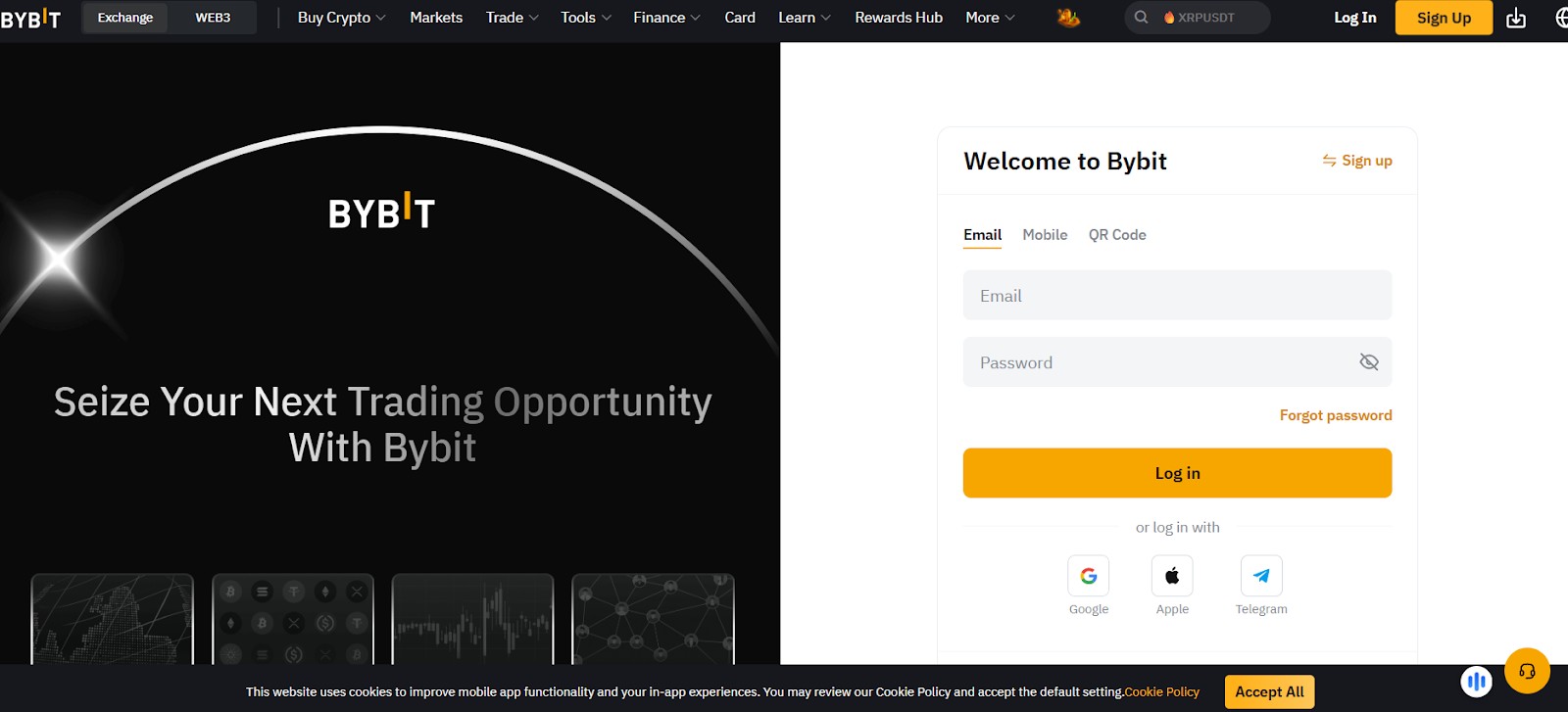
Create a primary account.
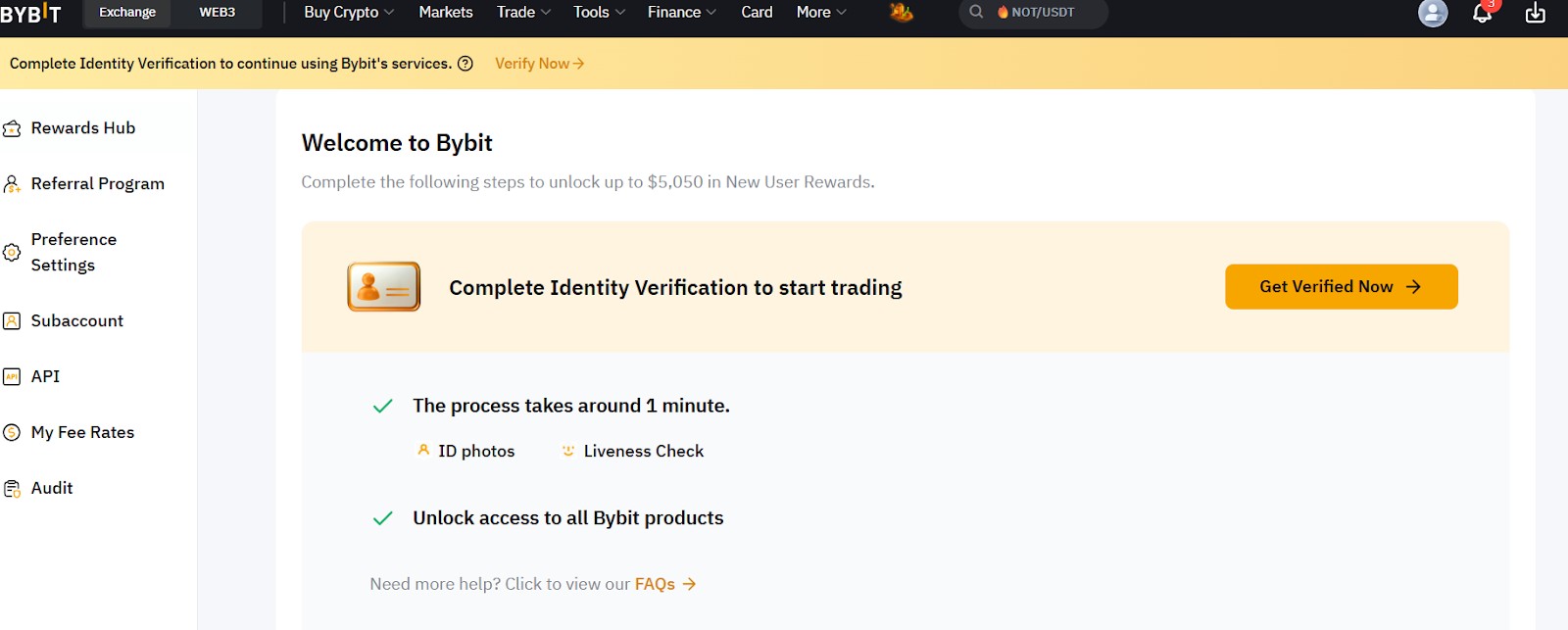
Verify identity via KYC.
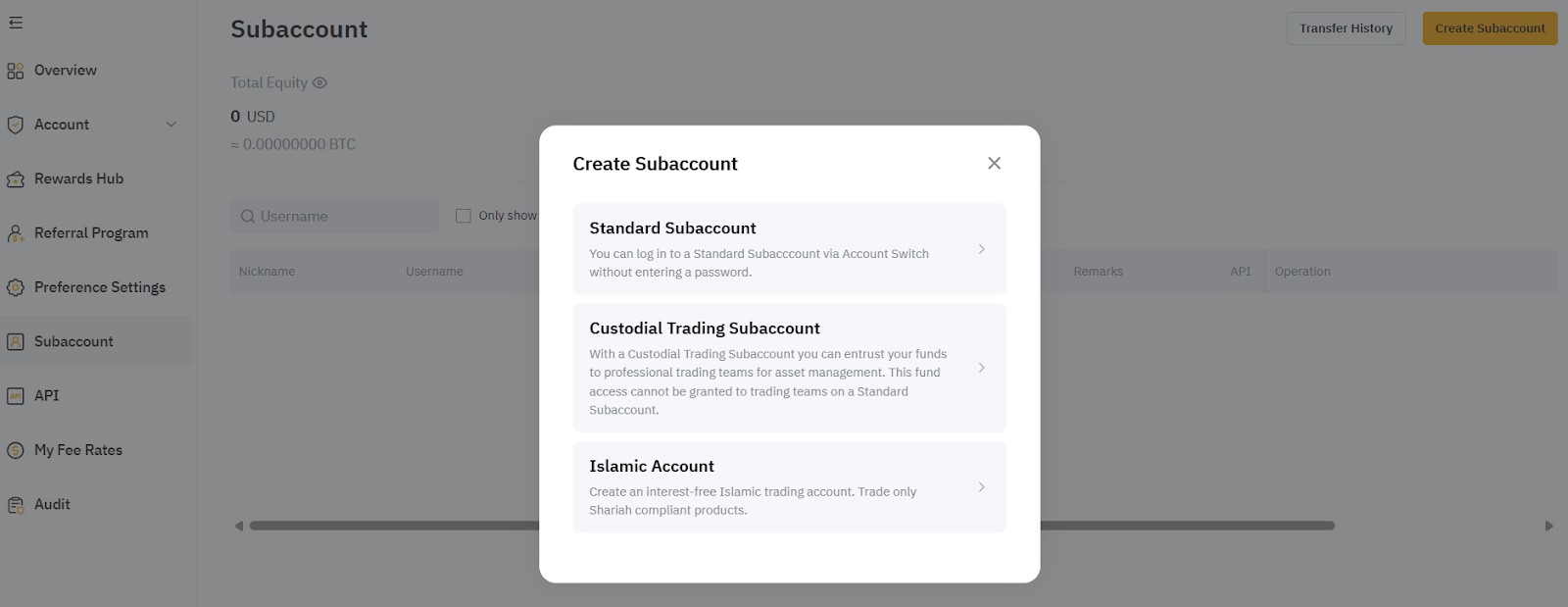
Open a subaccount and choose the “Islamic Account” designation.
Review and accept the Wakalah Agreement, which governs the relationship with Bybit under Islamic rules.
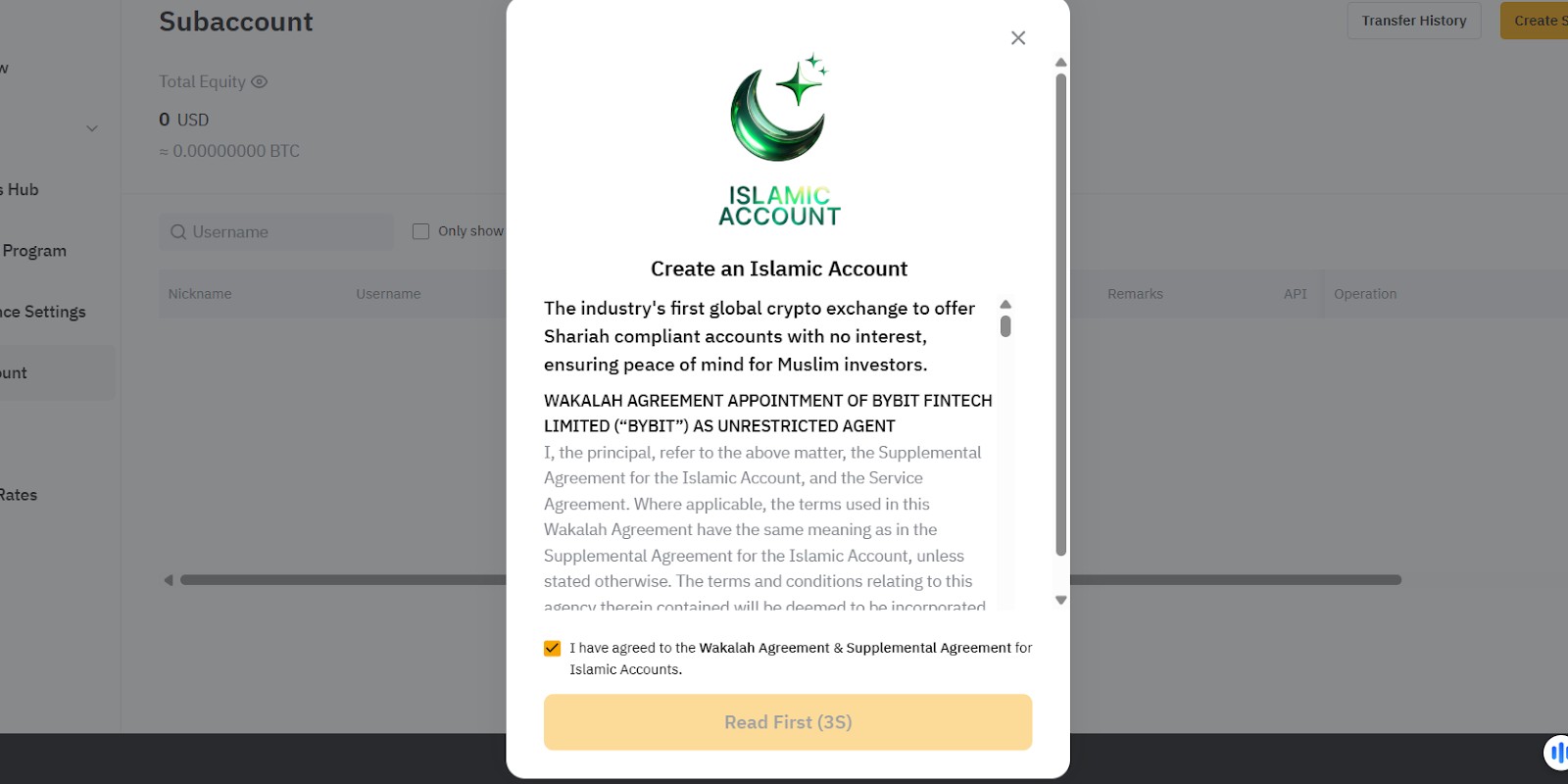
Choose a secure password and nickname to activate the account.

Traders cannot convert existing accounts into Islamic ones; instead, they must manage them separately. This restriction is in place to maintain the integrity of the compliance system.
Limitations and considerations
Even with double Shariah certification and interest‑free structures, the Bybit Islamic account is not a silver bullet. Crypto markets are inherently volatile; tokens can lose value quickly, and projects can fail. Here are key limitations to consider:
Volatility and speculation risk. Unlike sukuk or Islamic mutual funds backed by tangible assets, cryptocurrencies derive much of their value from network effects and market sentiment. Rapid price swings can feel like gambling, even if the underlying project has utility. Establish position‑sizing rules and use tools like DCA to mitigate timing risk.
Absence of profit‑sharing models. Islamic finance traditionally emphasises partnership structures like mudarabah or musharakah, where profits and losses are shared. Bybit’s Islamic Account does not implement these models; it remains a conventional brokerage with a halal asset filter. If profit‑sharing is important to you, look into private equity, sukuk, or Islamic crowd‑funding platforms.
Limited asset selection. The 75 approved tokens represent a small fraction of the thousands of cryptocurrencies available. Many large‑cap coins may be excluded because they fail Shariah screening. This limitation can restrict diversification opportunities.
Custody and counterparty risk. When you trade on Bybit, your assets are held by the exchange. While Bybit claims to segregate client funds and maintain robust security, you still face custodial risk. Consider using external hardware wallets for long‑term storage and transferring only the amount you intend to trade.
Evolving compliance landscape. Crypto regulations and Shariah interpretations are evolving. A token or practice deemed halal today may be reclassified as haram tomorrow. Stay informed by following announcements from Bybit, CryptoHalal, and national regulators.
By being aware of these challenges, you can use the Islamic account responsibly while recognising its limitations.
| Feature | Bybit Islamic Account | Rain (Bahrain) | CoinMENA (Bahrain) | Biokript (UAE) |
|---|---|---|---|---|
| Shariah certification | Double certification via Crypto Halal & ZICO Holdings | Certified by local Shariah advisors | Certified by Shariah Review Bureau | Built on profit‑sharing model with Shariah board oversight |
| Trading instruments | Spot trading only; supports 75 vetted tokens and automated DCA/grid bots | Spot trading for ~20 tokens; no automated tools | Spot trading and OTC services for GCC currencies; no bots | Uses a hybrid centralised/decentralised model with profit‑share tokens |
| Interest or swap fees | None; flat trading fees | None | None | None |
| Profit‑sharing model | No | No | No | Yes; revenue shared with token holders |
| Regulatory status | Licences in Dubai (VARA), Kazakhstan (AFSA), Turkey (CMB) | Licensed by Bahrain’s Central Bank | Licensed by Bahrain’s Central Bank | Regulated as a crypto asset provider in UAE |
| Custody model | Centralised exchange; custody by Bybit | Centralised exchange; custody by Rain | Centralised exchange; custody by CoinMENA | Hybrid custody with user‑controlled wallets for profit‑share tokens |
If you’d prefer to compare a few Shariah-friendly platforms side-by-side, the list below highlights alternatives to Bybit with swap-free structures and halal screening. Explore fees, supported assets, and eligibility so you can choose the setup that best fits your ethics and trading style.
| Swap Free | Crypto | Stocks | Currency pairs | Min. deposit, $ | Regulation | TU overall score | Open an account | |
|---|---|---|---|---|---|---|---|---|
| Yes | Yes | Yes | 90 | No | ASIC, FCA, DFSA, BaFin, CMA, SCB, CySec | 9.3 | Go to broker Your capital is at risk.
|
|
| Yes | Yes | Yes | 80 | 100 | CIMA, FCA, FSA (Japan), NFA, IIROC, ASIC, CFTC | 6.49 | Study review | |
| Yes | No | Yes | 57 | 5 | CySEC, FSC (Belize), DFSA, FSCA, FSA (Seychelles), FSC (Mauritius), SCA (United Arab Emirates), CMA (Kenya) | 9.35 | Go to broker Your capital is at risk. |
|
| Yes | Yes | Yes | 90 | 1 | ASIC, VFSC, FSA | 9.25 | Go to broker Your capital is at risk. |
|
| Yes | Yes | Yes | 68 | No | FSC (BVI), ASIC, IIROC, FCA, CFTC, NFA | 6.66 | Go to broker Your capital is at risk. |
Who should use the Bybit islamic account?
Not every Muslim trader will find Bybit’s Islamic Account suitable. It’s best for:
Faith‑conscious beginners. If you’re new to crypto and want a structured environment vetted by Shariah experts, this account provides guardrails. You can learn to trade spot markets without worrying about hidden interest charges.
Long‑term investors. The DCA and grid bots encourage disciplined accumulation over time. If your goal is to build positions gradually rather than day‑trade, these tools align well with Islamic finance’s emphasis on patience and shared risk.
Traders in licensed regions. Residents of jurisdictions where Bybit holds licences (e.g., Dubai, Kazakhstan, Turkey) may have more regulatory clarity and local support. If you live elsewhere, check local rules and consider alternatives.
You might consider a different platform if you prioritise profit‑sharing models, need access to a wider range of coins, or prefer to self‑custody your assets.
Check funding rates and screen halal assets

When reviewing a Bybit Islamic account, the first thing beginners check is whether swaps are removed. But that is just the surface. The deeper layer lies in how Bybit handles perpetual futures, which have funding rates that can act like disguised interest. Even if the account is labeled “swap-free,” if you are trading perpetuals, the funding mechanism may still expose you to riba. A smart way to test this is by monitoring how often funding payments are triggered on an Islamic account compared to a regular account. If the frequency or cost shifts unnaturally, it is a signal that the broker might be adjusting fees in a way that indirectly reintroduces interest.
Another overlooked factor is the list of halal-approved assets offered under the account. Many traders assume that all listed cryptocurrencies are automatically Shariah-compliant, but not all coins pass the test. For instance, tokens tied to gambling, lending, or excessive speculation conflict with Islamic finance principles. Beginners should cross-check the available coins with Shariah screening criteria published by recognized Islamic finance boards. By doing this, you avoid the mistake of thinking the “Islamic” label alone guarantees halal compliance and instead build a portfolio that is genuinely free from riba and gharar.
Conclusion
Bybit's Islamic Account provides a dedicated structure for Muslims to trade cryptocurrencies without violating Islamic investing rules. It removes interest-based earnings, filters out non-halal tokens, and includes certified oversight. With over 75 approved assets and tools like DCA and Spot Bots, it's a strong option for ethical investors. However, it excludes profit-sharing models and high-risk instruments. Traders must assess their own strategies and beliefs before deciding. This account is best suited for disciplined, faith-conscious crypto users.
FAQs
Can I convert my current Bybit account to Islamic?
No, you must create a separate Islamic subaccount; conversions aren't allowed.
Are leverage and derivatives allowed in the Islamic Account?
No, only spot trading is supported to meet Shariah guidelines.
Is the list of halal tokens regularly updated?
Yes, Bybit works with external advisors to maintain compliance.
Do I need to verify religious identity to open an Islamic account?
No documentation of religion is required, but terms must be accepted.
Related Articles
Team that worked on the article
Alamin Morshed is a contributor at Traders Union. He specializes in writing articles for businesses that want to improve their Google search rankings to compete with their competition.
Dan Blystone began his trading career in 1998 as an arbitrage clerk on the floor of the Chicago Mercantile Exchange (CME). He later traded bond and Eurex futures at proprietary firms such as Altea Trading, gaining valuable experience in high-frequency trading and risk management.
Chinmay Soni is a financial analyst with more than 5 years of experience in working with stocks, Forex, derivatives, and other assets. As a founder of a boutique research firm and an active researcher, he covers various industries and fields, providing insights backed by statistical data.
-
 Afghanistan
-
 Albania
-
 Algeria
-
 Angola
-
 Argentina
-
 Armenia
-
 Australia
-
 Austria
-
 Azerbaijan
-
 Bahamas
-
 Bahrain
-
 Bangladesh
-
 Belarus
-
 Belgium
-
 Bolivia
-
 Botswana
-
 Brazil
-
 Brunei
-
 Bulgaria
-
 Cambodia
-
 Cameroon
-
 Canada
-
 Chile
Chile
-
 China
China
-
 Colombia
-
 Congo
Congo
-
 Costa Rica
-
 Cote d'Ivoire
-
 Croatia
-
 Cuba
Cuba
-
 Cyprus
-
 Czechia
-
 DR Congo
-
 Denmark
-
 Dominican Republic
-
 Ecuador
-
 Egypt
Egypt
-
 El Salvador
-
 Estonia
-
 Eswatini
-
 Ethiopia
-
 Finland
-
 France
-
 Georgia
-
 Germany
-
 Ghana
Ghana
-
 Greece
-
 Haiti
Haiti
-
 Hong Kong
-
 Hungary
-
 India
India
-
 Indonesia
-
 Iran, Islamic republic
-
 Iraq
Iraq
-
 Ireland
-
 Israel
-
 Italy
Italy
-
 Jamaica
-
 Japan
Japan
-
 Jordan
-
 Kazakhstan
-
 Kenya
Kenya
-
 Korea
Korea
-
 Kuwait
-
 Kyrgyzstan
-
 Laos
Laos
-
 Latvia
-
 Lebanon
-
 Lesotho
-
 Libya
Libya
-
 Lithuania
-
 Luxembourg
-
 Madagascar
-
 Malaysia
-
 Malta
Malta
-
 Mauritius
-
 Mexico
-
 Moldova
-
 Mongolia
-
 Montenegro
-
 Morocco
-
 Mozambique
-
 Myanmar
-
 Namibia
-
 Nepal
Nepal
-
 Netherlands
-
 New Zealand
-
 Nigeria
-
 North Macedonia
-
 Norway
-
 Oman
Oman
-
 Pakistan
-
 Palestine
-
 Panama
-
 Papua New Guinea
-
 Paraguay
-
 Peru
Peru
-
 Philippines
-
 Poland
-
 Portugal
-
 Puerto Rico
-
 Qatar
Qatar
-
 Reunion
-
 Romania
-
 Rwanda
-
 Saudi Arabia
-
 Serbia
-
 Singapore
-
 Slovakia
-
 Slovenia
-
 Somalia
-
 South Africa
-
 Spain
Spain
-
 Sri Lanka
-
 Sweden
-
 Switzerland
-
 Syria
Syria
-
 Taiwan
-
 Tajikistan
-
 Tanzania
-
 Thailand
-
 Trinidad and Tobago
-
 Tunisia
-
 Turkey
-
 UAE
UAE
-
 Uganda
-
 Ukraine
-
 United Kingdom
-
United States
-
 Uruguay
-
 Uzbekistan
-
 Venezuela
-
 Vietnam
-
 Yemen
Yemen
-
 Zambia
-
 Zimbabwe
- Forex
- Crypto












