
Trusted Halal Cryptocurrency List For Muslim Investors In 2026


Editorial Note: While we adhere to strict Editorial Integrity, this post may contain references to products from our partners. Here's an explanation for How We Make Money. None of the data and information on this webpage constitutes investment advice according to our Disclaimer.
Halal cryptocurrency list for 2026:
Bitcoin (BTC). Considered halal when traded on spot markets without leverage or speculation.
Ethereum (ETH). Permissible if used in ethical projects; problematic if tied to gambling or riba-based DeFi.
Cardano (ADA). Viewed as Shariah-friendly due to transparency, efficiency, and real-world utility.
Polygon (MATIC). Halal when used in non-haram applications like public services and education.
Stellar (XLM). Favors halal use through cross-border payments and financial inclusion tools.
Algorand (ALGO). Suitable for Islamic finance if kept clear of interest-based DeFi integrations.
Islamic Coin (ISLM). Built for Shariah compliance with charitable structure and ethical governance.
Tezos (XTZ). Acceptable when applied in scientific, educational, or transparent smart contract use.
Solana (SOL). Potentially halal if traded without leverage and away from speculative DeFi.
Avalanche (AVAX). Permissible when supporting asset-backed, ethical, and transparent applications.
Figuring out which crypto tokens are halal or haram in 2026 is not just some theory anymore. With so many coins offering guaranteed returns or built on hype alone, Muslim investors now have to dig deeper before trusting any project. It is not just about skipping gambling coins or shady platforms. The real issue is spotting coins that sneak in interest-based systems or hide behind vague promises. If a token’s value comes from guessing games or borrowed money, it cannot be Sharia-friendly. These filters are not just rules, they are what protect faith and finance from getting mixed up in noise.
This overview represents part of a broader halal crypto list, curated to help Muslim investors identify coins that align with Shariah principles.
Risk warning: Cryptocurrency markets are highly volatile, with sharp price swings and regulatory uncertainties. Research indicates that 75-90% of traders face losses. Only invest discretionary funds and consult an experienced financial advisor.
Is crypto halal?
As digital finance continues to evolve, many Muslim investors are left wondering: Does cryptocurrency align with Sharia principles? In particular, it’s essential to understand which digital assets are acceptable and which should be avoided as per Islamic finance. For clarity, our list of halal crypto coins below distinguishes permissible assets from those that may fall into haram territory.
This article explores the criteria used to assess cryptocurrencies through the lens of Sharia principles and highlights a verified crypto halal list for 2026, offering insight into how these coins comply with Islamic financial ethics.
Halal crypto list: Which cryptocurrencies comply with Sharia
Islamic law requires that a digital asset be free from riba (interest), gharar (excessive uncertainty), and maysir (gambling). When it comes to cryptocurrencies, it involves avoiding interest-based mechanisms, unclear financial models, and speculative setups with no real substance. Being added to a halal coin list depends on how the project’s fundamentals meet these Islamic conditions.

Inclusion in the halal cryptocurrency list depends on the structure of the blockchain, clear information on token distribution, practical use in the economy, and how useful it is in everyday life. Payment features, limited supply, and no staking incentives are key factors for a coin to pass through any trusted crypto halal checker and make it to the halal crypto coins list reviewed by Islamic finance experts.
“Trading or renting out a medium of exchange is wrong because money is not productive and has no intrinsic utility.”
Sheikh Muhammad Taqi Usmani – Islamic Jurist, Chairman of AAOIFI Shariah Board
As per multiple Shariah audits, projects consistently appearing in the halal coins list have clear real-world use cases, transparent teams, and ethical intentions behind their protocols.
Which cryptocurrency is halal?
Bitcoin (BTC)
Bitcoin is widely regarded as the most Shariah-compliant cryptocurrency. It functions like digital gold, being decentralized, scarce, and free from interest (riba). Many investors begin with Bitcoin, as it meets key Islamic finance criteria. Many scholars agree that BTC is halal if traded under spot contracts with immediate settlement (taqabudh) and without leverage or speculative intent.
Ethereum (ETH)
Ethereum supports smart contracts and decentralized applications (DApps). Its halal status depends on usage. ETH is considered permissible when used in ethical, transparent projects. However, it becomes problematic if tied to haram sectors such as gambling, interest-based DeFi, or highly speculative schemes. Scholars emphasize evaluating the purpose behind the contract. Evaluating which coins are halal always involves checking the project’s purpose, and in Ethereum’s case, that purpose determines permissibility.
Cardano (ADA)
Cardano is built on peer-reviewed academic research and offers a transparent, energy-efficient, and decentralized blockchain. It avoids speculative hype and promotes real-world use cases in education, identity, and infrastructure, aligning with Islamic principles of social benefit and ethical finance.
Polygon (MATIC)
Polygon is a scaling solution for Ethereum that reduces gas fees and increases transaction speed. It supports ethical use cases across government, education, and financial services. As long as MATIC is not used in haram DApps (e.g., gambling platforms), it is generally considered halal. Polygon also qualifies as a Shariah compliant crypto because it supports transparency and inclusivity.
Stellar (XLM)
Stellar is focused on cross-border payments and financial inclusion. It provides utility in remittances and microfinance, particularly in underserved regions. XLM has no ties to interest or unethical sectors, making it favorable in halal screening, especially for charity-oriented and inclusive finance platforms. Hence, it consistently appears in expert-reviewed halal crypto coins list resources for Muslim investors.
Algorand (ALGO)
Algorand is a green blockchain that enables CBDCs, tokenized real-world assets, and compliant DeFi. Its transparent consensus model and broad institutional usage contribute to its halal appeal. As long as ALGO avoids riba-based integrations, it is suitable for Islamic investors. It also frequently features in the halal crypto coin list approved by independent Shariah boards.
Islamic Coin (ISLM)
ISLM is the first crypto designed specifically with Islamic principles in mind. It has a Shariah board and features like the EverGreen DAO, which donates a portion of earnings to charitable causes. This makes it a defining example of an Islamic cryptocurrency that embodies ethical governance and religious compliance. The coin is built to support halal finance ecosystems and avoid interest, speculation, and unethical use cases by design.
Tezos (XTZ)
Tezos is known for formal verification of smart contracts and energy efficiency. It is used in cultural, educational, and scientific contexts and offers strong transparency, which are key factors in Shariah compliance. XTZ is seen as a trustworthy and stable option when not used in speculative DeFi. Such projects strengthen the credibility of the Shariah compliant cryptocurrency list, as they show how innovation can coexist with religious principles.
Solana (SOL)
Solana is a high-speed, scalable blockchain used in many decentralized applications. It can be halal if traded on spot markets without leverage or margin. However, its involvement in speculative DeFi and meme token projects requires caution and careful vetting by Muslim investors.
Avalanche (AVAX)
Avalanche is a smart contract platform for launching scalable DApps and financial products. It is considered potentially halal when used to support real-asset projects, tokenization, or ethical finance. Scholars caution against DeFi platforms on AVAX that involve interest or excessive risk. The coin’s inclusion in the halal cryptocurrencies category depends on how developers and users employ it in real-world finance.
Staying updated is important
Halal compliance isn't just about the coin itself, but also about how you interact with it. Trading on spot markets, avoiding leverage, researching project intent, and steering clear of speculation are all essential steps toward ethical participation.
Muslim investors are encouraged to:
refer to updated halal and haram crypto list resources;
evaluate projects for transparency, utility, and ethical alignment;
seek guidance from trusted Shariah scholars when in doubt.
As technology and Shariah scholarship continue to converge, the Sharia law cryptocurrency ecosystem will only grow stronger, offering more choices for faith-conscious investing without compromising religious values.
How to invest in shariah-compliant crypto
To invest in Shariah compliant crypto, you will need an account with a crypto exchange that lists approved halal assets. We have presented the top options below based on our research for you to compare and choose from.
| Coinbase | OKX | BTCC | Cryptohopper | Crypto.com | |
|---|---|---|---|---|---|
|
Coins Supported |
400+ | 600+ | 399 | 1000 | 400+ |
|
Spot Taker fee, % |
0.5 | 0.1 | 0.3 | 0 | 0.5 |
|
Spot Maker Fee, % |
0.5 | 0.08 | 0.2 | 0 | 0.25 |
|
Min. Deposit, $ |
10 | 10 | 10 | No | 1 |
|
Tier-1 regulation |
Yes | No | Yes | No | Yes |
|
TU overall score |
8.5 | 8.46 | 8.08 | 7.8 | 7.76 |
|
Open an account |
Go to broker Your capital is at risk. |
Go to broker Your capital is at risk. |
Go to broker Your capital is at risk.
|
Go to broker Your capital is at risk. |
Go to broker Your capital is at risk. |
Haram coin list for 2026
Certain digital assets violate fundamental principles of Islamic law and fall outside the permissible scope for investment. The haram crypto list is regularly updated alongside the halal and crypto list to help investors distinguish permissible assets from those that violate faith-based financial ethics. The main criteria focus on the presence of riba, maysir, or gharar in the asset’s structure or use.
"High volatility and lack of intrinsic value in cryptocurrencies create elements of gharar that are incompatible with Islamic contracts", said Mufti Muhammad Taqi Usmani, a renowned Islamic theologian and expert in fiqh muamalat.
Tokens tied to the gambling industry, betting sites, or gaming platforms that involve risk and uncertainty fall under the restricted haram coin list. Projects offering fixed-interest staking, crypto lending, or guaranteed yield structures are also avoided. It also matters when a project lacks transparency in its codebase, token allocation, or legal structure.
Haram crypto list includes:
Shiba Inu (SHIB). Meme coin with no intrinsic value; highly speculative and driven by hype.
Dogecoin (DOGE). Popularized through meme culture; lacks substantial utility and often used in speculative trades.
SafeMoon (SAFEMOON). Known for pump-and-dump behavior; unclear business model and high volatility.
Pepe (PEPE). Meme token with no underlying project; primarily used for speculative gambling-like behavior.
Floki Inu (FLOKI). Marketed aggressively with little to no real-world utility; raises concerns over investor manipulation.
Luna Classic (LUNC). After the Terra collapse, it became a speculative asset without stable backing.
Hex (HEX). Promises return through staking, with mechanisms resembling interest or pyramid schemes.
Bitconnect (BCC). Exposed as a Ponzi scheme; it used deceptive high-yield returns with no real product.
CasinoCoin, GambleFi, and similar tokens. Directly tied to online gambling platforms, categorically haram.
Certain DeFi tokens like AAVE or Compound. When used in riba-based transactions, they contradict core Islamic finance rules.
These assets are contrasted against the halal crypto list, which emphasizes ethical and transparent projects aligned with Islamic principles.
Islamic cryptocurrency: Principles of Sharia in digital assets
An Islamic cryptocurrency operates strictly under Sharia law, excluding riba (interest), gharar (excessive uncertainty), and maysir (gambling). These assets must ensure transparency, fairness, and the absence of speculative elements.
“Bitcoin is inherently subject to the risk of maysir and gharar, making its use problematic from a Sharia perspective.”
A verified Shariah-compliant cryptocurrency list relies on certification or fatwa issued by recognized scholars. For instance, Islamic Coin (ISLM) obtained a Sharia compliance fatwa in June 2022. It operates on the Haqq Network blockchain and dedicates 10% of each new issuance to the Evergreen DAO charitable fund, aligning with the zakat principle.
Another notable example is OneGram (OGC), where each coin is backed by one gram of physical gold, offering intrinsic value and stability. These gold-backed halal coins serve as a bridge between traditional Islamic finance and digital innovation, ensuring intrinsic value and tangible backing. This project aims to merge Islamic finance with blockchain innovation, making it particularly appealing to Muslim investors.
To evaluate investment options, individuals can consult dedicated platforms that offer a list of halal cryptocurrencies and curated halal cryptocurrencies databases. These sources are among the most referenced by Muslim investors seeking clarity:
These platforms offer curated insights into halal crypto opportunities, helping investors make informed choices that respect their faith. A modern halal crypto screener can cross-check tokens against Shariah criteria, streamlining due diligence for faith-based investors.
A well-designed Shariah-compliant crypto framework integrates Islamic principles into the crypto space by focusing on clarity, real asset backing, and avoiding excessive speculation. Such systems also contribute to global halal crypto lists, improving access to transparent information. This thoughtful approach allows Muslim individuals to participate in digital finance while staying true to their ethical and religious standards.
Crypto halal checker: Tools for assessing Sharia compliance
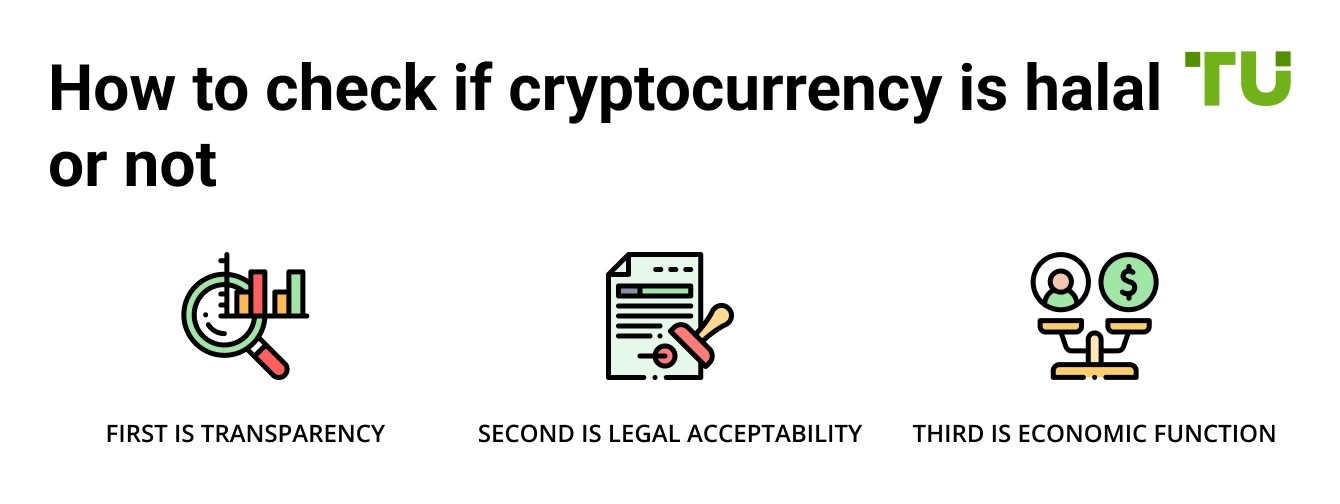
Verifying digital assets in accordance with Islamic principles involves examining their structure, purpose, and how they are distributed. To assess whether a digital currency fits within Islamic guidelines, tools like the reliable list of halal cryptocurrencies and similar evaluators are used.
These systems assess tokens through frameworks shaped by Islamic finance scholars, ensuring they meet both religious and financial standards.
The process typically involves three major areas of scrutiny:
Transparency. The project must have open-source code, clearly defined token supply models, visible validator roles, income sources, and overall business logic.
Legal acceptability. It must avoid interest-based systems, guaranteed staking returns, or any association with gambling.
Economic function. The token must serve real-world purposes like energy transactions, logistics, B2B payments, microloans, or infrastructure development.
Saraf Screening offers an advanced evaluation engine for Islamic cryptocurrency, taking into account both Sunni and Shia interpretations of Shariah. Each asset is analyzed with detailed ratings and commentary rooted in fatwas. Similarly, the Crypto Ummah platform provides a screening tool that classifies assets into halal, doubtful, or haram based on income generation, profit sharing, regulatory standing, and practical applications.
Some services go further by offering features like zakat estimators and location-based filters to reflect local Islamic finance rules. Such filters strengthen halal crypto lists and simplify decision-making for users comparing potential investments.
These tools help users fine-tune results for their regional context and simplify the decision-making process when identifying coins that align with Shariah law.
The real Sharia test is in the token’s structure not the label

The biggest mistake beginners make is assuming a token is halal just because it is not tied to gambling or adult content. But in 2026, many coins are wrapped in sleek branding while hiding lending mechanics or yield farming protocols that involve fixed returns. If you see any project promising guaranteed APY, look under the hood. Is there a pool that generates returns through interest-based lending? Are staking rewards fixed and contractual instead of risk-based? That is your red flag. Halal investing is not about the use case alone. It is about how profit is earned and whether uncertainty is kept in check.
Another thing many miss is the risk of indirect involvement. You might hold a token that looks clean, but if it belongs to a DeFi ecosystem that pools liquidity with haram platforms, you are still exposed. Take time to read how that token fits into the bigger system. Ask whether the revenue model includes swap fees from interest-based pairs or if it routes through lending layers with riba. Sharia compliance is not surface level. It sits inside the contract logic. That is where your real due diligence starts.
Conclusion
True Sharia-compliant crypto investing is not about simply avoiding coins tied to gambling or adult content, but requires discerning the underlying financial models that drive profit and risk. The most powerful safeguard for Muslim investors is careful scrutiny of each project's structure, especially to spot hidden riba-based returns or speculative schemes. Coins like Bitcoin and Islamic Coin stand out as strong examples when used ethically, while meme coins or interest-driven DeFi projects must be approached with extreme caution. Ultimately, real faith-conscious investing depends on understanding not just the label but the logic that powers every digital asset.
FAQs
What types of activities typically lead to a cryptocurrency being classified as haram on the Halal And Haram Crypto List (2026)?
How does the use of leverage and speculation influence a token’s status on the Halal And Haram Crypto List (2026)?
Why is ongoing Shariah scholarship important for maintaining the Halal And Haram Crypto List (2026)?
Can indirect association with non-compliant platforms affect a cryptocurrency’s status on the Halal And Haram Crypto List (2026)?
Editors' Top Picks and Insights





Related Articles
Team that worked on the article
Alamin Morshed is a contributor at Traders Union. He specializes in writing articles for businesses that want to improve their Google search rankings to compete with their competition.
Dan Blystone began his trading career in 1998 as an arbitrage clerk on the floor of the Chicago Mercantile Exchange (CME). He later traded bond and Eurex futures at proprietary firms such as Altea Trading, gaining valuable experience in high-frequency trading and risk management.
Chinmay Soni is a financial analyst with more than 5 years of experience in working with stocks, Forex, derivatives, and other assets. As a founder of a boutique research firm and an active researcher, he covers various industries and fields, providing insights backed by statistical data.
Ethereum is a decentralized blockchain platform and cryptocurrency that was proposed by Vitalik Buterin in late 2013 and development began in early 2014. It was designed as a versatile platform for creating decentralized applications (DApps) and smart contracts.
Risk management is a risk management model that involves controlling potential losses while maximizing profits. The main risk management tools are stop loss, take profit, calculation of position volume taking into account leverage and pip value.
An investor is an individual, who invests money in an asset with the expectation that its value would appreciate in the future. The asset can be anything, including a bond, debenture, mutual fund, equity, gold, silver, exchange-traded funds (ETFs), and real-estate property.
Index in trading is the measure of the performance of a group of stocks, which can include the assets and securities in it.
A Ponzi scheme may be defined as a fraudulent scheme in which the perpetrators attract investors and pay them a relatively small profit from new investors just before the criminals abscond with the overwhelming bounty of the funds.

-
 Afghanistan
-
 Albania
-
 Algeria
-
 Angola
-
 Argentina
-
 Armenia
-
 Australia
-
 Austria
-
 Azerbaijan
-
 Bahamas
-
 Bahrain
-
 Bangladesh
-
 Belarus
-
 Belgium
-
 Bolivia
-
 Botswana
-
 Brazil
-
 Brunei
-
 Bulgaria
-
 Cambodia
-
 Cameroon
-
 Canada
-
 Chile
Chile
-
 China
China
-
 Colombia
-
 Congo
Congo
-
 Costa Rica
-
 Cote d'Ivoire
-
 Croatia
-
 Cuba
Cuba
-
 Cyprus
-
 Czechia
-
 DR Congo
-
 Denmark
-
 Dominican Republic
-
 Ecuador
-
 Egypt
Egypt
-
 El Salvador
-
 Estonia
-
 Eswatini
-
 Ethiopia
-
 Finland
-
 France
-
 Georgia
-
 Germany
-
 Ghana
Ghana
-
 Greece
-
 Haiti
Haiti
-
 Hong Kong
-
 Hungary
-
 India
India
-
 Indonesia
-
 Iran, Islamic republic
-
 Iraq
Iraq
-
 Ireland
-
 Israel
-
 Italy
Italy
-
 Jamaica
-
 Japan
Japan
-
 Jordan
-
 Kazakhstan
-
 Kenya
Kenya
-
 Korea
Korea
-
 Kuwait
-
 Kyrgyzstan
-
 Laos
Laos
-
 Latvia
-
 Lebanon
-
 Lesotho
-
 Libya
Libya
-
 Lithuania
-
 Luxembourg
-
 Madagascar
-
 Malaysia
-
 Malta
Malta
-
 Mauritius
-
 Mexico
-
 Moldova
-
 Mongolia
-
 Montenegro
-
 Morocco
-
 Mozambique
-
 Myanmar
-
 Namibia
-
 Nepal
Nepal
-
 Netherlands
-
 New Zealand
-
 Nigeria
-
 North Macedonia
-
 Norway
-
 Oman
Oman
-
 Pakistan
-
 Palestine
-
 Panama
-
 Papua New Guinea
-
 Paraguay
-
 Peru
Peru
-
 Philippines
-
 Poland
-
 Portugal
-
 Puerto Rico
-
 Qatar
Qatar
-
 Reunion
-
 Romania
-
 Rwanda
-
 Saudi Arabia
-
 Serbia
-
 Singapore
-
 Slovakia
-
 Slovenia
-
 Somalia
-
 South Africa
-
 Spain
Spain
-
 Sri Lanka
-
 Sweden
-
 Switzerland
-
 Syria
Syria
-
 Taiwan
-
 Tajikistan
-
 Tanzania
-
 Thailand
-
 Trinidad and Tobago
-
 Tunisia
-
 Turkey
-
 UAE
UAE
-
 Uganda
-
 Ukraine
-
 United Kingdom
-
United States
-
 Uruguay
-
 Uzbekistan
-
 Venezuela
-
 Vietnam
-
 Yemen
Yemen
-
 Zambia
-
 Zimbabwe
- Forex
- Crypto










- Is crypto halal?
- Halal crypto list: Which cryptocurrencies comply with Sharia
- Which cryptocurrency is halal?
- How to invest in shariah-compliant crypto
- Haram coin list
- Islamic cryptocurrency: Principles of Sharia in digital assets
- Crypto halal checker: Tools for assessing Sharia compliance
- Expert opinion
- Conclusion
- FAQs


