
WhiteBIT Launchpad Guide For 2026


Editorial Note: While we adhere to strict Editorial Integrity, this post may contain references to products from our partners. Here's an explanation for How We Make Money. None of the data and information on this webpage constitutes investment advice according to our Disclaimer.
The WhiteBIT launchpad is the token sale platform on the WhiteBIT exchange that offers early access to curated crypto projects. Users vote to support a listing, and if the vote target is met, they receive token allocations. It provides a simple, exchange based way to join early stage launches without external wallets.
As crypto exchanges expand their ecosystems, launchpads have become a popular way to access new token projects early. WhiteBIT Launchpad is designed to connect users with vetted offerings through a structured and transparent process. In this article you will learn what WhiteBIT launchpad is, how the voting and distribution model works in 2026, how to participate step by step, what fees to expect, and which risks matter most.
What is WhiteBIT launchpad


The WhiteBIT launchpad is a curated token sale platform built inside the WhiteBIT exchange. Everything takes place in your account, so you do not need external wallets or contract interactions. Projects shown on the WhiteBIT launchpad go through an internal review, which helps filter out many low-quality launches, though it does not guarantee results.
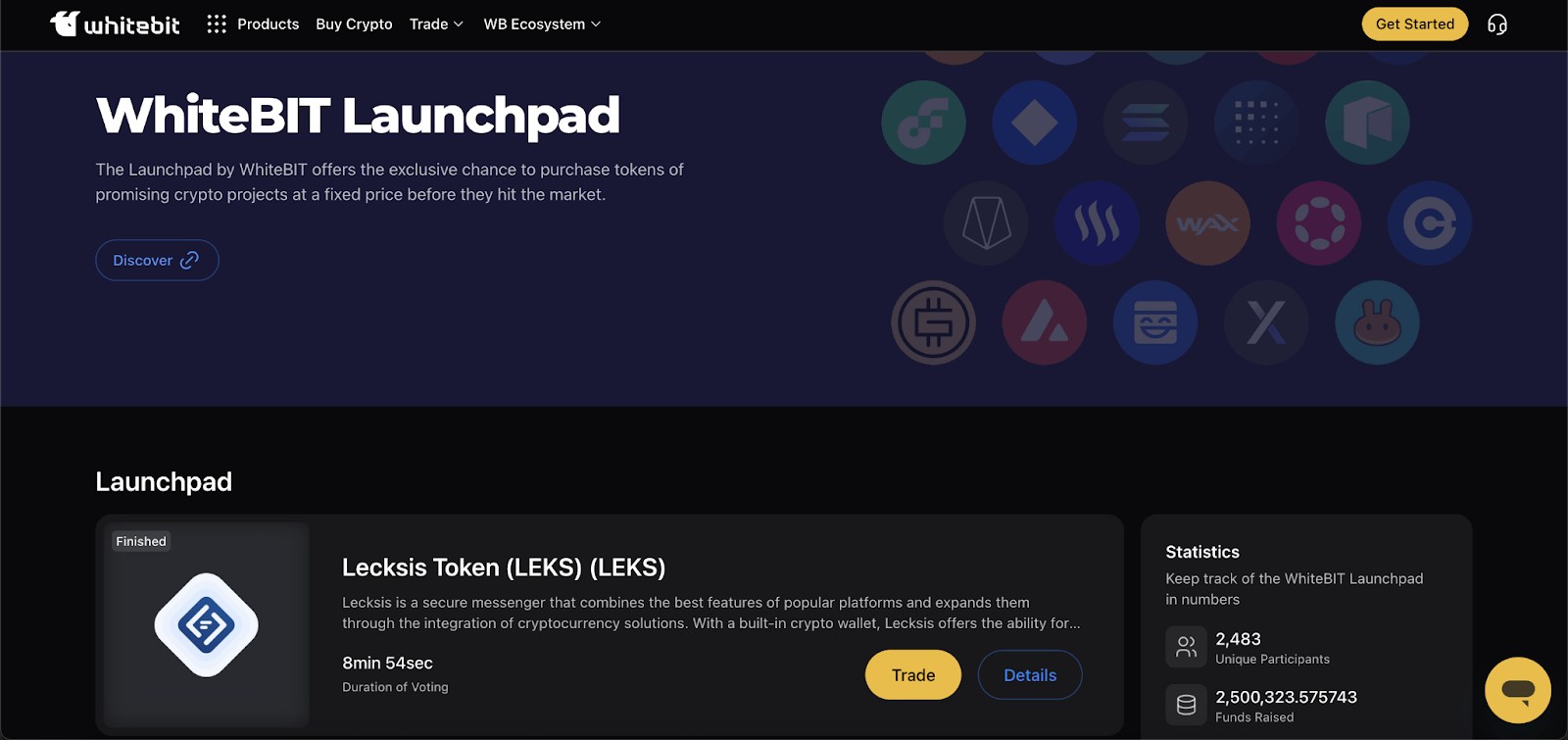
A defining feature is the vote to list model. Instead of only buying tokens early, users vote to support a listing. The project must meet a voting target before it moves to distribution and listing.
How WhiteBIT launchpad works
The WhiteBIT launchpad follows three simple stages.
Stage 1. Project presentation and voting window
WhiteBIT publishes the project page with a short overview, token concept, and event schedule. During the active period users can vote for the project. Voting power is tied to the amount you allocate for voting and to your WBT Holding level.
Stage 2. Settlement and results
After the voting window closes, WhiteBIT checks if the project met its required vote target. If it succeeds, the event moves to distribution. If it fails, the committed funds return to users.
Stage 3. Token distribution and listing
Tokens are credited to eligible users once the event is finalized. Many launches use vesting, so the tokens unlock in parts over time. After distribution, the token lists on WhiteBIT, giving users a direct place to trade when unlocks begin.
WBT Holding and eligibility
Access to the WhiteBIT launchpad depends on holding the WhiteBIT Coin, known as WBT, in a separate balance called Holding. Your Holding level decides whether you can join an event and how much you are allowed to commit during voting.
Most launchpad events require Level two or higher, which usually means keeping at least 200 WBT in Holding. Some events may set different limits, so the event page is always the final rulebook.
Your WBT level affects two things:
eligibility to vote;
the size of your allocation cap in USDT terms.
In practice, WBT works as both your access pass and your boost for higher allocation potential.
Pros and cons of WhiteBIT launchpad
Here is a clear look at the main strengths and weaknesses of the WhiteBIT launchpad in 2026. It helps you decide whether this platform matches your goals before you join any event.
- Pros
- Cons
Curated projects. WhiteBIT filters candidates before listing them on the launchpad, which can reduce obvious scam risk.
Community driven listings. Vote to list connects early buyers with real exchange demand.
Simple user flow. No external wallets, bridges, or contract approvals.
Clear WBT utility. Holding WBT provides concrete advantages beyond trading discounts.
Fast path to liquidity. Tokens are usually listed on WhiteBIT soon after distribution.
Allocation uncertainty. High participation can dilute per user results.
WBT price exposure. You may need to hold WBT for access, and its price can move while you qualify.
Event specific rules. Minimum Holding level, caps, and vesting terms vary by launch.
Verification and region limits. Some users may need higher verification or may be excluded by location.
Early token volatility. Even curated projects can drop sharply after listing.
How to join WhiteBIT launchpad step-by-step
Getting started with the WhiteBIT launchpad is simple because everything happens inside the WhiteBIT exchange. Meet the WBT Holding requirement, follow the event window, and read the rules before committing funds. Exact steps to follow are:
Step 1: Voting phase
Users who hold WBT tokens can participate in voting and support a selected project on the WhiteBIT Launchpad. The number of votes reflects community interest and directly influences whether the project moves forward.
Step 2: Settlement period
During the settlement phase, votes are counted to determine whether the project has reached the required threshold for exchange listing. This period also finalizes user participation for the upcoming token distribution.
Step 3: Token distribution
If the project successfully meets the voting requirements and the Launchpad campaign concludes, participants receive the allocated tokens. If the required number of votes is not reached, all committed funds are returned to users.

Risks and warnings
The WhiteBIT launchpad gives access to early-stage tokens, which come with significant risk. Prices can swing sharply after listing, and a strong promotion does not mean long term success. Some projects may fail or lose momentum.
Early token volatility. Prices can move heavily right after listing.
Vesting limits. Unlock schedules may delay your ability to sell.
Uncertain allocation. High demand can reduce the size you receive.
WBT exposure. Your results depend on both the new token and WBT price changes.
Platform risk. You rely on WhiteBIT to handle settlement and custody correctly.
Region rules. Some events may require higher verification or exclude certain locations.
Security caution. Always use official WhiteBIT pages and avoid third party links and only allocate funds you are prepared to lose.
Fees on WhiteBIT launchpad
There is no single fixed fee on the WhiteBIT launchpad. Your total cost depends on the event and on how you prepare for it.
WBT opportunity cost. Holding WBT ties up capital and exposes you to price changes.
Trading fees. Buying WBT or USDT includes standard spot trading costs.
Event pricing. Your real cost depends on token price, allocation size, demand, and vesting rules.
Time cost. Holding tokens through an event can affect your overall return.
Estimate the full cost before voting so you understand how each factor affects your outcome.
Security and regulation
WhiteBIT is a centralized exchange and the WhiteBIT launchpad is a custodial service. This makes the process simple, but it also means you depend on the platform to manage settlement and token distribution safely.
Custodial setup. WhiteBIT controls the settlement process, which adds convenience but also platform risk.
Verification levels. Access to some events may require higher verification steps.
Regional limits. Certain countries may be restricted from joining specific events.
Regulated environment. Rules can improve clarity but do not remove investment risk.
WhiteBIT launchpad compared with other launchpads
WhiteBIT launchpad is closer to an exchange native listing accelerator than to a typical on-chain launchpad. Here’s how it compares to other generic launchpads:
Project selection. WhiteBIT offers curated projects, while many open launchpads allow broad submissions with lighter filtering.
Access model. WhiteBIT relies on WBT Holding plus voting caps, while other launchpads often use staking, first come sales, or simple lotteries.
User experience. WhiteBIT keeps everything inside the exchange. On-chain launchpads often require external wallets and manual transaction steps.
Main trade off. WhiteBIT gives simplicity and community alignment, but demands WBT exposure and has voting uncertainty.
| Feature | WhiteBIT launchpad | Typical crypto launchpads |
|---|---|---|
| Project selection | Curated by WhiteBIT with community voting | Often open submissions or lighter filtering, sometimes fewer launches |
| Access model | WBT Holding tiers plus vote to list and USDT caps tied to WBT | Staking native token, first come sales, lotteries, or open access |
| User experience | Fully inside the WhiteBIT exchange, guided flow | Frequently requires external wallets, bridging, and manual approvals |
| Custody during sale | Custodial, WhiteBIT handles settlement and distribution | Mixed, many are non custodial or semi custodial |
| Allocation certainty | Medium, depends on voting demand and caps | Varies widely, high in FCFS, lower in lotteries |
| Best for | Users wanting simple early access with community influence | Users prioritizing on chain control or specific launch models |
| Main trade off | Convenience and demand alignment, but WBT exposure and voting uncertainty | More freedom, but higher technical friction and sometimes higher scam risk |
Who should use the WhiteBIT launchpad
The WhiteBIT launchpad is a good match for users who want early token access through a simple exchange interface and are willing to hold WBT to qualify. It also suits active users who prefer regular curated opportunities instead of rare, high profile launches.
It is not ideal for users who want guaranteed allocation sizes, do not want to hold exchange tokens, or prefer non custodial setups.
For users exploring early token launches, the launchpad is usually only one part of a broader trading setup. After participating in a vote or receiving allocations, most users also rely on established crypto exchanges in their region to manage trades, liquidity, and portfolio balance. Comparing these exchanges alongside launchpad opportunities helps ensure smoother transitions from early access to active trading. This makes it easier to plan how new tokens fit into a wider crypto strategy.
| Coinbase | OKX | BTCC | Cryptohopper | Crypto.com | |
|---|---|---|---|---|---|
|
Min. Deposit, $ |
10 | 10 | 10 | No | 1 |
|
Coins Supported |
400+ | 600+ | 399 | 1000 | 400+ |
|
Spot Taker fee, % |
0.5 | 0.1 | 0.3 | 0 | 0.5 |
|
Spot Maker Fee, % |
0.5 | 0.08 | 0.2 | 0 | 0.25 |
|
Alerts |
Yes | Yes | No | Yes | Yes |
|
Copy trading |
No | Yes | Yes | Yes | No |
|
TU overall score |
8.5 | 8.46 | 8.08 | 7.8 | 7.76 |
|
Open an account |
Go to broker Your capital is at risk. |
Go to broker Your capital is at risk. |
Go to broker Your capital is at risk.
|
Go to broker Your capital is at risk. |
Go to broker Your capital is at risk. |
Be selective and treat each vote as a real investment choice

From my work reviewing early token platforms over the years, I have learned that the WhiteBIT launchpad works best for users who approach each event with intention rather than excitement. The voting model encourages you to slow down and think about why a project deserves to be listed at all. I often start by checking whether the idea would still interest me if the market turned quiet or if vesting delayed access. If the answer is weak, I avoid the event.
Holding WBT during the process adds another layer of commitment, since price changes can affect your final outcome. That extra step pushes users to be more selective, which is something I see as a practical benefit rather than a barrier. When participants come in with a clear plan, a set budget, and realistic expectations, this launchpad can provide structured access to early opportunities without the technical issues that come with on-chain platforms.
Conclusion
The WhiteBIT launchpad offers a simple way to join early token sales while giving users a direct role in deciding which projects move forward. You qualify by holding WBT, take part in voting, and receive tokens if the event reaches its target. For users who plan their approach and focus on project quality, it can be a structured path to early exposure without the complexity of on-chain tools.
However, early access does not guarantee strong returns. Results depend on the project itself, market conditions, vesting rules, and the movement of WBT while you qualify. Treat each event as a separate high risk decision, set a budget you can stick to, and avoid joining every launch just for the sense of being early.
FAQs
Can I change my vote after joining a WhiteBIT launchpad event?
No. Once you commit funds to a WhiteBIT launchpad vote, the amount is locked until the event ends. You can only join once, so review project details before committing.
Does joining the WhiteBIT launchpad affect my trading account?
Your normal trading remains available. Only the assets you commit for voting or hold in WBT for qualification are restricted during the event.
Are all launchpad projects guaranteed to list on WhiteBIT?
No. A project lists only if it meets the required vote target. If it fails, the event ends without listing and your funds return.
What happens if a token’s vesting schedule changes later?
If a project adjusts its vesting terms, WhiteBIT announces the update on the event page. Users should check these updates regularly, as schedules can affect access to unlocked tokens.
Related Articles
Team that worked on the article
Dan Blystone began his trading career in 1998 as an arbitrage clerk on the floor of the Chicago Mercantile Exchange (CME). He later traded bond and Eurex futures at proprietary firms such as Altea Trading, gaining valuable experience in high-frequency trading and risk management.
Chinmay Soni is a financial analyst with more than 5 years of experience in working with stocks, Forex, derivatives, and other assets. As a founder of a boutique research firm and an active researcher, he covers various industries and fields, providing insights backed by statistical data.
-
 Afghanistan
-
 Albania
-
 Algeria
-
 Angola
-
 Argentina
-
 Armenia
-
 Australia
-
 Austria
-
 Azerbaijan
-
 Bahamas
-
 Bahrain
-
 Bangladesh
-
 Belarus
-
 Belgium
-
 Bolivia
-
 Botswana
-
 Brazil
-
 Brunei
-
 Bulgaria
-
 Cambodia
-
 Cameroon
-
 Canada
-
 Chile
Chile
-
 China
China
-
 Colombia
-
 Congo
Congo
-
 Costa Rica
-
 Cote d'Ivoire
-
 Croatia
-
 Cuba
Cuba
-
 Cyprus
-
 Czechia
-
 DR Congo
-
 Denmark
-
 Dominican Republic
-
 Ecuador
-
 Egypt
Egypt
-
 El Salvador
-
 Estonia
-
 Eswatini
-
 Ethiopia
-
 Finland
-
 France
-
 Georgia
-
 Germany
-
 Ghana
Ghana
-
 Greece
-
 Haiti
Haiti
-
 Hong Kong
-
 Hungary
-
 India
India
-
 Indonesia
-
 Iran, Islamic republic
-
 Iraq
Iraq
-
 Ireland
-
 Israel
-
 Italy
Italy
-
 Jamaica
-
 Japan
Japan
-
 Jordan
-
 Kazakhstan
-
 Kenya
Kenya
-
 Korea
Korea
-
 Kuwait
-
 Kyrgyzstan
-
 Laos
Laos
-
 Latvia
-
 Lebanon
-
 Lesotho
-
 Libya
Libya
-
 Lithuania
-
 Luxembourg
-
 Madagascar
-
 Malaysia
-
 Malta
Malta
-
 Mauritius
-
 Mexico
-
 Moldova
-
 Mongolia
-
 Montenegro
-
 Morocco
-
 Mozambique
-
 Myanmar
-
 Namibia
-
 Nepal
Nepal
-
 Netherlands
-
 New Zealand
-
 Nigeria
-
 North Macedonia
-
 Norway
-
 Oman
Oman
-
 Pakistan
-
 Palestine
-
 Panama
-
 Papua New Guinea
-
 Paraguay
-
 Peru
Peru
-
 Philippines
-
 Poland
-
 Portugal
-
 Puerto Rico
-
 Qatar
Qatar
-
 Reunion
-
 Romania
-
 Rwanda
-
 Saudi Arabia
-
 Serbia
-
 Singapore
-
 Slovakia
-
 Slovenia
-
 Somalia
-
 South Africa
-
 Spain
Spain
-
 Sri Lanka
-
 Sweden
-
 Switzerland
-
 Syria
Syria
-
 Taiwan
-
 Tajikistan
-
 Tanzania
-
 Thailand
-
 Trinidad and Tobago
-
 Tunisia
-
 Turkey
-
 UAE
UAE
-
 Uganda
-
 Ukraine
-
 United Kingdom
-
United States
-
 Uruguay
-
 Uzbekistan
-
 Venezuela
-
 Vietnam
-
 Yemen
Yemen
-
 Zambia
-
 Zimbabwe
- Forex
- Crypto










- What is WhiteBIT launchpad
- How WhiteBIT launchpad works
- WBT Holding and eligibility
- Pros and cons of WhiteBIT launchpad
- How to join WhiteBIT launchpad step-by-step
- Risks and warnings
- Fees on WhiteBIT launchpad
- Security and regulation
- WhiteBIT launchpad compared with other launchpads
- Who should use the WhiteBIT launchpad
- Expert opinion
- Conclusion
- FAQs


