
Will Gold Hit $5.000 An Ounce?


Editorial Note: While we adhere to strict Editorial Integrity, this post may contain references to products from our partners. Here's an explanation for How We Make Money. None of the data and information on this webpage constitutes investment advice according to our Disclaimer.
Will gold go to $5,000 an ounce:
Many long-term models suggest that the next phase of the gold cycle could be shaped by structural factors like global debt expansion, slowing productivity, and the rising influence of Asian markets. These conditions make the gold price forecast of 5000 dollars per ounce more realistic than in past cycles, especially if global monetary easing begins sooner than expected.
Will gold go to $5,000 an ounce?
Many analysts now believe gold will hit 5000 dollars, and it is just a matter of timing. They see structural demand from central banks, Asia’s rising wealth, and long-term currency debasement as core reasons gold may eventually reach $5000 per ounce.
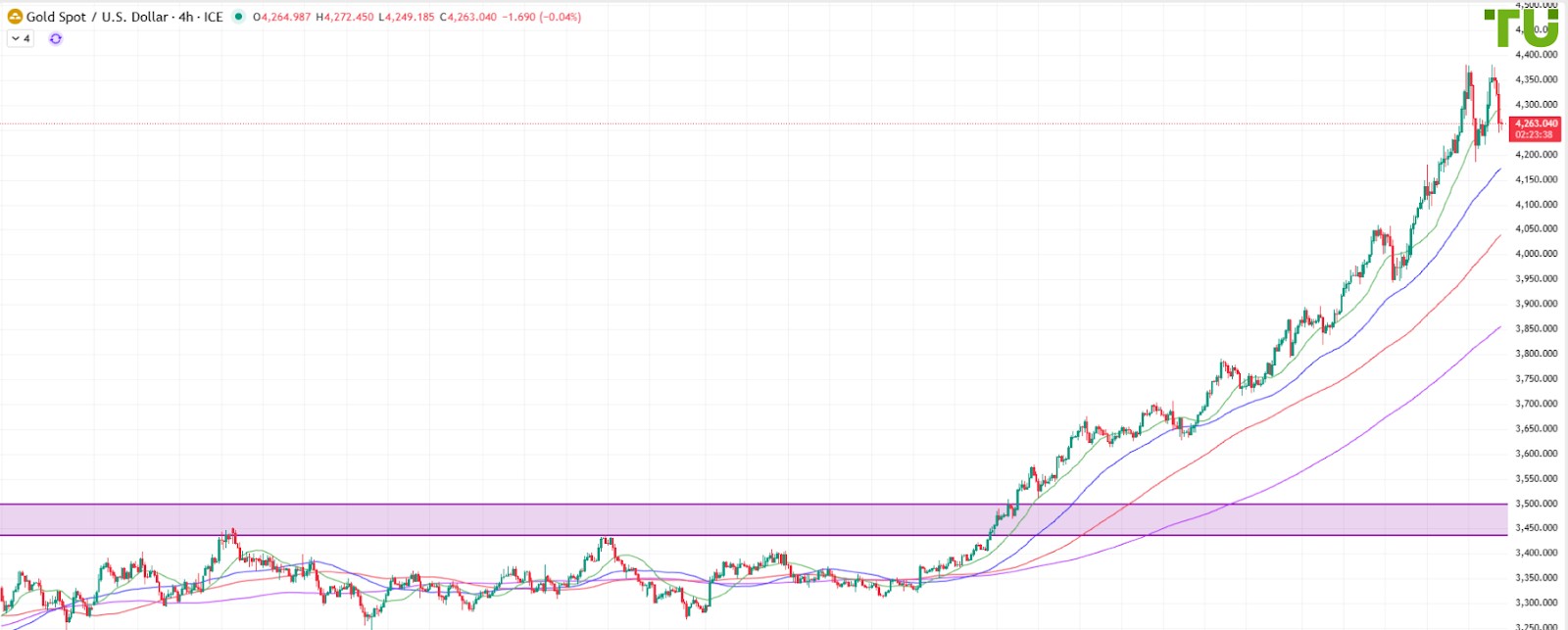
Most forecasts place the move to gold at 5000 dollars closer to 2028 to 2030. Analysts note that the gold market historically reacts to declining real yields and economic slowdowns with a delayed effect, which makes a steady climb toward gold’s price forecast of $5000 more plausible in the next major cycle.
So, the gold price forecast of $5000 per ounce remains ambitious in 2026, yet it can unfold if U.S. debt growth accelerates, real yields drop, and Asian and Middle Eastern buyers keep accumulating physical gold. These drivers already supported the climb above $4,300 and continue to shape expectations for it reaching $5000 in more bullish scenarios.
Analysts also point to long-term constraints on mine supply, environmental regulations, and declining ore grades. These supply factors limit how quickly new gold can enter the market. With demand rising faster than supply, long-term upward pressure strengthens the case for gold hitting $5000.
When will gold hit 5000 an ounce? Gold price predictions for the next 5 years
Major financial institutions and analysts are generally bullish on gold over the medium term, citing persistent geopolitical uncertainty, central bank demand, and inflation dynamics as key drivers. Several forecasts from reputable sources project a continuation of the rally that has already lifted prices to record levels in 2025.
Key expert gold price forecast $5000 per ounce
Bank of America (BofA). Analysts expect gold to benefit from long-term inflation risks, geopolitical tensions, and strong central bank demand. In optimistic scenarios, BofA sees gold potentially moving toward $4,500–$5,000 per ounce by 2026–2027 if real yields remain low and uncertainty persists.
J.P. Morgan It highlights gold’s role as a strategic hedge in diversified portfolios. The bank suggests prices could approach $5,000 per ounce by late 2026, with sustained upside over the following years driven by reserve diversification and macro instability.
HSBC. Its analysts forecast gold staying structurally strong, supported by emerging-market central bank purchases and safe-haven demand. Their medium-term outlook points to prices remaining well above $3,000 per ounce, with upside potential during periods of market stress.
Goldman Sachs. It emphasizes central bank buying and geopolitical risk as core drivers. The bank expects gold to remain one of the best-performing defensive assets, with prices trending higher into the late 2020s, especially if rate cuts resume globally.
UBS. It projects gold to hold elevated levels over the next five years as investors seek protection against currency debasement and financial volatility. The bank sees gold as a long-term strategic allocation, not just a short-term trade.
Traders Union gold price prediction 2026-2031
Short-term outlook (2026)
In the short term, gold prices are expected to remain highly sensitive to macroeconomic conditions, particularly interest rate policy, inflation expectations, and movements in the U.S. dollar. Central bank decisions, geopolitical developments, and shifts in risk sentiment will likely continue to drive price fluctuations. While safe-haven demand may support gold during periods of uncertainty, temporary corrections are possible if monetary policy remains restrictive or real yields rise. As a result, volatility is likely to persist throughout the year.
| Month | Minimum Price, $ | Average Price, $ | Maximum Price, $ |
|---|---|---|---|
| August 2026 | 3700 | 3800 | 3900 |
| September 2026 | 3700 | 3800 | 3900 |
| October 2026 | 3800 | 3900 | 4100 |
| November 2026 | 4200 | 4300 | 4500 |
| December 2026 | 4300 | 4500 | 4600 |
Long-term outlook
From a long-term perspective, gold’s outlook remains structurally strong. Persistent inflation risks, expanding government debt, and continued central bank gold purchases support its role as a store of value. Gold also benefits from its function as a hedge against currency depreciation and systemic financial stress. Although cyclical pullbacks are inevitable, long-term demand from institutional investors and monetary authorities may provide a solid foundation for sustained price support, making gold a strategic asset for investors with longer investment horizons. Within this long-term framework, investors increasingly consider a broader question: will gold reach $10,000 an ounce if the current cycle of inflationary pressure, rising debt, and monetary expansion persists.
| Year | Price in the middle of the year | Price at the end of the year |
|---|---|---|
| 2026 | $4000 | $4900 |
| 2027 | $5000 | $4900 |
| 2028 | $4900 | $4800 |
| 2029 | $5000 | $4900 |
| 2030 | $5000 | $5000 |
| 2031 | $5000 | $5000 |
| 2032 | $5100 | $5200 |
| 2033 | $5500 | $5600 |
| 2034 | $5500 | $5500 |
| 2035 | $5500 | $5500 |
| 2036 | $5600 | $5800 |
| 2037 | $6000 | $6300 |
| 2038 | $7000 | $8074 |
| 2039 | $8100 | $8000 |
| 2040 | $8000 | $7900 |
How to trade gold
To take advantage of gold price movements for short-term trading or long-term investing, you need a reliable and well regulated trading platform. A quality broker offers fast execution, competitive spreads, and access to instruments such as XAU/USD, CFDs, and gold-backed ETFs. These tools allow traders to respond efficiently to market volatility and follow longer-term price trends.
With ongoing discussion about whether gold could reach new record highs in the coming years, selecting the right broker becomes increasingly important. Stable execution during high-impact news events and transparent trading conditions can help manage risk and support a disciplined gold trading strategy.
| zForex | Plus500 | OANDA | FOREX.com | IG Markets | |
|---|---|---|---|---|---|
|
Demo |
Yes | Yes | Yes | Yes | Yes |
|
Gold |
Yes | Yes | Yes | Yes | Yes |
|
XAU/USD spread, pips |
No | 45 | 30 | 35 | 30 |
|
XAU/USD commission, $ |
No | 3 | 3 | 2.5 | No |
|
Min. deposit, $ |
10 | 100 | No | 100 | 1 |
|
Regulation |
No | CySEC, FCA, ASIC, FMA, FSCA, FSA Seychelles, EFSA, MAS, DFSA, SCB | FSC (BVI), ASIC, IIROC, FCA, CFTC, NFA | CIMA, FCA, FSA (Japan), NFA, IIROC, ASIC, CFTC | FCA, BaFin, ASIC, MAS, CySec, FINMA, BMA, CFTC, NFA |
|
TU overall score |
7.89 | 7.52 | 6.8 | 6.74 | 6.65 |
|
Open an account |
Go to broker Your capital is at risk.
|
Go to broker 80% of retail CFD accounts lose money. |
Go to broker Your capital is at risk. |
Study review | Study review |
Is gold expected to go higher?
Forecasting gold is always difficult, but 2026 brings a unique mix of slowing growth, shifting monetary policy, and persistent geopolitical risk. These conditions have led more analysts to explore scenarios where gold could approach $5000 or even test higher levels later. Strong central bank accumulation and steady investment demand add weight to these discussions.
The main drivers behind the current rally include:
Inflation and rate cuts. With the Federal Reserve expected to begin cutting rates in early 2026, investors are turning to gold to hedge against renewed inflationary pressures, driving prices higher. Historically, periods of monetary easing have preceded major uptrends in gold prices.
Weakening U.S. dollar. The inverse correlation between gold and the dollar remains intact. As the greenback softens, projections of gold reaching $4,500–$5,000 per ounce in the medium term are becoming more credible among long-term investors.
Safe-haven demand. Ongoing conflicts in Eastern Europe and the Middle East continue to inject volatility into equity and energy markets, reinforcing gold’s role as a reliable store of value during global uncertainty.
Central bank reserves. As detailed in the World Gold Council update, central-bank gold buying rebounded sharply in August 2025.
Analysts now watch new demand drivers as well. These include the growth of digital gold platforms, rising interest from sovereign wealth funds, and the use of gold-backed products as tools for long-term portfolio insurance.
XAU/USD News

UK energy policy signals continuity as Miatta Fahnbulleh backs faster net zero shift

EU sanctions talks pit Russian oil cap freeze against LNG shipping curbs

U.S. control of Venezuela oil revenues draws scrutiny over transparency

Gold drops to two-month low despite renewed U.S.-Iran war tensions
XAU/USD continues to press current resistance

Gold price holds above $4,550 as oil surge reinforces defensive flows
Gold demand is strong, and the trend still favors higher prices

From what I have seen over the years, gold tends to rise when people start looking for stability because they feel uncertain about where the economy is heading. That is what I see forming again. Central banks are buying quietly, long-term holders are staying in their positions, and more everyday savers in Asia and the Middle East are turning to gold instead of local currencies. These are the kinds of changes that usually build into long moves, not short spikes. When I look at today’s market, it reminds me of other periods when trust in policy started to fade and people wanted something solid they could rely on. I’ve watched gold climb through similar setups before, and this one feels familiar. I am not trying to call the exact price, but based on the way demand is building, I believe gold still has room to move higher.
Conclusion
While predicting gold's ascent to $5,000 an ounce is fraught with uncertainty, mounting macroeconomic pressures and persistent inflation risks make such a scenario increasingly plausible for the coming market cycle. Experts highlight that prolonged currency debasement and geopolitical tensions have historically propelled gold to new highs, as seen during previous financial crises. Ultimately, gold’s reputation as a safe-haven asset remains unshaken, bolstering its potential for outsized gains if market uncertainties intensify. Investors would be wise to recognize that in turbulent times, gold often shines brightest—potentially leading the way towards that landmark $5,000 threshold.
FAQs
How do supply constraints in gold mining influence the prospect of gold reaching $5,000 per ounce?
What impact do central bank buying trends have on long-term gold price forecasts?
How does the performance of the U.S. dollar affect the path toward gold reaching $5,000?
What risks could delay or prevent gold from achieving a $5,000 per ounce milestone?
Editors' Top Picks and Insights

Global fintech in 2026: Three trends that matter

From Jesus Christ to aliens: Polymarket's most absurd prediction markets

Hunting crypto owners: Why criminals have gone offline

BitMEX is shutting down: Why Trump could not save the exchange

Do governments need crypto workers?

Brent nears $100: Why oil prices are rising
Related Articles
Team that worked on the article
Dan Blystone began his trading career in 1998 as an arbitrage clerk on the floor of the Chicago Mercantile Exchange (CME). He later traded bond and Eurex futures at proprietary firms such as Altea Trading, gaining valuable experience in high-frequency trading and risk management.
Chinmay Soni is a financial analyst with more than 5 years of experience in working with stocks, Forex, derivatives, and other assets. As a founder of a boutique research firm and an active researcher, he covers various industries and fields, providing insights backed by statistical data.
An investor is an individual, who invests money in an asset with the expectation that its value would appreciate in the future. The asset can be anything, including a bond, debenture, mutual fund, equity, gold, silver, exchange-traded funds (ETFs), and real-estate property.
Risk management is a risk management model that involves controlling potential losses while maximizing profits. The main risk management tools are stop loss, take profit, calculation of position volume taking into account leverage and pip value.
Yield refers to the earnings or income derived from an investment. It mirrors the returns generated by owning assets such as stocks, bonds, or other financial instruments.
Forex leverage is a tool enabling traders to control larger positions with a relatively small amount of capital, amplifying potential profits and losses based on the chosen leverage ratio.
CFD is a contract between an investor/trader and seller that demonstrates that the trader will need to pay the price difference between the current value of the asset and its value at the time of contract to the seller.


-
 Afghanistan
-
 Albania
-
 Algeria
-
 Angola
-
 Argentina
-
 Armenia
-
 Australia
-
 Austria
-
 Azerbaijan
-
 Bahamas
-
 Bahrain
-
 Bangladesh
-
 Belarus
-
 Belgium
-
 Bolivia
-
 Botswana
-
 Brazil
-
 Brunei
-
 Bulgaria
-
 Cambodia
-
 Cameroon
-
 Canada
-
 Chile
Chile
-
 China
China
-
 Colombia
-
 Congo
Congo
-
 Costa Rica
-
 Cote d'Ivoire
-
 Croatia
-
 Cuba
Cuba
-
 Cyprus
-
 Czechia
-
 DR Congo
-
 Denmark
-
 Dominican Republic
-
 Ecuador
-
 Egypt
Egypt
-
 El Salvador
-
 Estonia
-
 Eswatini
-
 Ethiopia
-
 Finland
-
 France
-
 Georgia
-
 Germany
-
 Ghana
Ghana
-
 Greece
-
 Haiti
Haiti
-
 Hong Kong
-
 Hungary
-
 India
India
-
 Indonesia
-
 Iran, Islamic republic
-
 Iraq
Iraq
-
 Ireland
-
 Israel
-
 Italy
Italy
-
 Jamaica
-
 Japan
Japan
-
 Jordan
-
 Kazakhstan
-
 Kenya
Kenya
-
 Korea
Korea
-
 Kuwait
-
 Kyrgyzstan
-
 Laos
Laos
-
 Latvia
-
 Lebanon
-
 Lesotho
-
 Libya
Libya
-
 Lithuania
-
 Luxembourg
-
 Madagascar
-
 Malaysia
-
 Malta
Malta
-
 Mauritius
-
 Mexico
-
 Moldova
-
 Mongolia
-
 Montenegro
-
 Morocco
-
 Mozambique
-
 Myanmar
-
 Namibia
-
 Nepal
Nepal
-
 Netherlands
-
 New Zealand
-
 Nigeria
-
 North Macedonia
-
 Norway
-
 Oman
Oman
-
 Pakistan
-
 Palestine
-
 Panama
-
 Papua New Guinea
-
 Paraguay
-
 Peru
Peru
-
 Philippines
-
 Poland
-
 Portugal
-
 Puerto Rico
-
 Qatar
Qatar
-
 Reunion
-
 Romania
-
 Rwanda
-
 Saudi Arabia
-
 Serbia
-
 Singapore
-
 Slovakia
-
 Slovenia
-
 Somalia
-
 South Africa
-
 Spain
Spain
-
 Sri Lanka
-
 Sweden
-
 Switzerland
-
 Syria
Syria
-
 Taiwan
-
 Tajikistan
-
 Tanzania
-
 Thailand
-
 Trinidad and Tobago
-
 Tunisia
-
 Turkey
-
 UAE
UAE
-
 Uganda
-
 Ukraine
-
 United Kingdom
-
United States
-
 Uruguay
-
 Uzbekistan
-
 Venezuela
-
 Vietnam
-
 Yemen
Yemen
-
 Zambia
-
 Zimbabwe
- Forex
- Crypto












