
Is cryptocurrency alerting free?

Editorial Note: While we adhere to strict Editorial Integrity, this post may contain references to products from our partners. Here's an explanation for How We Make Money. None of the data and information on this webpage constitutes investment advice according to our Disclaimer.
Yes, cryptocurrency alerting can be free. Many crypto exchanges and apps offer basic price alerts at no cost. However, advanced alerts – such as custom conditions, on-chain data, or multi-channel notifications – are usually available only on paid plans.
Cryptocurrency alerting can be free, depending on the service that you use. For example, some exchanges offer email and SMS alerts for price changes and other activity, often without any cost. In addition, there are many services that offer free or low-cost cryptocurrency alerts.
As the cryptocurrency market is highly volatile and dynamic, it is vital for investors to keep track of their investments and stay up to date with the latest market developments. Cryptocurrency alerting is a tool that helps in achieving this. It notifies users of price changes, volume spikes, and other essential events in the cryptocurrency market. The question at hand is whether or not cryptocurrency alerting is free. In this article, the experts at TU will explore the various options available for cryptocurrency alerting and the associated costs, if any.
How do I get free cryptocurrency signals?
Cryptocurrency signals refer to trade recommendations or suggestions given by market specialists. These alerts offer insight into the market trends and can assist traders in making informed decisions. It is feasible to obtain free cryptocurrency signals, but it's essential to understand that these signals may not always be precise and may not ensure profits.
Experts have suggested the following ways to secure free cryptocurrency signals:
Telegram groups: A multitude of Telegram channels provide free cryptocurrency signals. However, it's crucial to be prudent and conduct your own research before making any trades based on these signals.
Social media platforms: Some traders and market specialists use social media platforms such as Twitter, Reddit, and Discord to share their insights and signals with the community.
Websites and discussion forums: Some websites and discussion forums offer free signals, and you can join these forums to get market insights and trade recommendations.
Cryptocurrency trading communities: Joining online cryptocurrency trading communities can give you access to a wealth of information and trading signals from experienced traders.
While third-party platforms and communities can provide free crypto signals, many traders prefer getting alerts directly from cryptocurrency exchanges. Exchange-based alerts are often more reliable, since they are tied to real market data, order books, and executed prices.
Most major exchanges offer free price alerts, volatility notifications, and market updates without requiring a paid subscription. Below is a comparison of popular crypto exchanges that provide built-in alert tools and signal-like features at no additional cost.
| Kraken | OKX | Coinbase | Crypto.com | Nexo | |
|---|---|---|---|---|---|
|
Min. Deposit, $ |
10 | 10 | 10 | 1 | No |
|
Coins Supported |
278 | 329 | 249 | 250 | 100 |
|
Spot Taker fee, % |
0.4 | 0.1 | 0.5 | 0.5 | 0.04 |
|
Spot Maker Fee, % |
0.25 | 0.08 | 0.5 | 0.25 | 0.07 |
|
Alerts |
Yes | Yes | Yes | Yes | Yes |
|
Copy trading |
Yes | Yes | No | No | No |
|
TU overall score |
9.2 | 8.9 | 7.68 | 6.81 | 6.73 |
|
Open an account |
Go to broker Your capital is at risk. |
Go to broker Your capital is at risk. |
Go to broker Your capital is at risk. |
Go to broker Your capital is at risk. |
Go to broker Your capital is at risk.
|
Why do you need a cryptocurrency price alert app?
Cryptocurrency markets are known for their instability, with prices capable of fluctuating quickly. A cryptocurrency price alert app can assist you in keeping up with these changes and making informed trading decisions. In addition, these applications allow you to establish alerts for specific price points, so you can take action promptly when prices reach your target.
Moreover, cryptocurrency price alert apps often furnish real-time market data, enabling you to monitor prices and market trends as they occur. This is particularly beneficial for day traders who need to respond to market movements quickly.
Five tips on how to use cryptocurrency price alert app correctly
1. Define clear and achievable price alerts: Before setting up your alerts, determine the price levels you want to be notified about. Be realistic and take into account market trends and volatility when setting your alerts.
2. Multiple alert levels: To manage your trades better, consider setting multiple price alerts at different levels. This can help you identify crucial price points and make more knowledgeable decisions.
3. Follow market trends: Use your cryptocurrency price alert app to follow market trends and price changes. This can provide you with valuable information on market conditions and help you make more informed decisions.
4. Monitor multiple cryptocurrencies: To stay informed about market conditions across various cryptocurrencies, consider setting up alerts for numerous coins. This can help you take advantage of opportunities in different markets.
5. Regularly evaluate and adjust alerts: Regularly review your alerts and adjust them as necessary based on market conditions and your trading objectives. This can help you stay on top of market movements and make the most of your cryptocurrency investments.
How to select the ideal cryptocurrency price alert app?
With numerous cryptocurrency price alert apps available, it can be challenging to choose the best one for your needs. Here are some steps you can follow to select your ideal crypto price alert app:
Identify your requirements: Before making a decision, consider your specific needs and what you hope to gain from using a cryptocurrency price alert app. Think about the kinds of notifications you want to receive, the cryptocurrencies you wish to monitor, and any additional features you may need.
Study available options: Once you have a clear understanding of your needs, research the various cryptocurrency price alert apps available. Look for platforms that cater to your needs and compare their features, such as real-time market data, customization options, and user-friendly interfaces.
Assess user feedback: Take the time to read reviews and user feedback to gain insight into the experiences of others who have used the app. Look for comments on the app's reliability, ease of use, and quality of customer support.
Test the app: Once you have narrowed down your options, test out the cryptocurrency price alert apps you are interested in. Most platforms offer a trial or demo version, allowing you to evaluate the app and determine if it meets your needs.
Evaluate the cost: Cryptocurrency price alert apps can be free or come at a cost, with paid options typically providing more features and greater reliability. Consider the cost and ensure that the platform offers good value for your money.
Make a selection: After weighing all the factors, select the cryptocurrency price alert app that best fits your needs. Ensure that the platform you choose meets your requirements and that you feel comfortable using it.
While free signals from Telegram groups and social platforms are widely available, they often come with noise, delays, or a lack of transparency. Many traders receive the alert only after the key price move has already happened, or without clear confirmation from market data.
Because of this, some investors prefer tools that track real market activity directly and generate alerts based on measurable signals rather than opinions.
MTracer is one such tool designed to help traders monitor real-time market activity without relying on third-party signal groups. Instead of posting trade calls, MTracer focuses on tracking price movements, volume changes, and unusual market behavior across cryptocurrencies.
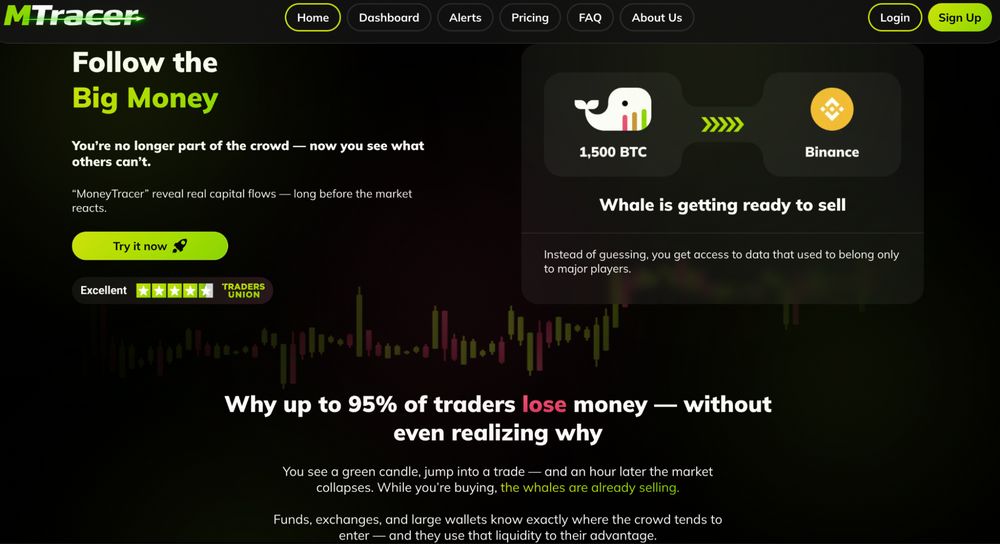
By using data-driven alerts, MTracer allows users to react to what is actually happening in the market rather than following delayed or subjective recommendations. This approach can be especially useful for traders who want more control over decision-making while still benefiting from timely notifications.
Use alerts selectively, combine them with basic market context

Crypto alerts are most effective when they’re treated as a decision-support tool, not as a trading strategy on their own. Free alerts are usually enough to stay aware of key price levels and sudden market moves, especially for beginners. But as traders become more active, they often realize that the real value lies not in the alert itself, but in how it fits into their overall workflow.
I’ve seen many traders overload themselves with notifications and still miss good entries because they didn’t define what the alert was supposed to trigger – a trade, a review, or simply caution. The best approach is to use alerts selectively, combine them with basic market context, and gradually decide whether more advanced, paid features are actually worth it for your style of trading.
Conclusion
Ultimately, while some cryptocurrency alerts are offered for free, many advanced features and timely notifications may come with a cost. Free alerts typically provide basic price threshold notifications, whereas paid services often include in-depth market analysis and real-time updates. For example, platforms like CoinMarketCap offer complimentary alerts, while others like CryptoCompare charge for premium features. The most important takeaway is that the value of an alert service hinges on how responsive and detail-oriented it is—when every second counts in the crypto market, investing in reliable alerts can make all the difference between opportunity and oversight.
FAQs
What types of events besides price changes can cryptocurrency alerts notify users about?
How important is the speed of alerts when using free cryptocurrency alert services?
What should traders keep in mind to avoid missing crucial market moves when using free crypto alert tools?
Why might some traders prefer exchange-based alerts over third-party free signal groups?
Editors' Top Picks and Insights

Lindsey Graham death: U.S. senator’s crypto legacy

Tether under pressure: USDT in Europe, audit questions, and the fight for trust

Lean Ethereum: Why Buterin wants to rebuild the network

SK Hynix debuts on Nasdaq: Largest U.S. offering by foreign company

SpaceX falls out of orbit: Does anyone still want Musk’s stock?

The crypto IPO problem: How high-profile listings became investor traps
Related Articles
Team that worked on the article
Chinmay Soni is a financial analyst with more than 5 years of experience in working with stocks, Forex, derivatives, and other assets. As a founder of a boutique research firm and an active researcher, he covers various industries and fields, providing insights backed by statistical data.

Dr. BJ Johnson is a PhD in English Language and an editor with over 15 years of experience. He earned his degree in English Language in the U.S and the UK.
A day trader is an individual who engages in buying and selling financial assets within the same trading day, seeking to profit from short-term price movements.
Cryptocurrency is a type of digital or virtual currency that relies on cryptography for security. Unlike traditional currencies issued by governments (fiat currencies), cryptocurrencies operate on decentralized networks, typically based on blockchain technology.
Copy trading is an investing tactic where traders replicate the trading strategies of more experienced traders, automatically mirroring their trades in their own accounts to potentially achieve similar results.
Bitcoin is a decentralized digital cryptocurrency that was created in 2009 by an anonymous individual or group using the pseudonym Satoshi Nakamoto. It operates on a technology called blockchain, which is a distributed ledger that records all transactions across a network of computers.
Ethereum is a decentralized blockchain platform and cryptocurrency that was proposed by Vitalik Buterin in late 2013 and development began in early 2014. It was designed as a versatile platform for creating decentralized applications (DApps) and smart contracts.

-
 Afghanistan
-
 Albania
-
 Algeria
-
 Angola
-
 Argentina
-
 Armenia
-
 Australia
-
 Austria
-
 Azerbaijan
-
 Bahamas
-
 Bahrain
-
 Bangladesh
-
 Belarus
-
 Belgium
-
 Bolivia
-
 Botswana
-
 Brazil
-
 Brunei
-
 Bulgaria
-
 Cambodia
-
 Cameroon
-
 Canada
-
 Chile
Chile
-
 China
China
-
 Colombia
-
 Congo
Congo
-
 Costa Rica
-
 Cote d'Ivoire
-
 Croatia
-
 Cuba
Cuba
-
 Cyprus
-
 Czechia
-
 DR Congo
-
 Denmark
-
 Dominican Republic
-
 Ecuador
-
 Egypt
Egypt
-
 El Salvador
-
 Estonia
-
 Eswatini
-
 Ethiopia
-
 Finland
-
 France
-
 Georgia
-
 Germany
-
 Ghana
Ghana
-
 Greece
-
 Haiti
Haiti
-
 Hong Kong
-
 Hungary
-
 India
India
-
 Indonesia
-
 Iran, Islamic republic
-
 Iraq
Iraq
-
 Ireland
-
 Israel
-
 Italy
Italy
-
 Jamaica
-
 Japan
Japan
-
 Jordan
-
 Kazakhstan
-
 Kenya
Kenya
-
 Korea
Korea
-
 Kuwait
-
 Kyrgyzstan
-
 Laos
Laos
-
 Latvia
-
 Lebanon
-
 Lesotho
-
 Libya
Libya
-
 Lithuania
-
 Luxembourg
-
 Madagascar
-
 Malaysia
-
 Malta
Malta
-
 Mauritius
-
 Mexico
-
 Moldova
-
 Mongolia
-
 Montenegro
-
 Morocco
-
 Mozambique
-
 Myanmar
-
 Namibia
-
 Nepal
Nepal
-
 Netherlands
-
 New Zealand
-
 Nigeria
-
 North Macedonia
-
 Norway
-
 Oman
Oman
-
 Pakistan
-
 Palestine
-
 Panama
-
 Papua New Guinea
-
 Paraguay
-
 Peru
Peru
-
 Philippines
-
 Poland
-
 Portugal
-
 Puerto Rico
-
 Qatar
Qatar
-
 Reunion
-
 Romania
-
 Rwanda
-
 Saudi Arabia
-
 Serbia
-
 Singapore
-
 Slovakia
-
 Slovenia
-
 Somalia
-
 South Africa
-
 Spain
Spain
-
 Sri Lanka
-
 Sweden
-
 Switzerland
-
 Syria
Syria
-
 Taiwan
-
 Tajikistan
-
 Tanzania
-
 Thailand
-
 Trinidad and Tobago
-
 Tunisia
-
 Turkey
-
 UAE
UAE
-
 Uganda
-
 Ukraine
-
 United Kingdom
-
United States
-
 Uruguay
-
 Uzbekistan
-
 Venezuela
-
 Vietnam
-
 Yemen
Yemen
-
 Zambia
-
 Zimbabwe
- Forex
- Crypto











