
How To Invest In Cryptocurrency: A Step-by-Step Guide



Editorial Note: While we adhere to strict Editorial Integrity, this post may contain references to products from our partners. Here's an explanation for How We Make Money. None of the data and information on this webpage constitutes investment advice according to our Disclaimer.
In 2026, cryptocurrency continues to be a relevant investment option, with global adoption crossing 420 million users and a total market cap now over $2.8 trillion (Statista). Although it’s still a volatile asset class, crypto presents strong diversification benefits. To start building a well-balanced portfolio, focus on trusted exchanges, secure storage methods like cold wallets, and risk-managed strategies such as staking or dollar-cost averaging.
Since the release of Bitcoin’s whitepaper in 2008, the crypto space has expanded dramatically. What began as a peer-to-peer digital currency has now evolved into a thriving global financial ecosystem. It’s no longer just about coins, it’s about entire economies powered by blockchain technology, with smart contracts, decentralized platforms, and thousands of digital assets changing how we think about value exchange.
Even with sharp ups and downs, the overall trajectory of digital assets suggests they are becoming a permanent fixture in modern finance. If you’re someone trying to understand how to invest in cryptocurrency for beginners, it’s crucial to stay informed about the tools, platforms, and regulations shaping the market in 2026. Whether you’re planning a short-term trade or long-term hold, this guide will walk you through essential strategies, risk controls, and the foundational steps in how to invest in crypto safely and smartly.
Risk warning: Cryptocurrency markets are highly volatile, with sharp price swings and regulatory uncertainties. Research indicates that 75-90% of traders face losses. Only invest discretionary funds and consult an experienced financial advisor.
Understanding cryptocurrency as an asset class
Cryptocurrency is more than a speculative bet, it’s an evolving financial ecosystem that blends technology, economics, and community-driven governance. A well-structured crypto portfolio can include not just coins for trading gains, but assets that serve functional purposes in the broader digital economy.
Through decentralized finance (DeFi) platforms, investors can lend, borrow, and earn yields without relying on banks, while stablecoins offer a hedge against extreme price swings by pegging value to fiat currencies. These digital assets run on blockchains, enabling transparency, security, and programmable transactions that go far beyond what traditional financial systems can offer. The potential here isn’t only in price appreciation, but in access to entirely new financial models that operate around the clock, without geographical limits.
Types of cryptocurrencies:
Utility tokens. Provide access to specific platforms, products, or services.
Stablecoins. Pegged to fiat or commodities, designed to reduce volatility.
Governance tokens. Allow holders to vote on protocol changes and upgrades.
Meme coins. Community-driven, sentiment-fueled tokens that often experience sharp price movements.
As of mid-2025, there are over 37 million crypto tokens in existence, yet fewer than 100 control about 90% of the total market value, with Bitcoin and Ethereum alone dominating around three-quarters.
Unlike traditional markets, crypto trades 24/7, offers on-chain transparency, and allows direct ownership without intermediaries, meaning traders can react instantly to market shifts without waiting for opening bells.
Getting started: How to invest in cryptocurrency in 2026
If you're about to dip a toe into the world of crypto, imagine it not as jumping into a pond, but learning to swim in shifting tides. Here’s how to build a crypto portfolio that’s secure, strategic, and ready for whatever market volatility throws your way.
Choose a trading strategy. Decide whether you'll be quick in and out (day trading, swing trading), a patient long-term holder (HODLing, value-based), or somewhere in between using automated bots. Matching this to how you handle risk, and how busy your life is, makes all the difference.
Select a crypto exchange. Pick any reputed crypto exchange. Some of the top names are presented in the table below:
| Kraken | OKX | BTCC | Coinbase | Nebeus | |
|---|---|---|---|---|---|
|
Min. Deposit, $ |
10 | 10 | 10 | 10 | 5 |
|
Coins Supported |
278 | 329 | 399 | 249 | 30 |
|
Spot Taker fee, % |
0.4 | 0.1 | 0.3 | 0.5 | Not available |
|
Spot Maker Fee, % |
0.25 | 0.08 | 0.2 | 0.5 | Not available |
|
Alerts |
Yes | Yes | No | Yes | No |
|
Copy trading |
Yes | Yes | Yes | No | No |
|
TU overall score |
9.2 | 8.9 | 7.84 | 7.68 | 7.6 |
|
Open an account |
Go to broker Your capital is at risk. |
Go to broker Your capital is at risk. |
Go to broker Your capital is at risk.
|
Go to broker Your capital is at risk. |
Go to broker Your capital is at risk.
|
Set up a crypto wallet. Don't leave ever ything on the exchange, use a cold wallet for better protection. These offline devices offer top security, especially if you're holding significant amounts. A mix of hot (for everyday moves) and cold (for long-term storage) is usually the best setup.
How to do research before buying cryptocurrency
Effective research is essential when determining how to invest in cryptocurrency wisely. In 2026’s competitive market, smart decisions depend on blending different approaches. Each method offers unique insights into an asset’s long-term viability, associated risks, and potential for sustainable growth.
Fundamental analysis
Fundamental research focuses on the underlying value and utility of a crypto asset. This involves studying whitepapers to understand the project’s purpose, examining token supply models, and evaluating the credibility of its developers. It's also crucial to assess how useful the asset is within its ecosystem.
Take Ethereum and Solana, for example. Comparing these platforms uncovers major differences in consensus mechanisms, speed, cost-efficiency, and overall ecosystem strength. The Bitcoin vs Ethereum debate itself reflects how different strategies and use cases shape value and adoption over time.
Understanding fundamentals plays a key role in building a solid crypto portfolio. Projects with real-world use and long-term vision are more likely to weather bear markets and benefit from future growth cycles.
Technical analysis for traders
Traders rely heavily on charts and indicators to time entries and exits. Tools like RSI, MACD, and volume analysis help interpret momentum and market sentiment across different timeframes. While these indicators don’t guarantee predictions, they offer valuable context for decision-making.
Advanced platforms such as TradingView make it easier to test strategies, layer indicators, and receive alerts. Platforms like CryptoQuant also provide real-time institutional data, including miner flows and liquidity trends. For active traders, refining your technical analysis in crypto can significantly improve short- to medium-term results in volatile environments.
On-chain metrics
On-chain analysis adds another layer of insight by examining blockchain activity directly. This includes tracking wallet behavior, token circulation speed, and large transactions, often indicators of accumulation or sell-offs.
Data providers like Glassnode and IntoTheBlock compile this information into visual dashboards that help assess how a network is being used. Integrating on-chain data into your research deepens your crypto market analysis, offering a clearer picture of behavioral patterns alongside technical and fundamental findings.
Risk management and security tips
Risk control is just as important as asset selection when navigating cryptocurrency markets. With sharp price swings and frequent market reversals, traders need solid strategies to protect their capital.
Our experts suggest allocating only 1–3% of your total capital to any single trade. This minimizes damage in the event of losses. Borrowed capital should be avoided unless you're experienced and using a tight margin strategy.
Some essential risk management guidelines include:
Don’t invest more than you can afford to lose. Crypto prices can drop 30–50% within a week.
Set stop-losses and have a clear exit plan for every trade.
Limit leverage, especially with derivatives, where liquidation risks are high.
Diversify across assets like large caps, altcoins, and stablecoins to reduce the impact of a single project failing.
From a security standpoint, two-factor authentication (2FA) should be enabled on all accounts. It adds a basic layer of defense against phishing and unauthorized access.
For long-term storage, cold wallets like Ledger or Trezor are recommended. These devices store your private keys offline, shielding them from remote hacks. Multi-signature wallets also enhance security by requiring confirmation from multiple trusted devices, an approach often used by institutional players and funds.
It’s also important to:
Regularly check and revoke smart contract permissions you no longer use.
Be cautious with browser plugins and mobile wallets, which are common malware targets.
Keep seed phrases securely offline, never store them in email or cloud platforms.
A proactive risk approach not only limits losses but also builds confidence, allowing you to operate consistently in any regulatory landscape and in rapidly evolving market conditions.
Best cryptocurrencies to invest in right now (2026 Edition)
As of Q2 2025, the following cryptocurrencies maintain the highest market capitalization and remain foundational assets for most investors:
Bitcoin (BTC). The original cryptocurrency, often referred to as “digital gold,” with a capped supply of 21 million coins and a dominant store-of-value narrative. BTC accounts for over 42% of the total market cap and remains the most widely held and traded asset in the ecosystem.
Ethereum (ETH). The leading programmable blockchain with over 5,000 active decentralized applications (dApps), Ethereum powers DeFi, NFTs, and Layer 2 networks. The transition to Proof-of-Stake has significantly reduced energy consumption and introduced scalable staking yields.
Solana (SOL). Known for high throughput and ultra-low fees, Solana continues to attract developers in sectors like gaming and consumer-facing DeFi. Recent upgrades (like Firedancer) have improved network resilience and validator performance.
Ripple (XRP). Despite regulatory challenges, XRP remains dominant in cross-border payments. Its partnerships with global financial institutions and compliance-focused approach make it attractive for utility-based exposure.
Cardano (ADA). A research-driven protocol, Cardano emphasizes peer-reviewed development and gradual upgrades. It supports smart contracts, staking, and native tokens, with a growing ecosystem of DeFi and social-impact applications.
These top five assets are widely supported across crypto exchanges, wallets, and DeFi platforms, offering high liquidity and long-term positioning within the broader blockchain economy.

High-potential altcoins
Beyond the usual large-cap tokens, many investors are now shifting their focus toward altcoins that offer strong fundamentals and practical use cases, often powered by cutting-edge innovations. These emerging assets aren't just speculative plays, they represent evolving technologies with real utility that’s catching the eye of both institutional and retail investors.
Some of the standout projects gaining serious momentum in 2026 include:
Arbitrum (ARB), which has quickly become a top EthereumLayer 2 scaling solution. Its growth in total value locked and developer participation signals long-term strength.
Chainlink (LINK), the leadin g oracle network, continues to serve as the critical data bridge between smart contracts and the outside world. It's a core part of many decentralized finance (DeFi) ecosystems.
Injective (INJ), a fast-growing platform enabling decentralized derivatives trading, cross-chain swaps, and lightning-fast execution.
SUI, developed using the Move language, is built for scale and offers a developer-friendly foundation for creating advanced decentralized apps.
According to TU Research (2026), more than 60% of wallet activity now revolves around altcoins. Daily active address growth across these tokens has risen by 17% year-over-year. Their influence stretches across DeFi, real-world asset tokenization, gaming platforms, and Ethereum scaling infrastructure. Many of these tokens are also tied to innovations in blockchain technology, giving them additional long-term relevance in the crypto space.
As investor interest grows, it becomes increasingly important to assess these tokens with care. Look closely at tokenomics, audit transparency, ecosystem funding, and staking incentives. These factors can help determine which coins deserve a place in your crypto portfolio, especially when planning for long-term diversification. And while volatility is a constant risk, well-researched altcoins often provide a stronger upside when placed within a broader mix of digital assets.
It’s also important to understand the regulatory environment, particularly for U.S. residents. If you're holding or trading crypto, you must consider how tax on crypto in the US applies to your activity, from capital gains to income on staking rewards. Even holding stablecoins, often thought of as less risky, can have implications depending on how they're used. Navigating these legal and financial considerations is key to building a sustainable and compliant investment strategy.
Strategies for long-term crypto investors
Long-term participants typically use dollar-cost averaging to build positions over time. Staking (ETH, ADA, SOL) offers passive returns, while crypto IRAs allow for tax-advantaged exposure. Tax-loss harvesting remains a sophisticated strategy for mitigating liabilities in volatile years.
Dollar-Cost Averaging (DCA)
This method involves investing a fixed amount at regular intervals, regardless of asset price. It minimizes the impact of volatility and removes emotional bias.
Example: Investing $100 weekly into ETH from Jan 2022 to Jan 2025 would result in an average buy price of ~$1,950, compared to a high of $4,800 and a low of $900.
According to Binance Academy (2025), DCA outperforms lump-sum investing 67% of the time in highly volatile markets like crypto.
53% of U.S. retail crypto investors in 2025 reported using DCA as their primary accumulation method (TU Survey).
Staking for passive yield
Staking provides a way to earn yield by locking tokens to support network operations (Proof-of-Stake).
Ethereum (ETH). ~3.9% APY after Merge (Lido & Coinbase pooled staking).
Cardano (ADA). ~3.3% APY with liquid staking options.
Solana (SOL). ~6–7% APY with validators like Marinade Finance.
TU Note: Avoid centralized platforms without proof-of-reserves or slashing protections.
Crypto IRAs and tax efficiency
Crypto IRAs (available via platforms like iTrustCapital and BitIRA) allow for long-term holdings in a tax-advantaged structure, reducing or deferring capital gains.
Roth-style IRAs allow tax-free withdrawals.
Traditional crypto IRAs offer deferred tax growth.
Additionally, tax-loss harvesting lets investors sell losing assets to offset gains elsewhere:
In 2022–2023, U.S. investors harvested over $800 million in crypto losses for tax benefit (TokenTax).
Diversification and rebalancing
Maintain a well-rounded portfolio:
50–60% in large caps (BTC, ETH).
20–30% in mid-cap altcoins.
10–15% in stablecoins or staked positions for liquidity.
Rebalan ce quarterly to lock in gains or cut underperformers.

Regulatory environment in the United States
Let’s unpack how the shifting regulatory landscape for digital assets impacts your crypto market analysis and risk management strategies.
SEC’s current classification of cryptocurrencies. In 2026, the SEC clarified that many tokens will be treated as securities if they resemble investment contracts, especially those promoted based on price gains or controlled centrally. Tokens with genuine utility, used as access tools rather than profit promises, are less likely to fall under securities rules.
Key legislation shaping the landscape. The FIT21 Act, passed by the House, divides regulatory authority: the CFTC handles decentralized commodities, and the SECfocuses on centralized tokens. Stablecoins are often exempt unless fraud is involved. The GENIUS Act, now law, mandates stablecoins be backed 1:1 with low-risk assets and enforces transparency and audits.
Regulators in action.SECChair Paul Atkins launched “Project Crypto” to offer clearer token classifications, ease compliance, and promote on-chain trading, signaling a shift toward faster, innovation-friendly guidelines. The Crypto Task Force, led by Commissioner Peirce, is actively drafting tailored rules to protect investors while enabling innovation.
Compliance reminders for traders. Under current rules, platforms must file Forms 1099-B or 1099-DA for crypto trades, while FinCEN requires registration as Money Services Businesses (MSBs) and adherence to anti-money laundering (AML) standards.
Federal support for crypto integration. A July 2025 White House report urges agencies (SEC, CFTC, IRS) to remove regulatory roadblocks and create a “crypto-friendly” framework across taxes, banking, mortgages, and retirement, ushering in what they dub a “Golden Age” for digital assets innovation.
Crypto investing mistakes to avoid
Let’s talk about common missteps in crypto investing, so you can avoid pitfalls and prioritize risk management, stay informed of the regulatory landscape, and sharpen your crypto market analysis instincts.
Chasing hype or social media coins. Jumping on a promoted coin because everyone's shouting about it often ends in regret. A sobering stat: following crypto influencers can cost the average investor nearly 8% in losses in just a month. It's smarter to research fundamentals before buying in.
FOMO buying and panic selling. Emo tional decisions are crypto’s silent killer. Many buy at the peak during bouts of market volatility and then bail out at the bottom. Instead, use dollar-cost averaging to spread entry over time, this helps smooth out the noise of wild price swings.
Ignoring transaction fees and gas. Those small fees add up fast, especially in congested networks like Ethereum, where gas can cost more than your entire trade. Timing and choosing lower-cost chains can save you more than you'd expect.
Falling for rug pulls and scams. Scammers lure newbies with flashy marketing and empty promises, then vanish with the funds. In 2024, over $190 million was lost to such scams, especially in meme coins. Always audit a token’s liquidity, the team behind it, and red-flags like gated code or hyper-pump marketing.
The future of crypto trading and investing
Role of DeFi, RWAs, and GameFi
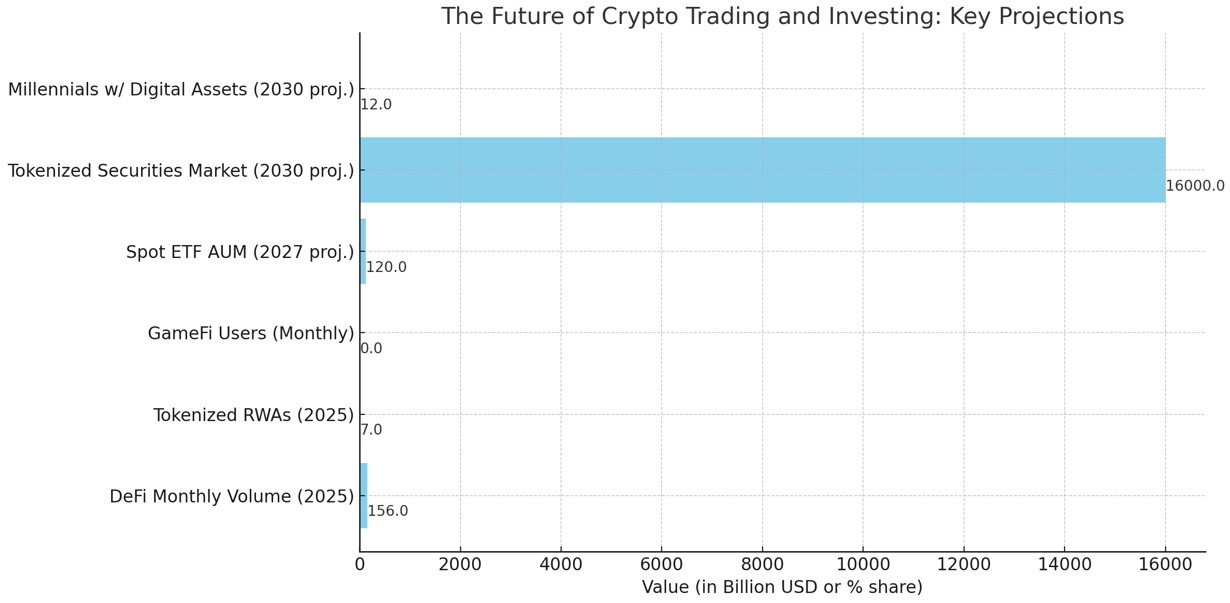
DeFi platforms processed over $156 billion/month in lending, staking, and DEX swaps (DeFiLlama, Q1 2025).
Over $7 billion in RWAs (real estate, treasury bills, invoices) are currently tokenized on-chain (RWA.xyz, 2025).
GameFi user base exceeded 3.4 million monthly active wallets, with projected market value of $105B by 2028 (DappRadar).
68% of new wallet addresses in 2024 interacted first with DeFi or NFT contracts (Chainalysis).
Top 3 DeFi chains by TVL: Ethereum, Arbitrum, and BNB Chain.
TU Forecast
By 2030, digital assets may represent 10–12% of the average Millennial investment portfolio (Traders Union projection).
Spot crypto ETFs expected to attract $120B+ AUM globally by 2027 (BlackRock, 2025 outlook).
Over 72 countries are piloting or launching CBDCs as of 2025 (Atlantic Council CBDC Tracker).
Tokenized securities market projected to hit $16 trillion by 2030 (Boston Consulting Group).
41% of Gen Z investors already hold crypto as part of their portfolios (Gemini, 2025 survey).
Resources and tools for U.S.-based crypto traders
Top tools for portfolio tracking and research include:
CoinGecko. Token data, rankings.
Messari. Institutional analytics.
TradingView. Charting and signals.
IntoTheBlock. Whale movement and wallet stats.
For execution, major platforms now include automated rebalancing, staking dashboards, and integrated tax reporting tools.
Avoiding hype traps and building conviction: Crypto investing for serious beginners

Many people start by jumping on whatever’s trending, usually the loudest token on social media. A better approach is to write down your own theory: why do you think this coin matters five years from now? Is it fixing a real-world issue? Is the tech behind it active and improving? Don’t stop there. Look up how many wallets are using it, whether developers are still building, and what the token’s supply looks like over time. This helps you build a clear strategy that keeps you grounded when the market gets noisy.
Here’s something surprisingly effective that most people miss: time-locked dollar-cost averaging. Pick one solid coin and commit to buying it every 30 days for a full year. No skipping, no panic selling. You can even use smart tools like Mean Finance to automate it. Each time you buy, write down how you felt and why you still believe in it. By the end of the year, not only will you have a portfolio, but you’ll also have a record of how your thinking evolved through the ups and downs. That’s real investor maturity.
Conclusion
Investing in cryptocurrency as a beginner may seem daunting, but by following clear steps—such as selecting a reliable wallet, choosing reputable exchanges, and managing your risks—you can confidently enter this dynamic market. The key takeaway is to prioritize security and continue educating yourself before making any significant investment. For example, always enable two-factor authentication and never invest more than you can afford to lose. By combining caution with curiosity, you position yourself to make informed decisions and potentially benefit from the exciting opportunities crypto has to offer. Remember, in the volatile world of cryptocurrency, knowledge and prudence are your most valuable assets.
FAQs
What is the difference between hot wallets and cold wallets for storing cryptocurrency?
How can beginners use on-chain analysis to improve their crypto investment decisions?
What are the key benefits of dollar-cost averaging when investing in cryptocurrency?
How do regulatory changes in the United States affect cryptocurrency investing for beginners?
Editors' Top Picks and Insights

Three trends that could reshape the crypto market over the next decade

Trump financial disclosure: How the president's crypto income became a U.S. ethics issue

Code red: What's behind Bitcoin’s sharp selloff?

MiCA is live: How EU new rules are changing crypto market

Bitcoin price prediction based on MVRV: Indicator points to BTC undervaluation

Amazon flooded with AI books: Crisis of trust in literature market
Related Articles
Team that worked on the article
Ciaran Ryan is a veteran financial journalist based in South Africa, where he covers cryptocurrency, mining, stock markets, and governance for Moneyweb. He also hosts the weekly Moneyweb Crypto Podcast.
Andreas Kristo Saragih is a seasoned equity research analyst with over a decade of experience across both buy-side and sell-side roles, focused on the Indonesian capital market. He has extensive sector coverage, including banking, consumer goods, retail, real estate, healthcare, transportation, poultry, cement, pharmaceuticals, construction, and infrastructure.
Chinmay Soni is a financial analyst with more than 5 years of experience in working with stocks, Forex, derivatives, and other assets. As a founder of a boutique research firm and an active researcher, he covers various industries and fields, providing insights backed by statistical data.
Risk management is a risk management model that involves controlling potential losses while maximizing profits. The main risk management tools are stop loss, take profit, calculation of position volume taking into account leverage and pip value.
Index in trading is the measure of the performance of a group of stocks, which can include the assets and securities in it.
Bitcoin is a decentralized digital cryptocurrency that was created in 2009 by an anonymous individual or group using the pseudonym Satoshi Nakamoto. It operates on a technology called blockchain, which is a distributed ledger that records all transactions across a network of computers.
Swing trading is a trading strategy that involves holding positions in financial assets, such as stocks or forex, for several days to weeks, aiming to profit from short- to medium-term price swings or "swings" in the market. Swing traders typically use technical and fundamental analysis to identify potential entry and exit points.
An investor is an individual, who invests money in an asset with the expectation that its value would appreciate in the future. The asset can be anything, including a bond, debenture, mutual fund, equity, gold, silver, exchange-traded funds (ETFs), and real-estate property.

-
 Afghanistan
-
 Albania
-
 Algeria
-
 Angola
-
 Argentina
-
 Armenia
-
 Australia
-
 Austria
-
 Azerbaijan
-
 Bahamas
-
 Bahrain
-
 Bangladesh
-
 Belarus
-
 Belgium
-
 Bolivia
-
 Botswana
-
 Brazil
-
 Brunei
-
 Bulgaria
-
 Cambodia
-
 Cameroon
-
 Canada
-
 Chile
Chile
-
 China
China
-
 Colombia
-
 Congo
Congo
-
 Costa Rica
-
 Cote d'Ivoire
-
 Croatia
-
 Cuba
Cuba
-
 Cyprus
-
 Czechia
-
 DR Congo
-
 Denmark
-
 Dominican Republic
-
 Ecuador
-
 Egypt
Egypt
-
 El Salvador
-
 Estonia
-
 Eswatini
-
 Ethiopia
-
 Finland
-
 France
-
 Georgia
-
 Germany
-
 Ghana
Ghana
-
 Greece
-
 Haiti
Haiti
-
 Hong Kong
-
 Hungary
-
 India
India
-
 Indonesia
-
 Iran, Islamic republic
-
 Iraq
Iraq
-
 Ireland
-
 Israel
-
 Italy
Italy
-
 Jamaica
-
 Japan
Japan
-
 Jordan
-
 Kazakhstan
-
 Kenya
Kenya
-
 Korea
Korea
-
 Kuwait
-
 Kyrgyzstan
-
 Laos
Laos
-
 Latvia
-
 Lebanon
-
 Lesotho
-
 Libya
Libya
-
 Lithuania
-
 Luxembourg
-
 Madagascar
-
 Malaysia
-
 Malta
Malta
-
 Mauritius
-
 Mexico
-
 Moldova
-
 Mongolia
-
 Montenegro
-
 Morocco
-
 Mozambique
-
 Myanmar
-
 Namibia
-
 Nepal
Nepal
-
 Netherlands
-
 New Zealand
-
 Nigeria
-
 North Macedonia
-
 Norway
-
 Oman
Oman
-
 Pakistan
-
 Palestine
-
 Panama
-
 Papua New Guinea
-
 Paraguay
-
 Peru
Peru
-
 Philippines
-
 Poland
-
 Portugal
-
 Puerto Rico
-
 Qatar
Qatar
-
 Reunion
-
 Romania
-
 Rwanda
-
 Saudi Arabia
-
 Serbia
-
 Singapore
-
 Slovakia
-
 Slovenia
-
 Somalia
-
 South Africa
-
 Spain
Spain
-
 Sri Lanka
-
 Sweden
-
 Switzerland
-
 Syria
Syria
-
 Taiwan
-
 Tajikistan
-
 Tanzania
-
 Thailand
-
 Trinidad and Tobago
-
 Tunisia
-
 Turkey
-
 UAE
UAE
-
 Uganda
-
 Ukraine
-
 United Kingdom
-
United States
-
 Uruguay
-
 Uzbekistan
-
 Venezuela
-
 Vietnam
-
 Yemen
Yemen
-
 Zambia
-
 Zimbabwe
- Forex
- Crypto










- Understanding cryptocurrency as an asset class
- Getting started: How to invest in cryptocurrency
- How to do research before buying cryptocurrency
- Risk management and security tips
- Best cryptocurrencies to invest in right now
- Strategies for long-term crypto investors
- Regulatory environment in the United States
- Crypto investing mistakes to avoid
- The future of crypto trading and investing
- Resources and tools for U.S.-based crypto traders
- Expert opinion
- Conclusion
- FAQs


