
Forex Multi Account Manager Software: Features, Uses and Comparison


Editorial Note: While we adhere to strict Editorial Integrity, this post may contain references to products from our partners. Here's an explanation for How We Make Money. None of the data and information on this webpage constitutes investment advice according to our Disclaimer.
Forex multi-account manager (MAM) software lets money managers control multiple Forex accounts from a single master account. Trades are distributed across linked accounts using predefined allocation methods based on factors such as balance, equity, lot size, or percentage. Each account remains separate, while execution, risk monitoring, performance tracking, and reporting are managed through one system.
Forex multi-account manager software has become an important tool for professionals handling multiple client accounts, strategies, or growing managed portfolios. According to the Bank for International Settlements, global over-the-counter Forex turnover reached $9.6 trillion per day in April 2025, up 28% from 2022. At this scale, reliable execution, accurate allocation, and operational control are essential.
This article explains how Forex multi-account manager software works, how MAM differs from PAMM and copy trading, and which features matter when managing multiple accounts. It also looks at execution, reporting, risk controls, and the practical factors to consider when choosing a MAM solution.
Risk warning: Forex trading carries high risks, with potential losses including your entire deposit. Market fluctuations, economic instability, and geopolitical factors impact outcomes. Studies show that 70-80% of traders lose money. Consult a financial advisor before trading.
What Forex multi-account manager software is
Forex multi-account manager (MAM) software allows a money manager to trade multiple client accounts from a single master environment. Instead of placing the same trade separately in each account, the software distributes orders according to predefined allocation rules while keeping each client's balance and trading results separate.
In practice, a MAM setup centralizes several functions:
trade execution across linked accounts;
allocation based on balance, equity, lot size, percentage, or other rules;
position and risk monitoring;
account-level performance tracking and reporting.
This makes MAM software particularly useful for professional money managers, strategy providers, and brokers that need to manage multiple Forex accounts without handling each account individually. The term FX multi-account manager is also commonly used for these systems, particularly in MetaTrader and API-based trading environments.
How MAM software works
MAM software connects a master trading account with multiple client sub-accounts. The manager trades from one environment, while the software handles how each order is distributed across the linked accounts according to predefined rules.
Master account and sub-accounts
The master account acts as the main execution point, while sub-accounts remain individually owned and tracked. When the manager opens, modifies, or closes a position, the MAM system applies the action across participating accounts based on their assigned allocation settings.
This gives the manager one point of control without treating every client account identically. Different account sizes and risk profiles can be reflected in the allocation rules, making configuration an important part of any multi-account manager Forex setup.
Trade allocation models
Allocation determines how each master trade is divided among the linked accounts. The appropriate method depends on factors such as account size, agreed risk levels, and the manager's strategy.
Common allocation methods include:
lot-based allocation;
equity-based allocation;
balance-based allocation;
percentage allocation;
hybrid or custom allocation.
For example, equity-based allocation can distribute a trade according to each account's share of total equity, while lot-based allocation assigns predetermined trade sizes to individual accounts. This flexibility allows managers to operate accounts with different capital and risk requirements from the same trading environment.
It is also one of the important distinctions between MAM and more standardized managed-account structures such as PAMM, which we compare below.
Execution flow from order to reporting
MAM system does more than distribute an order. It manages the full process from trade placement to account-level reporting:
A trade is opened from the master account.
The system calculates each sub-account's allocation.
Orders are distributed across the linked accounts.
Executions are recorded and reconciled for each account.
Positions, profit and loss (P/L), commissions, and fees are reflected in reporting.
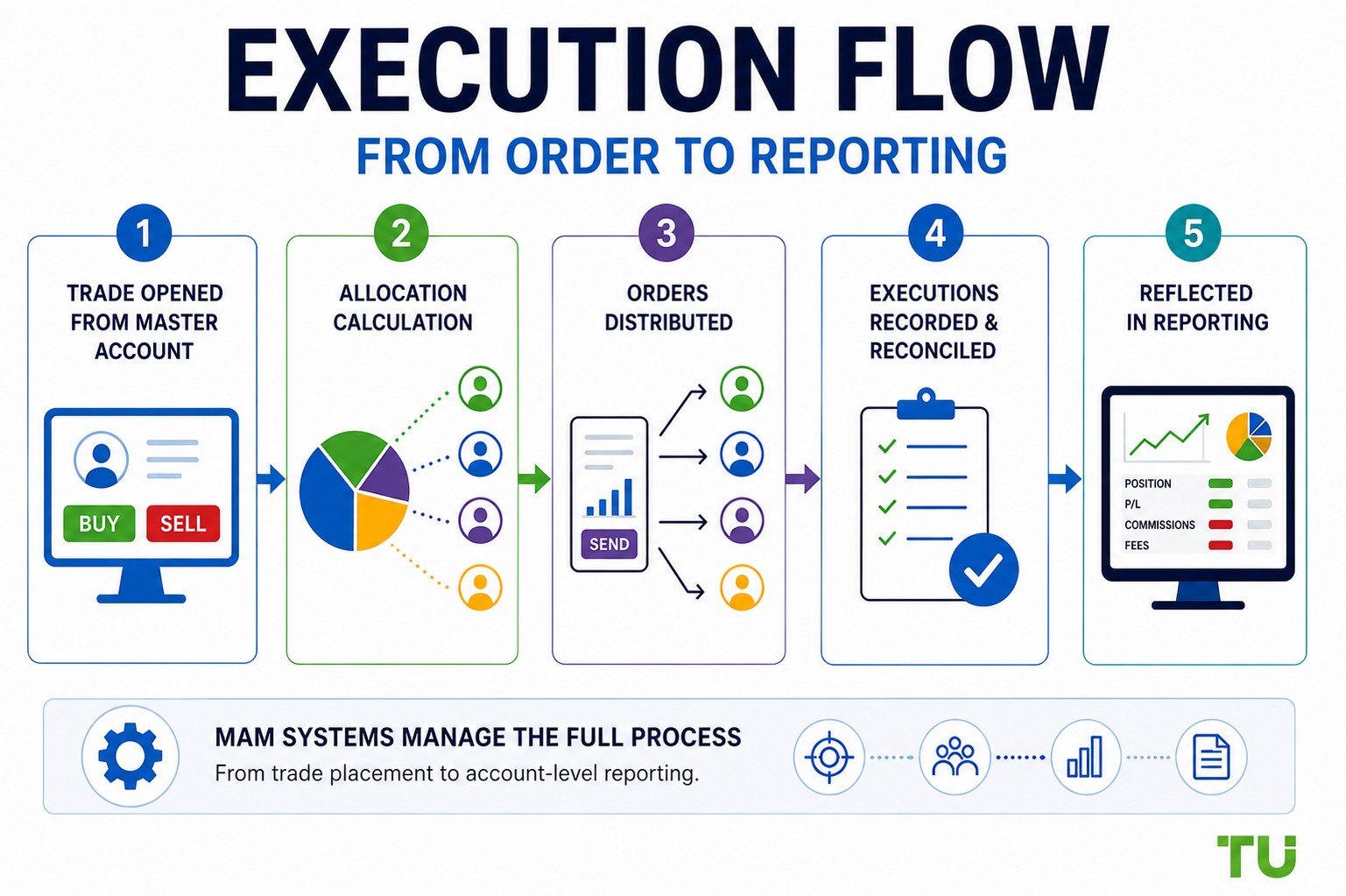
The value of this workflow becomes more apparent as the number of managed accounts grows. A reliable system reduces manual reconciliation and keeps allocation and reporting consistent across accounts. Poor execution or synchronization, by contrast, can create trade corrections, reporting discrepancies, and additional administrative work.
For managers considering how to manage multiple Forex accounts, this consistency is essential. Scaling is not simply about adding more accounts; the software must be able to execute, allocate, and record trades reliably as the managed portfolio expands.
MAM vs PAMM vs Copy trading
MAM, PAMM, and copy trading are often grouped together, but they serve different purposes. MAM offers greater account-level flexibility, PAMM uses a more standardized allocation structure, and copy trading focuses on replicating another trader's positions.
| Feature | MAM | PAMM | Copy trading |
|---|---|---|---|
| Structure | Master account linked to separate client accounts | Managed structure with proportional distribution | Trades copied to follower accounts |
| Allocation | Flexible by lot, equity, balance, or percentage | Primarily percentage-based | Based on follower and platform settings |
| Customization | Supports different account and risk profiles | More standardized | Usually set by individual followers |
| Best suited for | Professional money managers | More uniform managed-account models | Strategy replication |
MAM is generally better suited to managers who need different allocation rules across client accounts. PAMM can work better where investors follow a more uniform percentage-based model, while copy trading is designed primarily for users who want to replicate another trader's strategy.
The regulatory treatment can also differ. The Financial Conduct Authority (FCA) notes that copy trading may fall within portfolio or investment management when trades are executed automatically without clear manual input from the account holder.
Who uses the Forex multi-account manager software?
Independent money managers
Independent managers use MAM software to scale beyond a small number of manually handled accounts while maintaining consistent execution and allocation.
Strategy and signal providers
Strategy providers can use MAM infrastructure to manage execution across client accounts rather than relying on clients to reproduce trades manually.
Forex brokers
Brokers may offer MAM functionality as part of their managed-account infrastructure alongside MT4, MT5, or proprietary platforms.
Multi-strategy trading teams
Trading teams can use MAM tools to coordinate several strategies, account groups, and risk profiles. Here, the ability to manage multiple Forex accounts without fragmenting execution and reporting becomes particularly important.
What to look for in MAM software
The difference between MAM systems is not simply the number of features available. What matters is whether allocation, execution, and reporting remain reliable under real trading conditions.
Key areas to evaluate include:
Allocation flexibility. The system should support allocation methods suited to different account sizes and risk profiles.
Execution quality. Routing delays can affect entry prices, particularly during volatile periods.
Risk controls. Managers may need limits by account, strategy group, instrument, and exposure.
Reporting and fee logic. Performance history, fee calculations, allocation records, and investor statements should be clearly available.
Permissions and audit trails. Reliable records support oversight and help resolve account-level discrepancies.
Integration. Compatibility with MT4, MT5, APIs, and back-office systems can reduce manual work.
Execution under pressure also matters. Slippage, partial fills, trade amendments, and volatile sessions can expose weaknesses that are difficult to identify from the interface alone. A reliable FX multi-account manager should handle these conditions without creating unnecessary reconciliation or trade corrections.
Best Forex brokers for multi-account managers
The broker behind a MAM setup matters alongside the software itself. Trading costs, available markets, leverage, regulation, and account conditions can all affect how efficiently a manager operates multiple accounts.
The table below compares leading Forex brokers on these general trading conditions. MAM availability and features vary by broker, so managers should separately confirm which multi-account tools, allocation methods, and platform integrations are supported.
| Pepperstone | Fusion Markets | GTCFX | ATFX | FxPro | |
|---|---|---|---|---|---|
|
Min. deposit, $ |
No | 1 | 30 | 50 | 100 |
|
Tradable assets |
1200 | 250 | 27000 | 300+ | 2100 |
|
PAMM/MAM |
Yes | Yes | Yes | Yes | Yes |
|
Standard EUR/USD spread |
0.6 | 0.3 | 0.6 | 0.4 | 1.3 |
|
Max. leverage |
1:500 | 1:500 | 1:1000 | 1:400 | 1:500 |
|
Max. Regulation Level |
Tier-1 | Tier-1 | Tier-3 | Tier-1 | Tier-1 |
|
TU overall score |
9.3 | 9.25 | 9.2 | 9 | 8.9 |
|
Open an account |
Go to broker Your capital is at risk.
|
Go to broker Your capital is at risk. |
Go to broker Your capital is at risk. |
Go to broker 54.76% of retail investor accounts lose money when trading CFDs / Spread betting with this provider. |
Go to broker Your capital is at risk. |
Main risks and operational limits
MAM software makes it easier to manage accounts at scale, but it also means that execution or configuration problems can affect multiple accounts at once. The main risks include:
Strategy concentration. A poorly performing strategy can generate losses across every account to which it is allocated.
Allocation errors. Incorrect settings can distribute trades or risk differently from what the manager intended.
Execution differences. Slippage, partial fills, or delays can produce different results across linked accounts.
Reporting disputes. Inaccurate allocation records, fees, or performance reporting can create problems between managers and clients.
Operational dependence. Platform outages or integration failures can disrupt trading across the entire managed setup.
Regulation is another consideration, particularly when a service involves discretionary management of client accounts. Requirements depend on the jurisdiction and operating model. In the UK, for example, the Financial Conduct Authority (FCA) treats automatic copy trading without clear manual client input as portfolio or investment management, which brings regulatory obligations.
For anyone using Forex multi-account manager software, the technology therefore solves only part of the problem. Clear allocation rules, reliable execution, accurate reporting, and appropriate regulatory arrangements remain essential as the number of managed accounts grows.
Test MAM software under real conditions before scaling

I would never judge MAM software by its feature list alone. Flexible allocation, reliable execution, and transparent reporting all matter, but the real test is whether they continue to work together when several accounts are trading under different risk settings.
Before full deployment, I recommend running a controlled live test with around 5–10 accounts under different risk profiles. This gives you a much better picture of how the system handles partial fills, volatile periods, account synchronization, and reporting updates. It also helps identify problems with fee calculations or allocation before they affect a larger group of accounts.
Once the setup is working reliably, scaling should follow proven capacity rather than ambition. I would regularly review execution quality and allocation records, particularly after volatile sessions or changes to account settings. Adding more accounts should not also mean adding execution inconsistencies, reporting problems, or unnecessary manual work.
Conclusion
Forex multi-account manager software is essential for professionals who need to manage multiple client accounts reliably and efficiently. Its value lies not just in flexible allocation and centralized control, but in its ability to deliver consistent execution and transparent reporting even as complexity grows. For example, money managers and trading teams can scale their operations by using MAM setups that align with different risk profiles and account sizes, but only if the system holds up under real trading conditions. Ultimately, the true power of MAM software is proven not by its features, but by its performance under pressure, making controlled live testing and ongoing monitoring indispensable for long-term success.
FAQs
What allocation methods are most suitable for different types of Forex account clients in MAM systems?
How does risk management function in Forex multi-account manager software during high market volatility?
What are the main operational challenges when scaling up the number of client accounts in a MAM setup?
How does MAM software integrate with common trading platforms and back-office systems?
Editors' Top Picks and Insights






Related Articles
Team that worked on the article
Aleksandra Chaikina has been a contributor to Traders Union since 2021. With over 15 years of experience in copywriting and more than 5 years focused on financial content, she specializes in producing detailed guides, analytics, and comparative reviews across various sectors, including cryptocurrencies, Forex, investment strategies, and financial technologies.
Ciaran Ryan is a veteran financial journalist based in South Africa, where he covers cryptocurrency, mining, stock markets, and governance for Moneyweb. He also hosts the weekly Moneyweb Crypto Podcast.
Chinmay Soni is a financial analyst with more than 5 years of experience in working with stocks, Forex, derivatives, and other assets. As a founder of a boutique research firm and an active researcher, he covers various industries and fields, providing insights backed by statistical data.
Index in trading is the measure of the performance of a group of stocks, which can include the assets and securities in it.
Cryptocurrency is a type of digital or virtual currency that relies on cryptography for security. Unlike traditional currencies issued by governments (fiat currencies), cryptocurrencies operate on decentralized networks, typically based on blockchain technology.
CFD is a contract between an investor/trader and seller that demonstrates that the trader will need to pay the price difference between the current value of the asset and its value at the time of contract to the seller.
An investor is an individual, who invests money in an asset with the expectation that its value would appreciate in the future. The asset can be anything, including a bond, debenture, mutual fund, equity, gold, silver, exchange-traded funds (ETFs), and real-estate property.
Trade execution is knowing how to place and close trades at the right price. This is the key to turning your trading plans into real action and has a direct impact on your profits.

-
 Afghanistan
-
 Albania
-
 Algeria
-
 Angola
-
 Argentina
-
 Armenia
-
 Australia
-
 Austria
-
 Azerbaijan
-
 Bahamas
-
 Bahrain
-
 Bangladesh
-
 Belarus
-
 Belgium
-
 Bolivia
-
 Botswana
-
 Brazil
-
 Brunei
-
 Bulgaria
-
 Cambodia
-
 Cameroon
-
 Canada
-
 Chile
-
 China
-
 Colombia
-
 Congo
-
 Costa Rica
-
 Cote d'Ivoire
-
 Croatia
-
 Cuba
-
 Cyprus
-
 Czechia
-
 DR Congo
-
 Denmark
-
 Dominican Republic
-
 Ecuador
-
 Egypt
-
 El Salvador
-
 Estonia
-
 Eswatini
-
 Ethiopia
-
 Finland
-
 France
-
 Georgia
-
 Germany
-
 Ghana
-
 Greece
-
 Haiti
-
 Hong Kong
-
 Hungary
-
 India
-
 Indonesia
-
 Iran, Islamic republic
-
 Iraq
-
 Ireland
-
 Israel
-
 Italy
-
 Jamaica
-
 Japan
-
 Jordan
-
 Kazakhstan
-
 Kenya
-
 Korea
-
 Kuwait
-
 Kyrgyzstan
-
 Laos
-
 Latvia
-
 Lebanon
-
 Lesotho
-
 Libya
-
 Lithuania
-
 Luxembourg
-
 Madagascar
-
 Malaysia
-
 Malta
-
 Mauritius
-
 Mexico
-
 Moldova
-
 Mongolia
-
 Montenegro
-
 Morocco
-
 Mozambique
-
 Myanmar
-
 Namibia
-
 Nepal
-
 Netherlands
-
 New Zealand
-
 Nigeria
-
 North Macedonia
-
 Norway
-
 Oman
-
 Pakistan
-
 Palestine
-
 Panama
-
 Papua New Guinea
-
 Paraguay
-
 Peru
-
 Philippines
-
 Poland
-
 Portugal
-
 Puerto Rico
-
 Qatar
-
 Reunion
-
 Romania
-
 Rwanda
-
 Saudi Arabia
-
 Serbia
-
 Singapore
-
 Slovakia
-
 Slovenia
-
 Somalia
-
 South Africa
-
 Spain
-
 Sri Lanka
-
 Sweden
-
 Switzerland
-
 Syria
-
 Taiwan
-
 Tajikistan
-
 Tanzania
-
 Thailand
-
 Trinidad and Tobago
-
 Tunisia
-
 Turkey
-
 UAE
-
 Uganda
-
 Ukraine
-
 United Kingdom
-
United States
-
 Uruguay
-
 Uzbekistan
-
 Venezuela
-
 Vietnam
-
 Yemen
-
 Zambia
-
 Zimbabwe
- Forex
- Crypto










- What Forex multi-account manager software is
- How MAM software works
- Execution flow from order to reporting
- MAM vs PAMM vs Copy trading
- Who uses the Forex multi-account manager software?
- What to look for in MAM software
- Best Forex brokers for multi-account managers
- Main risks and operational limits
- Expert opinion
- Conclusion
- FAQs


