
What You Should Know About Forex Mini Accounts


Editorial Note: While we adhere to strict Editorial Integrity, this post may contain references to products from our partners. Here's an explanation for How We Make Money. None of the data and information on this webpage constitutes investment advice according to our Disclaimer.
Forex mini accounts allow retail traders to manage risk and gain market exposure using smaller lot sizes. Unlike standard accounts that use 100,000-unit lots, mini accounts operate with 10,000-unit lots, where one pip typically equals about $1. This structure creates a more controlled trading environment, making mini accounts suitable for both beginners and experienced traders testing strategies or limiting risk.
The Forex market processes over $9.6 trillion daily as of 2026, yet more than 90% of retail traders still lose capital, primarily due to poor risk management. A Forex mini account addresses this by enabling trading with 10,000-unit lots, where each pip is approximately $1, reducing exposure compared to standard accounts.
If you are asking what is a mini account in Forex, it is a practical step between demo accounts and higher-risk standard accounts, combining real market conditions with more disciplined risk control.
Risk warning: Forex trading carries high risks, with potential losses including your entire deposit. Market fluctuations, economic instability, and geopolitical factors impact outcomes. Studies show that 70-80% of traders lose money. Consult a financial advisor before trading.
Understanding the Forex mini account format
A Forex mini account is a live trading account that uses 10,000-unit lots, providing lower financial exposure per trade. If you are unsure what a mini account in Forex is, it can be described as a transitional account between demo and standard formats.
The mini Forex account structure is often selected by traders looking to test strategies in a controlled-risk environment, as reduced position sizes help limit both financial and psychological pressure.
Risk control and trade structure
Effective risk management is critical in Forex trading, and mini accounts provide a structured framework to support it. Below is a model for managing position sizes and exposure based on account equity:
| Account value | Lot size | Stop-Loss | Risk (2%) |
|---|---|---|---|
| $500 | 0.5 mini | 20 pips | $10 |
| $2,500 | 1 mini | 30 pips | $50 |
| $5,000 | 2 mini | 25 pips | $100 |
This structure allows traders to remain within the commonly recommended 1–2% risk per trade range. For example, risking $10 on a $500 account with a 20-pip stop-loss corresponds to a position size of 0.5 mini lots, maintaining consistency and avoiding overexposure.
A mini Forex trading account reinforces this discipline by design. It helps traders align position sizing with predefined stop-loss levels, making it easier to control drawdowns and preserve capital. The mini account Forex format also supports real-market trading behavior without requiring significant equity, which benefits both beginners and experienced traders refining their strategies.
By applying structured position sizing in a live environment, traders using mini Forex trading accounts can develop long-term habits essential for sustainable performance. This approach reduces emotional pressure and makes it easier to evaluate and adjust trading strategies over time.
How Mini accounts compare to Micro and Standard accounts
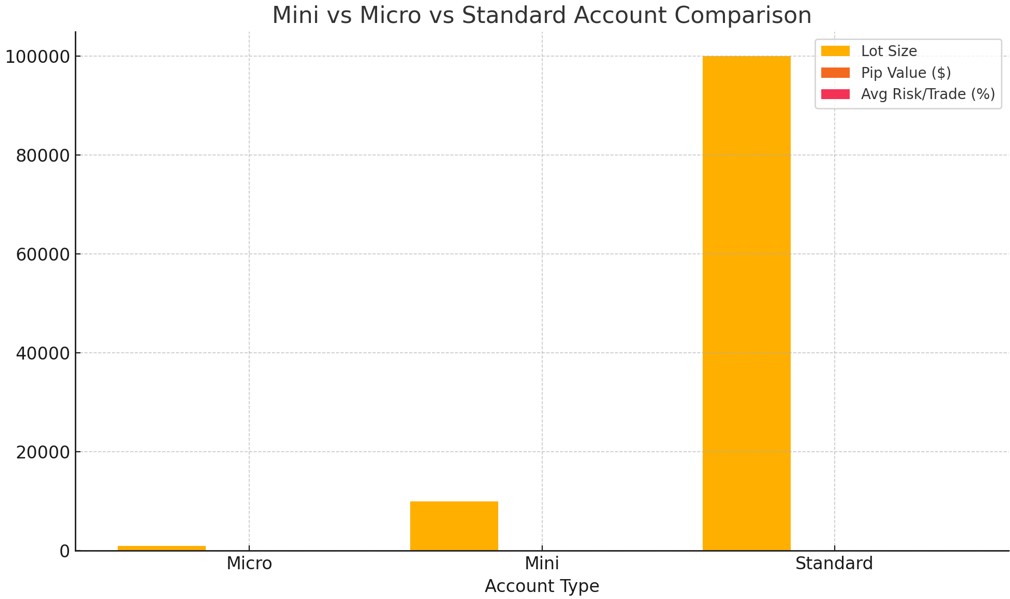
Forex accounts are typically categorized into three types: micro, mini, and standard. Each offers distinct trade sizing, risk levels, and financial requirements. Understanding these differences helps traders select the structure that aligns with their capital, risk tolerance, and trading objectives.
| Account type | Lot size | Pip value (EUR/USD) | Typical deposit | Recommended use |
|---|---|---|---|---|
| Micro | 1,000 units | ~$0.10 | $10–100 | Practice, very low-risk testing |
| Mini | 10,000 units | ~$1.00 | $100–500 | Strategy testing, risk control |
| Standard | 100,000 units | ~$10.00 | $1,000+ | Advanced strategies, scaling |
The comparison between a Forex mini vs micro account often depends on available capital and trading experience. Mini accounts provide a balanced option for traders looking to scale beyond micro positions without taking on the full exposure of standard accounts.
When evaluating account types, a mini Forex trading account offers greater return potential than micro accounts while maintaining lower volatility and risk compared to standard accounts.
Execution, infrastructure, and trade behavior
Recent broker data from 2025 indicates that mini Forex trading accounts experience fewer slippage events due to smaller order sizes and faster execution speeds.
The average mini Forex account user executes 15–20 trades per week, with most positions held for under four hours. VPS hosting and mobile alerts are widely used in mini Forex online trading, helping ensure uninterrupted order processing.
Order execution efficiency
Mini Forex trading accounts report approximately 15% fewer slippage events compared to standard accounts, based on recent broker observations. Smaller order sizes allow for faster fills and reduced price slippage, particularly during periods of high volatility. Most brokers rely on Tier-1 liquidity providers, supporting tighter spreads and minimal re-quotes for mini account orders.
Infrastructure and tools
VPS hosting is widely used among mini account traders running automated systems such as Expert Advisors. A VPS maintains continuous connectivity, reducing the risk of execution failures during power outages or unstable internet conditions. Mobile trading apps and custom alerts enable traders to monitor and adjust positions in real time, improving overall control.
Trading frequency and style
The average mini Forex account holder executes 15–20 trades per week, primarily focusing on major currency pairs such as EUR/USD and USD/JPY. Trade duration is typically under four hours, reflecting a preference for intraday and short-term momentum strategies. Mini accounts support scalping, basket trading, and news-based entries due to stable execution at smaller volumes.
Spread and liquidity impact
Trading mini lots helps avoid market depth disruptions that can occur with larger orders in standard accounts. Tighter spreads and cleaner entries are more common, especially during high-liquidity sessions such as the London–New York overlap. Mini accounts also allow higher trading frequency without significant liquidity constraints, even with moderate capital.
AI-driven strategies and trading efficiency
Recent quantitative analysis indicates that LSTM and ANN-based strategies can significantly improve risk-adjusted performance in mini account trading environments. In controlled conditions, these models have been shown to shift Sharpe ratios from deeply negative levels toward positive territory, highlighting their potential for more stable returns when applied with disciplined risk management.
AI-driven models have also demonstrated high forecasting accuracy, with mean absolute percentage error (MAPE) levels below 0.2% in live scenarios for major pairs such as EUR/USD. Traders using these tools on a Forex mini online platform can backtest, optimize, and deploy strategies efficiently without committing substantial capital.
Demographic profile and trading behavior
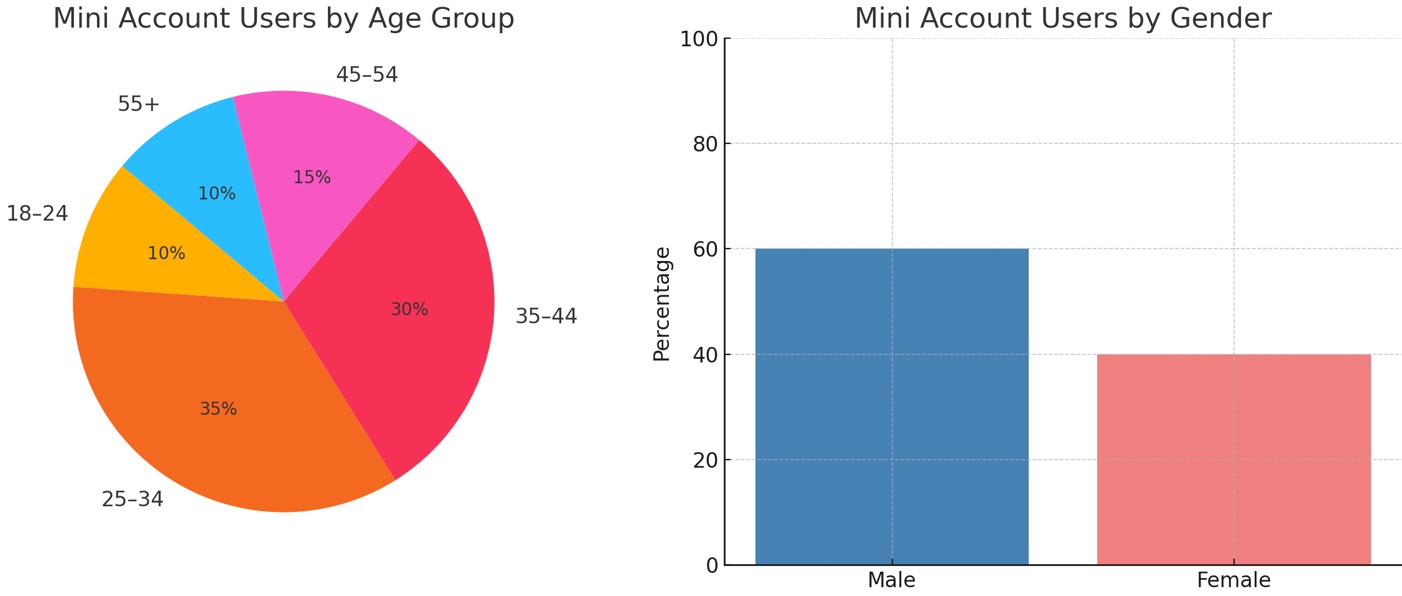
The typical user of Forex trading mini accounts falls within the 25–44 age range, with a majority male representation, while female participation continues to grow. On average, a mini account trader generates approximately $2 million in annual trading volume.
This segment prioritizes capital efficiency and access to analytical tools, making the mini Forex trading account a practical choice for traders focused on structured, cost-effective execution.
Trading volume and activity:
The average trade volume per user annually is around $2 million.
Traders typically execute 15–20 trades per week, with most positions held for under four hours, primarily focusing on high-liquidity currency pairs such as EUR/USD and GBP/USD.
Mini demo accounts and strategic planning
Many brokers offer a Forex mini demo account, which replicates real trading conditions using 10,000-unit lots and approximately $1 per pip, but with virtual capital.
Using a mini Forex demo account allows new traders to practice risk control and refine order execution. Once consistent performance is achieved, they can transition to live trading with a Forex trading mini account that follows the same lot structure.
How to open and use a mini Forex account
To open a mini Forex account, select a regulated broker that offers platforms such as MT4, MT5, or cTrader. The typical deposit ranges from $100 to $500. Traders then define risk per trade, usually no more than 2%, choose major currency pairs, and begin testing strategy logic in live market conditions.
With a mini Forex account, traders can work with multiple currency pairs such as EUR/USD, GBP/USD, and USD/JPY while applying fixed stop-loss levels and predefined risk limits.
Key benefits
Lower per-pip cost (~$1)
Smaller minimum deposit ($100–500)
Enhanced strategy control and lower psychological pressure
Real execution with manageable risk exposure
Flexibility to scale into standard accounts
By combining structure with flexibility, Forex mini accounts offer a practical solution for both new and experienced traders.
Best brokers offering Forex mini accounts
Choosing the right broker is essential when trading with a mini account, as execution quality, spreads, and platform stability directly affect performance. The best brokers typically offer flexible lot sizing, reliable order execution, and access to platforms such as MetaTrader 4 (MT4), MetaTrader 5 (MT5), or cTrader.
Below is a comparison of leading brokers that support Forex mini accounts, focusing on trading conditions, minimum deposits, and platform availability.
| OANDA | FOREX.com | IG Markets | GTCFX | RoboForex | |
|---|---|---|---|---|---|
|
Min. deposit, $ |
No | 100 | 1 | 30 | 10 |
|
Tradable assets |
129 | 5,500 | 20,000 | 27,000 | 12,000 |
|
Standard EUR/USD spread |
0.3 | 1.0 | 0.9 | 0.6 | 1.0 |
|
Micro |
Yes | Yes | Yes | Yes | Yes |
|
Mini account |
Yes | Yes | Yes | Yes | Yes |
|
Cent |
No | No | No | Yes | Yes |
|
Open an account |
Go to broker Your capital is at risk. |
Study review | Study review | Go to broker Your capital is at risk. |
Go to broker Your capital is at risk. |
Mini accounts offer a balanced entry into real market trading

A Forex mini account is one of the most practical options for traders who want real market exposure without the higher risk of standard lots. It creates a more controlled environment where position sizing, stop-loss placement, and overall risk management become easier to handle.
In my view, the main strength of a mini account is that it helps traders build discipline under live market conditions. Unlike demo trading, it reflects real spreads, execution, and emotional pressure, but keeps exposure at a manageable level. This makes it useful both for beginners and for experienced traders testing new strategies.
A mini account also works well as a transition stage between micro and standard trading. It gives traders enough market sensitivity to evaluate performance properly while keeping losses within a more reasonable range. For most retail traders, that balance is its main advantage.
Conclusion
Forex mini accounts offer an ideal balance between risk management and real market experience, making them an excellent stepping stone for both beginners and experienced traders. By trading 10,000-unit lots, users can control their exposure and discipline their strategy without committing excessive capital. For example, a trader can risk just $10 on a $500 account while still benefiting from live spreads and execution conditions. Ultimately, mini accounts provide the structure necessary for building long-term trading discipline and the flexibility to scale strategies confidently as skill and capital grow.
FAQs
What types of trading strategies are most suitable for Forex mini accounts?
How does a Forex mini account help in building trading discipline?
Are there differences in execution speed and slippage between mini and standard Forex accounts?
What is the typical deposit required to open a Forex mini account, and what currency pairs are commonly traded?
Editors' Top Picks and Insights






Related Articles
Team that worked on the article
Aleksandra Chaikina has been a contributor to Traders Union since 2021. With over 15 years of experience in copywriting and more than 5 years focused on financial content, she specializes in producing detailed guides, analytics, and comparative reviews across various sectors, including cryptocurrencies, Forex, investment strategies, and financial technologies.
Ciaran Ryan is a veteran financial journalist based in South Africa, where he covers cryptocurrency, mining, stock markets, and governance for Moneyweb. He also hosts the weekly Moneyweb Crypto Podcast.
Chinmay Soni is a financial analyst with more than 5 years of experience in working with stocks, Forex, derivatives, and other assets. As a founder of a boutique research firm and an active researcher, he covers various industries and fields, providing insights backed by statistical data.
Forex leverage is a tool enabling traders to control larger positions with a relatively small amount of capital, amplifying potential profits and losses based on the chosen leverage ratio.
Forex trading, short for foreign exchange trading, is the practice of buying and selling currencies in the global foreign exchange market with the aim of profiting from fluctuations in exchange rates. Traders speculate on whether one currency will rise or fall in value relative to another currency and make trading decisions accordingly. However, beware that trading carries risks, and you can lose your whole capital.
Scalping in trading is a strategy where traders aim to make quick, small profits by executing numerous short-term trades within seconds or minutes, capitalizing on minor price fluctuations.
Index in trading is the measure of the performance of a group of stocks, which can include the assets and securities in it.
Bitcoin is a decentralized digital cryptocurrency that was created in 2009 by an anonymous individual or group using the pseudonym Satoshi Nakamoto. It operates on a technology called blockchain, which is a distributed ledger that records all transactions across a network of computers.

-
 Afghanistan
-
 Albania
-
 Algeria
-
 Angola
-
 Argentina
-
 Armenia
-
 Australia
-
 Austria
-
 Azerbaijan
-
 Bahamas
-
 Bahrain
-
 Bangladesh
-
 Belarus
-
 Belgium
-
 Bolivia
-
 Botswana
-
 Brazil
-
 Brunei
-
 Bulgaria
-
 Cambodia
-
 Cameroon
-
 Canada
-
 Chile
-
 China
-
 Colombia
-
 Congo
-
 Costa Rica
-
 Cote d'Ivoire
-
 Croatia
-
 Cuba
-
 Cyprus
-
 Czechia
-
 DR Congo
-
 Denmark
-
 Dominican Republic
-
 Ecuador
-
 Egypt
-
 El Salvador
-
 Estonia
-
 Eswatini
-
 Ethiopia
-
 Finland
-
 France
-
 Georgia
-
 Germany
-
 Ghana
-
 Greece
-
 Haiti
-
 Hong Kong
-
 Hungary
-
 India
-
 Indonesia
-
 Iran, Islamic republic
-
 Iraq
-
 Ireland
-
 Israel
-
 Italy
-
 Jamaica
-
 Japan
-
 Jordan
-
 Kazakhstan
-
 Kenya
-
 Korea
-
 Kuwait
-
 Kyrgyzstan
-
 Laos
-
 Latvia
-
 Lebanon
-
 Lesotho
-
 Libya
-
 Lithuania
-
 Luxembourg
-
 Madagascar
-
 Malaysia
-
 Malta
-
 Mauritius
-
 Mexico
-
 Moldova
-
 Mongolia
-
 Montenegro
-
 Morocco
-
 Mozambique
-
 Myanmar
-
 Namibia
-
 Nepal
-
 Netherlands
-
 New Zealand
-
 Nigeria
-
 North Macedonia
-
 Norway
-
 Oman
-
 Pakistan
-
 Palestine
-
 Panama
-
 Papua New Guinea
-
 Paraguay
-
 Peru
-
 Philippines
-
 Poland
-
 Portugal
-
 Puerto Rico
-
 Qatar
-
 Reunion
-
 Romania
-
 Rwanda
-
 Saudi Arabia
-
 Serbia
-
 Singapore
-
 Slovakia
-
 Slovenia
-
 Somalia
-
 South Africa
-
 Spain
-
 Sri Lanka
-
 Sweden
-
 Switzerland
-
 Syria
-
 Taiwan
-
 Tajikistan
-
 Tanzania
-
 Thailand
-
 Trinidad and Tobago
-
 Tunisia
-
 Turkey
-
 UAE
-
 Uganda
-
 Ukraine
-
 United Kingdom
-
United States
-
 Uruguay
-
 Uzbekistan
-
 Venezuela
-
 Vietnam
-
 Yemen
-
 Zambia
-
 Zimbabwe
- Forex
- Crypto










- Understanding the Forex mini account format
- Risk control and trade structure
- How mini accounts compare to Micro and Standard accounts
- Execution, infrastructure, and trade behavior
- AI-driven strategies and trading efficiency
- Demographic profile and trading behavior
- Mini demo accounts and strategic planning
- How to open and use a mini Forex account
- Key benefits
- Best brokers offering Forex mini accounts
- Expert opinion
- Conclusion
- FAQs


