
Best Forex Scalping Strategies To Learn


Editorial Note: While we adhere to strict Editorial Integrity, this post may contain references to products from our partners. Here's an explanation for How We Make Money. None of the data and information on this webpage constitutes investment advice according to our Disclaimer.
Best Forex scalping strategies to learn are:
Scalping is a widely used trading method for those aiming to take advantage of small price fluctuations over a short period. In Forex trading, scalping involves making quick trades, often lasting only seconds or minutes. This article explores five practical Forex scalping strategies, including the 1-minute scalping method, moving average scalping, and other systems that active traders rely on to improve their results. These strategies offer actionable insights for traders seeking to refine their approach to scalping.
Best Forex scalping strategies
Forex scalping is a strategy that involves making multiple trades in a short period of time to profit from small price movements in the market. The goal of a scalper is to take advantage of small price changes, typically in the range of a few pips, and to exit the trades quickly with a small profit.
In this section, we will discuss some of the best Forex scalping strategies that you can use to improve your trading performance.
1-Minute scalping strategy
The 1-minute scalping strategy is a popular choice for Forex traders who are looking to make quick profits in a short amount of time. While it is relatively simple to follow, it still requires a certain level of skill and discipline to execute effectively.
One of the key features of this strategy is the low target per trade, which means that traders need to focus on quantity rather than quality. Here, it is not unusual for traders to place more than 100 trades a day to achieve their profit targets.
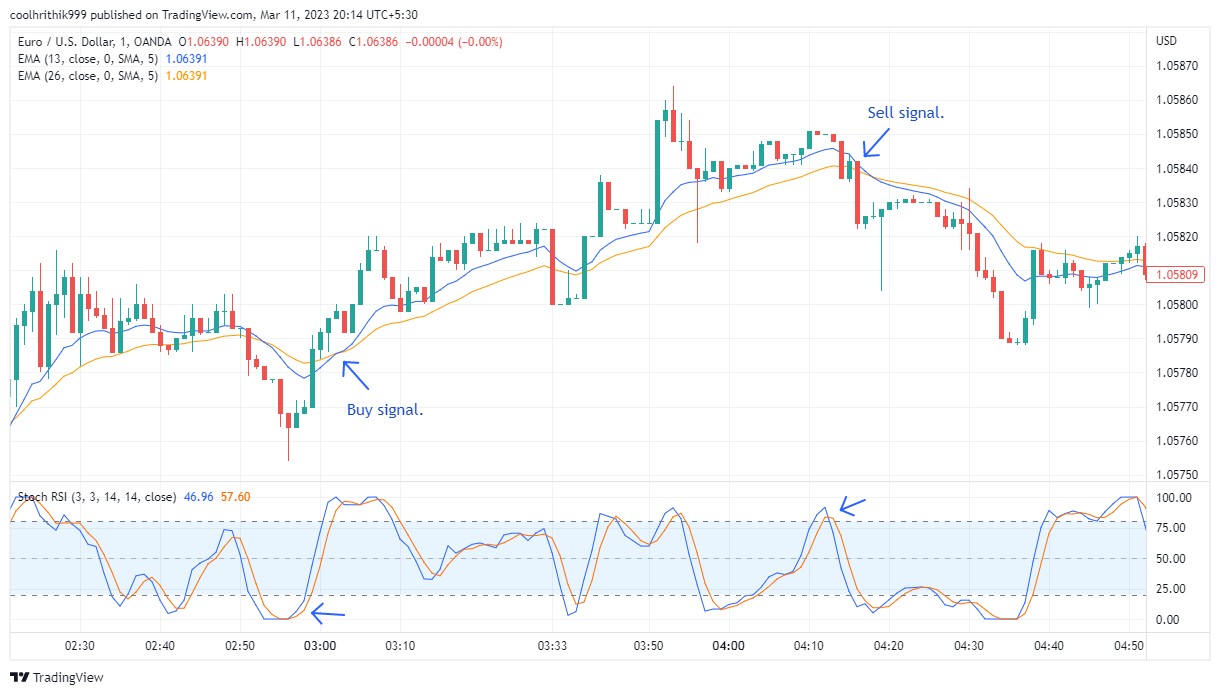
To use this strategy, traders should use the Stochastic Oscillator and two Exponential Moving Averages (EMA) with a 13-period and 26-period setting. These indicators can help traders identify entry and exit points for their trades. It is also important to note that the period settings can change according to a trader’s preference.
This approach can be implemented with any currency pair, but it is advisable to use it with major currency pairs with narrow spreads. Besides, traders should give priority to executing trades during high-volatility trading sessions, which usually take place during the New York closing and London opening times.
Overall, the 1-minute scalping strategy can be an effective way for Forex traders to make quick profits, given that it is backed by a lot of practice and discipline. Traders should always use risk management tools like stop-loss orders to protect their capital and avoid taking on excessive risk.
Moving average ribbon entry strategy
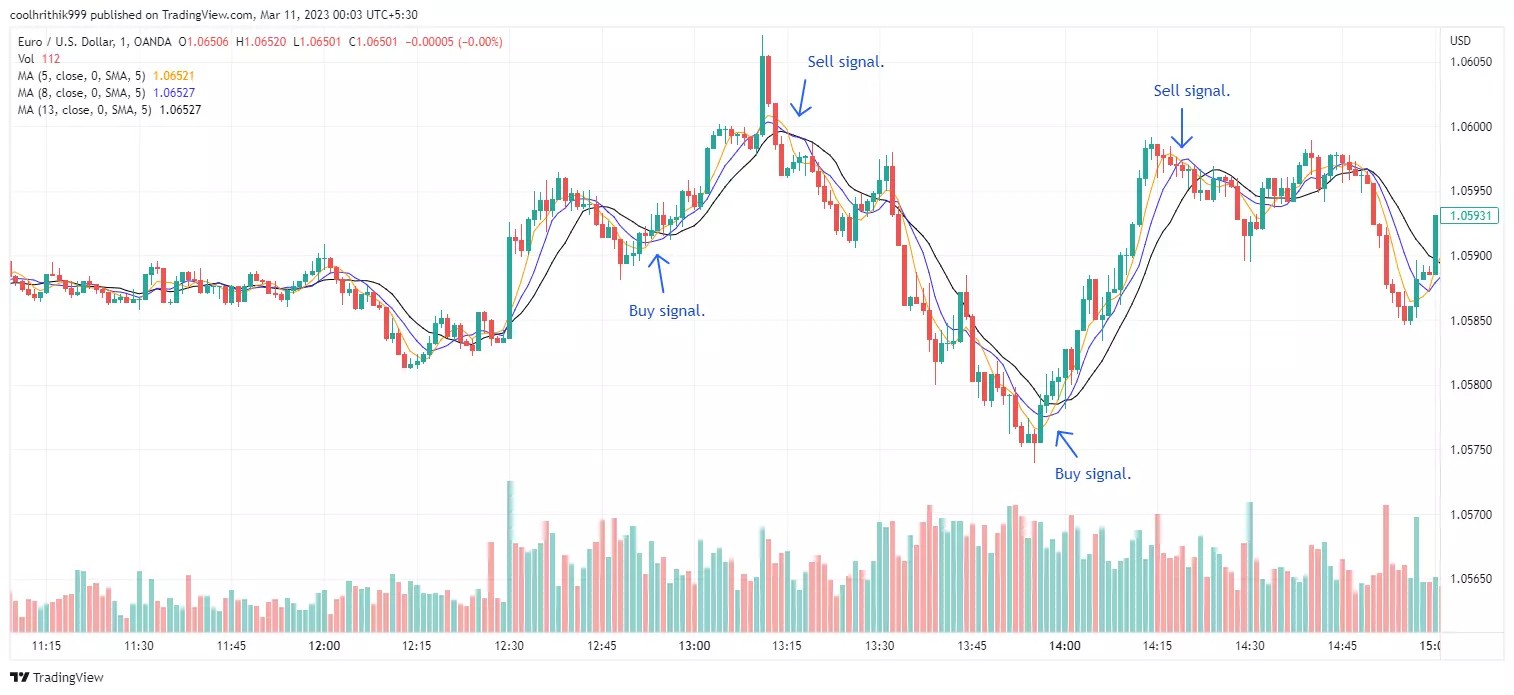
The Moving Average Ribbon Entry Strategy is a popular scalping technique among Forex traders due to its straightforwardness and efficiency. This strategy utilizes a combination of simple moving averages (SMAs) on a two-minute chart to identify robust trends that can be either bought or sold short on counter swings.
To execute this strategy, traders must place a combination of 5-8-13 SMAs on the chart. When the ribbons align and indicate an upward or downward trend, it implies a strong trend that is likely to persist. Consequently, traders can enter either a buy or sell short position, depending on the trend's direction.
If the market is experiencing range swings, the ribbons on the chart will level out, and the price may cross the ribbon frequently. This implies that the momentum is declining, which is favorable for a range or reversal. Consequently, traders must pay attention to the realignment of the ribbons, with them either rising or falling and spreading out, indicating more room between each line. This delicate pattern serves as a signal to buy or sell short.
This is an uncomplicated scalping strategy for Forex traders to master and can identify robust trends and enable quick profits on counter swings. Nevertheless, as with any trading strategy, traders should use appropriate risk management tools to safeguard their capital and avoid assuming excessive risk.
Bollinger band scalping
For Forex scalpers, Bollinger Bands can be an effective tool for trading in a volatile market. It is a technical analysis indicator that shows the standard deviation of the price relative to its moving average.
This strategy can be used with currency pairs that have low spreads in the Forex market. These pairs are usually the least volatile, making them ideal for scalpers who are looking to execute multiple trades within a short period of time.
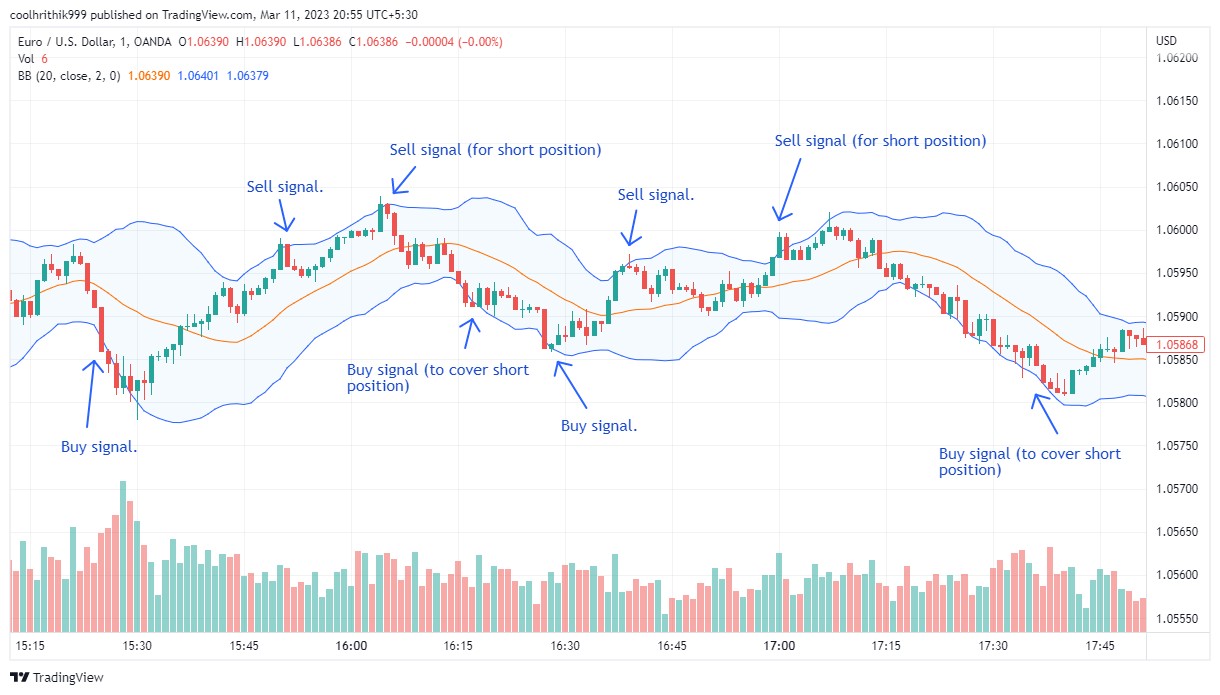
To use the Bollinger Band scalping strategy, scalpers should first plot Bollinger Bands on their chart. The bands consist of three lines: the upper band, the lower band, and the middle band. The middle band is typically a 20-period simple moving average, while the upper and lower bands are usually set two standard deviations away from the middle band.
When the price touches the upper band, it may be overbought, indicating that the price is due for a correction. Conversely, when the price touches the lower band, it may be oversold, indicating that the price is due for a rebound. Scalpers can use this information to enter and exit trades quickly and make a profit.
Parabolic SAR indicator scalping
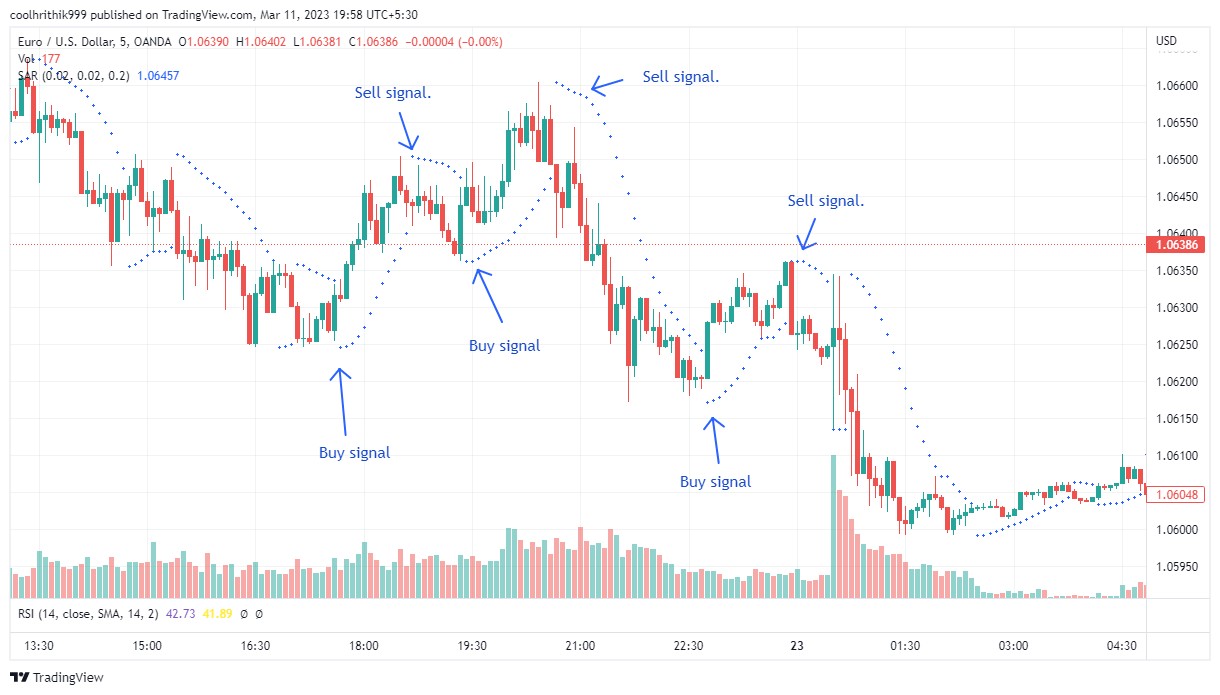
The Parabolic SAR (Stop and Reverse) is an indicator commonly used in Forex trading to determine trend direction and potential reversals. It can also be a useful tool for scalping strategies. This indicator forms a series of dots above or below the price, which are used to signal potential changes in trend direction.
When using the Parabolic SAR for scalping, traders will typically look for the dots to be positioned below the price, signaling a bullish trend, or above price, signaling a bearish trend. Once a trend direction has been established, traders can then use the dots as stop loss levels for their trades, aiming to capture a few pips of profit before closing the position.
RSI scalping
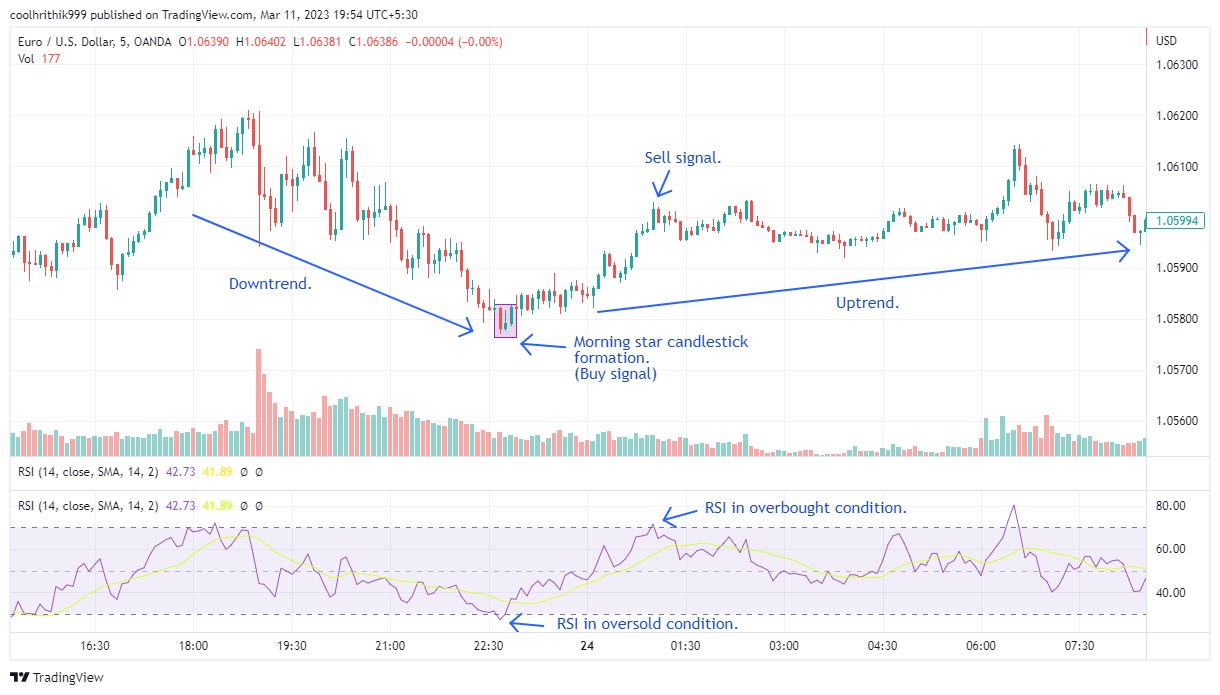
The RSI scalping strategy is a popular choice among Forex traders due to its effectiveness in identifying potential market reversals. The RSI is an oscillator that measures the speed and change of price movements, indicating when a currency pair is oversold or overbought. By setting the RSI to a shorter time frame, scalpers can quickly identify these signals and enter or exit trades accordingly. However, it's important to note that this strategy requires a thorough understanding of the RSI and market conditions, as false signals can occur. Traders should also consider combining the RSI with other indicators for confirmation before entering a trade.
How to choose your scalping strategy?
Experts have outlined some crucial points to consider when choosing your scalping strategy:
Research and evaluate your abilities. Before choosing a scalping strategy, it is essential to determine whether it is suitable for your personality, risk tolerance, and trading experience. Research different strategies and assess their compatibility with your skills and preferences.
Test on demo. It is recommended to test the chosen strategy on a demo account before using it in a live trading environment. This way, you can evaluate its effectiveness and see how it performs under different market conditions.
Focus on one currency pair. It is best to concentrate on one currency pair when scalping. This allows traders to better monitor technical charts and helps maintain focus, leading to better decision-making.
Choose high liquidity and volume pairs. Scalping requires quick entry and exit into the market, and trading in high liquidity and volume pairs allows traders to do so more easily.
Consider your temperament. Scalping requires a specific temperament, such as concentration, analytical skills, and patience. If you are someone who tends to make hasty decisions, then scalping may not be suitable for you. Take the time to assess your personality traits and whether they are compatible with this type of trading.
How to scalp in Forex?
Experts have prepared the following 5-step guide intended to help you learn the art of scalping in Forex market:
Choose your scalping strategy. As discussed earlier, there are various scalping strategies available such as Moving Average Ribbon Entry Strategy, Bollinger Band scalping, Parabolic SAR indicator scalping, and RSI scalping. Choose the one that aligns with your trading style, risk tolerance, and time commitment.
Choose a currency pair with good liquidity and volatility. Liquidity and volatility are essential for scalping as it requires rapid trading. Choose a currency pair that has high liquidity and volatility. For example, major currency pairs such as EUR/USD, GBP/USD, USD/JPY, etc. are more liquid and volatile.
Test your trading ideas on demo. Before jumping into live trading, it's important to test your trading ideas on demo accounts. This will help you understand the effectiveness of your strategy and identify any flaws in it. It's better to refine your strategy on a demo account rather than risking real money.
Understand market conditions for scalping. Scalping requires a good understanding of market conditions. Traders should be able to identify the best time to enter and exit the market. For example, volatile market conditions such as economic news releases or major market events can make scalping a highly risky strategy.
Finding the broker and currency pairs with tight spread ranges. The spread is the difference between the bid and ask price of a currency pair. It's important to find a broker that offers tight spread ranges as it can significantly impact your profits. In addition, choose a currency pair that has a tight spread range to minimize trading costs.
What are the best currency pairs for Forex scalpers?
Scalping in the Forex market involves executing rapid trades to profit from small price movements. Selecting the right currency pairs is crucial for effective scalping. Here are some top currency pairs favored by scalpers.
EUR/USD (Euro/US Dollar). This pair is the most actively traded in the forex market, offering high liquidity and tight spreads, which are essential for scalping strategies.
GBP/USD (British Pound/US Dollar). Known as "Cable," this pair provides significant volatility and liquidity, presenting ample opportunities for scalpers to capitalize on quick price movements.
USD/JPY (US Dollar/Japanese Yen). This pair is highly liquid and less volatile, making it suitable for scalping, especially during overlapping trading sessions of major markets.
USD/CHF (US Dollar/Swiss Franc). This pair is known for its stability and liquidity, offering scalpers opportunities during periods of market uncertainty.
AUD/USD (Australian Dollar/US Dollar). This pair is popular among scalpers due to its liquidity and the influence of commodity prices on its movements.
How to manage your risks scalping in Forex?
As with any trading strategy, risk management is a crucial element for successful scalping in the Forex market. Here are some expert tips that can help manage your risks while scalping:
Set a stop loss. A stop loss order is an order to automatically close out a trade at a certain price level in order to limit losses. As a scalper, you should always use a stop loss to limit your risk.
Determine your risk-reward ratio. Analysts suggest that scalpers should aim for a risk-reward ratio of at least 1:2, which means that for every dollar risked, the potential profit should be at least two dollars.
Use proper position sizing. It's important to properly size your positions according to your account balance and risk tolerance. Generally, it's recommended to risk no more than 1-2% of your account balance on each trade.
Avoid trading during news releases. Economic news releases can cause significant volatility in the market, making it difficult to manage risks. So, it's ideal to avoid scalping during major news releases.
Keep an eye on your leverage. Scalping typically involves using high leverage, which can increase both potential profits and losses. Be sure to use leverage responsibly and avoid overleveraging your account.
Is Forex scalping profitable?
Scalpers aim to make small profits on numerous trades, and the potential profit can add up over time. However, it is important to note that Forex scalping is also risky and can lead to significant losses if not executed properly.
The potential profit in Forex scalping depends on the trader's strategy and risk management. As mentioned earlier, scalpers aim to make small profits on multiple trades, usually ranging from a few pips to 10 or 15 pips per trade. Although the profits may seem small, they can add up quickly if the trader executes multiple successful trades.
Overall, Forex scalping can be profitable, but it requires a lot of practice, discipline, and a sound risk management plan to minimize potential losses. Traders should always remember that there are risks involved in any form of trading and should never risk more than they can afford to lose. Also you need to choose a reliable Forex broker.
| Trading.com USA | OANDA | FOREX.com | IG Markets | Interactive Brokers | |
|---|---|---|---|---|---|
|
Scalping |
Yes | Yes | Yes | Yes | Yes |
|
Demo |
Yes | Yes | Yes | Yes | Yes |
|
Min. deposit, $ |
50 | No | 100 | 1 | No |
|
Max. leverage |
1:50 | 1:200 | 1:50 | 1:200 | 1:30 |
|
Min Spread EUR/USD, pips |
0.9 | 0.1 | 0.7 | 0.6 | 0.2 |
|
Max Spread EUR/USD, pips |
No | 0.5 | 1.2 | 1.2 | 0.8 |
|
Investor protection |
No | £85,000 SGD 75,000 $500,000 | £85,000 | £85,000 €100,000 SGD 75,000 | $500,000 £85,000 |
|
Open an account |
Go to broker Your capital is at risk. |
Go to broker Your capital is at risk. |
Study review | Study review | Study review |
Add a volume indicator to spot real breakouts and avoid false ones

For beginners trying scalping, one advanced tip is to focus on liquidity zones that form just before major economic announcements. These zones are areas where big traders, like institutions, place large orders. By observing these levels, you can enter trades right after a quick fake move when the market shows its real direction. This allows you to take advantage of short-term momentum without risking too much by going against the trend. It's a less risky way to scalp during volatile periods and helps you align with the market's flow.
Another smart scalping trick is to use the 5-minute chart for placing trades while checking the 1-hour chart to confirm the trend. This method gives you a clear idea of the bigger picture while keeping your trades focused on quick moves. Adding a volume indicator can also help you spot real breakouts and avoid false ones. This dual approach gives beginners a better chance to trade confidently while reducing the risk of sudden market reversals.
Conclusion
In summary, mastering top Forex scalping strategies such as the 1-minute chart, Bollinger Bands, and RSI can provide traders with the agility and precision needed to capitalize on rapid market movements. The key to consistent short-term profits lies not only in selecting robust techniques, but also in applying rigorous risk management. For example, combining Bollinger Bands with disciplined stop-loss orders can help mitigate losses during volatile periods. By focusing on both proven strategies and expert money management, traders can turn scalping into a sustainable approach. Remember, in the fast-paced world of Forex, mastering your method and your mindset is the ultimate formula for long-term success.
FAQs
Which technical indicators can complement Forex scalping strategies for better trade confirmation?
How does selecting high-liquidity currency pairs enhance Forex scalping results?
What temperament or personal traits are ideal for successful Forex scalping?
Why is it important for beginners to test Forex scalping strategies on a demo account before live trading?
Editors' Top Picks and Insights



Related Articles
Team that worked on the article
Rinat Gismatullin is an entrepreneur and a business expert with 9 years of experience in trading. He focuses on long-term investing, but also uses intraday trading.
Dan Blystone began his trading career in 1998 as an arbitrage clerk on the floor of the Chicago Mercantile Exchange (CME). He later traded bond and Eurex futures at proprietary firms such as Altea Trading, gaining valuable experience in high-frequency trading and risk management.
Chinmay Soni is a financial analyst with more than 5 years of experience in working with stocks, Forex, derivatives, and other assets. As a founder of a boutique research firm and an active researcher, he covers various industries and fields, providing insights backed by statistical data.
Forex trading, short for foreign exchange trading, is the practice of buying and selling currencies in the global foreign exchange market with the aim of profiting from fluctuations in exchange rates. Traders speculate on whether one currency will rise or fall in value relative to another currency and make trading decisions accordingly. However, beware that trading carries risks, and you can lose your whole capital.
Scalping in trading is a strategy where traders aim to make quick, small profits by executing numerous short-term trades within seconds or minutes, capitalizing on minor price fluctuations.
The Stochastic Oscillator is a technical indicator used in financial analysis to gauge the momentum of a security's price and identify overbought or oversold conditions by comparing the closing price to a specified price range over a defined period.
Forex leverage is a tool enabling traders to control larger positions with a relatively small amount of capital, amplifying potential profits and losses based on the chosen leverage ratio.
Bollinger Bands (BBands) are a technical analysis tool that consists of three lines: a middle moving average and two outer bands that are typically set at a standard deviation away from the moving average. These bands help traders visualize potential price volatility and identify overbought or oversold conditions in the market.

-
 Afghanistan
-
 Albania
-
 Algeria
-
 Angola
-
 Argentina
-
 Armenia
-
 Australia
-
 Austria
-
 Azerbaijan
-
 Bahamas
-
 Bahrain
-
 Bangladesh
-
 Belarus
-
 Belgium
-
 Bolivia
-
 Botswana
-
 Brazil
-
 Brunei
-
 Bulgaria
-
 Cambodia
-
 Cameroon
-
 Canada
-
 Chile
Chile
-
 China
China
-
 Colombia
-
 Congo
Congo
-
 Costa Rica
-
 Cote d'Ivoire
-
 Croatia
-
 Cuba
Cuba
-
 Cyprus
-
 Czechia
-
 DR Congo
-
 Denmark
-
 Dominican Republic
-
 Ecuador
-
 Egypt
Egypt
-
 El Salvador
-
 Estonia
-
 Eswatini
-
 Ethiopia
-
 Finland
-
 France
-
 Georgia
-
 Germany
-
 Ghana
Ghana
-
 Greece
-
 Haiti
Haiti
-
 Hong Kong
-
 Hungary
-
 India
India
-
 Indonesia
-
 Iran, Islamic republic
-
 Iraq
Iraq
-
 Ireland
-
 Israel
-
 Italy
Italy
-
 Jamaica
-
 Japan
Japan
-
 Jordan
-
 Kazakhstan
-
 Kenya
Kenya
-
 Korea
Korea
-
 Kuwait
-
 Kyrgyzstan
-
 Laos
Laos
-
 Latvia
-
 Lebanon
-
 Lesotho
-
 Libya
Libya
-
 Lithuania
-
 Luxembourg
-
 Madagascar
-
 Malaysia
-
 Malta
Malta
-
 Mauritius
-
 Mexico
-
 Moldova
-
 Mongolia
-
 Montenegro
-
 Morocco
-
 Mozambique
-
 Myanmar
-
 Namibia
-
 Nepal
Nepal
-
 Netherlands
-
 New Zealand
-
 Nigeria
-
 North Macedonia
-
 Norway
-
 Oman
Oman
-
 Pakistan
-
 Palestine
-
 Panama
-
 Papua New Guinea
-
 Paraguay
-
 Peru
Peru
-
 Philippines
-
 Poland
-
 Portugal
-
 Puerto Rico
-
 Qatar
Qatar
-
 Reunion
-
 Romania
-
 Rwanda
-
 Saudi Arabia
-
 Serbia
-
 Singapore
-
 Slovakia
-
 Slovenia
-
 Somalia
-
 South Africa
-
 Spain
Spain
-
 Sri Lanka
-
 Sweden
-
 Switzerland
-
 Syria
Syria
-
 Taiwan
-
 Tajikistan
-
 Tanzania
-
 Thailand
-
 Trinidad and Tobago
-
 Tunisia
-
 Turkey
-
 UAE
UAE
-
 Uganda
-
 Ukraine
-
 United Kingdom
-
United States
-
 Uruguay
-
 Uzbekistan
-
 Venezuela
-
 Vietnam
-
 Yemen
Yemen
-
 Zambia
-
 Zimbabwe
- Forex
- Crypto












