
How to trade engulfing candle in Forex trading


Editorial Note: While we adhere to strict Editorial Integrity, this post may contain references to products from our partners. Here's an explanation for How We Make Money. None of the data and information on this webpage constitutes investment advice according to our Disclaimer.
To trade engulfing candles in Forex trading, identify bullish or bearish engulfing patterns on your chart and use them as entry signals. You can also combine engulfing patterns with other technical indicators, such as moving averages or the RSI, to enhance their effectiveness and increase the probability of successful trades.
How to trade bullish and bearish engulfing patterns
In the dynamic world of Forex trading, the ability to recognize and capitalize on powerful candlestick patterns is essential for success. Among these patterns, bullish and bearish engulfing patterns stand out as highly reliable signals that can provide valuable insights into market sentiment and potential price reversals. In this comprehensive guide, the experts at TU will delve into the intricacies of trading engulfing candles in Forex, exploring how to identify, interpret, and execute trades based on these unique patterns.
What is an engulfing candle?
Engulfing candles are significant candlestick patterns that signal potential trend reversals in the Forex market. These patterns occur when the body of one candle completely engulfs the body of the preceding candle, reflecting a strong shift in market sentiment. Engulfing candles can be divided into two types: bullish engulfing candles and bearish engulfing candles. Each type provides valuable insights into the direction of the market and helps traders identify potential trading opportunities.
Bullish engulfing candle
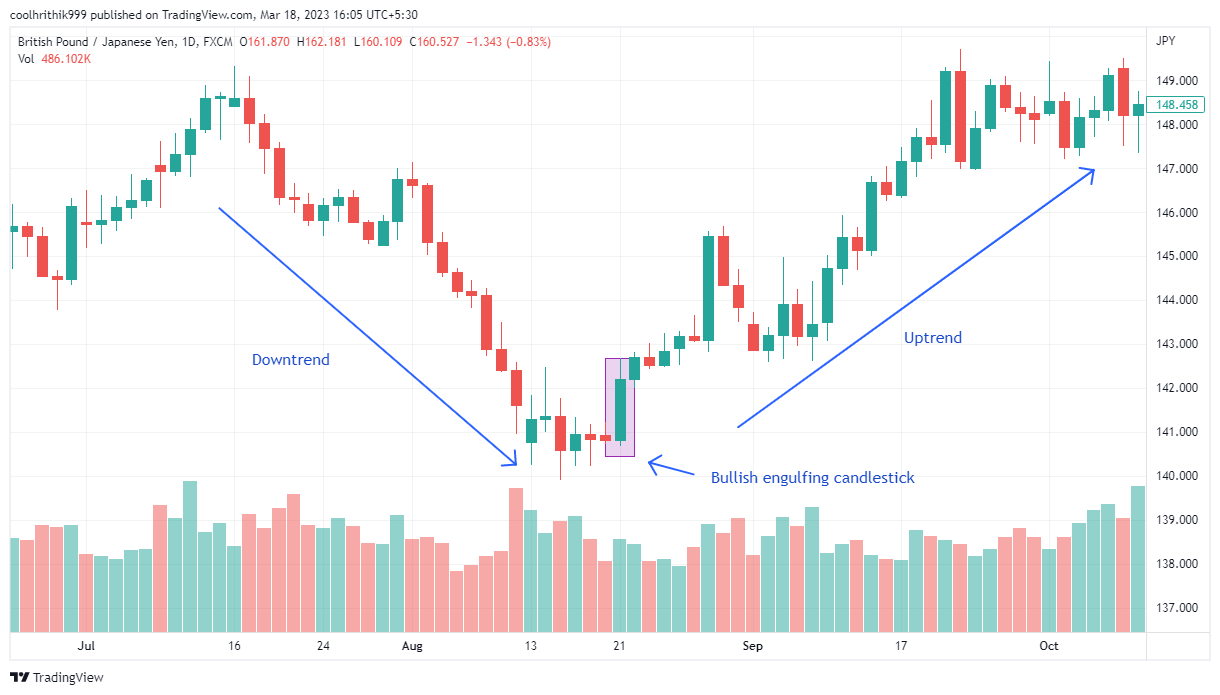
A bullish engulfing candle is a powerful pattern that signals the beginning of a potential uptrend. This pattern occurs after a series of red (or black) candles indicating a bearish trend. The bullish engulfing pattern consists of a green (or white) candle whose body entirely surrounds the previous day's red (or black) candlestick. This pattern is an indication that more buyers have entered the market, driving the price upward and resulting in a trend reversal. Traders often view the appearance of a bullish engulfing candle at the bottom of a downtrend as a strong buying opportunity.
Bearish engulfing candle
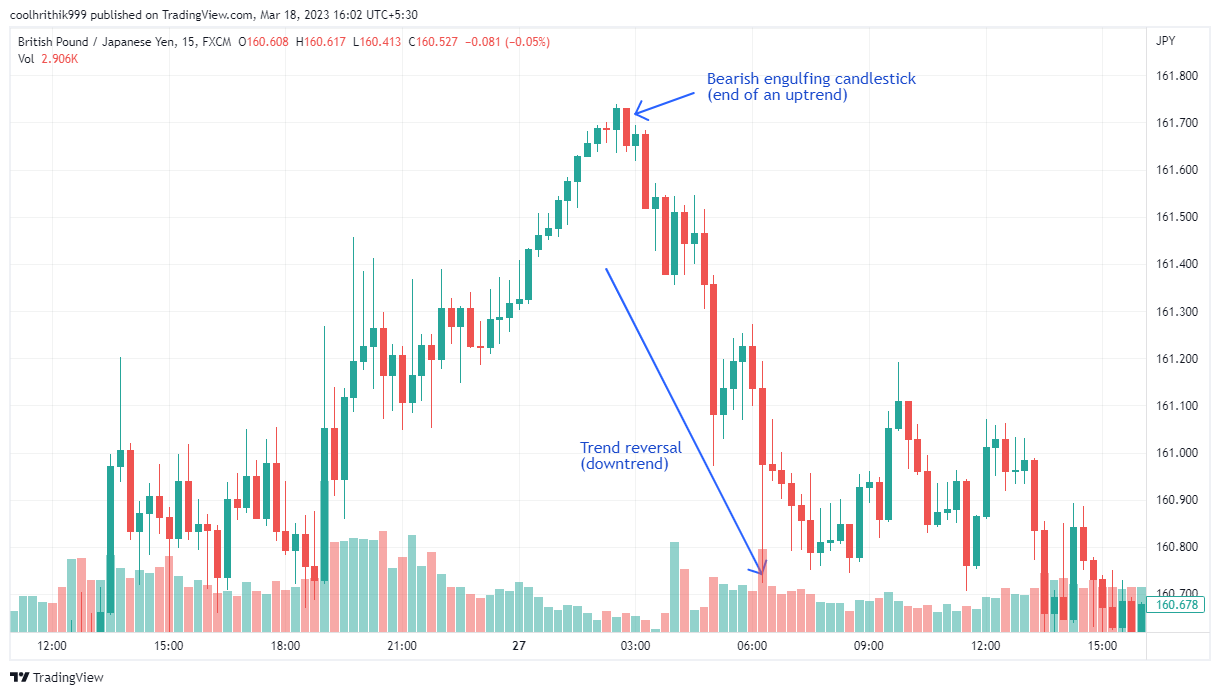
Conversely, a bearish engulfing candle serves as a warning sign for a potential downtrend. This pattern is the exact opposite of the bullish engulfing pattern and consists of a short green candle that is entirely covered by the subsequent red candle. The first candlestick in this pattern represents the bulls' control of the market, while the second candlestick shows that bearish pressure has pushed the market price lower. In a bearish engulfing pattern, the second period typically opens higher than the previous day but closes significantly lower, reflecting a shift in market sentiment.
| Type of candlestick | Formation | Location |
|---|---|---|
Bullish Engulfing | A green candle fully envelops the prior, smaller red candle | End of a downtrend |
Bearish Engulfing | A red candle fully envelops the prior, smaller green candle | Top of an uptrend |
Is the engulfing candle pattern reliable?
The reliability of engulfing candle patterns as a trading signal has long been a topic of debate among traders and market analysts. While these patterns can provide valuable insights into potential trend reversals, it's essential to consider various factors that can influence their effectiveness. In this section, we will analyze the reliability of engulfing candle patterns by examining their strengths and weaknesses, as well as discussing how traders can improve their accuracy by combining them with other technical indicators.
Strengths of engulfing candle patterns
Clear signals: One of the most significant advantages of engulfing candle patterns is their straightforward nature. These patterns are easy to identify, which allows traders to quickly spot potential trend reversals and make timely decisions.
High probability: Engulfing patterns tend to have a high probability of indicating trend reversals, particularly when they occur in conjunction with other confirming factors such as key support and resistance levels or oversold/overbought conditions.
Universally applicable: Engulfing patterns can be found in various financial markets, including Forex, stocks, and commodities. This versatility makes them valuable tools for traders across different asset classes.
Limitations of engulfing candle patterns
False signals: Like any other technical analysis tool, engulfing patterns can occasionally generate false signals. This can happen when the pattern is formed during periods of market consolidation or when there is insufficient follow-through buying or selling pressure.
Isolated analysis: Relying solely on engulfing patterns to make trading decisions can lead to false opportunities or increased risk. It's essential to combine these patterns with other technical indicators and market analysis techniques to improve their reliability.
How to use engulfing candle patterns?
To maximize the effectiveness of engulfing candle patterns, it's essential to use them in confluence with other technical indicators. This combination of tools allows traders to spot high-probability trade setups, determine optimal entry and exit points, and manage risk more effectively. In this section, we will explore various complex indicators that can be used in conjunction with engulfing patterns to enhance trading performance.
MACD
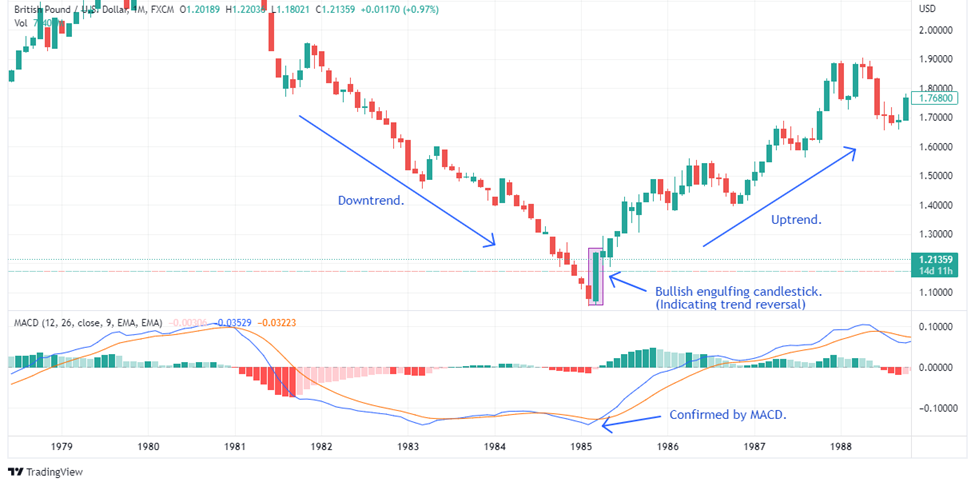
The Moving Average Convergence Divergence (MACD) is a popular momentum indicator that can be used alongside engulfing patterns to confirm trend reversals. When the MACD line crosses the signal line in the direction of the engulfing pattern, it provides additional confirmation of a potential trend change. For example, a bullish engulfing pattern accompanied by a positive MACD crossover can signal a strong buying opportunity. We have illustrated it in the chart below.
Moving Averages
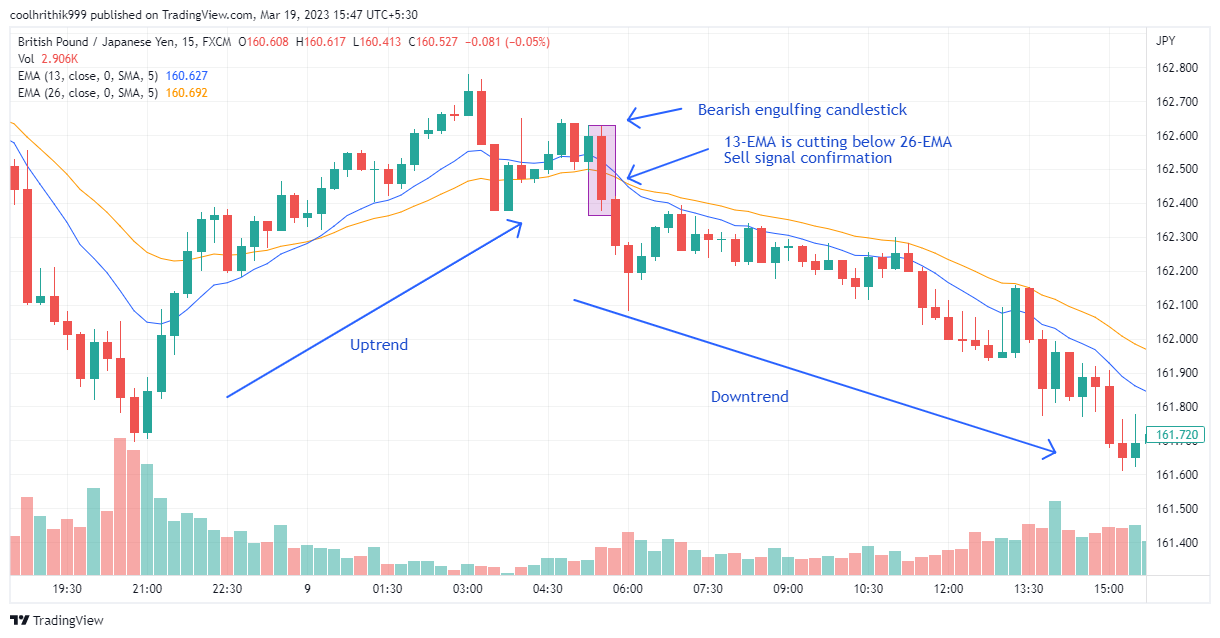
Moving averages (MAs) are widely-used tools for identifying trends and potential support and resistance levels. When an engulfing pattern forms near a key moving average, such as the 13-day and 26-day EMA, it can signal a strong reversal point. Combining engulfing patterns with MAs helps traders identify high-probability trade setups and improve the overall accuracy of their trading signals.
Parabolic SAR
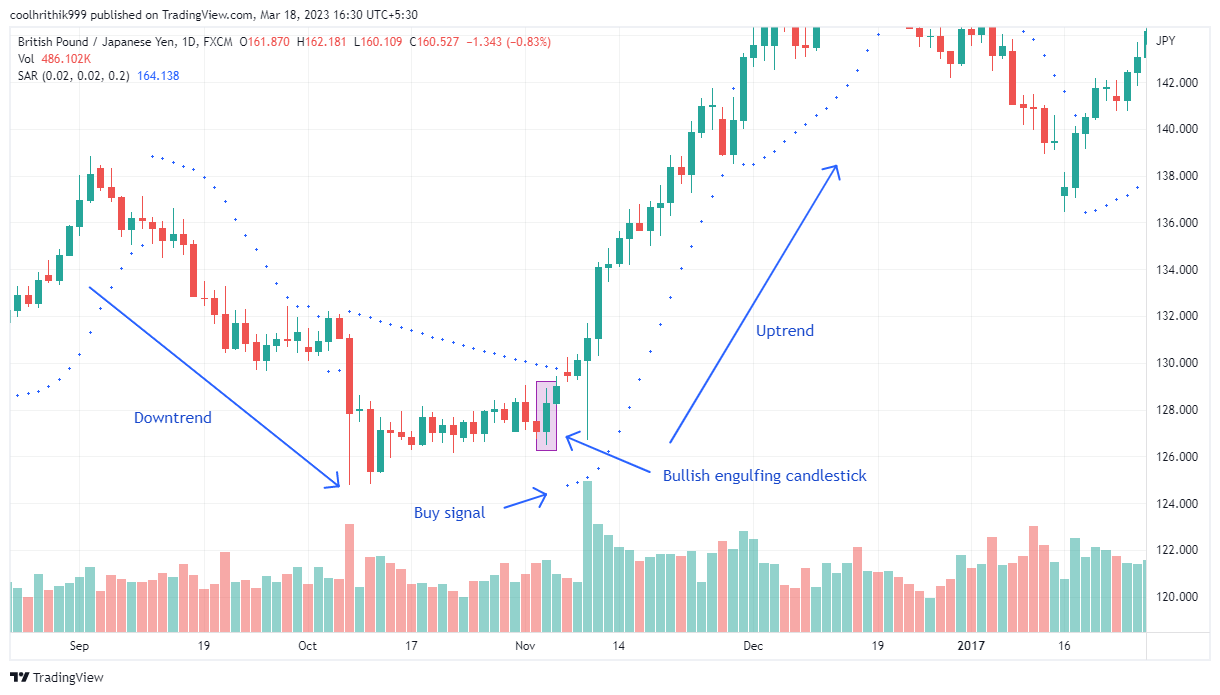
The Parabolic Stop and Reverse (SAR) indicator is a valuable tool for identifying trend direction and potential reversal points. When an engulfing pattern coincides with a Parabolic SAR reversal, it can provide a strong confirmation of a trend change. For instance, a bullish engulfing pattern accompanied by a Parabolic SAR reversal from above to below the price can indicate a potential uptrend.
How to use engulfing patterns effectively?
Engulfing patterns can be powerful tools for traders, offering insights into potential reversals, trend continuation, and exit signals. To harness the full potential of engulfing patterns, it's essential to understand their various applications and employ them strategically in your trading approach. In this section, TU experts will explore several ways to use engulfing patterns effectively, delving into extreme detail for each application.
Spotting reversals: One of the primary uses of engulfing patterns is to identify potential trend reversals. By carefully monitoring the market for bullish and bearish engulfing patterns, traders can pinpoint optimal entry points for new trades. When a reversal pattern is spotted, it's crucial to confirm the signal with additional technical indicators, such as the RSI, MACD, or Stochastic Oscillator. This confluence of signals increases the likelihood of a successful trade and helps traders ride the new trend to completion.
Trend continuation: Engulfing patterns can also serve as a confirmation of an existing trend's strength. For instance, if a bullish engulfing pattern appears during the retracement of an uptrend, it suggests that the trend is likely to continue, providing traders with more conviction in their current positions. Similarly, a bearish engulfing pattern during a retracement of the downtrend can indicate that the downward trend is still strong.
Exit strategy: Engulfing patterns can be valuable exit signals for existing trades. If a trader holds a position in a trend that appears to be nearing its end, an opposing engulfing pattern can signal that it's time to close the position. For example, if a trader is long in an uptrend and a bearish engulfing pattern forms, it might be a sign to exit the trade and lock in profits.
How to trade Forex using engulfing patterns?
Experts have prepared a straightforward three-step process to use engulfing patterns effectively:
Step 1: Identify the Pattern
First, keep an eye out for engulfing patterns on your Forex chart. These patterns show up when a larger candle (either bullish or bearish) follows a smaller candle in the opposite direction. Wait for a confirmation candle after spotting the pattern.
Step 2: Enter the Trade
To open a long (buy) position, enter the trade above the high of the bullish engulfing pattern. For a short (sell) position, enter the trade below the low of the bearish engulfing pattern.
Step 3: Set Profit Targets and Stop-Loss Orders
Establish your profit targets and stop-loss orders to manage your risk effectively. As a general rule of thumb, most traders place profit targets above the entry point for bullish engulfing patterns and below the entry point for bearish engulfing patterns. Similarly, stop-loss orders are set below the low of the bullish candle for long positions and above the high of the bearish candle for short positions.
Best Forex brokers
Engulfing patterns are easier to trade effectively when traders have access to reliable charting tools, fast execution, and competitive trading costs. Since this strategy often depends on precise entries, stop-loss placement, and confirmation from indicators, broker selection can directly affect the trading experience.
The table below compares some of the best Forex brokers based on key trading conditions and platform features.
| Plus500 | OANDA | Trading.com USA | FOREX.com | IG Markets | |
|---|---|---|---|---|---|
|
Min. deposit, $ |
100 | No | 50 | 100 | 1 |
|
Tradable assets |
2800 | 129 | 69 | 5500 | 20000 |
|
Currency pairs |
60 | 68 | 69 | 80 | 80 |
|
Standard EUR/USD spread |
0.7 | 0.3 | 1.1 | 1.0 | 0.9 |
|
Max. leverage |
1:300 | 1:200 | 1:50 | 1:50 | 1:200 |
|
Max. Regulation Level |
Tier-1 | Tier-1 | Tier-1 | Tier-1 | Tier-1 |
|
TU overall score |
7.7 | 7.24 | 6.22 | 7.12 | 7.04 |
|
Open an account |
Go to broker 81% of retail CFD accounts lose money. |
Go to broker Your capital is at risk. |
Go to broker Your capital is at risk. |
Study review | Study review |
Engulfing patterns work best with confirmation

Engulfing candles can be useful reversal signals, but I would not treat them as standalone entry points. In my view, their effectiveness depends heavily on market context. A bullish engulfing candle near support or a bearish engulfing candle near resistance usually carries more weight than the same pattern appearing in the middle of a choppy range.
I also recommend confirming engulfing patterns with tools such as moving averages, MACD, RSI, or clear support and resistance levels. This helps filter out weaker signals and reduces the risk of entering trades based on market noise rather than a meaningful shift in sentiment.
Conclusion
Mastering the engulfing candle pattern can give Forex traders a critical edge in identifying trend reversals and lucrative market turning points. By always seeking confirmation—such as combining engulfing signals with indicators like MACD, RSI, or key support and resistance levels—traders dramatically boost the reliability of their entries and exits. For example, a bullish engulfing near a major support zone often proves far more powerful than one in the middle of a flat market, and a bearish engulfing at resistance can warn of an impending downturn. Ultimately, the true value of the engulfing pattern lies in its ability to filter out market noise and highlight moments of real momentum shift—when paired with the right analytical tools and proper risk management, it becomes not just a signal, but a cornerstone of intelligent Forex strategy.
FAQs
What are common mistakes to avoid when trading engulfing candle patterns in Forex?
How does time frame selection impact the effectiveness of engulfing candle patterns in Forex trading?
Can engulfing candle patterns be integrated into automated trading strategies in Forex?
What risk management techniques are recommended when using engulfing candle patterns in Forex trading?
Editors' Top Picks and Insights






Related Articles
Team that worked on the article
Chinmay Soni is a financial analyst with more than 5 years of experience in working with stocks, Forex, derivatives, and other assets. As a founder of a boutique research firm and an active researcher, he covers various industries and fields, providing insights backed by statistical data.
Dr. BJ Johnson is a PhD in English Language and an editor with over 15 years of experience. He earned his degree in English Language in the U.S and the UK.
Mirjan Hipolito is a journalist and news editor at Traders Union. She is an expert crypto writer with five years of experience in the financial markets.
Bitcoin is a decentralized digital cryptocurrency that was created in 2009 by an anonymous individual or group using the pseudonym Satoshi Nakamoto. It operates on a technology called blockchain, which is a distributed ledger that records all transactions across a network of computers.
An investor is an individual, who invests money in an asset with the expectation that its value would appreciate in the future. The asset can be anything, including a bond, debenture, mutual fund, equity, gold, silver, exchange-traded funds (ETFs), and real-estate property.
A long position in Forex, represents a positive outlook on the future value of a currency pair. When a trader assumes a long position, they are essentially placing a bet that the base currency in the pair will appreciate in value compared to the quote currency.
Forex leverage is a tool enabling traders to control larger positions with a relatively small amount of capital, amplifying potential profits and losses based on the chosen leverage ratio.
Cryptocurrency is a type of digital or virtual currency that relies on cryptography for security. Unlike traditional currencies issued by governments (fiat currencies), cryptocurrencies operate on decentralized networks, typically based on blockchain technology.

-
 Afghanistan
-
 Albania
-
 Algeria
-
 Angola
-
 Argentina
-
 Armenia
-
 Australia
-
 Austria
-
 Azerbaijan
-
 Bahamas
-
 Bahrain
-
 Bangladesh
-
 Belarus
-
 Belgium
-
 Bolivia
-
 Botswana
-
 Brazil
-
 Brunei
-
 Bulgaria
-
 Cambodia
-
 Cameroon
-
 Canada
-
 Chile
-
 China
-
 Colombia
-
 Congo
-
 Costa Rica
-
 Cote d'Ivoire
-
 Croatia
-
 Cuba
-
 Cyprus
-
 Czechia
-
 DR Congo
-
 Denmark
-
 Dominican Republic
-
 Ecuador
-
 Egypt
-
 El Salvador
-
 Estonia
-
 Eswatini
-
 Ethiopia
-
 Finland
-
 France
-
 Georgia
-
 Germany
-
 Ghana
-
 Greece
-
 Haiti
-
 Hong Kong
-
 Hungary
-
 India
-
 Indonesia
-
 Iran, Islamic republic
-
 Iraq
-
 Ireland
-
 Israel
-
 Italy
-
 Jamaica
-
 Japan
-
 Jordan
-
 Kazakhstan
-
 Kenya
-
 Korea
-
 Kuwait
-
 Kyrgyzstan
-
 Laos
-
 Latvia
-
 Lebanon
-
 Lesotho
-
 Libya
-
 Lithuania
-
 Luxembourg
-
 Madagascar
-
 Malaysia
-
 Malta
-
 Mauritius
-
 Mexico
-
 Moldova
-
 Mongolia
-
 Montenegro
-
 Morocco
-
 Mozambique
-
 Myanmar
-
 Namibia
-
 Nepal
-
 Netherlands
-
 New Zealand
-
 Nigeria
-
 North Macedonia
-
 Norway
-
 Oman
-
 Pakistan
-
 Palestine
-
 Panama
-
 Papua New Guinea
-
 Paraguay
-
 Peru
-
 Philippines
-
 Poland
-
 Portugal
-
 Puerto Rico
-
 Qatar
-
 Reunion
-
 Romania
-
 Rwanda
-
 Saudi Arabia
-
 Serbia
-
 Singapore
-
 Slovakia
-
 Slovenia
-
 Somalia
-
 South Africa
-
 Spain
-
 Sri Lanka
-
 Sweden
-
 Switzerland
-
 Syria
-
 Taiwan
-
 Tajikistan
-
 Tanzania
-
 Thailand
-
 Trinidad and Tobago
-
 Tunisia
-
 Turkey
-
 UAE
-
 Uganda
-
 Ukraine
-
 United Kingdom
-
United States
-
 Uruguay
-
 Uzbekistan
-
 Venezuela
-
 Vietnam
-
 Yemen
-
 Zambia
-
 Zimbabwe
- Forex
- Crypto












