
Wire Transfer Explained


Editorial Note: While we adhere to strict Editorial Integrity, this post may contain references to products from our partners. Here's an explanation for How We Make Money. None of the data and information on this webpage constitutes investment advice according to our Disclaimer.
A wire transfer is an electronic method of sending money between bank accounts or through licensed money transfer providers, both domestically and internationally. It is widely used for personal and business payments because it offers a secure and relatively fast way to transfer funds without exchanging physical cash. While wire transfers are generally reliable for high-value transactions, they may involve processing fees and are typically irreversible once completed.
Today, transferring money locally or internationally has become significantly faster and more convenient than it was in the past. Previously, moving funds often relied on checks, drafts, or money orders, which could take days or even weeks to process. The introduction of wire transfers transformed this process, making cross-border and domestic transactions far more efficient and accessible.
Every day, millions of people around the world use wire transfers for purposes such as buying property, paying rent, sending gifts, or handling business transactions. If you are wondering what a wire transfer is and how it works, this guide explains the process, along with its main advantages and disadvantages.
What is a wire transfer?
A wire transfer is one of the most effective and fastest ways to move money electronically across town or across the globe. If you want to send money to a relative in a foreign country, you can transfer money through a bank or a non-bank source such as Western Union, Wise, and many other service providers. Wire transfers are feasible because you can transfer a few or even thousands of dollars nearby or to a foreign country in that country’s local currency.
Wire transfers do not involve physical cash. Instead, the transfer facilitates the movement of electronic or digital cash between banks or non-bank payment services, such as Western Union.
The receiver can take payment almost anywhere, by bank card, his personal bank account, or at any authorized pick-up location, such as a Western Union office. However, it usually takes a bit of effort compared to other money transfer methods. Such as person-to-person transfer, which is free and done using applications. A detailed list of pros and cons is discussed below.
- Pros
- Cons
- It is the fastest channel to transfer funds nationwide. You don't have to wait for it. Once you transfer the money, the receiver will be able to withdraw the money right away or within a few hours.
- The receiver doesn't have to go too far to collect the money because service providers have many branches or authorized pick-up sites globally, and some wire services coordinate with local banks or other payment services within a shared network. So, be sure which service the sender is using to complete the transfer.
- This method is much safer as providers must follow international wire transfer laws. As a result, you can rest assured that your funds are securely transferred minus, of course, any fees you must pay.
- Wire transfer services charge a fee for every transaction. Typically, the sender pays for the charges, and the receiver will get the amount sent in full and without deductions. But some services also charge a minimal fee from the receiver or a small percentage of the money received.
- It is risky because it's a non-reversible payment method. Once you make the transfer, you won't be able to stop or reverse the payment if you change your mind. This is problematic, especially if you don't know the beneficiary personally and the transaction is to pay for something that is unsatisfactory.
- Banks often impose a limit on the maximum amount of a transfer. So, this may conflict with a sender or receiver using this service.
Typical wire transfer case studies
There are many scenarios where a sender would want to send money quickly to the receiver, and a wire transfer is the best solution. The following are some of the most popular uses for wire transfers:
Money can be transferred overseas through wire transfers: This can be useful for circumstances like sending money to students studying overseas, for your Forex trading account, or sending money to family or friends.
Online bills can be paid with a wire transfer. Also, when you make an online purchase, the seller may request payment by wire transfer instead of using a credit or debit card. This is usually the case for high-value items.
Stocks and bonds can be purchased using wire transfers: Many stock brokers accept wire transfers as a form of payment for stocks and bonds.
How wire transfers work
You have probably given money to someone by hand, but in a wire transfer, there is no need to hand over the physical money. Instead, it allows the transfer of funds between two parties, even if both are in different geographical areas. Wire transfers or wire payments usually require specific information to transfer money successfully.
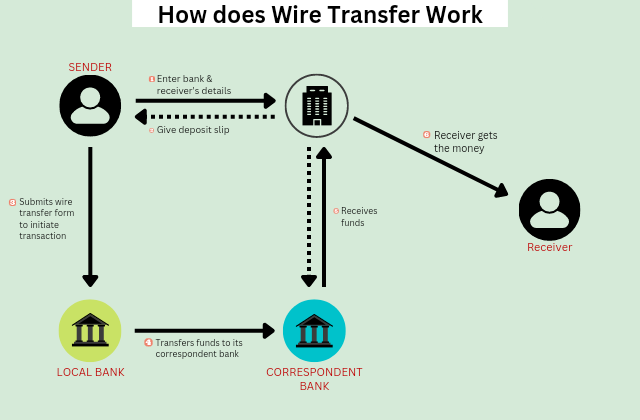
The following details must be provided to the bank by the sender:
Personal information
To start a wire transfer, you must give the recipient's name, address, and phone number, plus any other information the service requires.
Banking information
The recipient's financial information must also be given. This includes banking information like account and branch numbers. This step is required to ensure the money goes to the proper person.
Bank's information
The bank’s details for the beneficiary must be provided. This includes the bank's name, address, routing number, and its Society for Worldwide Interbank Financial Telecommunications (SWIFT) code.
Reason for transfer
At last, you need to explain why you are making the wire transfer. This is also necessary, where you provide the information and reasoning to the bank for the specific wire transfer. Mentioning the reason for each transfer is also mandatory to remove hints of money laundering, etc.
Once the information is documented, the wire transfer can begin. In the next step, the starting company sends a message containing payment instructions to the recipient's institution using a secure network, such as Fedwire or SWIFT routing. The recipient's bank deposits its reserves after receiving the information from the initiating bank.
Domestic and international wire transfers
A wire transfer is also known as a wire payment or payment by wire, which authorizes money to be moved rapidly and securely without any requirement of the exchange of physical money. It allows the transfer of money between two parties even if they are in different geographical locations. The sender shares information about the receiver, their account number, and the amount they want to transfer.
There are two wire transfer types:
Domestic wire transfers
Domestic transfers are payments made to various banks or financial institutions within the same nation. The recipients will securely provide their bank code to the sender for the particular account address. Therefore, receiving the money won't be a problem for the recipient.
The quickest payment for such transactions may take a few hours, but it may take up to an entire day. The reason is that domestic payments must pass through a domestic automated clearing system before being finally sent, which can take some time.
International wire transfers
In international wire transfers, if you send money you must provide the receiver's name, address, bank details and its SWIFT code, and the recipient’s bank account number. Money is transferred between two countries or regions using a wire transfer. Wire transfers to your friends or colleagues in another country are known as international wire transfers.
Often the wire transfer may take two business days to complete. So, you might be thinking, why is there an extra day? Because this extra time is used to clear the payment through the domestic automated clearing system and its foreign equivalent, so you shouldn't worry.
Are wire transfers safe?
People dealing with online banking and money transfers are constantly concerned about the safety and security of the funds. These concerns are valid as there are a rising number of bank frauds. In addition, wire transfers are carried out between banks before being put into the recipient's account.
Wire transfers are considered much safer than mailing a check or cash as a method of money transfer. They are safe transactions initiated by authorized staff members of your bank or a non-bank wire transfer service. Once they have begun, it is impossible to stop them.
Federal rules require individuals in the U.S. to provide proof of their identity and address when opening an account and using wire transfers.
The only safety concern is when swindlers gain access to someone else's bank account and can withdraw or redirect the funds to another account. In such circumstances, account holders might not be able to get their money back unless they report the incidents quickly enough to stop the swindlers from carrying out their schemes.
Are wire transfers expensive?
Senders are concerned about the fees charged while transferring money via wire transfer. Moving money through a wire transfer might not be cheap. For example, sending funds from a bank to the recipient's bank ranges from $0 to $50.
Domestic banks usually charge an outgoing fee of about $0 to $35. On the other hand, an international wire transfer for an outgoing transfer usually charges around $35 to $50.
It will be fair to claim that wire transfers are pricey and not inexpensive because this fee must be paid every time you opt for a wire transfer. But it may be a good option if you are in a hurry and need your funds to be transferred as quickly as possible.
Are wire transfers fast or slow?
Domestic wire transfers are usually completed in three days or less. Transfers between accounts at the same banking institution can take less than 24 hours. If you send money to another country, the receiver may not receive their funds for 5-7 days.
Sometimes, wire transfers can take very long. This could be the result of human error (e.g., making an error when filling out the form), the intervention of public holidays or natural disasters, or exotic locations. However, it becomes obvious why domestic and international wire transfers are so widely used. Consider how long banks might take to process checks or deposits, which can be up to 2 or 3 weeks.
The wait time varies from country to country. Depending on how you send money, there are numerous waiting periods for bank transfers.
The following are illustrations of transfer completion times by selected service providers:
Wise: It takes Wise 2-3 working days to complete the payment, but it could take up to a week for the money to get into the recipient's bank account.
PayPal: The clearing procedure typically takes 1-3 business days (but sometimes up to 3-5 business days).
Revolut: It usually takes 1–3 business days for a transfer to arrive in a recipient's account.
Best wire transfer alternatives
A wire transfer is the safest way to transfer money globally, although a percentage of the transfer amount or a flat fee is imposed on the money transferred. Many users are searching for alternative services due to these less-than-favorable factors and because it was more convenient in the early days of wire transfers for the user to move money from one end to another when wire transfers were initially launched. But today, the process has become convoluted because of heavy regulations.
Various other factors, such as delays in processing time, holidays, or an error while filling out the form, can frustrate the process. In such situations, people opt for different types of payment services.
Some alternative apps and services provide better and more efficient features and ease of use. A brief discussion of two alternatives and their relative features are discussed below.
Wise
Wise is the best service to transfer money today. It is the fastest with no or very little waiting time, but if you are opposed to debit or credit cards, the time limit might be increased up to a couple of days, plus it charges a meager flat fee or around 2% of the transfer/receiving amount.
Wise has no hidden fees; however, the exchange rate fee may be applied. So, this is one of the critical advantages of using Wise. It is 100% safe to use while you are transacting the money transfer. There is no bureaucracy in it. Wise offers meager currency exchange rates, the use of the application is intuitive, and the system has extensive global coverage.
Revolut
Revolut is another alternate application you can use for transferring money between two parties. It also provides many features and an easy-to-transfer-money interface. The application is swift and straightforward and provides rapid payment alerts and analysis.
Revolut offers allocation and auto-saving for your Revolut current account. It also gives frequent alerts and notifications for cryptocurrency rates and prices. Online spending fees are zero, either in the default or foreign currency.
Best Forex brokers for international transfers and trading
For traders who regularly fund Forex accounts through international transfers, choosing a broker with fast deposits, multiple payment options, and reliable transaction processing can make a significant difference. The best Forex brokers also combine competitive trading conditions with secure payment infrastructure and strong regulatory oversight.
Below is a comparison of some of the best Forex brokers that support convenient international funding methods and efficient account management for global traders.
| Plus500 | Trading.com USA | OANDA | FOREX.com | Venom by Cobra Trading | |
|---|---|---|---|---|---|
|
Min. deposit, $ |
100 | 50 | No | 100 | 5000 |
|
Tradable assets |
2800 | 69 | 129 | 5500 | No |
|
Bank Wire |
Yes | Yes | Yes | Yes | Yes |
|
Standard EUR/USD spread |
0.7 | 1.1 | 0.3 | 1.0 | 0.4 |
|
Max. leverage |
1:300 | 1:50 | 1:200 | 1:50 | 1:4 |
|
Max. Regulation Level |
Tier-1 | Tier-1 | Tier-1 | Tier-1 | Tier-1 |
|
TU overall score |
7.7 | 6.79 | 6.7 | 6.52 | 6.43 |
|
Open an account |
Go to broker 81% of retail CFD accounts lose money. |
Go to broker Your capital is at risk. |
Go to broker Your capital is at risk. |
Study review | Study review |
Wire transfers remain a reliable choice for larger trading transactions

In my view, wire transfers are still one of the most dependable funding methods for Forex traders handling larger deposits or international transactions. While newer payment apps offer convenience, traditional bank transfers continue to stand out for their security, global accessibility, and direct bank-to-bank processing.
Traders should also carefully compare transfer fees, processing times, and broker payment policies before sending funds internationally. Working with a regulated Forex broker that supports multiple funding methods can help reduce unnecessary costs and make account management far more efficient over time.
Conclusion
Wire transfers remain a cornerstone for fast, secure, and efficient money movement, especially for significant or international transactions. While fees and non-reversible nature may deter some users, the reliability and broad accessibility of wire transfers continue to make them a preferred choice for critical payments like real estate purchases or funding Forex accounts. Though modern alternatives like Wise and Revolut offer lower fees and user-friendly interfaces, traditional wire transfers excel where safety and direct bank-to-bank processing are paramount. Ultimately, choosing the right transfer method means weighing cost, speed, and security—but for high-value or cross-border needs, wire transfers still set the standard.
FAQs
What information is required to initiate a wire transfer?
Are there any limits to how much money can be sent by wire transfer?
What are the main risks associated with wire transfers?
When is a wire transfer preferred over other money transfer methods?
Editors' Top Picks and Insights






Related Articles
Team that worked on the article
Alamin Morshed is a contributor at Traders Union. He specializes in writing articles for businesses that want to improve their Google search rankings to compete with their competition.
Olga Shendetskaya has been a part of the Traders Union team as an author, editor and proofreader since 2017. Since 2020, Shendetskaya has been the assistant chief editor of the website of Traders Union, an international association of traders.
Forex trading, short for foreign exchange trading, is the practice of buying and selling currencies in the global foreign exchange market with the aim of profiting from fluctuations in exchange rates. Traders speculate on whether one currency will rise or fall in value relative to another currency and make trading decisions accordingly. However, beware that trading carries risks, and you can lose your whole capital.
Forex leverage is a tool enabling traders to control larger positions with a relatively small amount of capital, amplifying potential profits and losses based on the chosen leverage ratio.
Bitcoin is a decentralized digital cryptocurrency that was created in 2009 by an anonymous individual or group using the pseudonym Satoshi Nakamoto. It operates on a technology called blockchain, which is a distributed ledger that records all transactions across a network of computers.
Ethereum is a decentralized blockchain platform and cryptocurrency that was proposed by Vitalik Buterin in late 2013 and development began in early 2014. It was designed as a versatile platform for creating decentralized applications (DApps) and smart contracts.
Xetra is a German Stock Exchange trading system that the Frankfurt Stock Exchange operates. Deutsche Börse is the parent company of the Frankfurt Stock Exchange.

-
 Afghanistan
-
 Albania
-
 Algeria
-
 Angola
-
 Argentina
-
 Armenia
-
 Australia
-
 Austria
-
 Azerbaijan
-
 Bahamas
-
 Bahrain
-
 Bangladesh
-
 Belarus
-
 Belgium
-
 Bolivia
-
 Botswana
-
 Brazil
-
 Brunei
-
 Bulgaria
-
 Cambodia
-
 Cameroon
-
 Canada
-
 Chile
Chile
-
 China
China
-
 Colombia
-
 Congo
Congo
-
 Costa Rica
-
 Cote d'Ivoire
-
 Croatia
-
 Cuba
Cuba
-
 Cyprus
-
 Czechia
-
 DR Congo
-
 Denmark
-
 Dominican Republic
-
 Ecuador
-
 Egypt
Egypt
-
 El Salvador
-
 Estonia
-
 Eswatini
-
 Ethiopia
-
 Finland
-
 France
-
 Georgia
-
 Germany
-
 Ghana
Ghana
-
 Greece
-
 Haiti
Haiti
-
 Hong Kong
-
 Hungary
-
 India
India
-
 Indonesia
-
 Iran, Islamic republic
-
 Iraq
Iraq
-
 Ireland
-
 Israel
-
 Italy
Italy
-
 Jamaica
-
 Japan
Japan
-
 Jordan
-
 Kazakhstan
-
 Kenya
Kenya
-
 Korea
Korea
-
 Kuwait
-
 Kyrgyzstan
-
 Laos
Laos
-
 Latvia
-
 Lebanon
-
 Lesotho
-
 Libya
Libya
-
 Lithuania
-
 Luxembourg
-
 Madagascar
-
 Malaysia
-
 Malta
Malta
-
 Mauritius
-
 Mexico
-
 Moldova
-
 Mongolia
-
 Montenegro
-
 Morocco
-
 Mozambique
-
 Myanmar
-
 Namibia
-
 Nepal
Nepal
-
 Netherlands
-
 New Zealand
-
 Nigeria
-
 North Macedonia
-
 Norway
-
 Oman
Oman
-
 Pakistan
-
 Palestine
-
 Panama
-
 Papua New Guinea
-
 Paraguay
-
 Peru
Peru
-
 Philippines
-
 Poland
-
 Portugal
-
 Puerto Rico
-
 Qatar
Qatar
-
 Reunion
-
 Romania
-
 Rwanda
-
 Saudi Arabia
-
 Serbia
-
 Singapore
-
 Slovakia
-
 Slovenia
-
 Somalia
-
 South Africa
-
 Spain
Spain
-
 Sri Lanka
-
 Sweden
-
 Switzerland
-
 Syria
Syria
-
 Taiwan
-
 Tajikistan
-
 Tanzania
-
 Thailand
-
 Trinidad and Tobago
-
 Tunisia
-
 Turkey
-
 UAE
UAE
-
 Uganda
-
 Ukraine
-
 United Kingdom
-
United States
-
 Uruguay
-
 Uzbekistan
-
 Venezuela
-
 Vietnam
-
 Yemen
Yemen
-
 Zambia
-
 Zimbabwe
- Forex
- Crypto












