
Best P2P Crypto Exchanges In 2026



Editorial Note: While we adhere to strict Editorial Integrity, this post may contain references to products from our partners. Here's an explanation for How We Make Money. None of the data and information on this webpage constitutes investment advice according to our Disclaimer.

If you're too busy to read the entire article and want a quick answer, the best P2P crypto exchange is Kraken. Why? Here are its key advantages:
- Is legit in your country (Identified as United States
 )
) - Has a good user satisfaction score
- A high level of liquidity allows you to quickly complete transactions.
- The ability to trade cryptocurrencies around the clock from any device.
Best P2P crypto exchanges:
- Kraken - Best for trading crypto-fiat pairs (supports 7 fiat currencies, simple trading platform)
- OKX - Best automated trading solutions (copy trading, easy bot integration)
- BTCC - Multi-regulated exchange supporting copy trading, spot cryptocurrency trading, and derivatives with leverage up to 1:500.
- Coinbase - Highest level of security (multiple regulations, high data protection standards)
- Nebeus - Crypto platform registered with the Bank of Spain supporting 30+ cryptocurrencies, staking, crypto-backed loans, and a wallet with IBAN for euro transactions.
Peer-to-peer (P2P) exchanges are becoming increasingly popular for cryptocurrency trading. These platforms allow users to trade directly with each other, offering more privacy and often lower fees compared to traditional exchanges. In this article, we'll review the best P2P exchanges, focusing on several key aspects. We will compare the transaction fees, the range of supported fiat currencies and cryptocurrencies, and the available payment methods. This detailed comparison will help you choose the best platform for your trading needs.
Best P2P cryptocurrency exchanges
A peer-to-peer (P2P) crypto exchange allows traders to exchange cryptocurrencies directly with each other, bypassing intermediaries like banks. This direct interaction simplifies transactions and offers more privacy, as there's no need for an order book to match buy and sell orders.
On P2P exchanges, verified users can trade cryptocurrencies hassle-free. These platforms don't control the cryptocurrencies but facilitate direct transactions between users, ensuring they retain custody of their funds and choose from various payment methods with different fees.
| P2P | Min. Deposit, $ | P2P Maker Fee, % | P2P Taker Fee, % | Withdrawal fee | Open an account | |
|---|---|---|---|---|---|---|
| Yes | 10 | 0 | 0 | 0.0004 BTC 2.6 USDT | Go to broker Your capital is at risk. |
|
| Yes | 10 | 0 - 0.40 | 0.05 - 0.60 | Fixed fee - 25 USD PayPal - 1.5% USDC - 10 USD | Go to broker Your capital is at risk. |
|
| Yes | 1 | 0,10 - 0,16 | 0,16 - 0,20 | 0.0005 BTC | Go to broker Your capital is at risk. |
|
| Yes | 10 | 0 | 0 | Network fees | Go to broker Your capital is at risk.
|
|
| Yes | 5 | 0 | 0 | 0.0005 BTC | Go to broker Your capital is at risk.
|
What coins and fiat currencies can I exchange P2P?
We compared the total number of coins as well as fiat currencies available for exchange on these platforms, which are typically traded by users on P2P exchanges. This analysis helps in identifying which P2P exchanges offer the most diverse options for trading.
| Coins Supported | USD | EUR | GBP | Open an account | |
|---|---|---|---|---|---|
| 329 | Yes | Yes | No | Go to broker Your capital is at risk. |
|
| 249 | Yes | Yes | Yes | Go to broker Your capital is at risk. |
|
| 250 | Yes | Yes | Yes | Go to broker Your capital is at risk. |
|
| 474 | No | No | No | Go to broker Your capital is at risk.
|
|
| 50 | Yes | Yes | Yes | Go to broker Your capital is at risk.
|
What payment options do P2P exchanges support?
P2P exchanges support a variety of payment options to facilitate transactions between users. Common payment methods include:
Bank transfers. Most P2P platforms support direct bank transfers, allowing users to transfer funds from their bank accounts to complete transactions.
Credit and debit cards. Some P2P exchanges allow users to use credit and debit cards for buying and selling cryptocurrencies.
E-wallets. Popular e-wallet services like PayPal, Skrill, and Neteller are often supported, providing a quick and convenient payment option.
Cryptocurrency wallets. Users can also pay directly from their cryptocurrency wallets, making the process seamless for crypto-to-crypto transactions.
Mobile payment systems. Services like Apple Pay, Google Pay, and other mobile payment systems are sometimes supported for ease of use.
| Crypto | PayPal | Bank Card | Bank Wire | Advcash | Google Pay | Apple Pay | |
|---|---|---|---|---|---|---|---|
| Yes | No | Yes | No | No | Yes | Yes | |
| Yes | Yes | Yes | Yes | No | Yes | Yes | |
| Yes | Yes | Yes | Yes | Yes | Yes | Yes | |
| Yes | No | Yes | Yes | No | Yes | Yes | |
| Yes | Yes | Yes | Yes | No | No | No |
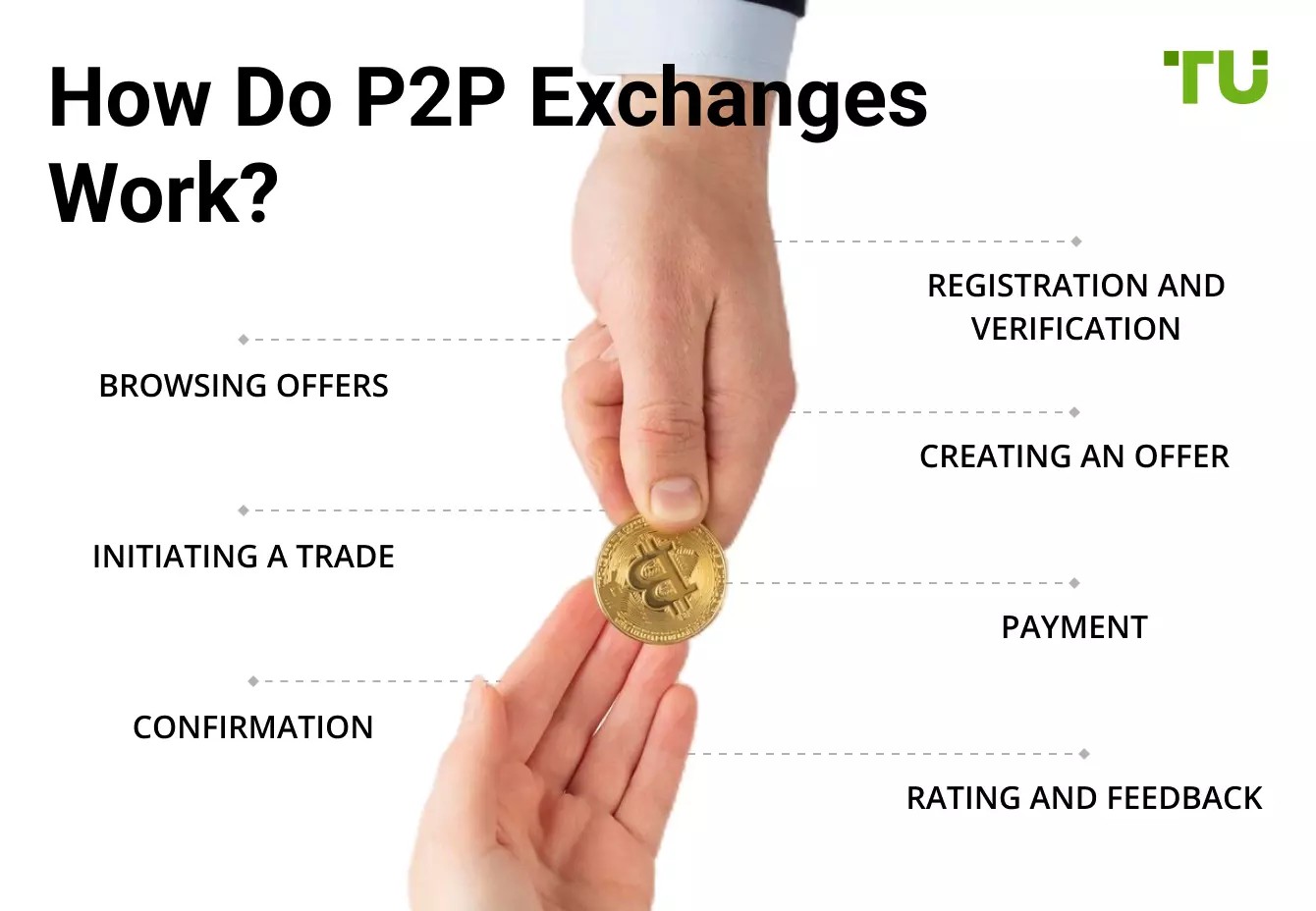
Registration and verification. Users sign up on a P2P exchange platform and complete any required identity verification processes.
Browsing offers. Users browse through offers posted by other users, which include details about the exchange rate, payment methods, and limits.
Creating an offer. Alternatively, users can create their own offers, specifying the amount of cryptocurrency they want to buy or sell, preferred payment method, and exchange rate.
Initiating a trade. Once a suitable offer is found, the user initiates a trade. The P2P platform typically holds the cryptocurrency in escrow to ensure the transaction proceeds smoothly.
Payment. The buyer transfers the agreed-upon amount of fiat currency to the seller using the specified payment method.
Confirmation. After receiving the payment, the seller confirms the transaction on the platform, which then releases the cryptocurrency from escrow to the buyer.
Rating and feedback. Users can rate and leave feedback about their trading experience, helping to build trust within the community.
P2P vs centralized exchanges — how do they compare?
| Feature | P2P exchanges | Centralized exchanges |
|---|---|---|
| Privacy | Higher, no intermediaries | Lower, requires verification and KYC |
| Fees | Generally lower, sometimes zero | Often higher to cover operational costs |
| Transaction Speed | Slower, dependent on user actions | Faster, automated matching and execution |
| Liquidity | Lower, depends on user availability | Higher, managed by the exchange |
| Payment Methods | Various, flexible | Limited, typically bank transfers and cards |
| Security | Depends on user caution, potential for scams | Higher, robust security measures in place |
| Customer Support | Limited, community-based support | Extensive, dedicated support teams |
| Control over Funds | Full control, no third-party intervention | Less control, funds held by the exchange |
| Global Access | Wide access, fewer restrictions | Often restricted by regional regulations |
How to choose the best P2P crypto exchange?
Choosing the right peer-to-peer (P2P) cryptocurrency exchange is essential for a safe and smooth trading experience. Here are the key points to consider:
Security. Prioritize platforms with strong security measures like two-factor authentication (2FA), encryption, and escrow services. These features help protect your transactions and funds from potential threats.
Supported currencies. Ensure the exchange supports the cryptocurrencies and fiat currencies you want to trade. A broader range of options makes it easier to meet your trading requirements.
Payment options. Look for exchanges that offer multiple payment methods, such as bank transfers, debit or credit cards, and digital payment systems. Having flexibility in payment options can simplify your transactions.
Fees. Check the exchange's fee structure, including trading fees, withdrawal fees, and any hidden charges. Low or zero fees can make a significant difference for frequent trades.
User experience. A clear and easy-to-navigate interface helps avoid confusion and errors during transactions. This is especially important for those new to trading.
Reputation. Research the exchange's history and user reviews to gauge its reliability. Positive feedback and a strong track record indicate trustworthiness.
Customer support. Accessible and responsive customer service is important, especially when dealing with transaction issues. Check if the platform provides live chat, email, or phone support.
Regulatory compliance. Ensure the exchange complies with local regulations and has proper licensing. Regulatory compliance adds credibility and helps protect your interests.
Methodology for compiling our ratings of crypto exchanges
Traders Union applies a rigorous methodology to evaluate crypto exchanges using over 100 quantitative and qualitative criteria. Multiple parameters are given individual scores that feed into an overall rating.
Key aspects of the assessment include:
-
User reviews. Client reviews and feedback are analyzed to determine customer satisfaction levels. Reviews are fact-checked and verified.
-
Trading instruments. Exchanges are evaluated on the range of assets offered, as well as the breadth and depth of available markets.
-
Fees and commissions. All trading fees and commissions are analyzed comprehensively to determine overall costs for clients.
-
Trading platforms. Exchanges are assessed based on the variety, quality, and features of platforms offered to clients.
-
Extra services. Unique value propositions and useful features that provide traders with more options for yield generation.
-
Other factors like brand popularity, client support, and educational resources are also evaluated.
How to choose a P2P platform for P2P transactions

When diving into peer-to-peer (P2P) crypto trading, it's crucial to recognize that while these platforms facilitate direct transactions between users, they also come with unique challenges. One often overlooked aspect is the importance of understanding the platform's dispute resolution mechanisms. In the event of a transaction disagreement, knowing how the platform mediates disputes can be the difference between a quick resolution and prolonged frustration. Before engaging in trades, familiarize yourself with the platform's policies on conflicts and ensure they have a robust system in place to protect your interests.
Another specialized consideration is the platform's liquidity for your specific trading pairs. Even if a P2P exchange supports a wide array of cryptocurrencies, the actual availability of buyers and sellers for your desired pair can vary significantly. Low liquidity can lead to unfavorable pricing and longer transaction times. Regularly monitor the platform's market activity for your chosen assets to ensure you can execute trades efficiently and at competitive rates.
Conclusion
In conclusion, selecting the right P2P crypto exchange is vital for maximizing security and minimizing trading costs as the market evolves in 2026. The top-rated platforms, such as Binance P2P and Bybit, stand out by offering robust user protections alongside competitive fees, making them ideal choices for both novice and seasoned traders. Prioritizing features like escrow services, reputation systems, and user-friendly interfaces can greatly enhance your trading safety and efficiency. Ultimately, your success in P2P cryptocurrency trading depends not just on the exchange you choose, but on your commitment to staying informed and vigilant in an ever-changing digital landscape.
FAQs
How do transaction fees differ between P2P crypto exchanges and centralized platforms?
What types of payment methods are commonly available on P2P crypto exchanges?
How is user privacy maintained on P2P crypto exchanges?
What factors should be considered when assessing the user experience on P2P crypto exchanges?
Editors' Top Picks and Insights

Tokenized stocks in the spotlight: How do they work and are they worth trading?

Do politicians make the best stock traders?

Crypto test drive: How automakers are exploring digital assets

Lindsey Graham death: U.S. senator’s crypto legacy

Tether under pressure: USDT in Europe, audit questions, and the fight for trust

Lean Ethereum: Why Buterin wants to rebuild the network
Related Articles
Team that worked on the article
Andrey Mastykin is an experienced author, editor, and content strategist who has been with Traders Union since 2020. As an editor, he is meticulous about fact-checking and ensuring the accuracy of all information published on the Traders Union platform.
Dan Blystone began his trading career in 1998 as an arbitrage clerk on the floor of the Chicago Mercantile Exchange (CME). He later traded bond and Eurex futures at proprietary firms such as Altea Trading, gaining valuable experience in high-frequency trading and risk management.
Chinmay Soni is a financial analyst with more than 5 years of experience in working with stocks, Forex, derivatives, and other assets. As a founder of a boutique research firm and an active researcher, he covers various industries and fields, providing insights backed by statistical data.
Crypto trading involves the buying and selling of cryptocurrencies, such as Bitcoin, Ethereum, or other digital assets, with the aim of making a profit from price fluctuations.
Index in trading is the measure of the performance of a group of stocks, which can include the assets and securities in it.
Ethereum is a decentralized blockchain platform and cryptocurrency that was proposed by Vitalik Buterin in late 2013 and development began in early 2014. It was designed as a versatile platform for creating decentralized applications (DApps) and smart contracts.
A wire transfer is a method of electronic funds transfer in which money is sent from one bank or financial institution to another, typically across international or domestic boundaries. It involves the sender providing their bank with specific instructions, including the recipient's bank details and the amount to be transferred, and the funds are then electronically moved from the sender's account to the recipient's account.
Cryptocurrency is a type of digital or virtual currency that relies on cryptography for security. Unlike traditional currencies issued by governments (fiat currencies), cryptocurrencies operate on decentralized networks, typically based on blockchain technology.
-
 Afghanistan
-
 Albania
-
 Algeria
-
 Angola
-
 Argentina
-
 Armenia
-
 Australia
-
 Austria
-
 Azerbaijan
-
 Bahamas
-
 Bahrain
-
 Bangladesh
-
 Belarus
-
 Belgium
-
 Bolivia
-
 Botswana
-
 Brazil
-
 Brunei
-
 Bulgaria
-
 Cambodia
-
 Cameroon
-
 Canada
-
 Chile
Chile
-
 China
China
-
 Colombia
-
 Congo
Congo
-
 Costa Rica
-
 Cote d'Ivoire
-
 Croatia
-
 Cuba
Cuba
-
 Cyprus
-
 Czechia
-
 DR Congo
-
 Denmark
-
 Dominican Republic
-
 Ecuador
-
 Egypt
Egypt
-
 El Salvador
-
 Estonia
-
 Eswatini
-
 Ethiopia
-
 Finland
-
 France
-
 Georgia
-
 Germany
-
 Ghana
Ghana
-
 Greece
-
 Haiti
Haiti
-
 Hong Kong
-
 Hungary
-
 India
India
-
 Indonesia
-
 Iran, Islamic republic
-
 Iraq
Iraq
-
 Ireland
-
 Israel
-
 Italy
Italy
-
 Jamaica
-
 Japan
Japan
-
 Jordan
-
 Kazakhstan
-
 Kenya
Kenya
-
 Korea
Korea
-
 Kuwait
-
 Kyrgyzstan
-
 Laos
Laos
-
 Latvia
-
 Lebanon
-
 Lesotho
-
 Libya
Libya
-
 Lithuania
-
 Luxembourg
-
 Madagascar
-
 Malaysia
-
 Malta
Malta
-
 Mauritius
-
 Mexico
-
 Moldova
-
 Mongolia
-
 Montenegro
-
 Morocco
-
 Mozambique
-
 Myanmar
-
 Namibia
-
 Nepal
Nepal
-
 Netherlands
-
 New Zealand
-
 Nigeria
-
 North Macedonia
-
 Norway
-
 Oman
Oman
-
 Pakistan
-
 Palestine
-
 Panama
-
 Papua New Guinea
-
 Paraguay
-
 Peru
Peru
-
 Philippines
-
 Poland
-
 Portugal
-
 Puerto Rico
-
 Qatar
Qatar
-
 Reunion
-
 Romania
-
 Rwanda
-
 Saudi Arabia
-
 Serbia
-
 Singapore
-
 Slovakia
-
 Slovenia
-
 Somalia
-
 South Africa
-
 Spain
Spain
-
 Sri Lanka
-
 Sweden
-
 Switzerland
-
 Syria
Syria
-
 Taiwan
-
 Tajikistan
-
 Tanzania
-
 Thailand
-
 Trinidad and Tobago
-
 Tunisia
-
 Turkey
-
 UAE
UAE
-
 Uganda
-
 Ukraine
-
 United Kingdom
-
United States
-
 Uruguay
-
 Uzbekistan
-
 Venezuela
-
 Vietnam
-
 Yemen
Yemen
-
 Zambia
-
 Zimbabwe
- Forex
- Crypto










