
Letsbonk.fun: Token Creation On Solana At New Scale


Editorial Note: While we adhere to strict Editorial Integrity, this post may contain references to products from our partners. Here's an explanation for How We Make Money. None of the data and information on this webpage constitutes investment advice according to our Disclaimer.
The Letsbonk launchpad is a Solana-based tool that lets users create and trade tokens within minutes. It connects directly to liquidity pools, so new tokens can begin trading as soon as they are deployed. The platform supports no-code token minting, transparent fees, and automatic integration with major Solana DEXs. This makes it one of the most active token launch systems in the ecosystem.
Letsbonk.fun has changed how tokens are created on Solana. Instead of relying on developers, users can mint and list new assets through a simple interface that connects directly to decentralized markets. This shift has expanded access to token creation and helped fuel rapid growth in the Letsbonk.fun ecosystem.
As activity on the platform increases, many users refer to it through names like Letsbonk, Lets bonk, or Bonkfun, but all point to the same idea: fast token deployment supported by clear fees, automated liquidity, and easy trading. The rise of the launchpad shows how accessible tools can reshape the pace of new projects on Solana.
Risk warning: Cryptocurrency markets are highly volatile, with sharp price swings and regulatory uncertainties. Research indicates that 75-90% of traders face losses. Only invest discretionary funds and consult an experienced financial advisor.
What is Bonk.fun and the Letsbonk ecosystem
Bonk.fun began as a meme-driven Solana project but evolved into a broader ecosystem for fast token creation. Today, the platform operates through the Bonk.fun interface and the connected LetsBonk domain, which together form the core of the Bonk Fun ecosystem. These tools allow users to mint tokens, set parameters, and begin trading without writing code.
Access is available through the browser or the Lets Bonk app, where users can create tokens and follow activity across new launches. Because the ecosystem runs on Solana’s fast network, tokens deployed through the Letsbonk platform appear immediately on major DEXs. This structure is what helped the platform grow into one of the leading token launch tools in the Solana ecosystem.
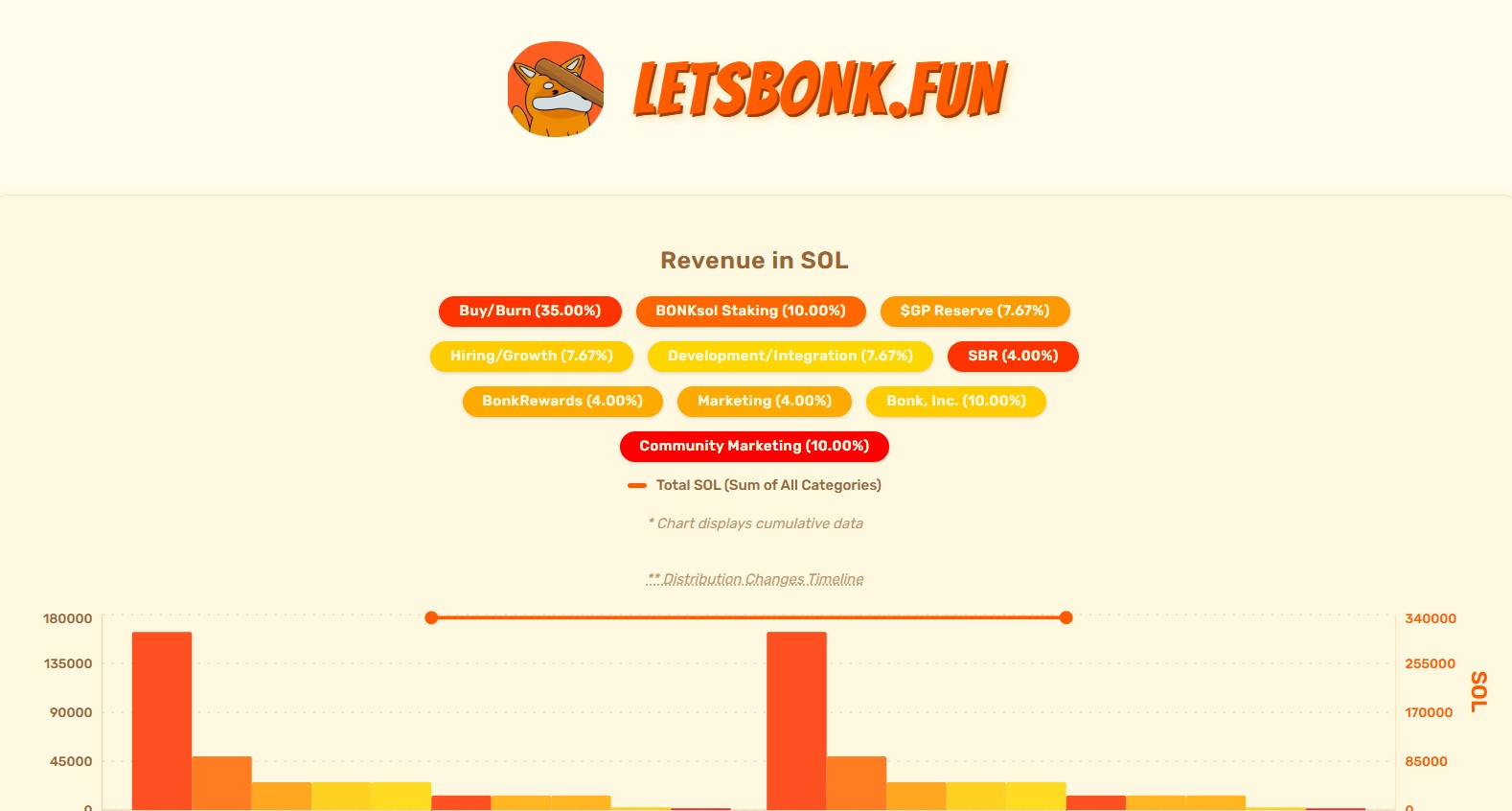
Step-by-step: how the Letsbonk launchpad works
Users can create tokens directly through the Letsbonk interface by entering a few basic details. The process is built around speed, automation, and direct integration with Solana liquidity tools. Here is how the system works from start to finish:
Enter token parameters
You choose the token name, supply, and fee settings inside the LetsBonk interface.
Deploy the token
The backend connects to Solana’s bonding-curve contract and publishes the token on-chain within seconds.
Start trading automatically
Once deployed, the token becomes tradable on Solana DEXs through routes commonly supported by aggregators like Raydium and Jupiter. Raydium LaunchLab further streamlines this process by automatically migrating liquidity to Raydium’s AMM after the bonding curve phase, burning LP tokens to lock liquidity and enable immediate, transparent trading.
Enable creator fees
A portion of activity goes back to creator rewards or BONK ecosystem programs, with details listed on the LetsBonk fees page.
Track performance
Developers and analysts can use Bonk launchpad’s API to monitor token lifecycles, volume, and liquidity over time.
This tight connection between creation, listing, and liquidity is what separates LetsBonk from older token-launch tools on Solana.
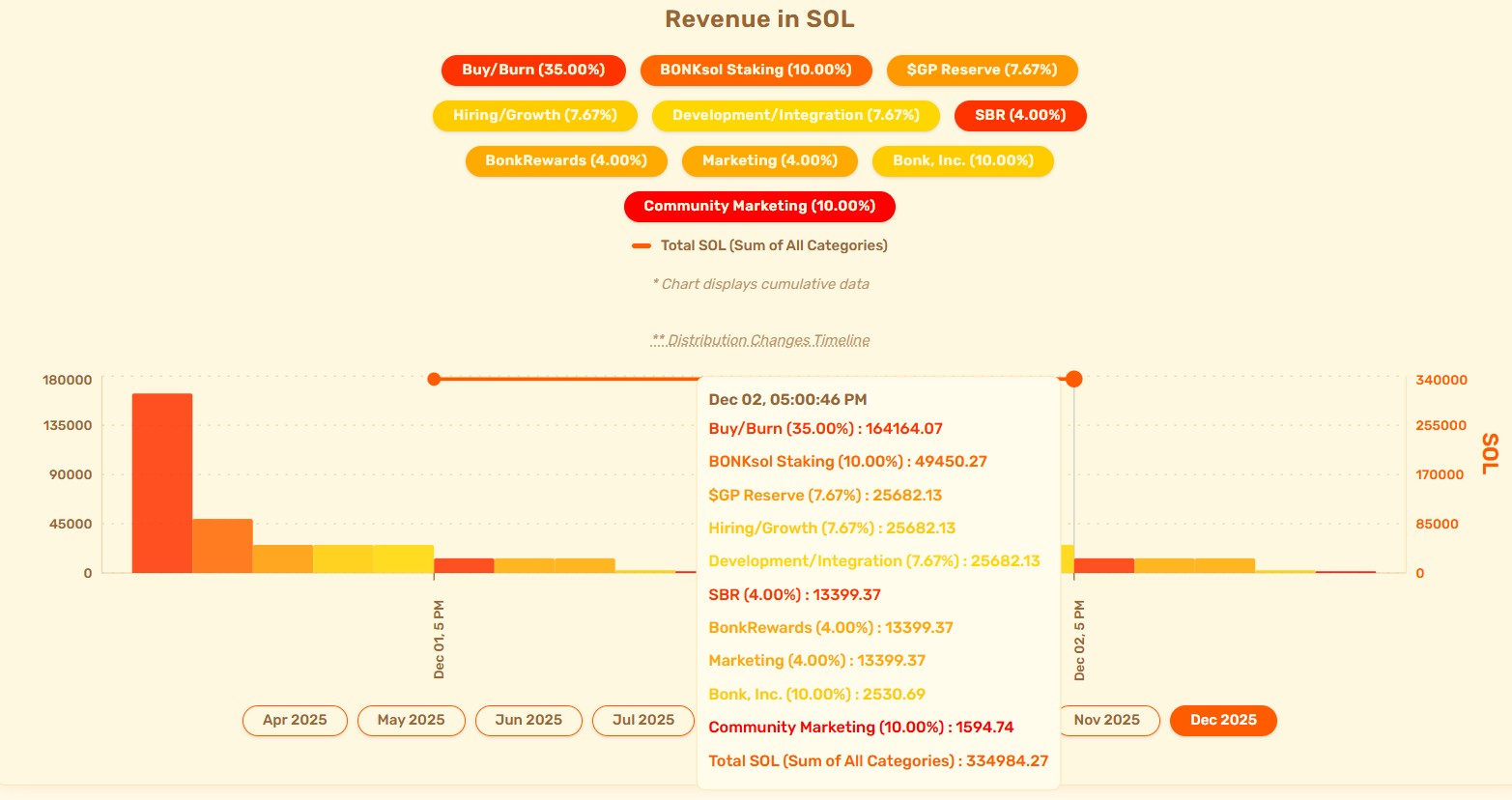
Performance metrics and real impact
The Bonk launchpad has become one of the busiest token-creation tools on Solana, with activity levels that outpace most competitors. Data published by the Letsbonk company shows how quickly the platform has grown.
High launch volume. More than 130,000 tokens are created each week on Letsbonk, making it the dominant bonding-curve launchpad on Solana.
Daily activity milestones. Launches often exceed 10,000 per day, a trend commonly referenced as the Bonk Pump Fun wave.
Diverse token use cases. While many projects are meme coins, creators also deploy governance tokens, art concepts, and experimental DeFi assets through the BonkFun launchpad.
Open developer access. The official Program ID of the Bonk launchpad on Solana is publicly available so developers can audit contracts or build additional tools on top of them.
Market share leadership. As of July 2025, the platform accounts for over 82% of Solana’s bonding-curve token launches.
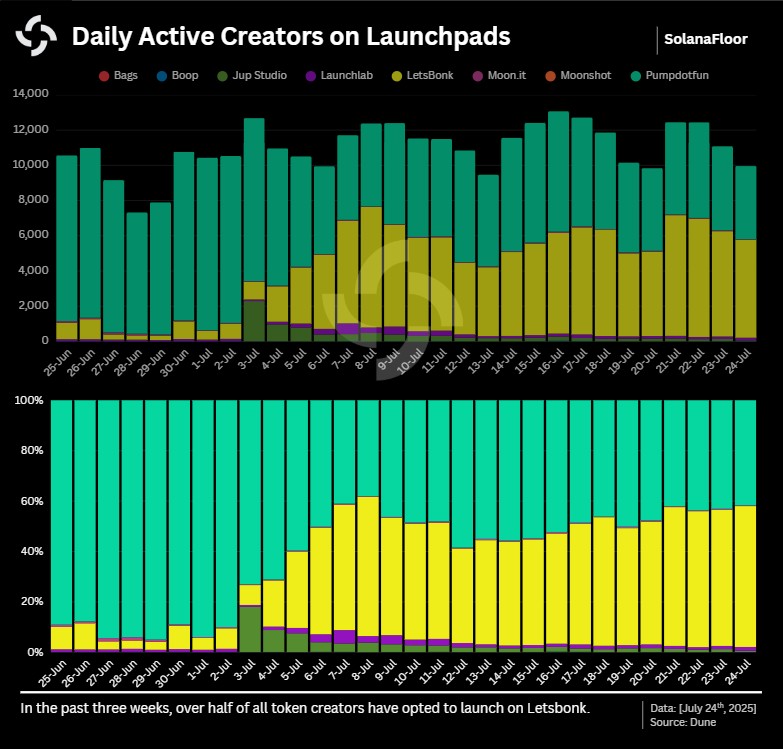
This scale and transparency have pushed the Bonk Fun launchpad into a leading role in Solana’s creator economy.
| Platform | Core model | Liquidity & listing | Key strength | Best suited for |
|---|---|---|---|---|
| LetsBonk | Bonding-curve launchpad integrated with BONK ecosystem | Near-instant routing to Solana DEXs after launch | Speed, openness, strong meme & community traction | Viral launches, fast experiments, BONK-aligned projects |
| Pump.fun | Fair-launch bonding curve with native trading flow | Bonding curve → internal DEX flow → migration | Massive volume, standardized mechanics, creator revenue share | Maximum exposure and high-frequency meme launches |
| Raydium LaunchLab | Configurable token launch infrastructure | Graduates directly into Raydium AMM pools | Greater control over parameters and post-launch economics | Builders seeking flexibility and structured liquidity |
Challenges and risks
Launching tokens through the Letsbonk launchpad is easy, but the low barrier to entry introduces real risks for both creators and traders.
Short token lifespans. Many launches on Letsbonk disappear within hours because they have no long-term plan or community support.
Extreme volatility. Prices often move sharply during early trading, especially for new meme tokens on the Bonk crypto launchpad.
Unclear project goals. Some creators publish tokens without defined utility, making it hard for buyers to evaluate value or intent.
Low liquidity risks. Liquidity can drain quickly, leaving traders unable to exit positions after initial hype fades.
Speculative focus. The high volume on the BonkFun launchpad attracts opportunistic creators, increasing the share of short-lived or low-quality projects.
Security concerns. Users must review contracts and distribution before trading, even with transparent tools.
These risks highlight the need for due diligence, especially within a fast, permissionless system.
What differentiates Letsbonk
The Letsbonk launchpad stands out because it removes many of the barriers that limited earlier token-creation tools on Solana. Its approach focuses on openness, speed, and flexibility for both beginners and developers.
Instant, public launches. Anyone can create a token without whitelists or private access, which makes Letsbonk different from older, gated platforms.
Direct links to Solana markets. Tokens deployed through the Bonk launchpad appear immediately on major DEX routes, giving creators and traders instant liquidity access.
Clear fee structure. The Letsbonk fees model outlines how charges are split, including the share allocated to the bonk ecosystem initiatives.
Tools for creators and developers. Beginners use the simple interface, while advanced users rely on Bonk launchpad’s API and open contracts.
Strong community presence. Updates, launch trends, and ecosystem news are shared through channels such as the Letsbonk Twitter (X) handle and the .letsbonk domain.
Flexible use cases. The platform supports small experimental projects as well as full-cycle token concepts, which broadens its appeal across the Solana community.

Together, these strengths define the modern identity of the Letsbonk platform and explain its fast adoption across the ecosystem.
Best practices for token creators and traders
Launching or trading tokens on the Bonk launchpad can be effective when users follow basic risk controls and communication standards.
Set clear token rules. Creators should define supply limits, utility, and distribution before launching on Letsbonk.
Avoid over-minting. Large or unlimited supplies reduce trust and weaken early market interest.
Build a real community. Successful projects use social channels and transparent updates to support long-term engagement.
Review liquidity pools. Traders should verify pool size, lock status, and activity before interacting with tokens on the Bonkfun launchpad.
Check wallet distribution. Concentrated holdings or sudden inflows can signal a short-lived or high-risk token.
Use Solana analytics tools. Explorers and dashboards help track volume, creator activity, and contract details.
Limit position size. Volatility on the Bonk crypto launchpad is high, so small allocations protect capital.
Avoid holding risky tokens overnight. Many meme-style launches move quickly and fade just as fast.
Following these steps helps both creators and traders approach Letsbonk launches with more discipline and better expectations.
Broader implications for Web3
The rise of Bonk.fun and the wider Letsbonk ecosystem has influenced more than token creation. It has introduced a new way for communities to participate in Web3 without technical barriers.
Expanded access to token tools. Groups, creators, and DAOs can now mint assets for rewards, governance, or experiments without coding.
Growth of social finance. Many new tokens act as community badges or engagement tools, making the Bonk launchpad attractive for memecoins.
Faster experimentation cycles. Permissionless launches let users test ideas quickly, helping Web3 evolve through rapid iteration.
Cultural adoption. Tokens created on Letsbonk often spread through social channels before entering trading platforms, blending culture and finance in new ways.
These trends show how simple launchpads can reshape Web3 by making asset creation more accessible and more connected to everyday communities.
Where to buy the BONK token
The BONK token is available across both decentralized and centralized trading platforms. Because liquidity is spread across the Solana ecosystem, users often compare routes before making a purchase.
Solana DEXs. BONK trades on Jupiter, Raydium, and Orca with pairs such as BONK/SOL and BONK/USDC.
Aggregators. Tools like Jupiter route orders through multiple pools to find better prices and lower slippage.
Centralized exchanges. Major CEXs list BONK in spot markets.
Block explorers. Advanced users track the token using its Solana program ID to review activity, supply changes, and contract calls.
Before buying, check our forecast, trading volume, liquidity depth, and recent wallet movements to avoid thin or inactive markets.
| Year | Price in the middle of the year | Price at the end of the year |
|---|---|---|
| 2026 | $0.0000041 | $0.000003 |
| 2027 | $0.0000025 | $0.0000018 |
| 2028 | $0.0000015 | $0.0000026 |
| 2029 | $0.0000022 | $0.0000019 |
| 2030 | $0.0000033 | $0.0000028 |
| 2031 | $0.0000024 | $0.0000018 |
| 2032 | $0.0000013 | $0.0000011 |
| 2033 | $0.000001 | $0.00000088 |
| 2034 | $0.00000086 | $0.00000094 |
| 2035 | $0.00000085 | $0.00000063 |
| 2036 | $0.00000047 | $0.00000054 |
| 2037 | $0.00000083 | $0.00000068 |
| 2038 | $0.0000011 | $0.00000086 |
| 2039 | $0.0000007 | $0.00000052 |
| 2040 | $0.00000043 | $0.00000074 |
If you are looking to open an account with a crypto exchanges, you can consider the list of the top crypto exchanges in the region presented below. As they operate at a very large scale, chances are that you can get access to BONK through them as well.
| OKX | Coinbase | Crypto.com | Cryptohopper | BTCC | |
|---|---|---|---|---|---|
|
Min. Deposit, $ |
10 | 10 | 1 | No | 10 |
|
Coins Supported |
600+ | 400+ | 400+ | 1000 | 399 |
|
Spot Taker fee, % |
0.1 | 0.5 | 0.5 | 0 | 0.3 |
|
Spot Maker Fee, % |
0.08 | 0.5 | 0.25 | 0 | 0.2 |
|
Alerts |
Yes | Yes | Yes | Yes | No |
|
Copy trading |
Yes | No | No | Yes | Yes |
|
TU overall score |
8.48 | 7.84 | 7.8 | 7.76 | 7.6 |
|
Open an account |
Go to broker Your capital is at risk. |
Go to broker Your capital is at risk. |
Go to broker Your capital is at risk. |
Go to broker Your capital is at risk. |
Go to broker Your capital is at risk.
|
Bonk News and Solana Meme Coin Insights
Bonk price forecast: Bullish momentum points to potential test of $0.00000426 resistance
Bonk extends downward price move as seller momentum dominates after major treasury loss
Bonk price prediction: Sellers maintain control as support pressure persists
Bonk drops around 9.5% after falling well below key moving averages and early volatility limits recovery
Bonk price prediction: Support test in focus
Bonk price prediction: Support pressure builds at $0.00000367
Slow down, check the data, and treat every launch with structured discipline

When I analyze activity on the Letsbonk launchpad, what stands out most is how quickly the market reacts to new token releases. The speed is exciting, but it also creates a sense of urgency that can influence decisions more than data. From my experience, this is where most traders make mistakes. They enter early without checking liquidity or distribution, or they assume that high launch volume guarantees quality. It rarely does.
The best results usually come from slowing down, reviewing the token’s contract, and studying the first few minutes of trading behavior. Even simple checks, like monitoring the creator’s past launches or comparing pool size to trading volume, can help filter out unsustainable projects. For creators, the lesson is different. Clear communication, predictable supply rules, and honest expectations give a token a better chance of surviving beyond the first hype cycle. The platform makes launching easy, but long-term value still depends on thoughtful design and transparency.
Due to extreme volatility, avoid holding newly launched tokens overnight unless you have verified their roadmap and ecosystem relevance. For better entries, use decentralized aggregators like Jupiter to access the best rate and lowest slippage.
Conclusion
In summary, the LetsBonk launchpad revolutionizes token creation on Solana by offering an intuitive, fast, and feature-rich platform tailored for both newcomers and seasoned developers. Its combination of streamlined launch processes, transparent fee structures, and robust toolsets positions LetsBonk as a catalyst for high-volume token innovation. For example, projects can launch tokens within minutes, while leveraging in-depth analytics and community engagement tools. Ultimately, LetsBonk not only simplifies Solana token launches but also empowers creators to shape the next wave of blockchain projects—reminding us that accessible innovation drives the ecosystem forward.
FAQs
What types of tokens can be created using LetsBonk Launchpad on Solana?
What risks should traders consider when buying newly launched tokens on LetsBonk?
How does LetsBonk Launchpad support developers and advanced users?
How does the LetsBonk Launchpad fee structure work for token creators?
Editors' Top Picks and Insights





Related Articles
Team that worked on the article
Viktoras Karapetjanc is a seasoned financial trader, market analyst, and content creator with over 20 years of expertise in Forex, cryptocurrency, and stock markets. As a contributor to the Traders Union website, he provides in-depth analysis, data-driven strategies, and educational content to empower traders of all levels.
Dan Blystone began his trading career in 1998 as an arbitrage clerk on the floor of the Chicago Mercantile Exchange (CME). He later traded bond and Eurex futures at proprietary firms such as Altea Trading, gaining valuable experience in high-frequency trading and risk management.
Chinmay Soni is a financial analyst with more than 5 years of experience in working with stocks, Forex, derivatives, and other assets. As a founder of a boutique research firm and an active researcher, he covers various industries and fields, providing insights backed by statistical data.
Bitcoin is a decentralized digital cryptocurrency that was created in 2009 by an anonymous individual or group using the pseudonym Satoshi Nakamoto. It operates on a technology called blockchain, which is a distributed ledger that records all transactions across a network of computers.
Crypto trading involves the buying and selling of cryptocurrencies, such as Bitcoin, Ethereum, or other digital assets, with the aim of making a profit from price fluctuations.
CFD is a contract between an investor/trader and seller that demonstrates that the trader will need to pay the price difference between the current value of the asset and its value at the time of contract to the seller.
Risk management is a risk management model that involves controlling potential losses while maximizing profits. The main risk management tools are stop loss, take profit, calculation of position volume taking into account leverage and pip value.
Copy trading is an investing tactic where traders replicate the trading strategies of more experienced traders, automatically mirroring their trades in their own accounts to potentially achieve similar results.

-
 Afghanistan
-
 Albania
-
 Algeria
-
 Angola
-
 Argentina
-
 Armenia
-
 Australia
-
 Austria
-
 Azerbaijan
-
 Bahamas
-
 Bahrain
-
 Bangladesh
-
 Belarus
-
 Belgium
-
 Bolivia
-
 Botswana
-
 Brazil
-
 Brunei
-
 Bulgaria
-
 Cambodia
-
 Cameroon
-
 Canada
-
 Chile
Chile
-
 China
China
-
 Colombia
-
 Congo
Congo
-
 Costa Rica
-
 Cote d'Ivoire
-
 Croatia
-
 Cuba
Cuba
-
 Cyprus
-
 Czechia
-
 DR Congo
-
 Denmark
-
 Dominican Republic
-
 Ecuador
-
 Egypt
Egypt
-
 El Salvador
-
 Estonia
-
 Eswatini
-
 Ethiopia
-
 Finland
-
 France
-
 Georgia
-
 Germany
-
 Ghana
Ghana
-
 Greece
-
 Haiti
Haiti
-
 Hong Kong
-
 Hungary
-
 India
India
-
 Indonesia
-
 Iran, Islamic republic
-
 Iraq
Iraq
-
 Ireland
-
 Israel
-
 Italy
Italy
-
 Jamaica
-
 Japan
Japan
-
 Jordan
-
 Kazakhstan
-
 Kenya
Kenya
-
 Korea
Korea
-
 Kuwait
-
 Kyrgyzstan
-
 Laos
Laos
-
 Latvia
-
 Lebanon
-
 Lesotho
-
 Libya
Libya
-
 Lithuania
-
 Luxembourg
-
 Madagascar
-
 Malaysia
-
 Malta
Malta
-
 Mauritius
-
 Mexico
-
 Moldova
-
 Mongolia
-
 Montenegro
-
 Morocco
-
 Mozambique
-
 Myanmar
-
 Namibia
-
 Nepal
Nepal
-
 Netherlands
-
 New Zealand
-
 Nigeria
-
 North Macedonia
-
 Norway
-
 Oman
Oman
-
 Pakistan
-
 Palestine
-
 Panama
-
 Papua New Guinea
-
 Paraguay
-
 Peru
Peru
-
 Philippines
-
 Poland
-
 Portugal
-
 Puerto Rico
-
 Qatar
Qatar
-
 Reunion
-
 Romania
-
 Rwanda
-
 Saudi Arabia
-
 Serbia
-
 Singapore
-
 Slovakia
-
 Slovenia
-
 Somalia
-
 South Africa
-
 Spain
Spain
-
 Sri Lanka
-
 Sweden
-
 Switzerland
-
 Syria
Syria
-
 Taiwan
-
 Tajikistan
-
 Tanzania
-
 Thailand
-
 Trinidad and Tobago
-
 Tunisia
-
 Turkey
-
 UAE
UAE
-
 Uganda
-
 Ukraine
-
 United Kingdom
-
United States
-
 Uruguay
-
 Uzbekistan
-
 Venezuela
-
 Vietnam
-
 Yemen
Yemen
-
 Zambia
-
 Zimbabwe
- Forex
- Crypto










- What is Bonk.fun and the Letsbonk ecosystem
- Step-by-step: how the Letsbonk launchpad works
- Performance metrics and real impact
- Challenges and risks
- What differentiates Letsbonk
- Best practices for token creators and traders
- Broader implications for Web3
- Where to buy the BONK token
- Expert opinion
- Conclusion
- FAQs


