
How Raydium Accelerator LaunchLab Works: A Simple Guide


Editorial Note: While we adhere to strict Editorial Integrity, this post may contain references to products from our partners. Here's an explanation for How We Make Money. None of the data and information on this webpage constitutes investment advice according to our Disclaimer.
To use Raydium LaunchLab on Solana, creators choose a launch mode, set supply, pricing curve, vesting, and a quote token such as SOL or USDC. The system builds a bonding curve pool automatically. After hitting the soft cap, liquidity moves to Raydium AMM and LP tokens are burned, enabling instant trading.
The Raydium Launchpad is based on Solana and offers a decentralized way to create and launch tokens with no-code tools, automatic liquidity, and clear pricing mechanics. It supports fast meme-style launches and structured tokenomics setups through bonding curves and automated migration to Raydium’s AMM. The goal is to lower technical barriers for creators while giving traders transparent access to new tokens. In this article, you will learn how Raydium LaunchLab works on Solana, how creators launch tokens step by step, how bonding curves and liquidity migration function, and what traders should watch for when joining new launches.
What is Raydium LaunchLab and why it matters
Raydium LaunchLab is a permissionless token creation and launch platform built on Solana. It connects new tokens directly to Raydium’s AMM, so liquidity forms automatically and trading begins without delays. The system supports fast meme-style launches and more complete tokenomics setups, which makes it useful for both casual creators and structured projects.
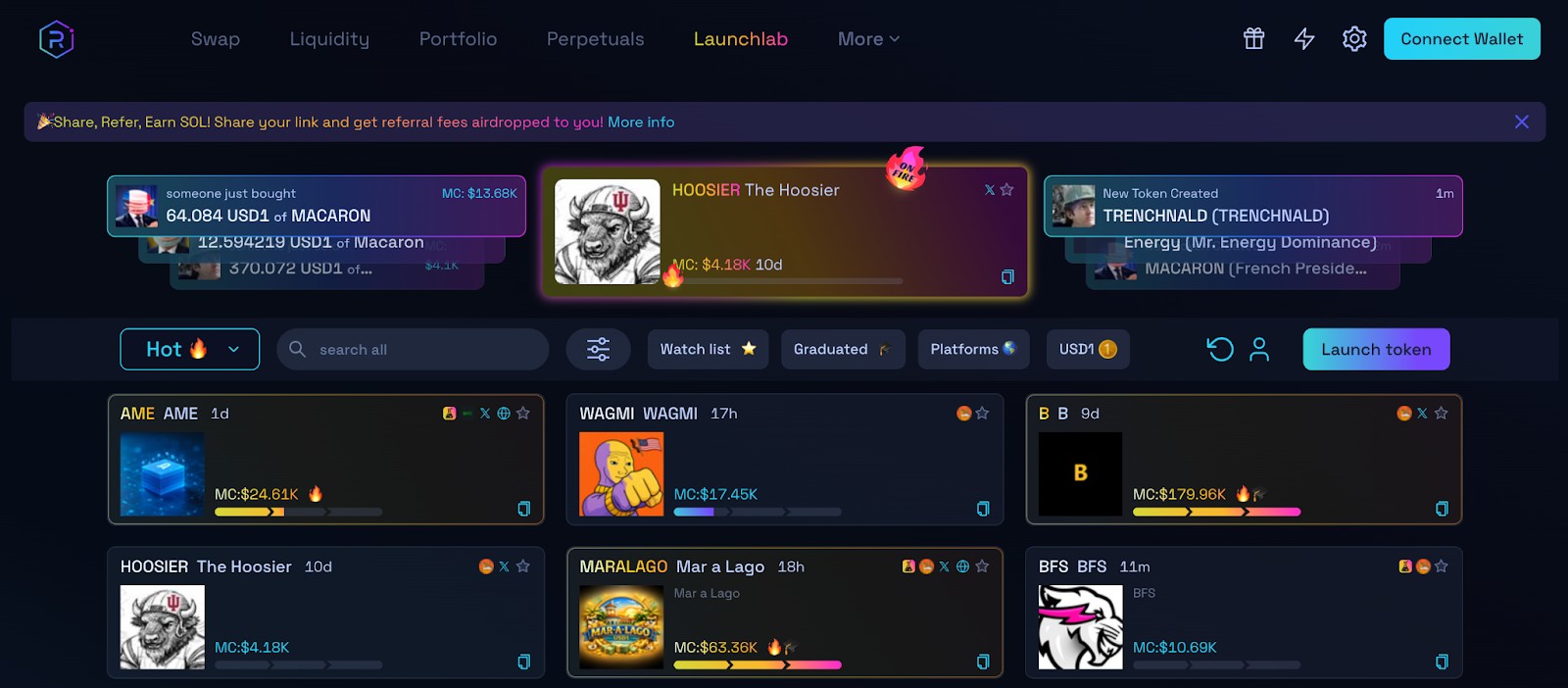
LaunchLab includes tools for no-code token creation, vesting design, curve pricing, and automatic market listing. These features lower development costs and help creators launch safely while keeping the process fully decentralized. For traders, this setup brings transparent pricing, verifiable contract logic, and instant access to tokens once migration completes.
How LaunchLab works: mechanics under the hood
LaunchLab runs on a smart contract system that uses bonding curves to set token pricing as funds enter the pool. Buyers interact with curves such as linear, exponential, or logarithmic, and each curve changes the token’s price as demand increases. This design gives creators a simple way to shape early price discovery.
Projects choose a launch mode and define core parameters like token supply, curve type, vesting, and the quote token. Funds collected during the sale fill the bonding curve pool until the soft cap is reached. When the sale ends or the threshold is met, liquidity automatically migrates to a Raydium AMM pool.
Liquidity lock. LP tokens are burned after migration, which prevents creators from withdrawing liquidity.
Instant trading. Trading begins on Raydium as soon as the AMM pool is active.
Transparent logic. Bonding curves and migration rules are handled by the verified Raydium LaunchLab program ID on Solana.
LaunchLab supports multiple quote tokens, including SOL, USDC, USDT, and jitoSOL. This flexibility helps creators choose assets that match their fundraising goals while keeping the entire launch flow transparent and on-chain.
Features for creators and traders
LaunchLab gives both creators and traders a set of tools that simplify token creation and improve visibility during the launch process.
No-code launch tools. Creators can mint and launch tokens without coding knowledge.
Configurable tokenomics. Supply, fees, vesting, and unlock schedules can be defined during setup.
Curve-based pricing. Bonding curves determine how the token price changes as buyers enter the pool.
Automatic liquidity lock. LP tokens are burned after migration to Raydium AMM, reducing rug-pull risks.
Immediate trading access. Trading opens on Raydium as soon as the AMM pool is created.
For technical users:
Raydium LaunchLab SDK. Supports backend automation, wallet integration, and dashboard tools.
Raydium LaunchLab API. Offers data on active launches, token parameters, and sale status for analytics and community dashboards.
Raydium LaunchLab IDL. Defines smart contract functions and ensures smooth integration with third-party apps.
These features make LaunchLab efficient for creators planning structured token launches and for traders seeking transparent early access.
LaunchLab vs alternatives
LaunchLab stands out from other Solana launch tools by offering more structure, deeper configuration, and stronger protections. Platforms like Pump.fun focus on speed and simplicity, while Raydium LaunchLab supports both quick meme-style / news oriented releases and advanced token setups.
Launch complexity. Pump.fun prioritizes instant launches, while LaunchLab allows full tokenomics planning and bonding curve selection.
Liquidity safety. Pump.fun relies on external liquidity steps, but LaunchLab burns LP tokens after migration, which reduces rug-pull risks.
Customization depth. LaunchLab offers vesting, fee settings, curve choices, and multiple quote tokens, while basic launchpads often provide only supply and name fields.
DEX integration. LaunchLab listings appear directly on Raydium AMM, while alternatives may require manual listing on external DEXs.
Security transparency. Raydium LaunchLab uses a public program ID, making contract verification easier than on minimal-contract platforms.
This makes LaunchLab suitable for creators who want simplicity without losing long-term structure, while alternatives appeal mainly to users launching fast, low-effort tokens.
Implications for the Solana ecosystem
The introduction of Raydium LaunchLab has influenced how new tokens are created and traded on Solana. Its structure supports fast launches, but it also encourages more transparent pricing and safer liquidity handling, which helps strengthen user trust across the ecosystem.
Higher token creation volume. LaunchLab lowers technical barriers, which increases the number of new tokens entering the Solana market.
Better liquidity standards. Automatic migration and LP burn reduce common risks found in unverified launches.
User responsibility. LaunchLab is permissionless, so traders must check tokenomics, vesting, and contract data before buying.
Growing need for tools. Community dashboards and scanners that track the Raydium LaunchLab program ID are becoming essential for evaluating launches.
Ecosystem influence. LaunchLab’s model of transparent bonding curves and locked liquidity may shape future launchpad formats across DeFi.
Best practices and risk management
Participating in LaunchLab events requires careful review of contract data, tokenomics, and liquidity design. Traders should confirm that the launch follows the expected Raydium structure and relies on the official program logic.
Contract verification. Check the official Raydium LaunchLab program ID Solana to confirm the token was deployed through the correct source.
Tokenomics review. Study vesting schedules, unlock timing, and the total supply to ensure there are no hidden or unfair allocations.
Liquidity lock conditions. Confirm that LP tokens will be burned or time-locked after migration to Raydium AMM.
Fee assessment. Review any Raydium LaunchLab fees to understand how the project allocates revenue and trading fees.
Authority validation. Check if the deployment used the standard Raydium LaunchLab authority, especially when interacting through third-party dashboards.
Creators should follow guidance outlined in the Raydium LaunchPad support docs to avoid structural errors that may cause trust issues or exclude the project from community indexers.

Where tokens go after a LaunchLab sale
After a LaunchLab sale ends, the tokens move directly into trading through an automated process. Liquidity from the bonding curve pool is migrated to a Raydium AMM pool, and the LP tokens are burned to lock liquidity permanently. This prevents creators from removing funds later and reduces common launch risks. Trading begins as soon as the AMM pool is active, giving early participants immediate access to buy or sell tokens. Over time, liquidity may spread to other Solana DEXs through arbitrage and routing tools. Because the entire flow takes place inside Raydium’s interface, users can manage tokens, provide liquidity, or monitor trading activity without switching platforms.
Once a token starts trading, access to trusted crypto exchanges in your region becomes the natural next step. These exchanges allow users to follow price action, manage positions, and decide how to act after early liquidity forms. Placing exchange options alongside LaunchLab information helps readers move smoothly from understanding launches to handling post-launch trading.
| OKX | Coinbase | Crypto.com | Cryptohopper | BTCC | |
|---|---|---|---|---|---|
|
Min. Deposit, $ |
10 | 10 | 1 | No | 10 |
|
Coins Supported |
600+ | 400+ | 400+ | 1000 | 399 |
|
Spot Taker fee, % |
0.1 | 0.5 | 0.5 | 0 | 0.3 |
|
Spot Maker Fee, % |
0.08 | 0.5 | 0.25 | 0 | 0.2 |
|
Alerts |
Yes | Yes | Yes | Yes | No |
|
Copy trading |
Yes | No | No | Yes | Yes |
|
TU overall score |
8.48 | 7.84 | 7.8 | 7.76 | 7.6 |
|
Open an account |
Go to broker Your capital is at risk. |
Go to broker Your capital is at risk. |
Go to broker Your capital is at risk. |
Go to broker Your capital is at risk. |
Go to broker Your capital is at risk.
|
Verify the source, watch the curve, and choose launches with clear safeguards

When I talk to traders who join new launches on Raydium LaunchLab, I always highlight the need to verify the contract source before anything else. A legitimate launch will use the official Raydium LaunchLab program ID, and this is one of the simplest ways to confirm that the deployment follows the standard structure. Projects that also burn LP tokens after liquidity migration and provide clear vesting terms tend to show stronger long-term intent.
I encourage traders to watch how the bonding curve behaves while the sale is active. If price climbs too quickly on very small volume, it may not hold once the token lists on Raydium AMM. Comparing each sale with past launches, reviewing the chosen quote token, and checking public data through the Raydium LaunchLab docs or API can help you make balanced decisions. The most consistent results come from treating each launch as a measured entry rather than reacting to early excitement.
Conclusion
The Raydium LaunchLab gives creators a simple way to launch tokens on Solana while offering traders transparent access to new assets. Its combination of bonding curves, automatic liquidity migration, and no-code setup supports both fast meme-style tokens and more structured project launches. Liquidity locks, public program IDs, and clear contract logic help reduce common risks while keeping the process fully decentralized.
As LaunchLab grows, new tools such as SDK integrations, API data, and community dashboards will make it easier to review launches and compare project quality. The platform already plays a central role in Solana’s token economy, and its design encourages safer, more predictable launch conditions. For both creators and traders, LaunchLab provides a flexible and transparent foundation for participating in early-stage token releases.
FAQs
What do I need to launch a token on Raydium LaunchLab?
You need a Solana wallet, enough funds for rent-exempt balances, a selected quote token such as SOL or USDC, and basic parameters like supply, pricing curve, and vesting. The setup is completed through LaunchLab’s no-code interface.
How can I confirm a launch is legitimate?
Check whether the token was deployed through the official Raydium LaunchLab program ID on Solana. Also review vesting terms, supply transparency, and whether LP tokens will be burned after liquidity migration.
Can tokens launched through LaunchLab integrate with external apps?
Yes. Using the Raydium LaunchLab SDK and IDL, developers can link tokens to wallets, DeFi platforms, games, or analytics tools. These resources help creators build broader utility around their project.
Are launch fees customizable for creators?
Yes. In advanced mode, creators can define Raydium LaunchLab fees, including platform cuts, referral fees, or trading fee shares. These settings help align fundraising and post-launch incentives.
Related Articles
Team that worked on the article
Aleksandra Chaikina has been a contributor to Traders Union since 2021. With over 15 years of experience in copywriting and more than 5 years focused on financial content, she specializes in producing detailed guides, analytics, and comparative reviews across various sectors, including cryptocurrencies, Forex, investment strategies, and financial technologies.
Dan Blystone began his trading career in 1998 as an arbitrage clerk on the floor of the Chicago Mercantile Exchange (CME). He later traded bond and Eurex futures at proprietary firms such as Altea Trading, gaining valuable experience in high-frequency trading and risk management.
Chinmay Soni is a financial analyst with more than 5 years of experience in working with stocks, Forex, derivatives, and other assets. As a founder of a boutique research firm and an active researcher, he covers various industries and fields, providing insights backed by statistical data.

-
 Afghanistan
-
 Albania
-
 Algeria
-
 Angola
-
 Argentina
-
 Armenia
-
 Australia
-
 Austria
-
 Azerbaijan
-
 Bahamas
-
 Bahrain
-
 Bangladesh
-
 Belarus
-
 Belgium
-
 Bolivia
-
 Botswana
-
 Brazil
-
 Brunei
-
 Bulgaria
-
 Cambodia
-
 Cameroon
-
 Canada
-
 Chile
Chile
-
 China
China
-
 Colombia
-
 Congo
Congo
-
 Costa Rica
-
 Cote d'Ivoire
-
 Croatia
-
 Cuba
Cuba
-
 Cyprus
-
 Czechia
-
 DR Congo
-
 Denmark
-
 Dominican Republic
-
 Ecuador
-
 Egypt
Egypt
-
 El Salvador
-
 Estonia
-
 Eswatini
-
 Ethiopia
-
 Finland
-
 France
-
 Georgia
-
 Germany
-
 Ghana
Ghana
-
 Greece
-
 Haiti
Haiti
-
 Hong Kong
-
 Hungary
-
 India
India
-
 Indonesia
-
 Iran, Islamic republic
-
 Iraq
Iraq
-
 Ireland
-
 Israel
-
 Italy
Italy
-
 Jamaica
-
 Japan
Japan
-
 Jordan
-
 Kazakhstan
-
 Kenya
Kenya
-
 Korea
Korea
-
 Kuwait
-
 Kyrgyzstan
-
 Laos
Laos
-
 Latvia
-
 Lebanon
-
 Lesotho
-
 Libya
Libya
-
 Lithuania
-
 Luxembourg
-
 Madagascar
-
 Malaysia
-
 Malta
Malta
-
 Mauritius
-
 Mexico
-
 Moldova
-
 Mongolia
-
 Montenegro
-
 Morocco
-
 Mozambique
-
 Myanmar
-
 Namibia
-
 Nepal
Nepal
-
 Netherlands
-
 New Zealand
-
 Nigeria
-
 North Macedonia
-
 Norway
-
 Oman
Oman
-
 Pakistan
-
 Palestine
-
 Panama
-
 Papua New Guinea
-
 Paraguay
-
 Peru
Peru
-
 Philippines
-
 Poland
-
 Portugal
-
 Puerto Rico
-
 Qatar
Qatar
-
 Reunion
-
 Romania
-
 Rwanda
-
 Saudi Arabia
-
 Serbia
-
 Singapore
-
 Slovakia
-
 Slovenia
-
 Somalia
-
 South Africa
-
 Spain
Spain
-
 Sri Lanka
-
 Sweden
-
 Switzerland
-
 Syria
Syria
-
 Taiwan
-
 Tajikistan
-
 Tanzania
-
 Thailand
-
 Trinidad and Tobago
-
 Tunisia
-
 Turkey
-
 UAE
UAE
-
 Uganda
-
 Ukraine
-
 United Kingdom
-
United States
-
 Uruguay
-
 Uzbekistan
-
 Venezuela
-
 Vietnam
-
 Yemen
Yemen
-
 Zambia
-
 Zimbabwe
- Forex
- Crypto












