
How To Check A Smart Contract And Why It’s Important



Editorial Note: While we adhere to strict Editorial Integrity, this post may contain references to products from our partners. Here's an explanation for How We Make Money. None of the data and information on this webpage constitutes investment advice according to our Disclaimer.
Verifying or auditing smart contracts plays a crucial role in maintaining security within blockchain ecosystems. It helps uncover hidden functions or vulnerabilities that bad actors could exploit to siphon funds, offering protection to both developers and investors. Conducting a thorough smart contract check not only adds a layer of security but also signals to users that the project has taken essential safety measures.
Because smart contracts cannot be changed once they are deployed, even minor mistakes can lead to major consequences. That’s why getting it right before launch is so important. A well-audited contract builds investor confidence, strengthens a project’s reputation, and reduces the chances of legal complications.
In this article, we’ll walk through how to check if a smart contract is legit, including what tools can assist you and which elements deserve careful attention during the verification process. Whether you're investing in a DeFi project or launching your own token, understanding the basics of contract review is critical to avoiding avoidable risks.
Risk warning: Cryptocurrency markets are highly volatile, with sharp price swings and regulatory uncertainties. Research indicates that 75-90% of traders face losses. Only invest discretionary funds and consult an experienced financial advisor.
How to check a smart contract: step-by-step guide
Before investing in a token, it’s important to make sure it is safe and shows no signs of fraud. We’ve prepared a step-by-step guide on how to check a smart contract for scams, suitable even for beginners.
Step 1: Find the smart contract address
Locate the official source: only copy the smart contract address from the project’s official website or verified social channels. Addresses posted in comments or unofficial chats could lead to scam contracts. MetaMask’s security guide stresses that reputable dApps provide the address up front and display it before you sign any transaction.

Step 2: Check the smart contract via a blockchain explorer
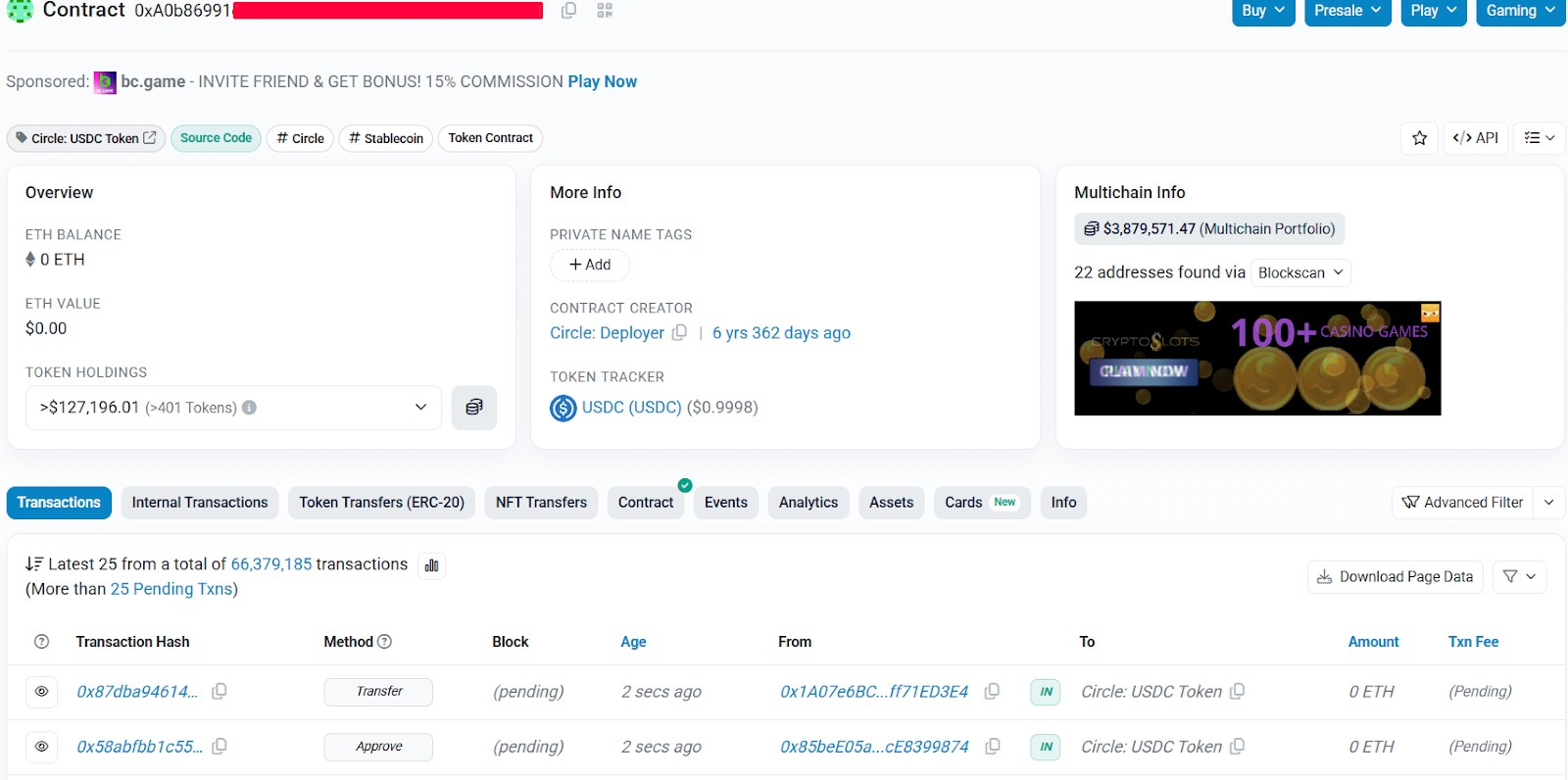
Check verification status. Paste the address into a block explorer such as Etherscan (Ethereum), BscScan (BNB Chain) or Basescan (Base). Verified contracts display a “Contract Verified” label and allow the source code to be read. Lack of verification is a red flag; some legitimate projects delay verification until launch, but scammers often obfuscate code to hide malicious functions.
Review basic token info. Examine the name, symbol, total supply, and transaction history. MetaMask recommends checking recent contract activity and looking for sell transactions; honeypot scams prevent selling, so a lack of sells could signal trouble. On Etherscan, the comments section can also reveal community sentiment.
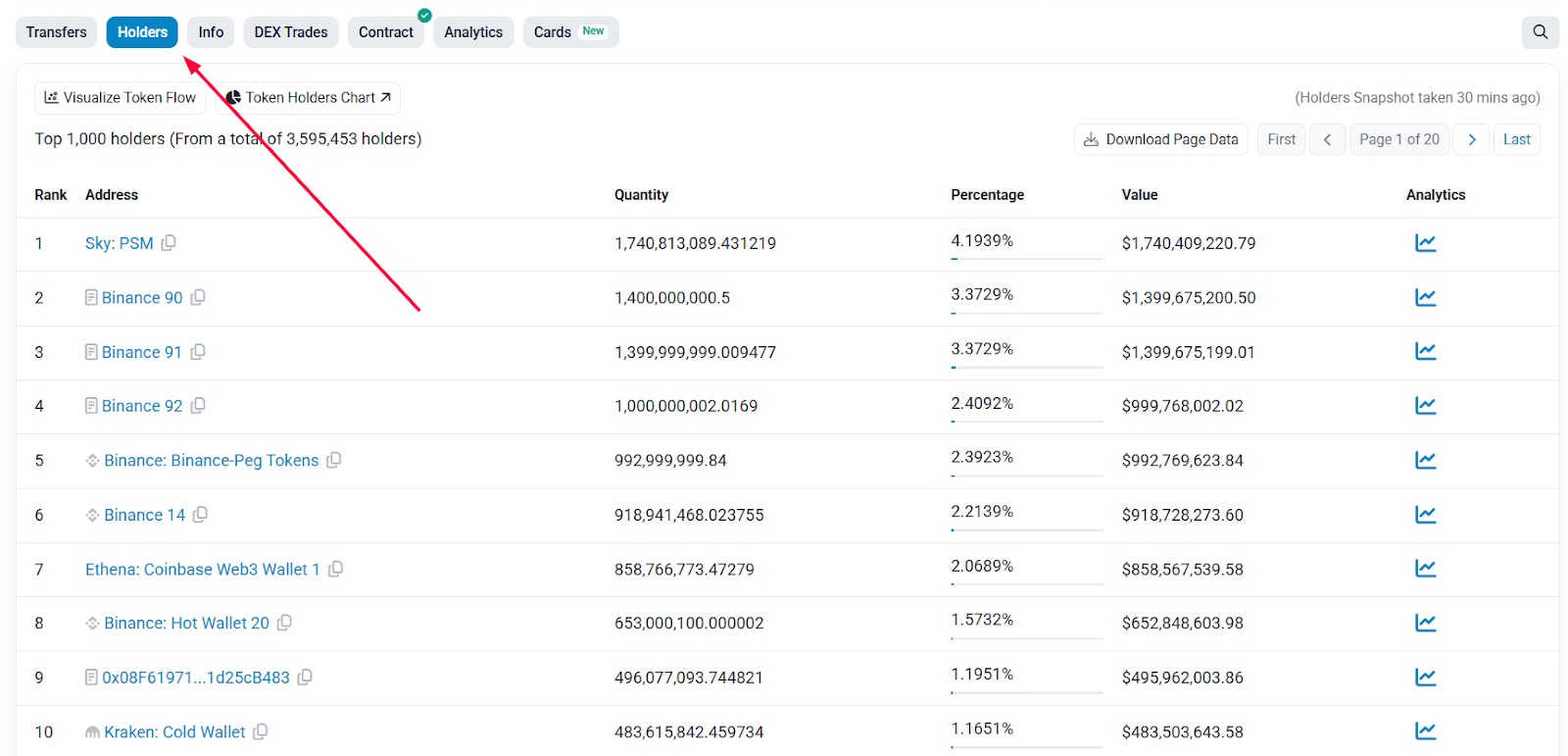
Look at holders. Navigate to the “Holders” tab. If one wallet controls over 50 % of the supply or the contract itself holds a large share, it could enable liquidity drains. Well‑designed projects often lock or burn a significant portion of tokens to reassure investors.
Step 3: Verify the source code
Use the explorer’s verification tools. The simplest way to ensure a contract’s bytecode matches its source is to run Etherscan’s “Verify and Publish” function. QuickNode’s verification guide advises selecting the correct compiler version and license and uploading either a flattened single‑file contract or all imported files. If you’re deploying a contract yourself, frameworks like Hardhat, Brownie, Foundry or Remix can automate verification by submitting the code and constructor arguments during deploy ment.
Check for SPDX licenses and metadata. Including standardized SPDX license identifiers and storing metadata simplifies verification and builds trust. Bitbond’s Token Tool notes that metadata storage and recognized SPDX headers help explorers and auditors confirm contract provenance.
Step 4: Use automated analyzers
Before investing in a token, run its address through automated analyzers:
Token Sniffer. Identifies clones, fee manipulations and honeypot behaviour.
GoPlus Labs. Evaluates 30+ parameters such as trading restrictions, contract ownership and token‑burn functions.
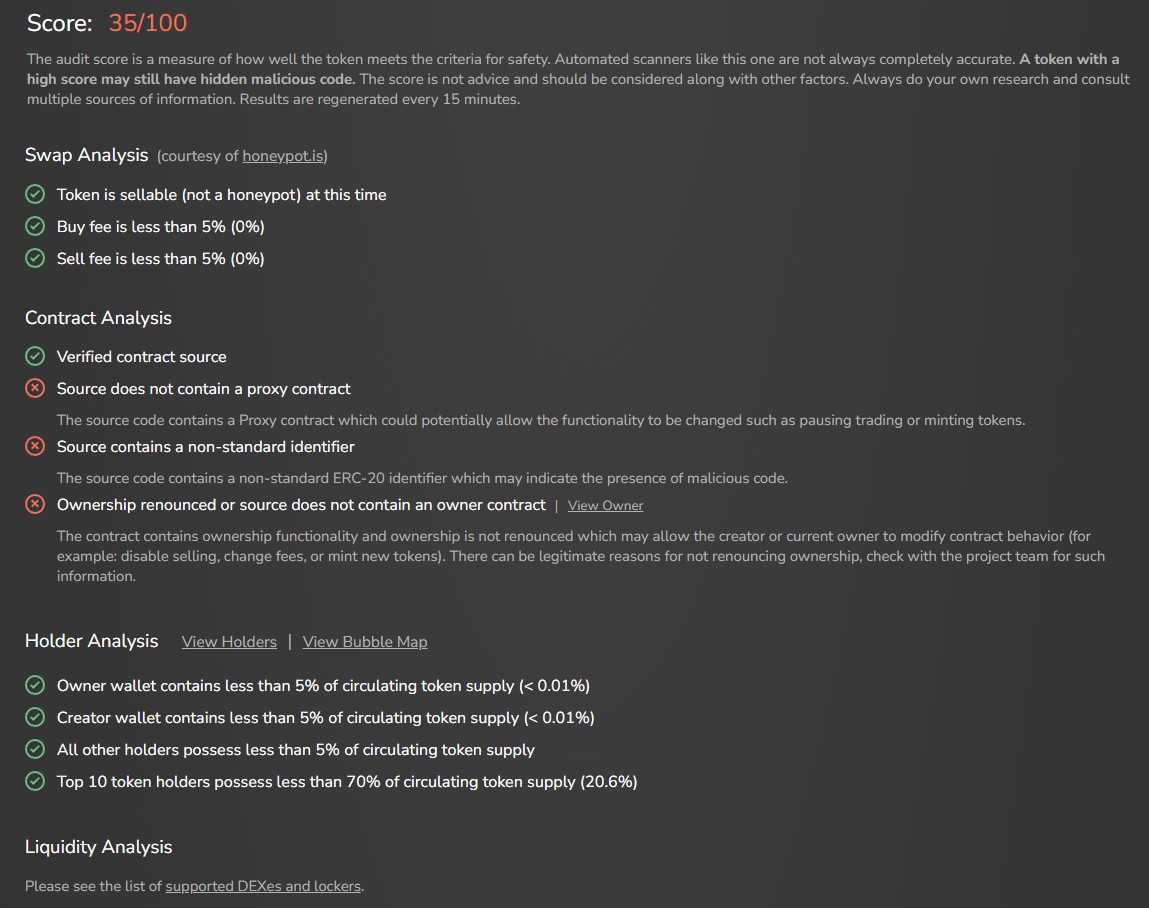
Honeypot.is. Tests whether the token can be sold, highlighting scams where sellers are trapped.
De.Fi scanner (Rug pull checker). Generates a rug‑pull report with insights on owner permissions, liquidity locks and unusual fee structures.
For developers or sophisticated investors, advanced tools can reveal subtle flaws:
Echidna. A property‑based fuzzing tool by Trail of Bits that generates randomized inputs to test user‑defined assertions and exposes unexpected behaviorquillaudits.com. It produces coverage reports, helping ensure critical code paths are exercised.
Diligence Fuzzing. A cloud‑hosted service from ConsenSys that uses the Harvey bytecode fuzzer. It integrates with Foundry and Scribble and automates vulnerability discovery.
Cyfrin Aderyn. A Rust‑based static analysis tool focused on Solidity. It offers fast detection with low false positives, integrates with CI pipelines and supports Hardhat and Foundry.
Slither. A Python static analysis framework with more than 92 built‑in vulnerability detectors and a modular API for custom checks.
Automated tools catch many common bugs, but they aren’t foolproof, manual reviews and professional audits are still essential.
Step 5: See who owns the tokens
In the blockchain explorer, go to the Holders tab.
Warning signs: a single wallet holds more than 50% of the tokens, the majority of tokens are not locked (no “lock” or “burn” on the addresses), or the contract itself holds a significant share of tokens, this can be a loophole for draining liquidity.
Step 6: Assess liquidity and exchanges
Check the token’s liquidity on DEXTools.io or DexScreener.
Pay attention to the liquidity amount (preferably over $50k), whether the liquidity is locked (via Unicrypt, Deeplock, etc.), and where the token is traded (if it’s only on one DEX, be cautious).

Step 7: Additional checks
Audit reports. Check whether the project has undergone an audit by reputable firms (CertiK, Trail of Bits, Hacken, ConsenSys). Audit reports should be public and matched against the verified contract. Projects claiming audits without verifiable reports are suspect.
Review documentation and team transparency. Legitimate projects publish whitepapers, roadmaps and team bios. The ChangeNOW scam‑prevention guide warns that anonymous developers, vague documentation and aggressive marketing promises (“x100 returns”) are common red flags.
Community and listings. Use CoinGecko or similar sites to see if the token has an active community and legitimate exchange listings. Projects with no community presence or only bot‑filled channels should be avoided.
Check recent activity and fees. MetaMask advises scanning recent transactions to spot sell restrictions or unusually high transaction fees. Fees above 10–15 % often indicate scam tokens.
Tools for checking a smart contract
Before interacting with or investing in a smart contract, it’s crucial to assess its safety and reliability. The tools below help developers, auditors, and investors detect risks, verify code, and uncover hidden vulnerabilities.
They range from basic block explorers for checking verification status to advanced fuzzing and static analysis frameworks for deep security auditing.
| Tool | Purpose | Key features |
|---|---|---|
| Etherscan/BscScan/Basescan | Block explorers and code verifiers | Show verification status, source code, transaction history, holders and comments. Support self‑verification via intuitive interfaces. |
| GoPlus Labs Token Security | Automated token risk scoring | Analyzes admin privileges, trading restrictions, mint/burn functions and other parameters to flag potential scam contracts. |
| Token Sniffer | Honeypot and fee detection | Identifies clones, abnormal taxes and trading locks. Useful for quickly spotting fee traps or copycat tokens. |
| De.Fi Scanner (Rug Pull Checker) | Rug‑pull risk assessment | Generates comprehensive reports on owner permissions, liquidity locking and unusual token logic. |
| Echidna | Property‑based fuzzing | Tests user‑defined assertions against randomized inputs to uncover edge cases and logic errors. |
| Diligence Fuzzing (Harvey) | Cloud fuzzing service | Bytecode‑level fuzzing integrated with Foundry and Scribble; automates vulnerability discovery. |
| Slither | Static analysis | Provides over 92 detectors, custom analysis via Python API and CI integration. |
| Cyfrin Aderyn | Static analysis | Rust‑based tool with low false positives, CI/CD integration and support for Hardhat/Foundry projects. |
What are smart contracts: a simple breakdown for traders
Smart contracts are self‑executing programs recorded on blockchains that run when predefined conditions are met. They underpin DeFi protocols, NFTs, token issuance and governance. The concept started with Ethereum but now spans multiple networks such as BNB Chain, Polygon, Avalanche, Arbitrum, Fantom and Base. By June 2025 the total value locked in DeFi protocols exceeded $137 billion, including $80 billion on Ethereum alone, underscoring the economic scale riding on smart‑contract security.
Smart contracts run on blockchains that support computation:
Ethereum: the most popular platform for DeFi and NFTs.
BNB Chain: a fast and inexpensive option, often used for new tokens.
Polygon, Avalanche, Arbitrum, Fantom, and others: alternatives with low fees and high transaction speeds.
Smart contracts have become the foundation of DeFi (decentralized finance) because they allow you to:
conduct transactions directly between users;
create exchanges, staking pools, and lending platforms;
automate investment strategies.
According to Dune Analytics, as of February 2024, more than 63 million smart contracts had been deployed. A DefiLlama study showed that by June 2025, the total value locked (TVL) in DeFi protocols exceeded $137 billion, with $80 billion on Ethereum alone. This proves that smart contracts are not just a technology, they are the backbone of today’s crypto economy.
Common vulnerabilities and scam schemes
Smart contracts can contain code with vulnerabilities or malicious functions that allow developers to manipulate tokens or disappear in just a few hours. By knowing the common DeFi scam schemes and technical traps, a trader can identify risks in advance and stay safe when dealing with a new token.
Leading vulnerabilities
The OWASP Smart Contract Top 10 for 2026 highlights the most critical weaknesses developers and investors must understand:
Access control vulnerabilities. Flawed permission checks allow unauthorized users to modify contract state. Web3HackHub estimated that access‑control issues caused $953.2 million in losses in 2024.
Price oracle manipulation. Attackers tamper with oracles to influence exchange rates and profit from mispricing.
Logic errors. Mistakes in business logic lead to incorrect reward distribution or lending/borrowing functions.
Lack of input validation. Unchecked user inputs can break logic or trigger unexpected behavior.
Re‑entrancy attacks. Malicious contracts repeatedly call a vulnerable function before it finishes, draining funds. GMX V1’s July 2025 exploit is a recent example.
Unchecked external calls. Failing to verify the success of external function calls can leave contracts in an inconsistent state.
Flash‑loan attacks. Exploit the ability to borrow large sums within a single transaction, manipulating protocol logic and draining liquidity.
Integer overflow/underflow. Arithmetic errors can cause token balances to wrap around, leading to miscalculations.
Insecure randomness. Predictable random numbers can be exploited in lotteries or token distributions.
Denial‑of‑service (DoS) attacks. Exploit resource exhaustion or gas‑consuming loops to disable contract functions.
Real cases of hacks and thefts
Pike Finance (April 2024). The DeFi lending protocol Pike Finance suffered two exploits totalling $1.98 million across Ethereum, Arbitrum and Optimism. A vulnerability in the protocol’s contracts allowed attackers to drain $1.68 million on April 30 and $300,000 on April 26.
GMX V1 (July 2025). A re‑entrancy bug in GMX’s v1 GLP pools enabled an attacker to repeatedly enter and exit mint/burn functions within a single transaction, draining $40–42 million. The protocol paused minting, offered a white‑hat bounty and urged users to migrate to v2.
Resupply (June 2025). This DeFi lending platform lost $9.5 million when an attacker manipulated the valuation of collateral in a newly deployed vault. The exploit exploited unprotected exchange‑rate logic and poor oracle data, underscoring the need for robust price feeds.
Force Bridge (May 2025). A cross‑chain bridge connecting Ethereum and Binance Smart Chain lost $3.6 million after a compromised private key allowed unauthorized validator control. The attacker laundered funds through Tornado Cash, making them difficult to trace.
Nobitex exchange (June 2025). Iran’s largest exchange suffered a politically motivated breach; attackers used stolen admin credentials to drain about $90 million from hot wallets across multiple chains. Some of the stolen funds were burned in addresses containing anti‑government messages.
Additional tips to avoid smart contract scams
Even if a smart contract passes a basic check, that doesn’t always guarantee its safety. To reduce the risk of losing funds, it’s important to also evaluate the broader context of the project, from the team’s behavior to suspicious network activity.
Never approve unlimited token allowances. MetaMask warns that approvals hand control of your tokens to a contract. Approve only the amount you intend to use, and regularly revoke allowances using tools like Etherscan’s Token Approval Checker.
Beware of unrealistic promises and anonymous teams. ChangeNOW’s scam‑prevention guide highlights that exaggerated returns, anonymous developers and copy‑cat branding are hallmarks of fraudulent projects.
Monitor social sentiment and independent reviews. Engage with communities on Reddit, Twitter and Discord. Legitimate projects encourage open discussion and share audit reports; scams often ban critical questions.
Use hardware wallets and multi‑sig. Many hacks stem from compromised private keys (e.g., Force Bridge and Nobitex). Hardware wallets, multisignature custody and separation of roles can mitigate off‑chain risks. It’s also crucial to choose a reliable cryptocurrency exchange for your token transactions. We’ve selected the top exchanges that offer the best trading conditions for beginners.
| Crypto | Foundation year | Min. Deposit, $ | Coins Supported | Spot Taker fee, % | Spot Maker Fee, % | Alerts | Copy trading | Tier-1 regulation | TU overall score | Open an account | |
|---|---|---|---|---|---|---|---|---|---|---|---|
| Yes | 2011 | 10 | 278 | 0.4 | 0.25 | Yes | Yes | Yes | 9.2 | Go to broker Your capital is at risk. |
|
| Yes | 2017 | 10 | 329 | 0.1 | 0.08 | Yes | Yes | No | 8.9 | Go to broker Your capital is at risk. |
|
| Yes | 2011 | 10 | 399 | 0.3 | 0.2 | No | Yes | Yes | 7.84 | Go to broker Your capital is at risk.
|
|
| Yes | 2012 | 10 | 249 | 0.5 | 0.5 | Yes | No | Yes | 7.68 | Go to broker Your capital is at risk. |
|
| Yes | 2014 | 5 | 30 | Not available | Not available | No | No | Yes | 7.6 | Go to broker Your capital is at risk.
|
Checking proxy risks and oracle dependencies

When checking a smart contract, don’t stop at reading the source code or running it through a block explorer. The real test is tracing proxy contracts and upgradeability. Many beginners don’t realize that the contract they see may not be the one controlling funds, instead, it can delegate calls to another hidden contract. A practical way to spot this is by looking for “delegatecall” or “proxy” patterns in the bytecode and checking if the implementation address can be swapped later. This means that even if today’s code looks safe, the owner might push malicious changes tomorrow without warning. Beginners who learn to follow the upgrade paths protect themselves from one of the most common hidden risks in DeFi.
Another layer most people miss is external dependencies. A contract might look secure, but if it relies on an external oracle or third-party contract, your safety depends on those too. For example, price-feed oracles have been manipulated in flash loan attacks, draining contracts that were otherwise bug-free. The smart move for a beginner is to map out every external call a contract makes and ask: “What happens if this dependency fails or gets manipulated?” This mindset turns contract checking from a shallow scan into a risk map, and that’s how you avoid falling for scams that pass casual reviews.
Conclusion
Smart contracts are the automatic rules on which the entire DeFi market runs. However, they are also the most common vector for fraud and theft. It’s crucial for a trader to know how to check smart contracts using simple tools, from Etherscan to Token Sniffer. In this article, we explained how to assess a token’s security step by step, what to look out for, and which real-world fraud cases have already occurred. A deliberate approach and a basic check can save your money and your nerves.
FAQs
Can you get your funds back if you fall victim to a scam?
As a rule, no. In decentralized networks, transactions are irreversible. The only exception is if the scam project comes under investigation by law enforcement agencies.
Why do some contracts not allow you to sell a token?
This is a sign of a honeypot, a trap in which buying is allowed but selling is blocked or heavily restricted in the code.
Where can you find news about hacks and scams?
On websites like Rugdoc, CertiK Alert, Cointelegraph, and DeFiLlama Exploits. You can also find up-to-date information on X (Twitter) using the hashtag #DeFiScam.
What is a scam via the “mint function”?
This is when a contract allows someone to issue an unlimited number of tokens. The attacker can instantly devalue the token by minting millions of units.
Editors' Top Picks and Insights

Is Bitcoin right for you? Five traits shared by many cryptocurrency holders

Chasing hits: Why investors are losing interest in Netflix

Tokenized stocks in the spotlight: How do they work and are they worth trading?

Do politicians make the best stock traders?

Crypto test drive: How automakers are exploring digital assets

Lindsey Graham death: U.S. senator’s crypto legacy
Related Articles
Team that worked on the article
Oleg Tkachenko is an economic analyst and risk manager having more than 14 years of experience in working with systemically important banks, investment companies, and analytical platforms. He has been a Traders Union analyst since 2018.
Dan Blystone began his trading career in 1998 as an arbitrage clerk on the floor of the Chicago Mercantile Exchange (CME). He later traded bond and Eurex futures at proprietary firms such as Altea Trading, gaining valuable experience in high-frequency trading and risk management.
Chinmay Soni is a financial analyst with more than 5 years of experience in working with stocks, Forex, derivatives, and other assets. As a founder of a boutique research firm and an active researcher, he covers various industries and fields, providing insights backed by statistical data.
Index in trading is the measure of the performance of a group of stocks, which can include the assets and securities in it.
Crypto trading involves the buying and selling of cryptocurrencies, such as Bitcoin, Ethereum, or other digital assets, with the aim of making a profit from price fluctuations.
Bitcoin is a decentralized digital cryptocurrency that was created in 2009 by an anonymous individual or group using the pseudonym Satoshi Nakamoto. It operates on a technology called blockchain, which is a distributed ledger that records all transactions across a network of computers.
An investor is an individual, who invests money in an asset with the expectation that its value would appreciate in the future. The asset can be anything, including a bond, debenture, mutual fund, equity, gold, silver, exchange-traded funds (ETFs), and real-estate property.
Cryptocurrency is a type of digital or virtual currency that relies on cryptography for security. Unlike traditional currencies issued by governments (fiat currencies), cryptocurrencies operate on decentralized networks, typically based on blockchain technology.

-
 Afghanistan
-
 Albania
-
 Algeria
-
 Angola
-
 Argentina
-
 Armenia
-
 Australia
-
 Austria
-
 Azerbaijan
-
 Bahamas
-
 Bahrain
-
 Bangladesh
-
 Belarus
-
 Belgium
-
 Bolivia
-
 Botswana
-
 Brazil
-
 Brunei
-
 Bulgaria
-
 Cambodia
-
 Cameroon
-
 Canada
-
 Chile
Chile
-
 China
China
-
 Colombia
-
 Congo
Congo
-
 Costa Rica
-
 Cote d'Ivoire
-
 Croatia
-
 Cuba
Cuba
-
 Cyprus
-
 Czechia
-
 DR Congo
-
 Denmark
-
 Dominican Republic
-
 Ecuador
-
 Egypt
Egypt
-
 El Salvador
-
 Estonia
-
 Eswatini
-
 Ethiopia
-
 Finland
-
 France
-
 Georgia
-
 Germany
-
 Ghana
Ghana
-
 Greece
-
 Haiti
Haiti
-
 Hong Kong
-
 Hungary
-
 India
India
-
 Indonesia
-
 Iran, Islamic republic
-
 Iraq
Iraq
-
 Ireland
-
 Israel
-
 Italy
Italy
-
 Jamaica
-
 Japan
Japan
-
 Jordan
-
 Kazakhstan
-
 Kenya
Kenya
-
 Korea
Korea
-
 Kuwait
-
 Kyrgyzstan
-
 Laos
Laos
-
 Latvia
-
 Lebanon
-
 Lesotho
-
 Libya
Libya
-
 Lithuania
-
 Luxembourg
-
 Madagascar
-
 Malaysia
-
 Malta
Malta
-
 Mauritius
-
 Mexico
-
 Moldova
-
 Mongolia
-
 Montenegro
-
 Morocco
-
 Mozambique
-
 Myanmar
-
 Namibia
-
 Nepal
Nepal
-
 Netherlands
-
 New Zealand
-
 Nigeria
-
 North Macedonia
-
 Norway
-
 Oman
Oman
-
 Pakistan
-
 Palestine
-
 Panama
-
 Papua New Guinea
-
 Paraguay
-
 Peru
Peru
-
 Philippines
-
 Poland
-
 Portugal
-
 Puerto Rico
-
 Qatar
Qatar
-
 Reunion
-
 Romania
-
 Rwanda
-
 Saudi Arabia
-
 Serbia
-
 Singapore
-
 Slovakia
-
 Slovenia
-
 Somalia
-
 South Africa
-
 Spain
Spain
-
 Sri Lanka
-
 Sweden
-
 Switzerland
-
 Syria
Syria
-
 Taiwan
-
 Tajikistan
-
 Tanzania
-
 Thailand
-
 Trinidad and Tobago
-
 Tunisia
-
 Turkey
-
 UAE
UAE
-
 Uganda
-
 Ukraine
-
 United Kingdom
-
United States
-
 Uruguay
-
 Uzbekistan
-
 Venezuela
-
 Vietnam
-
 Yemen
Yemen
-
 Zambia
-
 Zimbabwe
- Forex
- Crypto











