
What Is A Smart Contract?


Editorial Note: While we adhere to strict Editorial Integrity, this post may contain references to products from our partners. Here's an explanation for How We Make Money. None of the data and information on this webpage constitutes investment advice according to our Disclaimer.
A smart contract is a self-executing program stored on a blockchain that automatically carries out predefined actions once certain conditions are met. By 2025, smart contracts on Ethereum facilitated over $78.1 billion in Total Value Locked (TVL), with more than 4.3 million new contracts deployed in the first half alone. These code-based agreements automate trades, lending, and digital escrow with trustless execution.
Smart contracts are reshaping how digital transactions happen at the core. From cryptocurrency trading to Forex markets, traders increasingly rely on them to create seamless, trust-free environments. Today, they’re not just useful, they’re becoming essential infrastructure for anyone who operates in fast-paced digital markets. With the rise of blockchain automation, many processes that once required intermediaries are now handled through code, saving both time and cost.
This guide offers a comprehensive breakdown of how smart contracts work, how they’re being used, the risks involved, and what lies ahead. If you've ever wondered, what is a smart contract, this isn’t just a surface-level explanation, it’s a deep dive tailored to traders in the U.S. looking to apply this knowledge in real scenarios.
Understanding the evolution of trade automation
Before smart contracts entered the picture, traders had to depend heavily on centralized systems, clearinghouses, broker-dealers, and custodians, to handle trade execution and settlement. This setup often resulted in higher fees, slower processing times, and increased counterparty risks. Although the 2000s brought advancements like APIs, algorithmic trading, and high-frequency platforms, these still relied on middlemen and didn’t solve the deeper issue of trust in transaction processing. Understanding the difference between smart contract vs traditional contract is essential for anyone navigating today’s rapidly evolving financial markets.
In contrast, the rise of blockchain-based automation introduced a new way to execute financial logic using secure and decentralized systems. This model was revolutionized with the launch of Ethereum contracts in 2015, which replaced manual verification with programmable logic that could automatically enforce rules. Instead of asking a third party to hold funds or oversee trades, code-based agreements now allow transactions to be triggered directly on-chain, bringing precision, transparency, and speed to digital finance.
According to Deloitte’s 2024 report on Blockchain in Financial Services,
“78% of global financial institutions are actively testing or deploying blockchain-based automation. Among these, smart contracts are considered the most impactful, particularly in areas like settlement, digital escrow, and derivatives.”
This momentum only grew into 2025. Chainalysis estimates show that over $7.4 trillion flowed through DeFi protocols in 2024, powered largely by smart contracts. The Coinbase Institutional Outlook (Q1 2025) highlights the shift:
“More than 65% of institutional trading desks surveyed now execute at least one part of their workflow through smart contract-powered platforms.”
From a broader perspective:
use of traditional centralized trade systems has declined from nearly universal reliance in 2000 to just 30% in 2025;
API and algorithmic execution methods jumped from 5% to 82% in the same period;
blockchain automation, previously nonexistent in 2015, has reached 85% institutional adoption as of 2025.
These changes are reflected in industry charts showing how decentralized trading has now become foundational to modern market infrastructure. By removing the need for intermediaries, this shift has enabled peer-to-peer transactions at scale, minimized risk, and brought more transparency into the trading process.
In summary, smart contracts are no longer an experimental concept. They’ve become essential tools in transforming how trades are executed, how trust is built, and how finance operates in a programmable world.
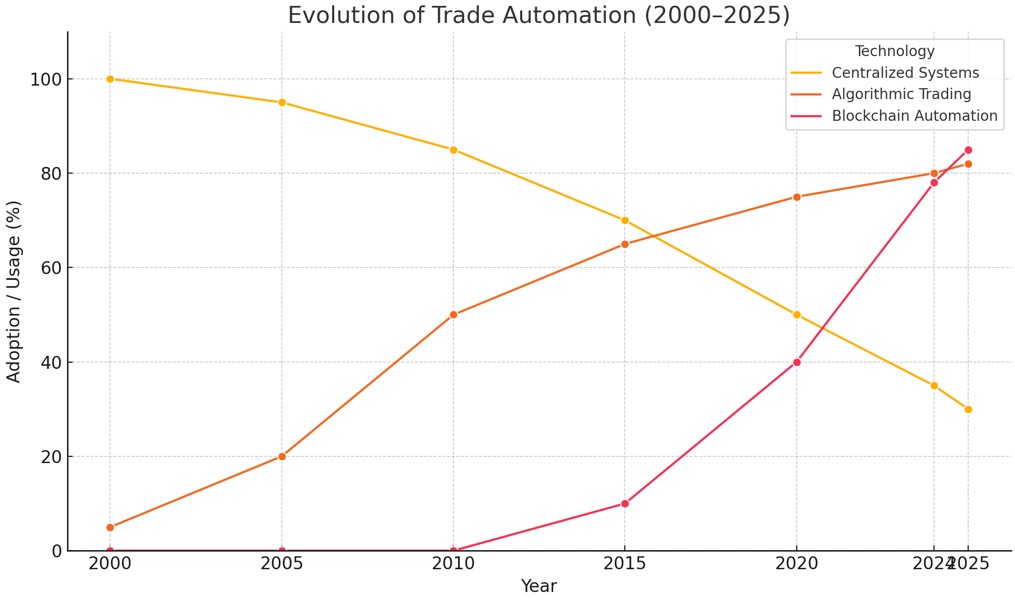
Key insights (2000–2025):
Centralized systems are projected to decline further to 30% reliance in 2025.
Algorithmic trading adoption is expected to rise slightly to 82%, showing maturity and integration.
Blockchain automation shows significant growth, reaching 85% institutional interest, solidifying its role as a core infrastructure for decentralized trading and smart contracts.
The mechanism behind blockchain-based agreements
Blockchain agreements aren’t just lines of code, they’re programmable contracts that remove human error, delays, and middlemen. Their real power lies in how they automate value exchange while keeping everything auditable.
Automation of execution
Smart contracts act like built-in referees. Once conditions are met, actions trigger automatically without external approval. This is where trustless systems shine, since you don’t need to rely on banks or brokers to verify deals.
Wallets as risk shields
Blockchain wallets don’t only store assets, they manage permissions, keys, and access logic. Multi-sig wallets, for example, require multiple confirmations, making hacks harder. These features matter most when trading crypto derivatives, where leverage increases risk and mistakes can be costly.
The rise of programmable finance
With DeFi protocols, contracts can handle lending, borrowing, or insurance in real time. That means your money isn’t just sitting, it’s constantly working through coded rules. The efficiency comes from automation, but the strategy comes from how you design and use those tools.
| Metric | Insight |
|---|---|
| New smart contracts deployed (Q1 2025) | 6.2 million contracts, more than the total for all of 2024 |
| Ethereum’s share of global DeFi TVL | 63%, holding $78.1 billion out of a global $123.6 billion |
| Aave’s share of Ethereum DeFi TVL | 45%, with $25.41 billion in Total Value Locked |
| Public auditability of smart contracts | 100% of contracts on public blockchains are fully auditable |
Real-world use in the financial sector
Smart contracts are already being used in some of the most important financial use cases today:
DeFi lending. Platforms such as Aave and Compound make it possible for users to lend or borrow assets directly through smart contracts. The entire process: collateral management, interest calculation, and liquidation, is handled without human involvement, making it efficient and transparent.
Tokenized derivatives. With projects like Synthetix, users can gain exposure to synthetic versions of commodities, Forex pairs, and indexes. These tokenized assets behave like traditional financial instruments but are powered by blockchain-based automation.
Insurance. Platforms such as Etherisc and Lemonade are using smart contracts to process claims for flight delays and weather-related events. These payouts are triggered automatically, without the need for manual intervention, showing how powerful on-chain execution can be when applied to real-world insurance models.
One of the key benefits of smart contracts is their role as digital escrows. They hold funds securely and release them only when preset conditions are met. This reduces the need for third-party intermediaries and speeds up transaction completion.
Chainalysis reported that DeFi transactions on-chain crossed $7.4 trillion in volume in 2024, with 18% involving synthetic Forex derivatives and similar instruments. According to Messari, the total value locked (TVL) across several chains saw impressive gains, Core's TVL grew 90% quarter-over-quarter to $811.8 million, while Starknet’s TVL surged 550% year-to-date, reaching $252 million.
What’s driving these developments is the rise of well-designed decentralized apps. These dApps combine smooth front-end experiences with robust backend logic powered by smart contracts. DeFi protocols like Uniswap, GMX, and Curve show how financial transactions are increasingly relying on automated systems and programmable money to execute without manual control or third-party approval.
Key 2025 insights
DeFi lending sits at $58 billion. This includes protocols like Aave and Compound, with Aave alone contributing around $40.3 billion, driven by increased demand for decentralized borrowing and lending services.
Tokenized derivatives lack reliable data. While previously cited figures claimed $1.7 trillion, no 2025-backed metrics could confirm this scale, making prior estimates speculative.
Digital escrow reached $1.87 billion. The blockchain-based escrow market grew steadily in 2024 and is set to expand further in 2025 as cross-border payments and institutional interest increase.
Decentralized insurance grows to $3.51 billion. This sector is gaining traction by covering smart contract risks, weather events, flight delays, and parametric health triggers.
Core DeFi TVL stands at $123.6 billion. Total Value Locked across all decentralized finance protocols signals a rebound and Layer 2 adoption post-2022 bear cycle.
Starknet TVL climbs to $629 million. As a leading ZK-rollup layer 2, Starknet’s growth is fueled by dApp activity, ecosystem grants, and Ethereum scaling momentum.

Limitations and vulnerabilities to watch for
Even in a fast-moving crypto world, the biggest risks don’t come from price swings, they come from the cracks in the technology itself. Knowing where these cracks appear can keep you ahead.
Smart contract vulnerabilities
Bugs like reentrancy attacks can drain entire pools of funds, as seen in the infamous DAO hack. Many dApps for finance depend on automated rules, but a single overlooked loophole can let hackers rewrite the playbook. Always check if the project has undergone audits by trusted tools like MythX or CertiK before investing.
Oracle feeds
Smart contracts rely on external data, like price feeds or weather reports, to function. Weak or manipulated oracle feeds can trigger false trades, liquidations, or payouts. Think of it as a trustworthy messenger, if the messenger lies, the entire contract fails.
Peer-to-peer transactions
One of crypto’s strengths is direct exchange without intermediaries, but peer-to-peer transactions also carry hidden risks. Fraud, double-spending attempts, or fake identities are harder to reverse than in traditional banking. Reputation systems and escrow features can help reduce exposure.
Open-source validation
Not all projects are equally transparent. If a protocol’s code isn’t open-source or widely reviewed, you’re trusting a black box. The fewer eyes on the code, the higher the chance for hidden flaws to slip by unnoticed.
How traders can benefit and stay secure
Smart contracts open up a powerful ecosystem for traders, but navigating it safely requires more than knowing how to click “confirm.” Here’s how to build both opportunity and protection into your approach.
Blockchain governance
Understand voting power. In many protocols, blockchain governance is controlled by token holders, which means whales or early investors can steer updates that affect fees, security, or even payouts. Traders need to track governance proposals like they track charts.
Avoid passivity. Simply trading without engaging with governance risks leaving your capital exposed to sudden rule changes or network upgrades.
Trade settlement blockchain
Focus on speed and cost. Using trade settlement blockchain networks designed for fast execution can save traders from high slippage or delayed settlements that erode gains.
Verify settlement layers. Not every blockchain handles trades the same way, layer-2 scaling solutions, for example, can reduce costs but add exit risks if liquidity dries up.
Immutable contract code
Code is law. Immutable contract code means trades and settlements cannot be undone if something goes wrong. This gives traders finality, but also no recourse in case of a mistake or exploit. Double-check contract addresses before locking in trades.
Use audited contracts. Security audits don’t guarantee safety, but they massively lower the chance of trading through flawed or malicious code.
Case study: Automating futures contracts on Ethereum
Here’s how Ethereum contracts enable a decentralized futures trade:
Capital allocation. A trader deposits USDC into GMX via MetaMask.
Contract activation. A smart contract opens a long ETH/USD position with a 2x multiplier.
Trigger monitoring. Oracle feeds from Chainlink monitor real-time ETH prices.
Outcome. At the take-profit or stop-loss threshold, the position closes automatically and funds are returned.
This is not merely automation, it is programmable money that reacts to real-time data and follows instructions without pause or emotion. It’s the evolution of trading discipline, coded into a financial machine.
Expert and institutional perspectives
As per Coinbase Prime’s 2025 report, over 65% of institutional clients are now dealing with smart contract-based assets. These investors point to speed, transparency, and traceable records as key advantages.
Stani Kulechov, CEO of Aave, recently noted that "safety modules and pooled liquidity now directly rival CeFi frameworks."
The MIT Digital Currency Initiative suggests that smart contracts could gradually replace many core financial systems, especially in settlement and regulatory processes. These shifts are now prompting U.S. regulators to respond.
From a legal angle, we are entering a phase of trade settlement blockchain protocols that closely resemble traditional infrastructure but remove delays and middlemen.
The SEC, while still cautious, has started viewing some DeFi tools as enablers of trustless environments. Regulatory clarity around liability and reporting should improve as activity continues to grow.
Where the industry is headed
The future of smart contracts goes beyond what we see today:
Interoperability. Systems like Polkadot and Cosmos are enabling smart contracts to work across chains, essential for trading synthetic Forex assets or transferring value between ledgers.
Zero-knowledge p roofs. Contracts using zk-SNARKs verify logic without exposing details, ideal for institutional confidentiality.
AI integration. Experiments are emerging where machine learning models initiate smart contracts based on price models or macroeconomic triggers.
Over time, we’ll see the emergence of smart contract layers that handle tokenized assets like real estate, ETFs, or IP rights. This convergence of blockchain with real-world markets could redefine asset ownership and liquidity.
Getting started: Platforms and tools for U.S. traders
To experiment with smart contracts safely, U.S. traders can begin with trusted, accessible tools:
| Tool | Role | Benefits |
|---|---|---|
| MetaMask | Wallet interface | Key to managing on-chain capital |
| Zapper | DeFi dashboard | Visualizes smart contract-based positions |
| dYdX | Perpetuals exchange | Offers deep liquidity and auto-liquidations |
| GMX | Futures and spot trading | Runs on Arbitrum, uses oracle-based pricing |
| Etherscan | Blockchain explorer | Review, audit, and verify smart contracts |
Using these tools, traders can test smart contracts in simulated environments or deploy capital in secure, user-audited pools.
Build composable trades and protect your edge with smart contract tactics

Most traders see smart contracts as just automation tools. But the real power kicks in when you start linking them together across DeFi platforms. For example, let’s say you close a trade on a DEX. What if those profits instantly moved into a yield protocol, and then triggered a backup insurance contract, all without you lifting a finger? That’s composability. You’re not just trading anymore, you’re setting up a chain reaction that runs exactly how you want, every single time.
Here’s something most beginners miss, your trade can be hijacked before it even goes live. MEV bots scan the blockchain for juicy trades and jump ahead in line, often causing price changes or failed orders. But there’s a way around this: submit your transaction through a private mempool like Flashbots. That way, your move stays hidden until it’s confirmed. If you’re trading large volumes or relying on timing, this one step can keep your edge safe and your profits clean.
Conclusion
Smart contracts have evolved from a niche concept into a critical tool powering modern digital finance. By understanding how smart contracts work, traders gain access to decentralized tools that can automate processes such as trade execution and settlement, reducing reliance on brokers or traditional custodians.
With the rapid growth of blockchain automation, markets are shifting toward systems built on transparency, speed, and logic-based trust. Whether through DeFi lending, synthetic derivatives, or digital escrow, smart contracts are redefining how financial value is created and exchanged.
As adoption expands and platforms mature, the ability to engage with these technologies will separate passive participants from empowered traders. The infrastructure is in place, the future of finance is already running on-chain.
FAQs
Can smart contracts be paused or stopped once deployed?
Only if built with a kill-switch or admin role. Otherwise, the contract runs autonomously once on-chain.
Are smart contracts taxable in the U.S.?
Yes. Capital gains from smart contract trades (e.g., swaps or yield farming) are taxable. Use tools like Koinly or CoinTracker to report.
How do smart contracts handle errors in input data?
If the contract lacks proper error-handling logic, it can behave unpredictably. Audited contracts usually include fail-safes.
Can traditional assets like real estate be linked to smart contracts?
Yes. These are known as tokenized assets and are gaining traction, especially in jurisdictions with digital property laws.
Editors' Top Picks and Insights






Related Articles
Team that worked on the article
Oleg Tkachenko is an economic analyst and risk manager having more than 14 years of experience in working with systemically important banks, investment companies, and analytical platforms. He has been a Traders Union analyst since 2018.
Andreas Kristo Saragih is a seasoned equity research analyst with over a decade of experience across both buy-side and sell-side roles, focused on the Indonesian capital market. He has extensive sector coverage, including banking, consumer goods, retail, real estate, healthcare, transportation, poultry, cement, pharmaceuticals, construction, and infrastructure.
Chinmay Soni is a financial analyst with more than 5 years of experience in working with stocks, Forex, derivatives, and other assets. As a founder of a boutique research firm and an active researcher, he covers various industries and fields, providing insights backed by statistical data.
CFD is a contract between an investor/trader and seller that demonstrates that the trader will need to pay the price difference between the current value of the asset and its value at the time of contract to the seller.
Take-Profit order is a type of trading order that instructs a broker to close a position once the market reaches a specified profit level.
Trade execution is knowing how to place and close trades at the right price. This is the key to turning your trading plans into real action and has a direct impact on your profits.
Ethereum is a decentralized blockchain platform and cryptocurrency that was proposed by Vitalik Buterin in late 2013 and development began in early 2014. It was designed as a versatile platform for creating decentralized applications (DApps) and smart contracts.
Cryptocurrency is a type of digital or virtual currency that relies on cryptography for security. Unlike traditional currencies issued by governments (fiat currencies), cryptocurrencies operate on decentralized networks, typically based on blockchain technology.

-
 Afghanistan
-
 Albania
-
 Algeria
-
 Angola
-
 Argentina
-
 Armenia
-
 Australia
-
 Austria
-
 Azerbaijan
-
 Bahamas
-
 Bahrain
-
 Bangladesh
-
 Belarus
-
 Belgium
-
 Bolivia
-
 Botswana
-
 Brazil
-
 Brunei
-
 Bulgaria
-
 Cambodia
-
 Cameroon
-
 Canada
-
 Chile
Chile
-
 China
China
-
 Colombia
-
 Congo
Congo
-
 Costa Rica
-
 Cote d'Ivoire
-
 Croatia
-
 Cuba
Cuba
-
 Cyprus
-
 Czechia
-
 DR Congo
-
 Denmark
-
 Dominican Republic
-
 Ecuador
-
 Egypt
Egypt
-
 El Salvador
-
 Estonia
-
 Eswatini
-
 Ethiopia
-
 Finland
-
 France
-
 Georgia
-
 Germany
-
 Ghana
Ghana
-
 Greece
-
 Haiti
Haiti
-
 Hong Kong
-
 Hungary
-
 India
India
-
 Indonesia
-
 Iran, Islamic republic
-
 Iraq
Iraq
-
 Ireland
-
 Israel
-
 Italy
Italy
-
 Jamaica
-
 Japan
Japan
-
 Jordan
-
 Kazakhstan
-
 Kenya
Kenya
-
 Korea
Korea
-
 Kuwait
-
 Kyrgyzstan
-
 Laos
Laos
-
 Latvia
-
 Lebanon
-
 Lesotho
-
 Libya
Libya
-
 Lithuania
-
 Luxembourg
-
 Madagascar
-
 Malaysia
-
 Malta
Malta
-
 Mauritius
-
 Mexico
-
 Moldova
-
 Mongolia
-
 Montenegro
-
 Morocco
-
 Mozambique
-
 Myanmar
-
 Namibia
-
 Nepal
Nepal
-
 Netherlands
-
 New Zealand
-
 Nigeria
-
 North Macedonia
-
 Norway
-
 Oman
Oman
-
 Pakistan
-
 Palestine
-
 Panama
-
 Papua New Guinea
-
 Paraguay
-
 Peru
Peru
-
 Philippines
-
 Poland
-
 Portugal
-
 Puerto Rico
-
 Qatar
Qatar
-
 Reunion
-
 Romania
-
 Rwanda
-
 Saudi Arabia
-
 Serbia
-
 Singapore
-
 Slovakia
-
 Slovenia
-
 Somalia
-
 South Africa
-
 Spain
Spain
-
 Sri Lanka
-
 Sweden
-
 Switzerland
-
 Syria
Syria
-
 Taiwan
-
 Tajikistan
-
 Tanzania
-
 Thailand
-
 Trinidad and Tobago
-
 Tunisia
-
 Turkey
-
 UAE
UAE
-
 Uganda
-
 Ukraine
-
 United Kingdom
-
United States
-
 Uruguay
-
 Uzbekistan
-
 Venezuela
-
 Vietnam
-
 Yemen
Yemen
-
 Zambia
-
 Zimbabwe
- Forex
- Crypto










- Understanding the evolution of trade automation
- The mechanism behind blockchain-based agreements
- Real-world use in the financial sector
- Limitations and vulnerabilities to watch for
- How traders can benefit and stay secure
- Automating futures contracts on Ethereum
- Expert and institutional perspectives
- Where the industry is headed
- Platforms and tools for U.S. traders
- Expert opinion
- Conclusion
- FAQs


