
Smart Contract Risks Explained


Editorial Note: While we adhere to strict Editorial Integrity, this post may contain references to products from our partners. Here's an explanation for How We Make Money. None of the data and information on this webpage constitutes investment advice according to our Disclaimer.
Common smart contract risks include reentrancy attacks, oracle manipulation, flash-loan exploits, poor access controls, unrestricted external calls, logic errors and business flaws. Because contracts are immutable once deployed, even small bugs can lock or drain funds permanently.
Among the biggest concerns for crypto investors are growing smart contract security risks, which now rank among the leading threats to DeFi capital. According to Chainalysis, more than $2.2 billion was lost in 2024 through contract exploits, most of which stemmed from governance gaps, coding errors, or protocol design flaws. These increasing DeFi vulnerabilities have turned into a systemic challenge for participants in code-driven markets. As 2026 brings rapid innovation alongside more advanced attack methods, understanding these risks is no longer optional for anyone actively involved in decentralized trading.
Risk warning: Cryptocurrency markets are highly volatile, with sharp price swings and regulatory uncertainties. Research indicates that 75-90% of traders face losses. Only invest discretionary funds and consult an experienced financial advisor.
What smart contracts actually do in trading
Smart contracts replace intermediaries by automatically executing trades, loans and yield strategies. On decentralized exchanges like Uniswap and Curve they route orders and manage liquidity pools; on lending platforms such as Aave and Compound, they adjust interest rates, collateral ratios and liquidation thresholds; and on synthetic or derivatives protocols like GMX and Perpetual Protocol they settle perpetual swaps and handle funding rates. This heavy utilisation means that any risks of smart contract logic errors or governance missteps directly translate into code‑based trading flaws.
Common weak points that affect traders
Smart contracts are prone to both technical and economic vulnerabilities. The Bank of Canada highlights that connecting blockchains to each other or to off‑chain data introduces new points of failure and that flash loans allow attackers to secure “billions of dollars in funding without any credit checks or collateral requirements”. CoinLaw’s 2025 report catalogues recurring flaws, which we summarise here:
Reentrancy attacks. These allow an attacker to repeatedly call a contract before previous calls finish, draining funds, as seen in the DAO hack (2016) which lost $60 million.
Integer overflow/underflow. Poorly handled arithmetic can reset balances; the Bancor vulnerability in 2017 exposed $10 million in tokens.
Unprotected functions. Functions without access control let anyone drain funds or change state, causing $15 million in losses in 2023.
Front‑running and oracle manipulation. Attackers reorder transactions or feed manipulated price data; 20% of DeFi protocols were front‑run in 2022 and price‑oracle manipulation remains a key protocol exploit vector.
Unrestricted external calls. External calls to other contracts can re‑enter unexpectedly; such unchecked calls accounted for 18% of reported vulnerabilities.
Logic errors and business flaws. Badly designed lending logic, like Euler’s 2023 bug, allowed flash‑loan exploits; CoinLaw attributes $63 million in losses to flawed business logic.
These issues underscore how DeFi vulnerabilities can stem from simple oversights. Attackers also chain multiple exploits together; the Bybit hack in February 2025 combined key‑management weaknesses and compromised interfaces to steal $1.5 billion.
The role of human error and code complexity
Much of DeFi’s risk originates from people rather than math. Smart contracts are immutable once deployed, meaning bugs cannot be patched without complex migrations. CoinLaw notes that permanent bugs locked $500 million of user funds on Ethereum in 2023 and irreversible transactions led to $1.6 billion in accidental losses in 2022. Shortages of skilled blockchain developers leave 42% of projects underprepared, and mismanagement of intricate code generated 25% of all vulnerabilities in 2023.
Lack of peer review contributed to 40% of smart contract failures, and insufficient testing increased exploit rates by 300%. The more complex the system, the more likely blockchain logic errors will manifest under exotic conditions, such as flash‑loan amplification or gas‑limit edge cases. Governance mistakes add another layer: a March 2025 vote accidentally shifted liquidation parameters in a major lending protocol, triggering over $60 million in forced liquidations. These incidents remind traders that Ethereum contract issues often stem from human governance choices rather than technical flaws.
Vitalik Buterin’s well-known observation, “Code is law, but law can be political,” underscores how Ethereum contract issues can arise from human governance choices, not just technical flaws. In March 2025, a governance vote in a top-20 DeFi lending protocol unintentionally altered liquidation parameters, triggering $62 million in forced liquidations within two days, an incident that an independent security analyst described as “a political decision with immediate market consequences.”
The human factor remains at the heart of crypto protocol risks. As Trail of Bits noted in a January 2025 review, “Every upgradeable contract has two threat surfaces: the code you see and the governance that can change it.” Developer decisions on upgradeability, admin rights, and integration testing can open new exploit vectors even in battle-tested systems. For traders, monitoring these governance actions is as critical as analyzing the underlying code.
Audits: Not a silver bullet
Security audits are critical, but they are not warranties. CoinLaw highlights that audited projects experienced 98% fewer hacks than unaudited ones in 2023 yet emphasises that audits vary in scope and quality. Types of audits include automated scans, manual reviews, formal verification, penetration testing and real‑time monitoring. However, each method has limitations: automated tools miss nuanced logic errors, manual audits are time‑consuming, and formal verification is costly.
Furthermore, crypto protocol risks often arise after audits when upgrades or integrations add new attack surfaces. Traders should check when the last audit occurred, who performed it, whether the deployed code matches the audited version and whether post‑audit changes were re‑evaluated.
| Protocol | Year | Loss | Audit status | Primary exploit vector | Notes for traders |
|---|---|---|---|---|---|
| bZx | 2020 | $8M | Yes | Logic flaw in margin trading contracts | Audit missed edge-case liquidation condition. |
| Uranium Finance | 2021 | $50M | Yes | Migration function exploit | Admin keys allowed attacker to trigger malicious migration. |
| Euler Finance | 2023 | $197M | Yes | Flash-loan attack exploiting debt mechanism | Complex interaction between lending/borrowing modules. |
| Inscribe Protocol | 2024 | $50M | Yes | Oracle manipulation (low-liquidity TWAP feed) | No bounds check; price feed accepted manipulated input. |
| Orbit Bridge | 2025 | $81M | Yes | Cross-chain verification bypass | Exploit vector introduced in post-audit upgrade. |
| StakeWise v3 Pool | 2025 | $16M | Yes | Governance parameter misconfiguration | Upgrade changed validator withdrawal rules without re-audit. |
Trail of Bits explains, “An audit is not a warranty. Security is a process; continuous monitoring, regression testing, and re-auditing after every meaningful change are what keep protocols resilient.” Many protocols skip post-upgrade reviews to save cost or time, leaving traders exposed to Ethereum contract issues that were not present during the initial assessment.
Traders should not only check whether a protocol was audited but also:
When the last audit occurred.
Who performed it (smart contract audit firms vary widely in rigor).
Whether the live deployed code matches the audited version.
If post-audit upgrades were re-evaluated.
For better DeFi user protection, combine audit verification with your own due diligence: read public audit reports, check for “out of scope” warnings, and monitor for upgrade transactions via Etherscan.
Rug Pulls, permissioned backdoors, and protocol governance
Not all losses stem from code bugs; social engineering and governance exploits can be equally destructive. The FSB warns that DeFi’s operational fragilities and interconnectedness leave it exposed to liquidity mismatches and leverage. Governance centralisation can turn these fragilities into decentralized governance threats. Founders may embed emergency functions in upgradeable contracts, allowing them to drain treasury funds or seize user assets.
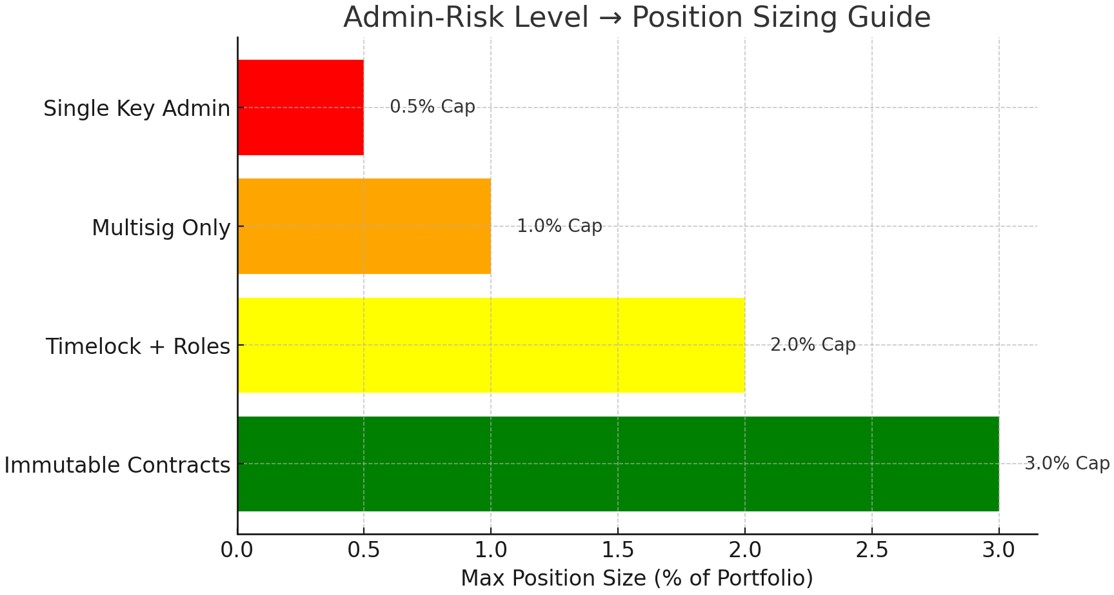
Wonderland’s 2022 scandal demonstrated that even community‑led projects can suffer from leadership abuse. CoinLaw reports that 23% of smart‑contract projects risk regulatory sanctions due to inadequate governance. To avoid rug pull indicators, traders should examine who holds admin keys, whether contracts have time‑locked upgrades and how treasury spending is controlled. Participating in governance forums helps identify malicious proposals before they pass.
Defensive strategies for traders
Protection begins with due diligence. Traders can reduce exposure to exploit vectors by adopting the following practices:
Read contract summaries. Use Etherscan to review contract code, focusing on upgrade functions and admin privileges.
Verify audits. Check audit reports from multiple smart contract audit firms and ensure the live code matches the audited version.
Monitor liquidity and activity. Tools like DefiLlama and DeBank reveal unusual outflows or wallet behaviour that often precede decentralized finance hacks.
Use protective wallets. Transaction‑preview wallets such as Rabby or institutional custodians like Fireblocks help block malicious transactions.
Watch governance. Follow protocol forums and vote on proposals to prevent governance attacks. On‑chain alerts for admin key usage can flag rug pull indicators.
Diversify exposure. Spread funds across audited protocols, avoid holding large balances on bridges and maintain a cold‑storage fallback.
Combining these steps creates layers of defence and embodies DeFi user protection best practices.
What the data says: Losses are mounting
DeFi losses have remained significant in recent years, though the scale and tactics have shifted. Euler Finance suffered a confirmed $197 million exploit in 2023, making it one of the largest protocol hacks. That same year, Mango Markets was drained of roughly $116 million, highlighting the risk of flash-loan exploits.
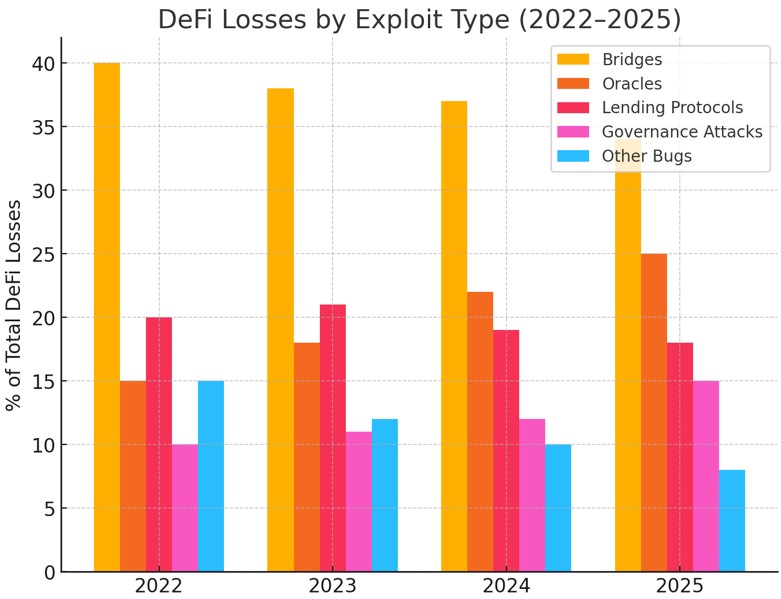
Cross-chain bridges remain among the most vulnerable points in DeFi. Research shows that between May 2021 and August 2024, bridge-related hacks accounted for over $3.2 billion in cumulative losses, the largest category of DeFi exploits.
Immunefi reports that in 2024, crypto hacks and exploits caused around $1.49 billion in losses. By April 2025 alone, hackers had already stolen about $1.7 billion, surpassing the full-year 2024 total.
These numbers confirm that while the number of incidents may fluctuate, the scale of individual attacks is growing, and attacker sophistication continues to rise, especially in cross-chain and flash-loan environments.
Regulatory developments in the U.S.
Regulators are stepping up oversight of DeFi. The Securities and Exchange Commission (SEC) has declared certain lending and staking contracts to be securities, requiring registration and disclosure. The Commodity Futures Trading Commission (CFTC) warns that derivatives protocols must comply with commodity laws, and FinCEN insists on anti‑money‑laundering compliance. CoinLaw notes that increasing scrutiny by US agencies threatens the viability of 23% of smart‑contract projects.
The Bank of Canada emphasises that DeFi’s anonymous, borderless nature complicates oversight. Moreover, the immutability of smart contracts conflicts with privacy regulations like GDPR, raising legal questions about reversible transactions. For traders, this means that interacting with unregulated or sanctioned protocols could result in legal exposure. Staying informed about regulatory guidance and favouring compliant platforms is a prudent part of managing crypto protocol risks.
Future outlook: Can code really be trusted?
Despite these challenges, innovation is advancing. Formal verification, once reserved for mission‑critical contracts, is gaining traction as costs decline. Zero‑knowledge proofs enable off‑chain computations with verifiable outputs, reducing on‑chain load and privacy risks. Automated auditing tools like Slither and Mythril identified 92% of known vulnerabilities in test environments and real‑time monitoring audits prevented $100 million in potential losses.
Bug bounty programs paid ethical hackers $65 million in 2023, incentivising defence. AI‑powered analysis is beginning to spot anomalous contract behaviour before humans can. Yet no measure is absolute. As the FSB notes, DeFi’s vulnerabilities mirror those of traditional finance and are amplified by crypto‑asset volatility. Ultimately, trust in code must be paired with human oversight, sound governance and continuous learning.
Even after understanding the risks involved, if you’re still willing to invest in crypto, consider using any of the exchanges below to do so. They are reputed, allowing you with some comfort on one end.
| Crypto | Foundation year | Min. Deposit, $ | Coins Supported | Spot Taker fee, % | Spot Maker Fee, % | Alerts | Copy trading | Tier-1 regulation | TU overall score | Open an account | |
|---|---|---|---|---|---|---|---|---|---|---|---|
| Yes | 2012 | 10 | 400+ | 0.5 | 0.5 | Yes | No | Yes | 8.5 | Go to broker Your capital is at risk. |
|
| Yes | 2011 | 10 | 399 | 0.3 | 0.2 | No | Yes | Yes | 8.08 | Go to broker Your capital is at risk.
|
|
| Yes | 2016 | 1 | 400+ | 0.5 | 0.25 | Yes | No | Yes | 7.76 | Go to broker Your capital is at risk. |
|
| Yes | 2011 | 10 | 400+ | 0.4 | 0.25 | Yes | Yes | Yes | 7.68 | Go to broker Your capital is at risk. |
|
| Yes | 2018 | No | 100 | 0.07 | 0.04 | Yes | No | Yes | 6.57 | Go to broker Your capital is at risk.
|
Smart contract risk traps beginners overlook in DeFi

Smart contracts may look simple on the surface, but a hidden layer of complexity makes them highly vulnerable. One of the biggest mistakes beginners make is ignoring upgradeable contracts. Many DeFi protocols use proxy architectures, where developers can alter contract logic after deployment. If you don’t verify upgrade permissions, you risk holding tokens in a protocol where the admin can change withdrawal rules overnight. Always check the “proxy admin” in the contract’s code and track governance proposals before locking in funds. A single unnoticed upgrade can open a backdoor for rug pulls, something static audits often fail to catch.
Another critical, under-discussed risk is oracle dependency. Most DeFi platforms rely on price feeds, but when liquidity is thin or oracles are poorly configured, attackers exploit time-weighted average prices (TWAP) to manipulate asset values. This has caused multi-million-dollar losses in protocols like Mango Markets and Inscribe. To protect yourself, study which oracle a platform uses, confirm if it aggregates multiple data sources, and avoid protocols with single-source oracles on volatile assets. Understanding these dependencies gives you an edge over traders who only check “audit passed” badges without digging deeper.
Conclusion
Working around the risks of smart contract design, governance, and market interaction is part of modern trading. Using reliable tools, verifying multiple audits, and participating in governance can reduce exposure to decentralized governance threats. Traders should bookmark trusted data sources, follow security best practices, and treat DeFi vulnerabilities as active market risks, not distant hypotheticals. In 2026, understanding how each protocol’s exploit vector could affect your positions, and spotting early rug pull indicators such as sudden admin key activity or governance takeovers, can make the difference between preserving capital and being caught in the next major loss. For ongoing insights and vetted risk analysis, TradersUnion remains a consistent ally for anyone seeking to outpace both market volatility and technical pitfalls.
FAQs
What’s the biggest source of DeFi losses in 2024?
Bridges accounted for 37% of total DeFi losses in 2024, often from validation bypasses or insecure upgrade paths.
How can I spot a high-risk smart contract before trading?
Look for single admin keys, no timelock, missing oracle fallback, or unexplained contract upgrades in the last 90 days.
Are audited DeFi protocols completely safe?
No. Many exploited protocols had audits. Safety depends on continuous reviews and whether post-audit changes were checked.
What’s the fastest way to react if a protocol I use is exploited?
Withdraw funds immediately, verify exploit scope in official channels, and monitor asset health on-chain before redeploying capital.
Editors' Top Picks and Insights






Related Articles
Team that worked on the article
Emilio is a futures trader and financial writer who specializes in technical analysis, market news, and trading psychology. He began his career by completing the Cornerstone Traders Qualification under the mentorship of a gold futures veteran from Bank of America on Wall Street.
Dan Blystone began his trading career in 1998 as an arbitrage clerk on the floor of the Chicago Mercantile Exchange (CME). He later traded bond and Eurex futures at proprietary firms such as Altea Trading, gaining valuable experience in high-frequency trading and risk management.
Chinmay Soni is a financial analyst with more than 5 years of experience in working with stocks, Forex, derivatives, and other assets. As a founder of a boutique research firm and an active researcher, he covers various industries and fields, providing insights backed by statistical data.
Volatility refers to the degree of variation or fluctuation in the price or value of a financial asset, such as stocks, bonds, or cryptocurrencies, over a period of time. Higher volatility indicates that an asset's price is experiencing more significant and rapid price swings, while lower volatility suggests relatively stable and gradual price movements.
Forex leverage is a tool enabling traders to control larger positions with a relatively small amount of capital, amplifying potential profits and losses based on the chosen leverage ratio.
CFD is a contract between an investor/trader and seller that demonstrates that the trader will need to pay the price difference between the current value of the asset and its value at the time of contract to the seller.
Copy trading is an investing tactic where traders replicate the trading strategies of more experienced traders, automatically mirroring their trades in their own accounts to potentially achieve similar results.
Risk management is a risk management model that involves controlling potential losses while maximizing profits. The main risk management tools are stop loss, take profit, calculation of position volume taking into account leverage and pip value.

-
 Afghanistan
-
 Albania
-
 Algeria
-
 Angola
-
 Argentina
-
 Armenia
-
 Australia
-
 Austria
-
 Azerbaijan
-
 Bahamas
-
 Bahrain
-
 Bangladesh
-
 Belarus
-
 Belgium
-
 Bolivia
-
 Botswana
-
 Brazil
-
 Brunei
-
 Bulgaria
-
 Cambodia
-
 Cameroon
-
 Canada
-
 Chile
Chile
-
 China
China
-
 Colombia
-
 Congo
Congo
-
 Costa Rica
-
 Cote d'Ivoire
-
 Croatia
-
 Cuba
Cuba
-
 Cyprus
-
 Czechia
-
 DR Congo
-
 Denmark
-
 Dominican Republic
-
 Ecuador
-
 Egypt
Egypt
-
 El Salvador
-
 Estonia
-
 Eswatini
-
 Ethiopia
-
 Finland
-
 France
-
 Georgia
-
 Germany
-
 Ghana
Ghana
-
 Greece
-
 Haiti
Haiti
-
 Hong Kong
-
 Hungary
-
 India
India
-
 Indonesia
-
 Iran, Islamic republic
-
 Iraq
Iraq
-
 Ireland
-
 Israel
-
 Italy
Italy
-
 Jamaica
-
 Japan
Japan
-
 Jordan
-
 Kazakhstan
-
 Kenya
Kenya
-
 Korea
Korea
-
 Kuwait
-
 Kyrgyzstan
-
 Laos
Laos
-
 Latvia
-
 Lebanon
-
 Lesotho
-
 Libya
Libya
-
 Lithuania
-
 Luxembourg
-
 Madagascar
-
 Malaysia
-
 Malta
Malta
-
 Mauritius
-
 Mexico
-
 Moldova
-
 Mongolia
-
 Montenegro
-
 Morocco
-
 Mozambique
-
 Myanmar
-
 Namibia
-
 Nepal
Nepal
-
 Netherlands
-
 New Zealand
-
 Nigeria
-
 North Macedonia
-
 Norway
-
 Oman
Oman
-
 Pakistan
-
 Palestine
-
 Panama
-
 Papua New Guinea
-
 Paraguay
-
 Peru
Peru
-
 Philippines
-
 Poland
-
 Portugal
-
 Puerto Rico
-
 Qatar
Qatar
-
 Reunion
-
 Romania
-
 Rwanda
-
 Saudi Arabia
-
 Serbia
-
 Singapore
-
 Slovakia
-
 Slovenia
-
 Somalia
-
 South Africa
-
 Spain
Spain
-
 Sri Lanka
-
 Sweden
-
 Switzerland
-
 Syria
Syria
-
 Taiwan
-
 Tajikistan
-
 Tanzania
-
 Thailand
-
 Trinidad and Tobago
-
 Tunisia
-
 Turkey
-
 UAE
UAE
-
 Uganda
-
 Ukraine
-
 United Kingdom
-
United States
-
 Uruguay
-
 Uzbekistan
-
 Venezuela
-
 Vietnam
-
 Yemen
Yemen
-
 Zambia
-
 Zimbabwe
- Forex
- Crypto










- What smart contracts actually do in trading
- Common weak points that affect traders
- The role of human error and code complexity
- Audits: Not a silver bullet
- Rug Pulls, permissioned backdoors, and protocol governance
- Defensive strategies for traders
- What the data says: Losses are mounting
- Regulatory developments in the U.S.
- Future outlook: Can code really be trusted?
- Expert opinion
- Conclusion
- FAQs


