The tweet was deleted by the author.
But we saved everything 🙂.

The stock market may close for the weekend, but the financial world does not stand still. Economic developments, geopolitical events, mergers, and acquisitions continue to influence share prices even when trading is unavailable. That is one of the reasons why investors are paying closer attention to tokenized stocks.
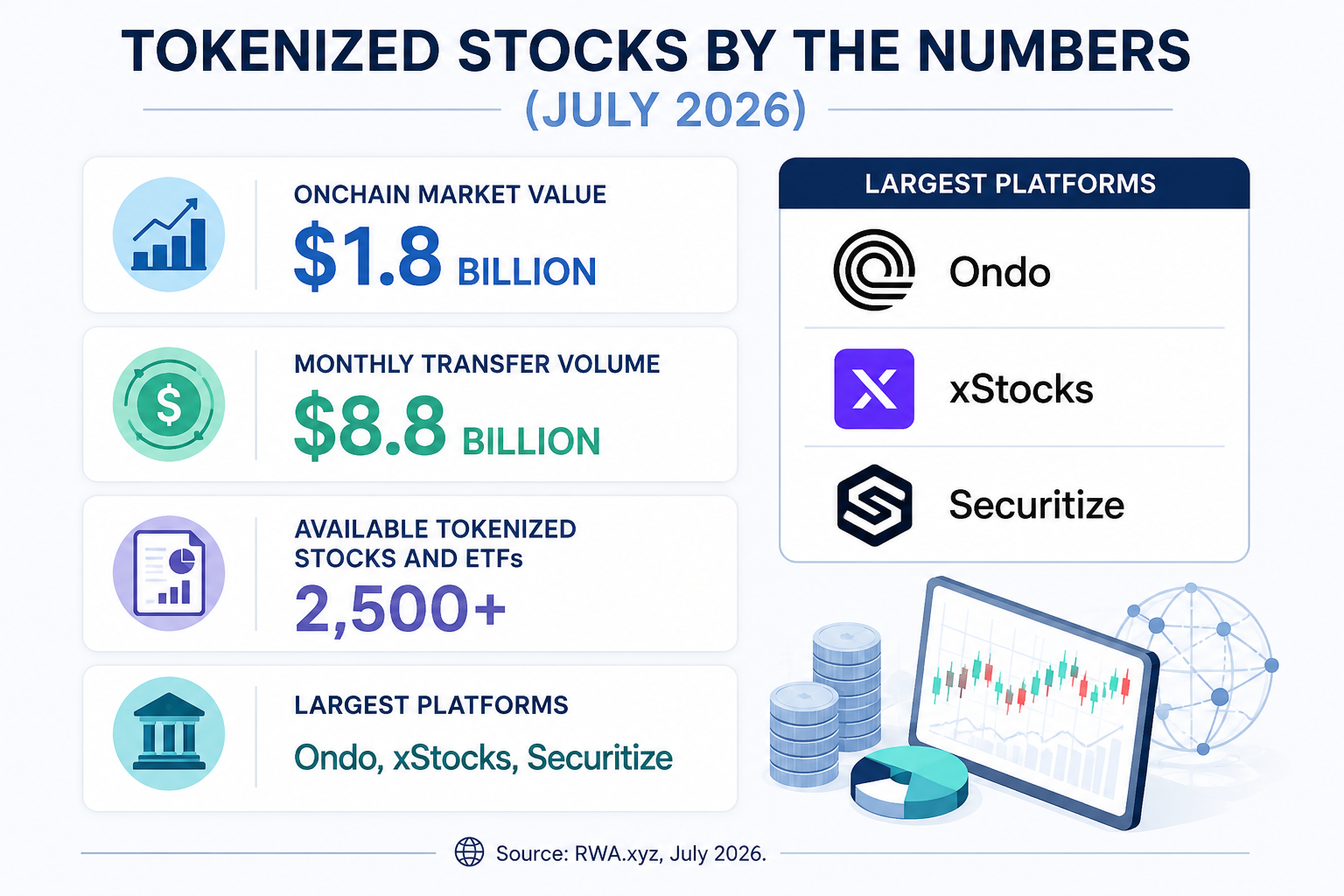
The market for tokenized stocks is expanding rapidly. Tokenized public equities accounted for approximately $1.8 billion in onchain value and nearly $8.8 billion in monthly transfer volume as of July 2026, according to RWA.xyz.
Bitget CEO Gracy Chen also noted that trading volume in tokenized stocks on the exchange during the most recent weekend was 10 times higher than the previous weekend, highlighting growing investor interest in around-the-clock access to equity markets.
Tokenized stocks have existed for several years, but a new wave of product launches is bringing them back into the spotlight. Interest has accelerated as crypto platforms expand beyond digital assets and offer blockchain-based versions of publicly traded companies and exchange-traded funds (ETFs), giving users access to both markets through a single ecosystem.
One of the latest developments came from xStocks, a tokenized equities platform backed by Kraken, which has been rapidly expanding its distribution network. In May, Bitget Wallet integrated xStocks, giving its users access to more than 130 tokenized U.S. stocks and ETFs alongside cryptocurrencies and other tokenized real-world assets. The platform says its tokenized equities are backed 1:1 by the underlying securities and can be traded around the clock.
The renewed interest reflects a broader trend toward the tokenization of real-world assets (RWAs), one of the fastest-growing segments of the digital asset market. Governments, banks, and asset managers are increasingly exploring blockchain-based representations of traditional financial instruments, from bonds and money market funds to private credit. Tokenized stocks extend that concept to public equities by making them accessible through blockchain infrastructure instead of conventional brokerage accounts.
The concept has also gained support from traditional finance. In his 2024 annual letter to investors, BlackRock Chairman and CEO Larry Fink wrote that "every stock, every bond, every fund, every asset can be tokenized," describing tokenization as the next generation of financial markets. While that vision extends well beyond public equities, the latest launches suggest tokenized stocks are becoming one of its first large-scale applications.
Supporters argue that tokenization could make capital markets more efficient by enabling near-instant settlement, fractional ownership, and broader global access to financial assets. Skeptics counter that the technology still depends on trusted intermediaries and operates within a regulatory framework that remains under development.
This is not the first attempt to bring stocks onchain. Earlier initiatives, including Binance's tokenized stock offering launched in 2021, were eventually discontinued amid regulatory scrutiny. Today's products place greater emphasis on regulatory compliance, transparent custody arrangements, and asset backing. Even so, tokenized stocks remain fundamentally different from owning shares through a traditional brokerage account.
A tokenized stock is a digital token issued on a blockchain that represents exposure to a publicly traded company's shares. Depending on the issuer, each token is typically backed 1:1 by the corresponding stock, which is held by a regulated custodian. The token's price is designed to closely track the market value of the underlying security.Instead of purchasing shares through a stock exchange, investors buy blockchain-based tokens using a compatible wallet or supported trading platform. Transactions are recorded on a blockchain, allowing users to hold and transfer tokenized assets in much the same way as cryptocurrencies.
The exact structure varies by issuer, making it important to understand what a particular token represents. Some products are redeemable for the underlying asset or its cash equivalent, while others simply provide economic exposure to a stock's price. Investor rights, including dividend distributions or voting rights, also depend on the product's legal framework rather than the blockchain technology itself.
For many crypto-native investors, the appeal lies in convenience. Tokenized stocks can often be purchased fractionally, integrated into decentralized finance (DeFi) applications, and traded beyond the opening hours of traditional stock exchanges. However, these additional features do not automatically make them equivalent to conventional equity ownership.
At first glance, tokenized stocks may look identical to conventional shares because their prices are designed to track the same publicly traded companies. The key difference is ownership. When investors buy shares through a brokerage account, they become shareholders of the company. Tokenized stocks, meanwhile, represent exposure to those shares through a blockchain-based token issued by a third party.
That distinction affects the rights attached to the investment. Traditional shareholders may receive dividends, vote on corporate matters, and participate in other shareholder actions. With tokenized stocks, those rights depend on the issuer and the product's legal structure. Some providers distribute dividend payments to token holders, while voting rights are often unavailable or handled through the platform rather than the company itself.
The differences do not necessarily make one product better than the other. Instead, they reflect two distinct ways of accessing the same market. Investors considering tokenized stocks should evaluate not only the underlying company but also the issuer, custody arrangements, and the rights associated with each token.
Tokenized stocks appeal to investors looking for greater flexibility than traditional brokerage accounts can offer. Depending on the platform, they may be available outside regular market hours, support fractional ownership, and allow users to manage stocks alongside cryptocurrencies in a single wallet.
Robinhood CEO Vlad Tenev believes tokenized equities could eventually become "the default way to get exposure to U.S. stocks outside the U.S.," reflecting expectations that blockchain-based securities will expand access to global markets.
However, the technology does not eliminate the challenges associated with investing in equities. Liquidity remains lower than on major stock exchanges, meaning large orders may be harder to execute without affecting the price. Investors also depend on the issuer to maintain the link between the token and the underlying asset, making due diligence just as important as it is in traditional finance.
Regulation remains another key consideration. While jurisdictions such as the European Union are gradually establishing clearer rules for digital assets, tokenized securities are still subject to evolving legal frameworks in many markets. As a result, the availability of tokenized stocks, as well as the rights they confer, can vary significantly between platforms and countries.
The latest wave of tokenized stock launches reflects growing confidence that blockchain can play a larger role in traditional finance. Recent RWA.xyz data also illustrates the pace of adoption, with the market's monthly transfer volume climbing to nearly $8.8 billion and the total value of tokenized public equities approaching $2 billion. Although these figures remain small compared with global equity markets, they indicate that tokenized stocks are moving beyond a niche experiment.
At the same time, tokenized stocks should not be viewed as digital copies of conventional shares. They provide an alternative way to gain exposure to publicly traded companies, but the legal structure, investor rights, and regulatory protections often differ from those associated with direct share ownership. As the market continues to mature, understanding those distinctions may prove more important than the technology itself.

 Afghanistan
 Albania
 Algeria
 Angola
 Argentina
 Armenia
 Australia
 Austria
 Azerbaijan
 Bahamas
 Bahrain
 Bangladesh
 Belarus
 Belgium
 Bolivia
 Botswana
 Brazil
 Brunei
 Bulgaria
 Cambodia
 Cameroon
 Canada
 Chile
Chile
 China
China
 Colombia
 Congo
Congo
 Costa Rica
 Cote d'Ivoire
 Croatia
 Cuba
Cuba
 Cyprus
 Czechia
 DR Congo
 Denmark
 Dominican Republic
 Ecuador
 Egypt
Egypt
 El Salvador
 Estonia
 Eswatini
 Ethiopia
 Finland
 France
 Georgia
 Germany
 Ghana
Ghana
 Greece
 Haiti
Haiti
 Hong Kong
 Hungary
 India
India
 Indonesia
 Iran, Islamic republic
 Iraq
Iraq
 Ireland
 Israel
 Italy
Italy
 Jamaica
 Japan
Japan
 Jordan
 Kazakhstan
 Kenya
Kenya
 Korea
Korea
 Kuwait
 Kyrgyzstan
 Laos
Laos
 Latvia
 Lebanon
 Lesotho
 Libya
Libya
 Lithuania
 Luxembourg
 Madagascar
 Malaysia
 Malta
Malta
 Mauritius
 Mexico
 Moldova
 Mongolia
 Montenegro
 Morocco
 Mozambique
 Myanmar
 Namibia
 Nepal
Nepal
 Netherlands
 New Zealand
 Nigeria
 North Macedonia
 Norway
 Oman
Oman
 Pakistan
 Palestine
 Panama
 Papua New Guinea
 Paraguay
 Peru
Peru
 Philippines
 Poland
 Portugal
 Puerto Rico
 Qatar
Qatar
 Reunion
 Romania
 Rwanda
 Saudi Arabia
 Serbia
 Singapore
 Slovakia
 Slovenia
 Somalia
 South Africa
 Spain
Spain
 Sri Lanka
 Sweden
 Switzerland
 Syria
Syria
 Taiwan
 Tajikistan
 Tanzania
 Thailand
 Trinidad and Tobago
 Tunisia
 Turkey
 UAE
UAE
 Uganda
 Ukraine
 United Kingdom
United States
United Kingdom
United States
 Uruguay
 Uzbekistan
 Venezuela
 Vietnam
 Yemen
Yemen
 Zambia
 Zimbabwe