
What Is A Defi Smart Contract?


Editorial Note: While we adhere to strict Editorial Integrity, this post may contain references to products from our partners. Here's an explanation for How We Make Money. None of the data and information on this webpage constitutes investment advice according to our Disclaimer.
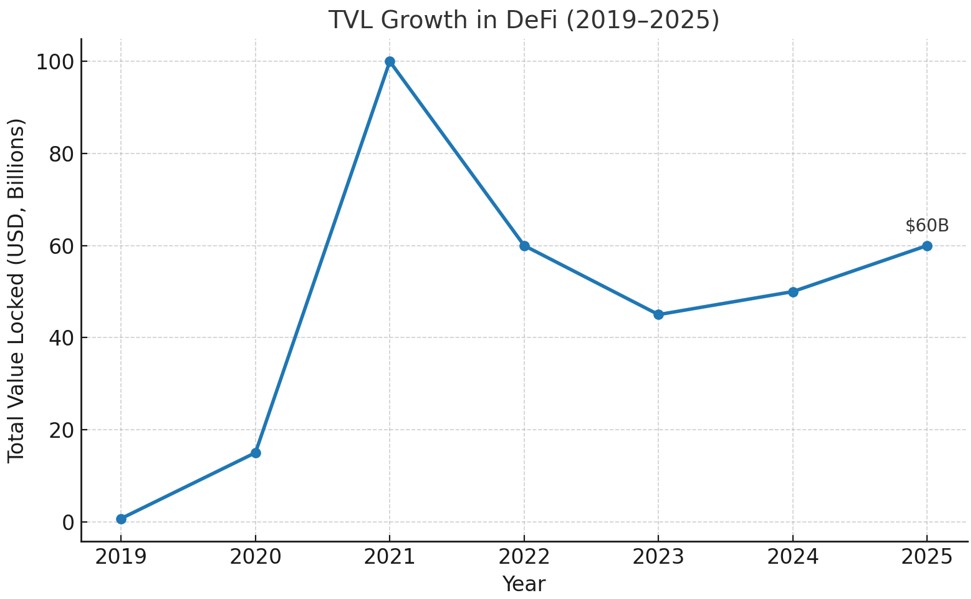
A DeFi smart contract refers to a self-operating agreement built on blockchain, which executes trades, loans, and settlements automatically, without the need for middlemen. As of 2025, the decentralized finance space has surpassed $60 billion in total value locked (DefiLlama). Platforms like Uniswap handle over $1.6 billion in daily swaps, while dYdX sees more than $2.3 billion in derivatives volume. For active market participants, this translates to continuous access, transparent execution, and built-in risk controls.
Over the years, the smart contract and DeFi ecosystem has evolved into one of the most groundbreaking shifts in financial technology. Back in 2019, the total value locked in decentralized finance was under $1 billion. By mid-2025, that figure had exploded past $60 billion. This tremendous growth shows how far smart contracts have come, transitioning from simple token swaps to powering complex lending markets and derivatives platforms that operate without human intervention.
For anyone wondering, what is DeFi smart contract functionality in practical terms, it’s essentially code on a blockchain protocol that manages financial rules on its own. These contracts allow traders to open positions, settle them, and manage risk automatically. In a competitive 2026 market, this kind of automation is not just efficient, it’s essential for strategy execution in real time.
Risk warning: Cryptocurrency markets are highly volatile, with sharp price swings and regulatory uncertainties. Research indicates that 75-90% of traders face losses. Only invest discretionary funds and consult an experienced financial advisor.
How blockchain is reshaping trading operations
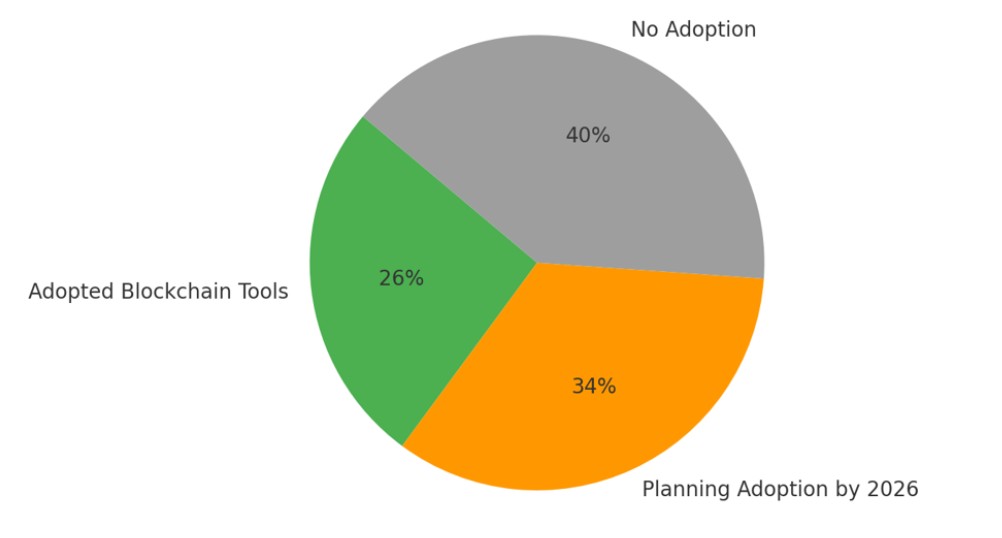
Blockchain infrastructure brings transparency, immutability and real‑time settlement to markets. Every trade settled on a blockchain is timestamped and publicly auditable, reducing counterparty risk and giving traders confidence that orders will clear as expected. Institutional adoption underscores this shift: Chainalysis estimates that North America alone received about $1.3 trillion in on‑chain value between July 2023 and June 2024, roughly 22.5% of global crypto activity. This flow of capital demonstrates that on‑chain markets are no longer experimental; they are becoming a parallel financial system.
Beyond transparency, blockchains also enable on‑chain settlement without brokers or clearing houses. Transactions record directly on the ledger, which reduces settlement times from days to seconds. The ability to audit execution costs and slippage in real time helps traders fine‑tune strategies and avoid hidden fees. As more institutions integrate blockchain rails, Statista projects that over 25% of U.S. financial services firms will adopt some form of blockchain technology by 2026. This infrastructure shift paves the way for decentralized apps (dApps) that reduce costs and expand global access.
The role of automation in decentralized finance
Automation sits at the heart of DeFi smart contract systems. A smart contract is the engine that powers a protocol, while DeFi represents the wider ecosystem of tools built on top of these contracts. In practice it is not smart contract vs DeFi but a partnership. Programmable agreements enable scalable, trust‑free markets, and the decentralized apps built on top deliver user‑friendly interfaces. On Ethereum, smart contract interactions account for nearly 62% of all daily transactions, and DeFi protocols such as Uniswap and Aave contribute roughly 25% of the network’s transaction volume. This data illustrates how automated scripts have become the dominant form of blockchain activity.
And automation isn’t limited to Ethereum. Solana offers high‑frequency trade automation with the capacity to process thousands of transactions per second, while layer‑2 networks such as Arbitrum and Optimism route trades off the main chain to reduce costs. Average Ethereum gas fees have fallen to about $3.78 per transaction, down from more than $18 in early 2022, thanks to rollups and upgrades like EIP‑4844 that slash rollup fees by more than 50%. Automation also allows rules‑based execution: traders can schedule swaps when gas prices dip, implement stop‑losses, or direct profits to cold storage automatically.
| Feature | Ethereum | Solana |
|---|---|---|
| Market Share | ~55% of DeFi TVL (2025) | $10.6 bn, rapidly growing across protoco l |
| Key Protocol Types | AMMs (Uniswap, Curve), Lending (Aave, MakerDAO) | Perpetuals (dYdX v4), high-frequency DEXs |
| Performance | ~25–30 TPS on base layer; rollups raise throughput up to 142 TPS in theory | Up to 65,000 TPS capacity thanks to PoH and optimized architecture |
| Strengths | High security, deep liquidity, mature ecosystem, strong auditing support | Low fees, high-speed automation, scalable dApps |
| Weaknesses | Higher gas fees, slower execution, congestion in peak times | Less battle-tested, occasional outages, higher MEV risk |
Comparative analysis: Centralized vs Decentralized approaches
Centralized exchanges (CEXs) and DeFi smart contract platforms offer distinct trade‑offs. The table below summarizes the key differences. Remember that many professionals adopt a hybrid approach, using CEXs for fiat ramps and regulated products while harnessing DeFi for innovation and yield.
| Feature | Centralized Systems (CEX) | DeFi Protocols (DEX/dApps) |
|---|---|---|
| Custody | Broker/exchange controls funds (crypto custody risk) | Trader retains control via wallet |
| Accessibility | Requires KYC, regional limits | Open globally via wallet |
| Speed | Millisecond matching, opaque clearing | Seconds to minutes, fully auditable smart transaction execution |
| Costs | Fees, spreads, withdrawal costs | Transparent fees, gas fluctuations |
| Transparency | Limited reporting | Full on-chain settlement and traceability |
Most professional traders today use a hybrid model with fiat ramps and regulated instruments on CEX, innovation and unique yield in decentralized apps.
Risks traders should be aware of
Trading on decentralized apps isn’t risk‑free. The following threats can quietly erode profits or lead to catastrophic losses if overlooked:
Code flaws. Smart contracts are immutable once deployed. Bugs can result in exploits that drain funds. The 2022 Wormhole bridge hack is a stark example: a vulnerability in the bridge connecting Ethereum and Solana allowed attackers to steal more than $320 million. Although the stolen assets were eventually restored, the incident shows that unaudited code can create systemic risk.
Rug pulls and insider risk. Projects with anonymous teams or opaque governance have led to hundreds of millions in losses. Always verify the team’s transparency and check whether control of the protocol is decentralized. Third‑party assessments like DeFi Safety and RugDoc rate projects on governance and upgrade risk.
Impermanent loss. Providing liquidity to volatile pairs may yield negative returns compared with simply holding the assets. Understand the mechanics of AMMs and consider hedging strategies or concentrated liquidity pools that reduce divergence risk.
Bridge exploits. Cross‑chain bridges are attractive targets because they hold assets across multiple blockchains. Wormhole’s exploit proved that bridging protocols multiply attack surfaces. Until next‑generation bridges undergo rigorous audits, traders should limit exposure by keeping funds on chains with strong security guarantees.
Regulatory uncertainty. In the U.S., agencies like the SEC and CFTC are increasing scrutiny of DeFi derivatives and governance tokens. New reporting requirements could push some activity toward DEXs, but they also create legal risks if protocols are deemed unregistered securities. Consult legal counsel when trading tokenized derivatives.
Opportunities for U.S. traders in 2026
While risks exist, the DeFi landscape is rich with opportunities:
Stablecoin lending yields. Protocols such as Aave and Compound often deliver 8–12% APY on stablecoins. During periods of high borrowing demand, yields can spike to 15%, far exceeding the sub‑4% rates offered by traditional U.S. savings accounts. These returns come from borrowers paying interest to secure leverage and from incentive tokens distributed by the protocol.
Expansion of the token economy. Tokenized Treasury bills, bonds and commodities are entering DeFi. Mid‑2025 saw more than $600 million in tokenized U.S. Treasury bills circulate on‑chain, creating low‑volatility yield opportunities tied to real‑world assets. As regulatory frameworks mature, tokenized treasuries and corporate debt could grow into a multi‑billion‑dollar token economy.
Advanced crypto finance tools. Platforms like Yearn and Enzyme offer automated portfolio rebalancing and algorithmic hedging. These crypto finance tools use smart contracts to optimize yield across multiple pools, reducing manual overhead. With the rise of trade automation systems, even smaller traders can deploy sophisticated strategies once reserved for hedge funds.
Access to unique trading pairs. DEX such as GMX, Uniswap and dYdX provide exposure to synthetic assets, perpetual contracts and altcoin derivatives that may be unavailable on CEXs. This breadth of instruments opens arbitrage and niche strategy opportunities for traders willing to navigate on‑chain execution.
| Foundation year | DEX | Staking | Yield farming | NFT | Crypto bonuses | Regulation | TU overall score | Open an account | |
|---|---|---|---|---|---|---|---|---|---|
| 2023 | Yes | Yes | No | No | No | No | 4.52 | Go to broker Your capital is at risk.
|
|
| 2019 | Yes | Yes | Yes | No | No | No | 4.95 | Study review | |
| 2021 | Yes | Yes | No | Yes | No | No | 4.9 | Study review | |
| 2022 | Yes | Yes | Yes | No | No | No | 4.44 | Study review | |
| 2020 | Yes | Yes | Yes | No | No | No | 4.41 | Study review |
How to evaluate the safety and utility of protocols
Due diligence is essential before committing capital. Use the following checklist to vet protocols and minimize risk:
Total value locked (TVL). Higher TVL often signals market confidence, though fast‑rising TVL can also precede a rug pull. DeFi protocols on Ethereum collectively hold over $45 billion, while smaller chains may host projects with TVL under $100 million, proceed cautiously with low‑TVL platforms.
Audit history. Look for independent security reports from firms such as Certik, Trail of Bits or OpenZeppelin. Projects with recurring audits suffer fewer exploits; according to security tracker Rekt.news, most major DeFi hacks in 2024 involved unaudited contracts.
Team transparency. Publicly doxxed teams and active GitHub repositories reduce the risk of rug pulls. Anonymous teams aren’t necessarily malicious, but they demand stricter scrutiny. A strong governance forum with active participation signals community oversight.
Community strength. Protocols with lively Discords or forums and thousands of voters in governance proposals are less susceptible to manipulation. For example, MakerDAO’s governance forums attract thousands of votes per proposal, whereas tiny projects may have only a handful of participants.
Third‑party reviews. Services like DeFi Safety and RugDoc publish structured assessments of security, governance and upgrade mechanisms. Scores above 70% generally correlate with better longevity. Always cross‑reference multiple reviewers and monitor updates.
Future trends worth watching
Messari’s Q2 2025 report highlights the next wave of DeFi smart contract systems and the impact they may have on trading strategies:

Cross-chain compatibility. Bridges are evolving from early, vulnerable versions toward more secure, audited models. For instance, Wormhole V2 and LayerZero are expected to dominate by 2026, enabling safer asset flows across chains. Cross-chain volume already exceeds $15B monthly in 2025, and growth is expected to double by 2027 as interoperability improves.
Zero-knowledge rollups. These scaling solutions reduce gas costs by 60–80% and enhance privacy. StarkNet and zkSync have already onboarded hundreds of thousands of wallets, and by 2026 ZK rollups are forecast to support 30–40% of Ethereum’s transaction load, making smart transaction execution faster and cheaper.
Real-world asset tokenization. The token economy now includes tokenized Treasury bills, bonds, and commodities. In 2025, tokenized T-bills surpassed $600M in circulation, and forecasts suggest this market could grow past $5B by 2027. This trend allows U.S. traders to access stable on-chain yields tied to traditional markets, broadening the scope of crypto finance tools.
Advanced trade automation systems. The next generation of platforms is combining AI-driven routing with self-executing contracts to optimize arbitrage, portfolio rebalancing, and hedging. These systems are projected to handle 20–25% of DeFi trading flows by 2027, making them a core part of DeFi trading platforms.
Together, these innovations expand the trader’s toolkit, improve execution, and strengthen the on-chain settlement layer of the token economy. For U.S. traders, these trends represent not just technical improvements but new ways to diversify portfolios and capture market inefficiencies.
Using on-chain execution layers to front-run proof-of-liquidity arbitrage in DeFi protocols

If you're new to DeFi this year, skip the usual “buy and hope” mindset. There’s a sharper way in, by spotting big liquidity moves before they happen and placing your trades smartly. Let’s say you notice a large borrowing transaction queued on Aave. That often hints at upcoming price changes in connected tokens. By using tools that scan the mempool and timing your smart contract to execute just before these transactions are confirmed, you can position yourself ahead of the market. It’s not about speed like Wall Street, it’s about timing your strategy in the open, right where everyone can see, but only a few know how to act.
Forget chasing those flashy APYs for a second. What really pays in DeFi is noticing when the money itself moves, especially in platforms like Curve or Balancer. When a big investor pulls out of a stablecoin pool, it throws the balance off, creating tiny windows where trading across pools becomes profitable. You can track these shifts with analytics tools, then set up a contract that reacts on your behalf when the numbers hit your sweet spot. That way, you're not farming rewards, you’re building a steady stream of returns that runs on code, not luck.
Conclusion
The DeFi smart contract is no longer experimental, it is a cornerstone of global markets. For traders:
Start small with proven DeFi trading platforms like Uniswap or Aave.
Always check audits through blockchain auditing tools.
Diversify across protocols and retain crypto custody in personal wallets.
Track SEC/CFTC updates on compliance.
Use crypto finance tools for safer smart transaction execution.
By understanding self-executing contracts, assessing risks, and acting with discipline, traders can capture opportunities while protecting capital. For further research, explore the glossaries and analysis tools at Traders Union.
FAQs
How do DeFi smart contracts generate yield?
They automate lending, borrowing, and liquidity provision. Yield comes from borrower interest, trading fees in liquidity pools, and token incentives.
What role do tokenized assets play in DeFi trading?
Tokenized Treasury bills, bonds, and commodities bring stable, real-world income on-chain, giving traders new low-volatility opportunities.
Can U.S. traders legally use DeFi platforms?
Yes, but access depends on protocol compliance. The CFTC and SEC are monitoring DeFi derivatives and governance tokens, so due diligence is vital.
How can traders protect funds from DeFi exploits?
Check audits, track TVL, use blockchain auditing tools, and diversify holdings. Avoid unaudited projects and watch for abnormal liquidity drops.
Editors' Top Picks and Insights




Related Articles
Team that worked on the article
Michael has decades of experience as a professional trader, hedge fund manager and incubator of emerging traders. He has built a number of trading analytic platforms with 3 successful exits and has served as the CEO of a regulated CFD broker and as a director of a public company in his late 20’s.
Dan Blystone began his trading career in 1998 as an arbitrage clerk on the floor of the Chicago Mercantile Exchange (CME). He later traded bond and Eurex futures at proprietary firms such as Altea Trading, gaining valuable experience in high-frequency trading and risk management.
Chinmay Soni is a financial analyst with more than 5 years of experience in working with stocks, Forex, derivatives, and other assets. As a founder of a boutique research firm and an active researcher, he covers various industries and fields, providing insights backed by statistical data.
CFD is a contract between an investor/trader and seller that demonstrates that the trader will need to pay the price difference between the current value of the asset and its value at the time of contract to the seller.
Bitcoin is a decentralized digital cryptocurrency that was created in 2009 by an anonymous individual or group using the pseudonym Satoshi Nakamoto. It operates on a technology called blockchain, which is a distributed ledger that records all transactions across a network of computers.
An investor is an individual, who invests money in an asset with the expectation that its value would appreciate in the future. The asset can be anything, including a bond, debenture, mutual fund, equity, gold, silver, exchange-traded funds (ETFs), and real-estate property.
The CFTC protects the public from fraud, manipulation, and abusive practices related to the sale of commodity and financial futures and options, and to fosters open, competitive, and financially sound futures and option markets.
Cryptocurrency is a type of digital or virtual currency that relies on cryptography for security. Unlike traditional currencies issued by governments (fiat currencies), cryptocurrencies operate on decentralized networks, typically based on blockchain technology.

-
 Afghanistan
-
 Albania
-
 Algeria
-
 Angola
-
 Argentina
-
 Armenia
-
 Australia
-
 Austria
-
 Azerbaijan
-
 Bahamas
-
 Bahrain
-
 Bangladesh
-
 Belarus
-
 Belgium
-
 Bolivia
-
 Botswana
-
 Brazil
-
 Brunei
-
 Bulgaria
-
 Cambodia
-
 Cameroon
-
 Canada
-
 Chile
Chile
-
 China
China
-
 Colombia
-
 Congo
Congo
-
 Costa Rica
-
 Cote d'Ivoire
-
 Croatia
-
 Cuba
Cuba
-
 Cyprus
-
 Czechia
-
 DR Congo
-
 Denmark
-
 Dominican Republic
-
 Ecuador
-
 Egypt
Egypt
-
 El Salvador
-
 Estonia
-
 Eswatini
-
 Ethiopia
-
 Finland
-
 France
-
 Georgia
-
 Germany
-
 Ghana
Ghana
-
 Greece
-
 Haiti
Haiti
-
 Hong Kong
-
 Hungary
-
 India
India
-
 Indonesia
-
 Iran, Islamic republic
-
 Iraq
Iraq
-
 Ireland
-
 Israel
-
 Italy
Italy
-
 Jamaica
-
 Japan
Japan
-
 Jordan
-
 Kazakhstan
-
 Kenya
Kenya
-
 Korea
Korea
-
 Kuwait
-
 Kyrgyzstan
-
 Laos
Laos
-
 Latvia
-
 Lebanon
-
 Lesotho
-
 Libya
Libya
-
 Lithuania
-
 Luxembourg
-
 Madagascar
-
 Malaysia
-
 Malta
Malta
-
 Mauritius
-
 Mexico
-
 Moldova
-
 Mongolia
-
 Montenegro
-
 Morocco
-
 Mozambique
-
 Myanmar
-
 Namibia
-
 Nepal
Nepal
-
 Netherlands
-
 New Zealand
-
 Nigeria
-
 North Macedonia
-
 Norway
-
 Oman
Oman
-
 Pakistan
-
 Palestine
-
 Panama
-
 Papua New Guinea
-
 Paraguay
-
 Peru
Peru
-
 Philippines
-
 Poland
-
 Portugal
-
 Puerto Rico
-
 Qatar
Qatar
-
 Reunion
-
 Romania
-
 Rwanda
-
 Saudi Arabia
-
 Serbia
-
 Singapore
-
 Slovakia
-
 Slovenia
-
 Somalia
-
 South Africa
-
 Spain
Spain
-
 Sri Lanka
-
 Sweden
-
 Switzerland
-
 Syria
Syria
-
 Taiwan
-
 Tajikistan
-
 Tanzania
-
 Thailand
-
 Trinidad and Tobago
-
 Tunisia
-
 Turkey
-
 UAE
UAE
-
 Uganda
-
 Ukraine
-
 United Kingdom
-
United States
-
 Uruguay
-
 Uzbekistan
-
 Venezuela
-
 Vietnam
-
 Yemen
Yemen
-
 Zambia
-
 Zimbabwe
- Forex
- Crypto










- How blockchain is reshaping trading operations
- The role of automation in decentralized finance
- Centralized vs Decentralized approaches
- Risks traders should be aware of
- Opportunities for U.S. traders
- How to evaluate the safety and utility of protocols
- Future trends worth watching
- Expert opinion
- Conclusion
- FAQs


