
How Ethereum Evolved Over Time



Editorial Note: While we adhere to strict Editorial Integrity, this post may contain references to products from our partners. Here's an explanation for How We Make Money. None of the data and information on this webpage constitutes investment advice according to our Disclaimer.
Ethereum is not just evolving through code; it is transforming through people. Its shift from mining to staking reflects a deeper change in how users contribute to, govern, and trust the network. This is not just technological progress. It is the rise of a decentralized economy shaped by its own community.
Ethereum’s evolution is more than a series of technical upgrades. It is a live experiment in how ownership and participation online could be redefined. What began as infrastructure for smart contracts is now emerging as the financial backbone of web3. The shift from mining to staking is not only about improving speed or lowering costs. It represents a move away from purely technical systems toward community-driven coordination. In this new phase, Ethereum’s future will rely as much on its people as it does on its technology.
Risk warning: Cryptocurrency markets are highly volatile, with sharp price swings and regulatory uncertainties. Research indicates that 75-90% of traders face losses. Only invest discretionary funds and consult an experienced financial advisor.
The genesis of Ethereum
Ethereum began as an idea to extend blockchain beyond digital currency. By introducing smart contracts and decentralized applications, it opened the door to new use cases across the digital economy.
| Year | Event / Description |
|---|---|
| 2013 | Vitalik Buterin's vision — proposed a blockchain platform to support decentralized applications, laying the foundation for Ethereum. |
| 2014 (Jan) | Early development — Ethereum was announced at the North American Bitcoin Conference; development of the Ethereum Virtual Machine (EVM) and Solidity began. |
| 2014 (Mid) | Funding the project — a public crowdsale raised over $18 million to fund Ethereum's launch. |
| 2014 | Building the team — the core team included Buterin, Alisie, Di Iorio, Hoskinson, and Chetrit. Later joined by Lubin, Wood, and Wilcke. |
| 2016 | The DAO incident — a vulnerability in The DAO led to a $50M exploit, resulting in a hard fork and the creation of Ethereum Classic. |
| 2017–2021 | Scalability concerns — growing adoption caused network congestion and high fees, revealing the need for major scalability upgrades. |
| 2022 (Sep) | Transition to Proof of Stake — Ethereum completed its shift from Proof of Work to Proof of Stake, reducing energy usage and improving scalability potential. |
| 2024 | Activated on March 13, this upgrade introduced proto-danksharding (EIP-4844), enabling temporary data blobs for cheaper rollup storage. It also added new opcodes (EIP-1153) and exposed consensus layer information to smart contracts (EIP-4788). |
| 2025 | The Pectra update aims to enhance user experience by integrating smart contract functionality into externally owned accounts (EOAs), increasing the maximum effective balance for stakeholders, and doubling blob throughput to reduce fees in Ethereum rollups. |
Understanding proof-of-work (PoW)
Proof-of-work was Ethereum’s original method for securing its blockchain and processing transactions. It depended on computing power and global competition to maintain trust and decentralization. Miners used high-powered computers to solve complex puzzles. The first to solve a puzzle added the next block of transactions to the blockchain and received Ether as a reward.
This process required specialized equipment, such as advanced GPUs or ASICs. The more computing power a miner had, the better their chances of earning rewards. As a result, mining became increasingly competitive and often shifted to regions with cheaper electricity. On average, new blocks were added every 12 to 14 seconds, with miners earning rewards from newly created Ether as well as transaction fees.
| Reason | Explanation |
|---|---|
| Trustless consensus | Enabled people around the world to agree on truth without needing to trust anyone. |
| Security through effort and energy | Kept the blockchain secure by requiring real computational work and energy. |
| Incentives for securing the network | Rewarded participants who contributed to the network’s security. |
However, the system had notable drawbacks. Ethereum’s mining operations consumed large amounts of electricity, at times using more power than some small countries. This drew criticism from environmental advocates and raised questions about sustainability. Mining was also expensive. The high cost of equipment and energy created barriers that prevented most users from participating, leaving profits primarily to those with access to low-cost electricity and capital. Additionally, during periods of high network activity, the system struggled to keep up. Congestion led to slower transaction times and rising gas fees.
These limitations made it clear that Ethereum needed a more efficient and inclusive alternative. That change came in 2022, when the network transitioned to proof-of-stake, a model that dramatically reduces energy consumption and lowers the barriers to participation.
The Beacon Chain. Laying the groundwork for PoS
The Beacon Chain played a central role in Ethereum’s shift from proof-of-work to proof-of-stake. Launched in December 2020, it operated in parallel with the main Ethereum network and served as the foundation for testing the new consensus model. Unlike the mainnet, the Beacon Chain did not process transactions or run smart contracts. Its sole purpose was to manage validators, track their activity, and ensure the mechanics of staking worked as intended.
This setup allowed Ethereum developers to test the proof-of-stake system in a live environment without risking the core network. It also enabled users to begin staking their ETH and participating in the network's future operations. By successfully managing validator participation and block finality, the Beacon Chain built confidence in the new approach. Its stable performance paved the way for "The Merge" in September 2022, when it was successfully integrated with the main Ethereum network, completing the platform’s long-planned transition to proof-of-stake.
The merge. Ethereum's shift to proof-of-stake
The Merge marked a major milestone in Ethereum’s development, shifting its consensus mechanism from proof-of-work to proof-of-stake. This transition, completed on September 15, 2022, significantly reduced the network’s energy consumption and changed the way Ethereum operates at a fundamental level.
Prior to the Merge, Ethereum relied on miners to confirm transactions and secure the network. These miners used powerful hardware to solve complex problems, a process that consumed large amounts of energy. The Merge brought together Ethereum’s original mainnet and the Beacon Chain, which had been quietly running the proof-of-stake system in parallel. With the networks combined, miners were replaced by validators - ETH holders who lock up their coins to help maintain the network.
The shift to proof-of-stake eliminated the need for mining and resulted in more than a 99% drop in energy usage. This made Ethereum far more sustainable and positioned the network for future improvements. The transition was triggered automatically when a specific level of chain difficulty was reached. It did not involve launching a new coin or creating a hard fork, which allowed the upgrade to happen smoothly without disrupting the ecosystem.
In the post-Merge environment, validators take on the role of confirming transactions and producing new blocks. To become a validator, users must stake 32 ETH. Validators are chosen at random to propose or attest to blocks, and those who act dishonestly or go offline for extended periods can lose part of their staked assets.
While the Merge did not immediately speed up the network or reduce transaction fees, it laid the technical foundation for future upgrades. Enhancements such as sharding are expected to improve scalability and reduce costs, making Ethereum more accessible and efficient as adoption grows.
Post merge developments and upgrades
After Ethereum transitioned to proof-of-stake, its development continued with major upgrades aimed at improving functionality and scalability. Two of the most significant were the Shanghai and Dencun updates, which moved the network closer to becoming faster, more efficient, and more user-friendly.
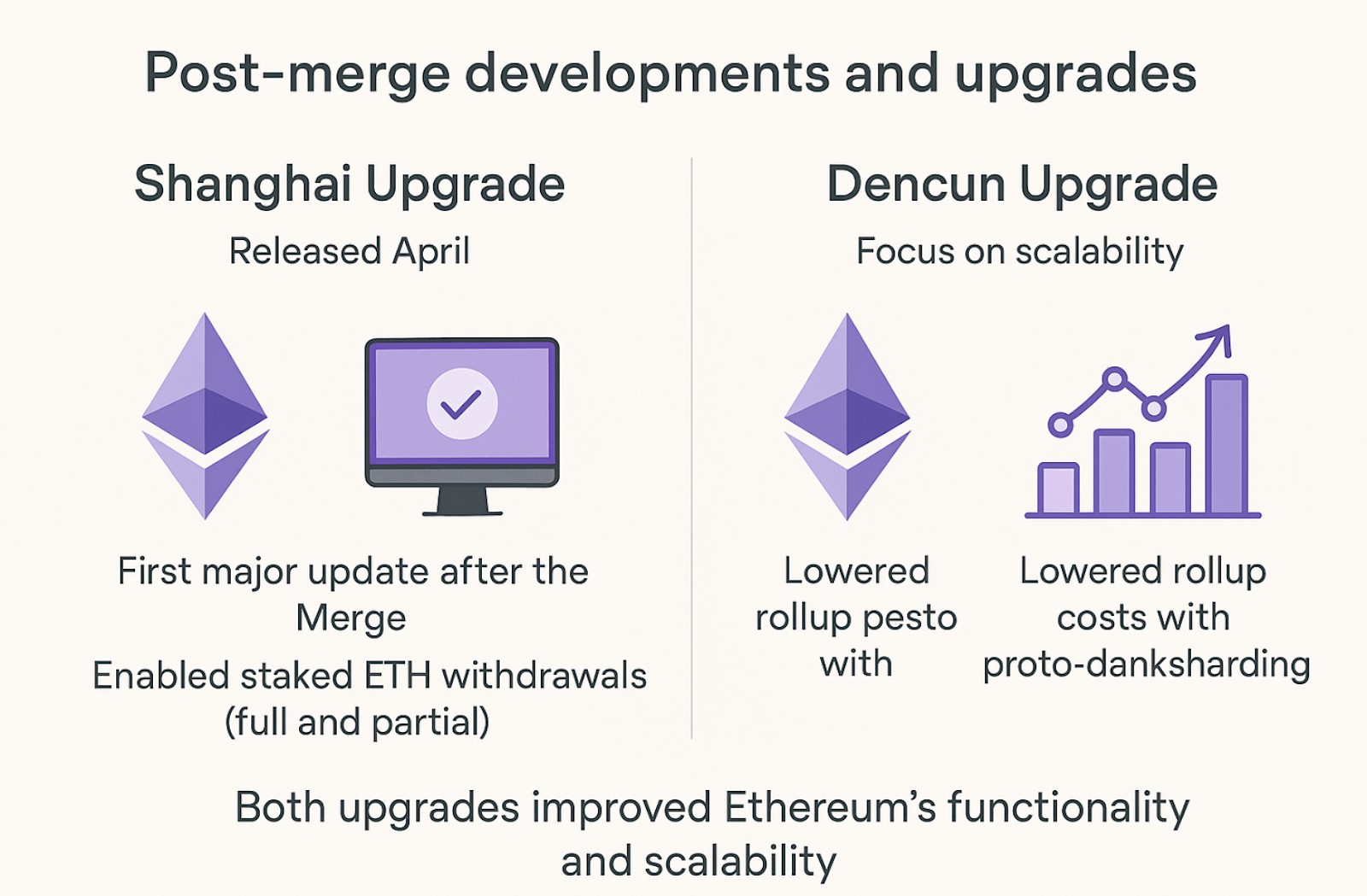
Released in April 2023, the Shanghai upgrade was Ethereum’s first major update after the Merge. It introduced the long-awaited ability for validators to withdraw staked ETH, which had been locked since the Beacon Chain launched in 2020. The update allowed two types of withdrawals: full withdrawals, enabling validators to exit and retrieve their entire stake, and partial withdrawals, which let them claim only earned rewards while continuing to validate. To maintain network stability, withdrawals are processed in a queue. This change strengthened confidence in Ethereum’s staking model and encouraged broader participation, contributing to a more decentralized ecosystem.
The Dencun upgrade followed, focusing on scalability. It combined two updates: Deneb, which addressed the consensus layer, and Cancun, which improved the execution layer. A central feature of this upgrade was proto-danksharding, which introduced data blobs to lower the cost of posting data for rollups. Rollups, which bundle multiple transactions into one, are key to scaling Ethereum efficiently. Lowering their cost improves both network speed and affordability. Dencun also enhanced compatibility with layer 2 networks such as Arbitrum and Optimism, helping Ethereum move closer to processing thousands of transactions per second.
Together, these upgrades reflect Ethereum’s push to balance decentralization, security, and performance, making the network more usable for developers and accessible to a global user base.
Implications for investors and the broader ecosystem
Ethereum’s move to proof-of-stake, along with recent upgrades, has had a notable impact on investor sentiment and the wider blockchain industry.
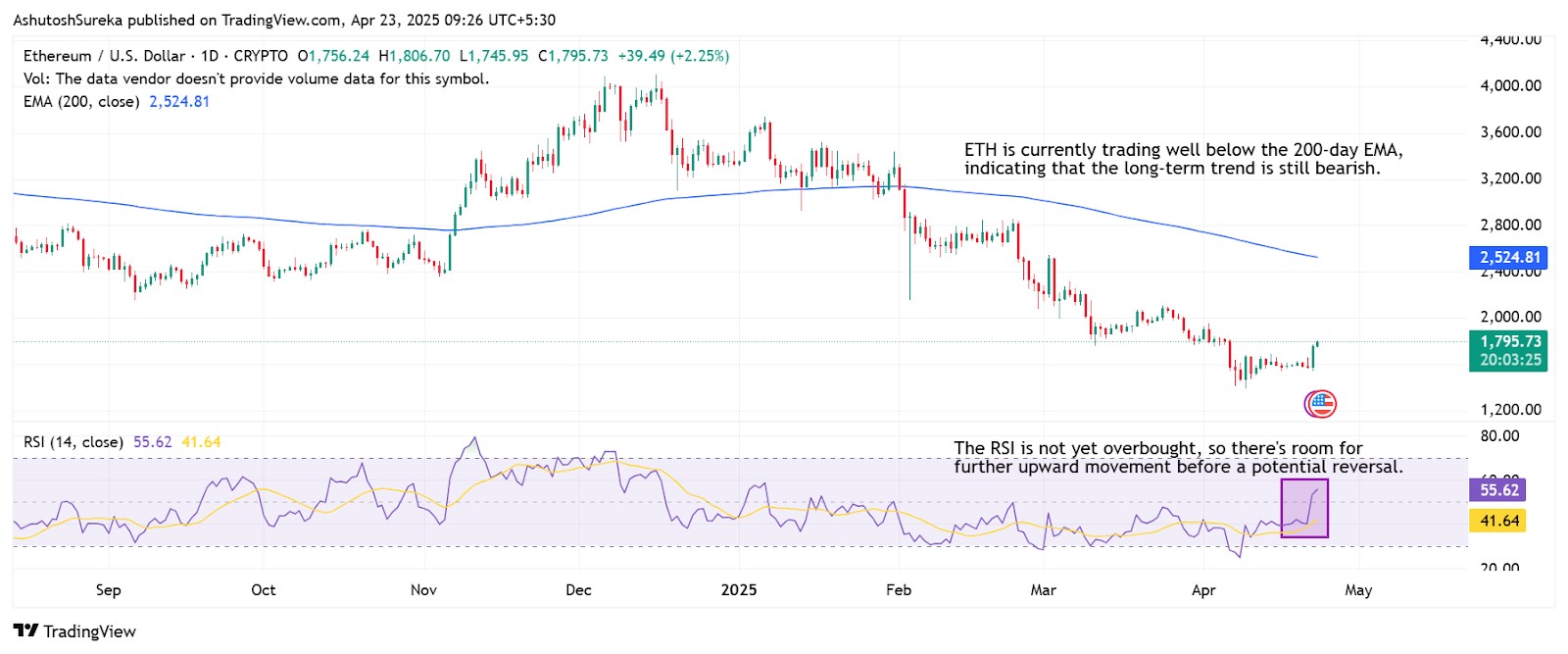
Over the past three months, Ether’s price has declined by roughly 40%, falling to around $1,795. This drop reflects broader weakness in the crypto market and increased competition from other blockchain platforms. As a result, some investors have shifted their attention to alternatives that offer faster transactions and lower fees. The absence of significant institutional capital flowing into Ether has also played a role in its recent underperformance.
Despite market pressure, Ethereum remains a core infrastructure for decentralized applications and financial services. However, its ability to maintain dominance is being tested as competing platforms gain traction:
Solana, for example, has seen growing adoption thanks to its high throughput and low costs. Its architecture supports faster block creation, attracting both developers and users.
Cardano, meanwhile, takes a research-based approach to blockchain design, focusing on scalability and long-term sustainability. Its proof-of-stake model and steady upgrades aim to offer a secure environment for smart contracts.
EOS promotes fast transaction speeds and minimal fees through its delegated proof-of-stake system, but continues to face challenges in user adoption and developer engagement compared with Ethereum.
Ethereum’s future performance will depend not only on market trends but also on how effectively it addresses scalability and maintains its appeal to developers and users alike.
Why Ethereum’s biggest upgrade is not code - it is user alignment

Most people think the biggest thing Ethereum did was move from mining to staking. But the real shift is that users and builders are finally pulling in the same direction. When more people stake ETH, the network runs smoother and safer. But it also means those same people now have real influence. Ethereum is slowly turning into a setup where users help shape the platform instead of just using it. That shift in how people see their role is what is really driving Ethereum forward. People are getting more invested than they think — literally and emotionally.
Another thing that is easy to miss is how Ethereum’s upgrades are no longer just code drops. They are moments that test the whole group. Every big change now asks a deeper question — is everyone on the same page? If not, things can split. If yes, Ethereum becomes stronger without even needing new features. For someone just starting out, that is the real thing to watch. The tech matters. But staying strong comes from belief and working together — not just clever programming.
Conclusion
Ethereum is not changing like normal software. It is growing like a community that needs both tech and people to succeed. Every upgrade now checks more than just the code — it checks if people are still aligned. What matters most is not how fast it runs, but whether everyone involved still believes in the direction it is going. If Ethereum keeps growing this way, with users and developers building together, it won’t just scale. It will turn into something tougher and more united- an online economy with its own rules and its own heartbeat.
FAQs
What prompted Ethereum's transition to proof-of-stake?
Ethereum shifted to proof-of-stake to reduce energy consumption, improve network security, and lay the foundation for greater scalability. The move was part of a long-term plan to make Ethereum more sustainable and efficient.
How does staking work in Ethereum's PoS model?
In Ethereum's proof-of-stake system, validators lock up a minimum of 32 ETH as collateral to propose and verify blocks. They earn rewards for honest participation and risk losing a portion of their stake for malicious actions.
How do recent upgrades affect Ethereum's scalability?
Recent upgrades like the Merge and Shanghai have improved energy efficiency and unlocked staking withdrawals. Upcoming changes, including proto-danksharding, aim to reduce transaction costs and boost throughput for broader adoption.
What can we expect from Ethereum's future developments?
Ethereum’s roadmap includes upgrades focused on scalability, like danksharding and rollup enhancements, along with stronger security and decentralization. These changes aim to support mass adoption and complex decentralized applications at scale.
Editors' Top Picks and Insights

Do politicians make the best stock traders?

Crypto test drive: How automakers are exploring digital assets

Lindsey Graham death: U.S. senator’s crypto legacy

Tether under pressure: USDT in Europe, audit questions, and the fight for trust

Lean Ethereum: Why Buterin wants to rebuild the network

SK Hynix debuts on Nasdaq: Largest U.S. offering by foreign company
Related Articles
Team that worked on the article
Anton Kharitonov is an active trader and analyst. He employs both short- and long-term trading strategies, primarily based on fundamental factors, supported by technical indicators and intermarket analysis.
Chinmay Soni is a financial analyst with more than 5 years of experience in working with stocks, Forex, derivatives, and other assets. As a founder of a boutique research firm and an active researcher, he covers various industries and fields, providing insights backed by statistical data.
Mirjan Hipolito is a journalist and news editor at Traders Union. She is an expert crypto writer with five years of experience in the financial markets.
CFD is a contract between an investor/trader and seller that demonstrates that the trader will need to pay the price difference between the current value of the asset and its value at the time of contract to the seller.
Ethereum is a decentralized blockchain platform and cryptocurrency that was proposed by Vitalik Buterin in late 2013 and development began in early 2014. It was designed as a versatile platform for creating decentralized applications (DApps) and smart contracts.
Cryptocurrency is a type of digital or virtual currency that relies on cryptography for security. Unlike traditional currencies issued by governments (fiat currencies), cryptocurrencies operate on decentralized networks, typically based on blockchain technology.
An investor is an individual, who invests money in an asset with the expectation that its value would appreciate in the future. The asset can be anything, including a bond, debenture, mutual fund, equity, gold, silver, exchange-traded funds (ETFs), and real-estate property.
Index in trading is the measure of the performance of a group of stocks, which can include the assets and securities in it.

-
 Afghanistan
-
 Albania
-
 Algeria
-
 Angola
-
 Argentina
-
 Armenia
-
 Australia
-
 Austria
-
 Azerbaijan
-
 Bahamas
-
 Bahrain
-
 Bangladesh
-
 Belarus
-
 Belgium
-
 Bolivia
-
 Botswana
-
 Brazil
-
 Brunei
-
 Bulgaria
-
 Cambodia
-
 Cameroon
-
 Canada
-
 Chile
Chile
-
 China
China
-
 Colombia
-
 Congo
Congo
-
 Costa Rica
-
 Cote d'Ivoire
-
 Croatia
-
 Cuba
Cuba
-
 Cyprus
-
 Czechia
-
 DR Congo
-
 Denmark
-
 Dominican Republic
-
 Ecuador
-
 Egypt
Egypt
-
 El Salvador
-
 Estonia
-
 Eswatini
-
 Ethiopia
-
 Finland
-
 France
-
 Georgia
-
 Germany
-
 Ghana
Ghana
-
 Greece
-
 Haiti
Haiti
-
 Hong Kong
-
 Hungary
-
 India
India
-
 Indonesia
-
 Iran, Islamic republic
-
 Iraq
Iraq
-
 Ireland
-
 Israel
-
 Italy
Italy
-
 Jamaica
-
 Japan
Japan
-
 Jordan
-
 Kazakhstan
-
 Kenya
Kenya
-
 Korea
Korea
-
 Kuwait
-
 Kyrgyzstan
-
 Laos
Laos
-
 Latvia
-
 Lebanon
-
 Lesotho
-
 Libya
Libya
-
 Lithuania
-
 Luxembourg
-
 Madagascar
-
 Malaysia
-
 Malta
Malta
-
 Mauritius
-
 Mexico
-
 Moldova
-
 Mongolia
-
 Montenegro
-
 Morocco
-
 Mozambique
-
 Myanmar
-
 Namibia
-
 Nepal
Nepal
-
 Netherlands
-
 New Zealand
-
 Nigeria
-
 North Macedonia
-
 Norway
-
 Oman
Oman
-
 Pakistan
-
 Palestine
-
 Panama
-
 Papua New Guinea
-
 Paraguay
-
 Peru
Peru
-
 Philippines
-
 Poland
-
 Portugal
-
 Puerto Rico
-
 Qatar
Qatar
-
 Reunion
-
 Romania
-
 Rwanda
-
 Saudi Arabia
-
 Serbia
-
 Singapore
-
 Slovakia
-
 Slovenia
-
 Somalia
-
 South Africa
-
 Spain
Spain
-
 Sri Lanka
-
 Sweden
-
 Switzerland
-
 Syria
Syria
-
 Taiwan
-
 Tajikistan
-
 Tanzania
-
 Thailand
-
 Trinidad and Tobago
-
 Tunisia
-
 Turkey
-
 UAE
UAE
-
 Uganda
-
 Ukraine
-
 United Kingdom
-
United States
-
 Uruguay
-
 Uzbekistan
-
 Venezuela
-
 Vietnam
-
 Yemen
Yemen
-
 Zambia
-
 Zimbabwe
- Forex
- Crypto











