
How to Create and Use a Telegram Wallet: Complete Guide for Crypto Users in 2026


Editorial Note: While we adhere to strict Editorial Integrity, this post may contain references to products from our partners. Here's an explanation for How We Make Money. None of the data and information on this webpage constitutes investment advice according to our Disclaimer.
To create a Telegram wallet in 2026:
Open Telegram and search for @wallet.
Tap Start and follow the prompts to create a wallet.
If you want full control over your assets, activate TON Wallet (formerly TON Space) and securely back up your recovery phrase.
Fund your wallet using a bank card, P2P transfer, or cryptocurrency deposit.
Enable two-step verification and other security settings to protect your account.
Telegram wallet has become one of the largest crypto ecosystems integrated into a messaging platform. According to TON-related reports, more than 100 million users worldwide have activated TON Wallet services, while the U.S. launch in 2025 expanded access to tens of millions of additional Telegram users. Built on The Open Network (TON), the ecosystem allows users to store, send, receive, swap, and stake digital assets directly within Telegram.
This guide explains how to create a Telegram wallet, how to open wallet in Telegram, and how to set up TON Wallet for crypto transactions in 2026. It also covers the main wallet types, security features, and key functions currently available to Telegram users.
Risk warning: Cryptocurrency markets are highly volatile, with sharp price swings and regulatory uncertainties. Research indicates that 75-90% of traders face losses. Only invest discretionary funds and consult an experienced financial advisor.
History of TON wallet adoption
Telegram’s crypto ecosystem has expanded rapidly in recent years, driven by direct wallet integration inside the messenger and the growth of The Open Network (TON). By late 2024, the custodial wallet service reported more than 100 million activated wallets globally, supported by simplified onboarding, in-chat transfers, and the ability to send cryptocurrency using Telegram usernames instead of wallet addresses.
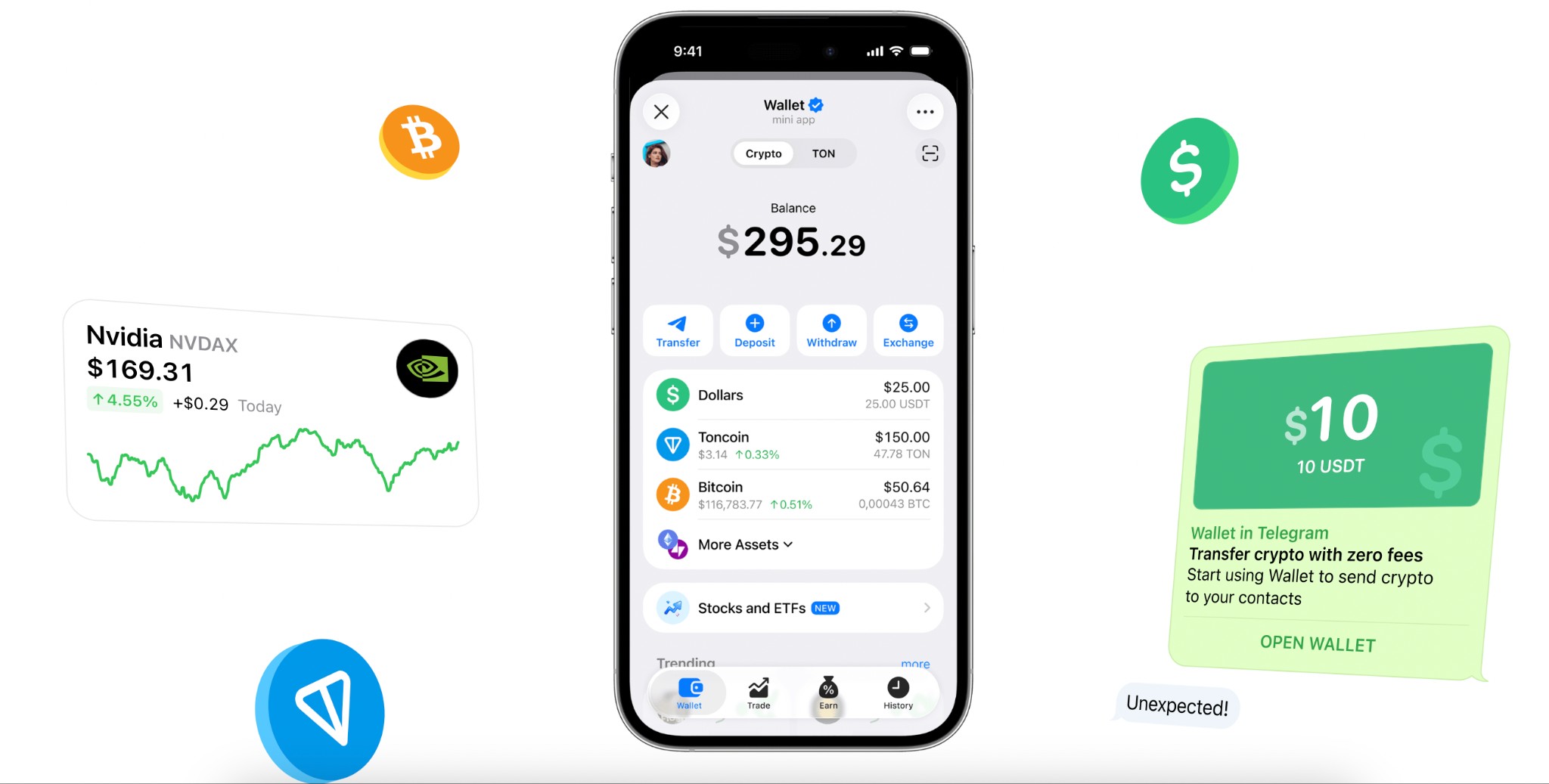
A major milestone came in 2025 with the expansion of TON Space, which later evolved into TON Wallet and increasingly became positioned as a gateway to decentralized finance (DeFi) services inside Telegram. The rollout significantly expanded self-custody access, allowing users to manage private keys directly while interacting with TON-based applications and digital assets.
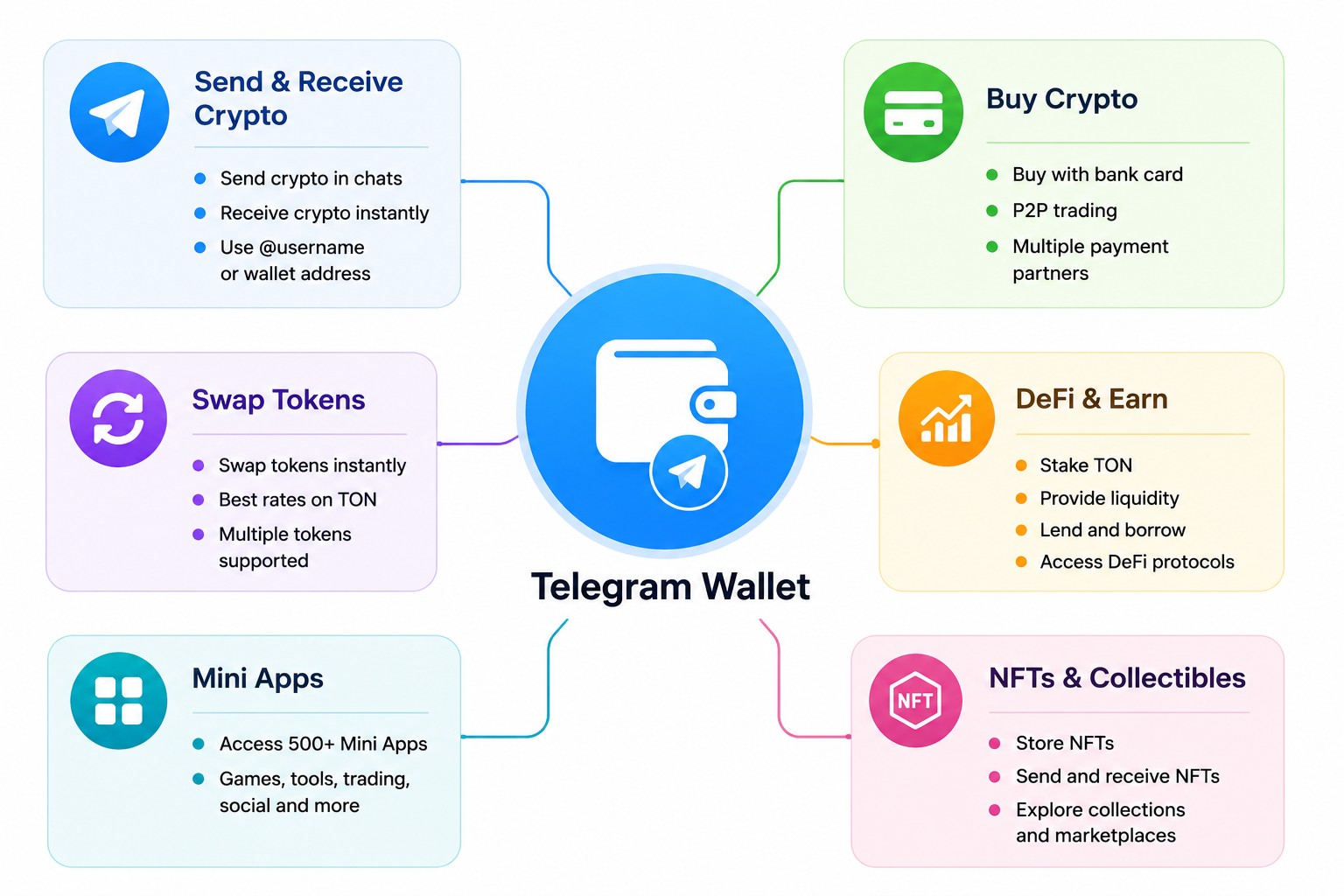
Telegram’s ecosystem strategy now extends beyond simple wallet functionality and includes:
TON Mini Apps, with hundreds of active applications across payments, gaming, social tools, and Web3 services.
Access to decentralized exchanges, token swaps, staking, and NFT platforms directly within the TON ecosystem.
Developer support programs and grants from the TON Foundation designed to accelerate mini app and infrastructure development.
Integration with payment providers and fiat on-ramp services that simplify cryptocurrency purchases inside Telegram.
Network activity has grown alongside adoption. According to TON blockchain statistics, the network now processes well over 1 million transactions per day, significantly exceeding the levels reported during the early stages of Telegram wallet adoption. Activity is increasingly driven by mini apps, trading tools, DeFi services, gaming ecosystems, and wallet-to-wallet transfers across the TON network.
As of 2026, Telegram wallet has evolved from a simple crypto transfer tool into a broader ecosystem combining payments, self-custody, decentralized applications, and DeFi functionality within a single interface.
How to create a Telegram wallet (custodial vs self-custodial)
How to get Telegram wallet (custodial)
The custodial Telegram wallet is the fastest way to start using cryptocurrency inside Telegram. It is designed for beginners because wallet management and security functions are handled by the service provider. If you are looking for how to create a Telegram wallet or how to open wallet in Telegram, this is usually the simplest option.
Step-by-step instructions on how to get Telegram Wallet (custodial):
Open Telegram. Make sure you are using the latest version of the Telegram app.
Search for @wallet. Use the search bar to find the official Wallet bot.
Start the bot. Tap Start to launch the wallet interface.
Open wallet. Follow the prompts to create a wallet account inside Telegram.
Complete verification if required. Depending on your region and intended use, the service may request identity verification before certain features become available.
Add funds. Fund the wallet using a bank card, cryptocurrency transfer, or supported P2P services.
Use wallet features. Send and receive TON, USDT, and other supported assets, buy cryptocurrency, exchange tokens, and access additional wallet services directly inside Telegram.
How to create TON wallet on Telegram (self‑custodial)
TON Wallet (formerly TON Space) is a self-custodial wallet that gives users full control over their private keys and digital assets. This option is designed for users who want direct ownership of funds and access to decentralized applications within the TON ecosystem.
Step-by-step instructions on how to create a TON wallet on Telegram (self‑custodial):
Open Wallet. Launch Telegram Wallet through the Wallet interface.
Select TON Wallet. Choose the self-custodial wallet option to begin setup.
Create wallet. Telegram will generate a new wallet linked to your account while keeping private key management under your control.
Back up the recovery phrase. Write down and securely store the recovery phrase shown during setup. This phrase is required to restore access if you lose your device.
Confirm the backup. Complete the verification step to confirm that the recovery phrase has been saved correctly.
Start using the wallet. Once activated, you can store assets, connect to TON-based applications, swap tokens, stake cryptocurrency, and interact with decentralized services.
This option is generally recommended for experienced users, long-term holders, and anyone who wants direct control over their assets. It also provides access to a broader range of Web3 services within the TON ecosystem.
Feature metrics and real-world usage
Telegram’s TON wallet ecosystem has continued to grow as more users adopt self-custodial wallets, mini apps, and decentralized services within the TON network.
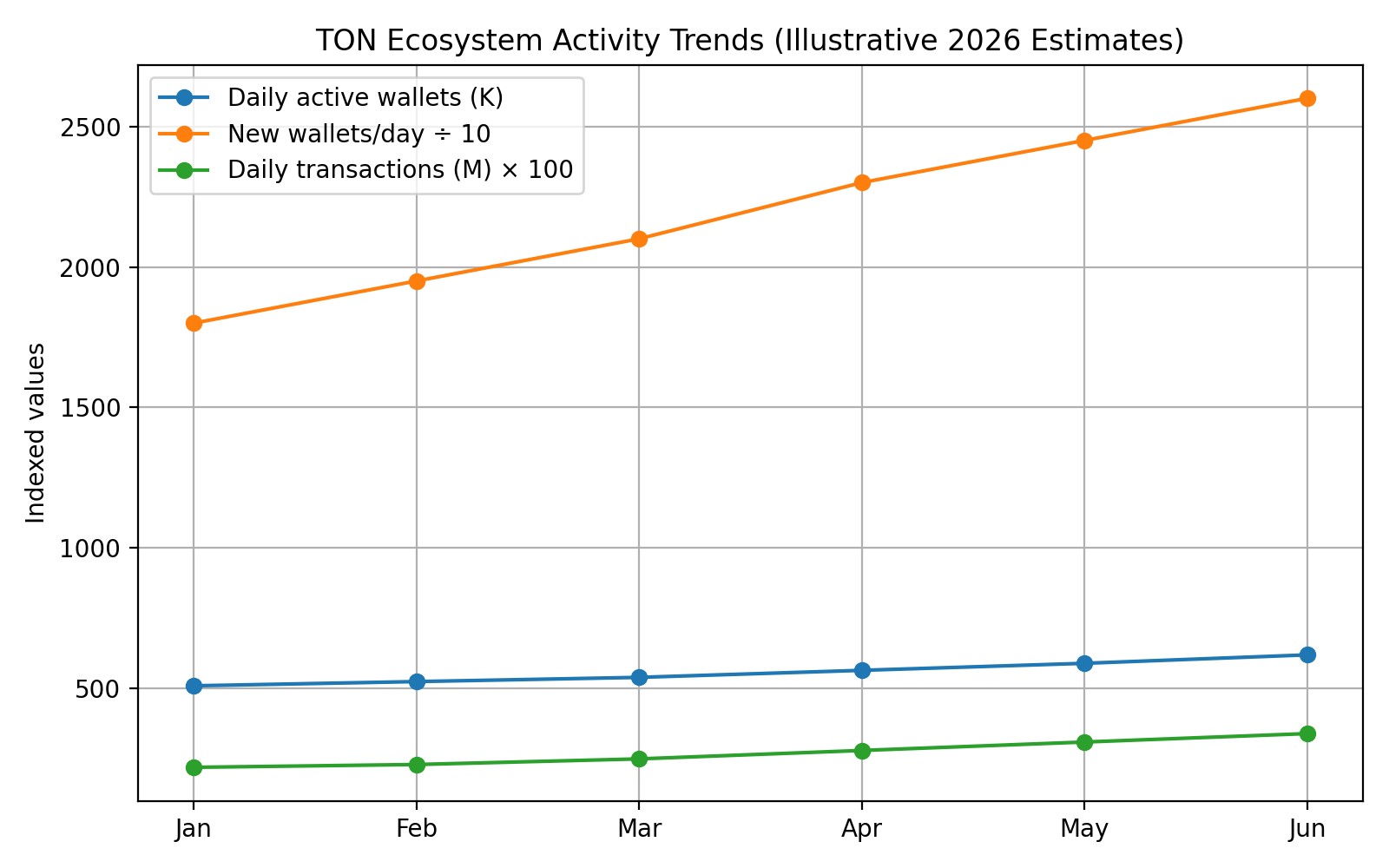
Daily active wallets increased from approximately 510,000 in January to more than 620,000 by June 2026, reflecting sustained user engagement beyond simple transfers and payments.
New wallet creation remained strong throughout the period, with an estimated 18,000–26,000 new wallets added each day. Growth has been supported by rising interest in staking, token swaps, mini apps, and other Web3 services available through Telegram.
Network activity also expanded significantly. Daily transaction volume rose from roughly 2.2 million transactions in January to about 3.4 million by June 2026, highlighting the growing role of Telegram wallet in payments, DeFi, and digital asset management.
Trading bots, gaming applications, and mini apps continue to generate a meaningful share of TON blockchain activity, demonstrating that Telegram wallet is increasingly used as an access point to the broader TON ecosystem rather than solely as a tool for sending and receiving cryptocurrency.
Overall, these metrics illustrate the rapid expansion of Telegram wallet and its growing importance within the TON ecosystem.
TON Blockchain and Telegram integration
The Open Network (TON) was originally developed by Telegram and launched as an independent community-driven blockchain after Telegram's withdrawal from direct involvement in the project. Today, TON serves as the primary blockchain infrastructure for Telegram's crypto ecosystem, supporting payments, digital assets, mini apps, and decentralized services.
Telegram's integration with TON has expanded significantly since 2022. What began as a simple custodial wallet service has evolved into a broader ecosystem that includes self-custodial wallets, decentralized applications, token swaps, staking, NFT platforms, and Web3 services accessible directly from the Telegram interface.
Recent TON network upgrades have focused on improving scalability, transaction processing, validator performance, and developer tools. These improvements have helped TON support millions of daily transactions and hundreds of millions of user accounts across the ecosystem.
| Event | Date | Detail |
|---|---|---|
| Custodial @wallet launch | April 2022 | Telegram introduced in-chat cryptocurrency transfers and wallet functions through the Wallet bot |
| TON Space announcement | September 2023 | Self-custodial wallet introduced at Token2049 Singapore |
| TON Space rollout | Late 2023 | Self-custodial functionality became available in most supported regions |
| TON Wallet expansion | 2025 | Self-custodial wallet services expanded, including the U.S. market |
| TON ecosystem growth | 2026 | TON supports millions of daily transactions and more than 100 million activated wallet users |
U.S. rollout and trader-relevant features
The U.S. rollout of TON Wallet gave Telegram users access to Toncoin, USDT, P2P transfers, staking, swaps, and DeFi tools directly inside the app. Reports at launch also highlighted access for up to 87 million U.S. Telegram users, adding a major new market to TON Wallet’s global user base.
Users can buy USDT through MoonPay using Apple Pay, Google Pay, debit cards, or credit cards, with 0% fees promoted during the launch period. TON Wallet also introduced off-ramp functionality, allowing users to withdraw crypto funds directly to bank cards.
For traders, the most relevant features are fast transfers, stablecoin access, swaps, staking, and integrated trading tools through TON ecosystem services such as Omniston and STON.fi. Planned security improvements include whitelists, blacklists, transaction simulation, and fraud-detection tools.
Market impact and trader insights
The expansion of Telegram’s wallet ecosystem has had a noticeable impact on TON network activity, user adoption, and trading volumes. As Telegram increased support for self-custodial wallets, staking, mini apps, and DeFi services, TON evolved from a niche blockchain into one of the most active ecosystems connected to a mainstream messaging platform.
Network metrics illustrate this growth. According to TON blockchain statistics, the network now processes more than 4.2 million transactions per day, while daily active wallets exceed 619,000. Total activated on-chain wallets have surpassed 54 million, and the TON ecosystem continues adding tens of thousands of new wallet activations daily.
Market activity has expanded alongside adoption. TON-related announcements, wallet launches, and major Telegram integrations have repeatedly generated spikes in trading volume, user engagement, and on-chain activity. The network currently operates at roughly 43 transactions per second, supported by low fees and sub-second finality designed for large-scale consumer applications.
For traders, Telegram wallet increasingly serves as an entry point into the broader TON ecosystem. Users often begin with wallet-based transfers and stablecoin payments before moving into staking, decentralized exchanges, mini apps, and more advanced trading tools available across TON services.
Best exchanges for Telegram wallet users
Although Telegram wallet supports buying, storing, and transferring digital assets, many users still rely on crypto exchanges for larger purchases, advanced trading tools, deeper liquidity, and broader asset selection. The comparison below highlights leading cryptocurrency exchanges based on supported coins, trading fees, platform features, and overall trading conditions.
| OKX | Coinbase | Crypto.com | Cryptohopper | BTCC | |
|---|---|---|---|---|---|
|
Min. Deposit, $ |
10 | 10 | 1 | No | 10 |
|
Coins Supported |
600+ | 400+ | 400+ | 1000 | 399 |
|
Spot Taker fee, % |
0.1 | 0.5 | 0.5 | 0 | 0.3 |
|
Spot Maker Fee, % |
0.08 | 0.5 | 0.25 | 0 | 0.2 |
|
Alerts |
Yes | Yes | Yes | Yes | No |
|
Copy trading |
Yes | No | No | Yes | Yes |
|
TU overall score |
8.48 | 7.84 | 7.8 | 7.76 | 7.6 |
|
Open an account |
Go to broker Your capital is at risk. |
Go to broker Your capital is at risk. |
Go to broker Your capital is at risk. |
Go to broker Your capital is at risk. |
Go to broker Your capital is at risk.
|
Custodial vs self-custodial: Feature comparison for traders
Telegram currently offers two wallet models: the custodial Wallet and the self-custodial TON Wallet. While both allow users to store and transfer digital assets inside Telegram, they differ significantly in terms of asset control, security, account recovery, and access to decentralized services.
For beginners, the custodial wallet provides the easiest way to create a wallet in Telegram and start using cryptocurrency. More experienced users often prefer self-custodial wallets because they retain full control of their private keys and gain access to the broader TON ecosystem.
The table below compares the key differences between Telegram's custodial and self-custodial wallet solutions in 2026.
| Feature | Custodial wallet (@wallet) | Self-custodial TON Wallet |
|---|---|---|
| How to create wallet in Telegram | Create through @wallet bot | Create TON Wallet and back up recovery phrase |
| Private key control | Managed by provider | Controlled by user |
| Account recovery | Through provider procedures | Via recovery phrase only |
| KYC requirements | May be required for certain features and limits | Not required for basic wallet use |
| Supported assets | TON, USDT and selected assets | TON ecosystem assets and tokens |
| Token swaps | Available | Available |
| Staking | Limited | Available |
| NFTs and collectibles | Limited support | Supported |
| DeFi access | Limited | Full access to TON-based DeFi services |
| Mini Apps integration | Basic | Full ecosystem integration |
| Security responsibility | Shared with provider | Fully controlled by user |
| Best suited for | Beginners and everyday transfers | Advanced users and long-term asset management |
Choose self-custody if you plan to hold significant crypto balances

Many users choose a Telegram wallet because it is one of the easiest ways to start using cryptocurrency. However, before deciding between the custodial Wallet and the self-custodial TON Wallet, it is important to understand who controls the assets. Convenience and control rarely come together in equal measure.
For beginners who mainly send, receive, or store small amounts of cryptocurrency, the custodial wallet may be sufficient. Users who actively trade, stake assets, interact with DeFi protocols, or hold larger balances should consider a self-custodial solution. In that case, the recovery phrase becomes the most important security element, as losing it can mean losing access to funds permanently.
My recommendation is simple: choose the wallet type based on how you plan to use it. If your activity is limited to basic transfers, convenience may be the priority. If you intend to participate in the broader TON ecosystem, ownership of private keys and proper backup procedures should take precedence over ease of use.
Conclusion
The rapid growth of Telegram Wallet, now integrated deeply with The Open Network, has made it a cornerstone for everyday crypto users and seasoned traders alike. Whether opting for the beginner-friendly custodial wallet or the advanced self-custodial TON Wallet, users can access transfers, staking, DeFi services, and mini apps directly within the Telegram app. For example, US users gained seamless access to Toncoin and USDT with robust fiat onramps, while advanced traders leverage decentralized exchanges and token swaps without leaving the platform. As Telegram’s crypto ecosystem expands, one thing becomes clear: the future of digital asset management is conveniently converging inside the world’s favorite messaging app.
FAQs
What are the differences between custodial and self-custodial wallets in Telegram for asset management?
How do daily transaction volumes and active wallet numbers reflect the growth of Telegram Wallet in 2026?
What functionalities can traders and active users access through Telegram Wallet in 2026?
Why has Telegram integrated decentralized applications and mini apps into its wallet ecosystem?
Editors' Top Picks and Insights






Related Articles
Team that worked on the article
Aleksandra Chaikina has been a contributor to Traders Union since 2021. With over 15 years of experience in copywriting and more than 5 years focused on financial content, she specializes in producing detailed guides, analytics, and comparative reviews across various sectors, including cryptocurrencies, Forex, investment strategies, and financial technologies.
Dan Blystone began his trading career in 1998 as an arbitrage clerk on the floor of the Chicago Mercantile Exchange (CME). He later traded bond and Eurex futures at proprietary firms such as Altea Trading, gaining valuable experience in high-frequency trading and risk management.
Chinmay Soni is a financial analyst with more than 5 years of experience in working with stocks, Forex, derivatives, and other assets. As a founder of a boutique research firm and an active researcher, he covers various industries and fields, providing insights backed by statistical data.
Cryptocurrency is a type of digital or virtual currency that relies on cryptography for security. Unlike traditional currencies issued by governments (fiat currencies), cryptocurrencies operate on decentralized networks, typically based on blockchain technology.
Copy trading is an investing tactic where traders replicate the trading strategies of more experienced traders, automatically mirroring their trades in their own accounts to potentially achieve similar results.
Index in trading is the measure of the performance of a group of stocks, which can include the assets and securities in it.
An investor is an individual, who invests money in an asset with the expectation that its value would appreciate in the future. The asset can be anything, including a bond, debenture, mutual fund, equity, gold, silver, exchange-traded funds (ETFs), and real-estate property.
CFD is a contract between an investor/trader and seller that demonstrates that the trader will need to pay the price difference between the current value of the asset and its value at the time of contract to the seller.

-
 Afghanistan
-
 Albania
-
 Algeria
-
 Angola
-
 Argentina
-
 Armenia
-
 Australia
-
 Austria
-
 Azerbaijan
-
 Bahamas
-
 Bahrain
-
 Bangladesh
-
 Belarus
-
 Belgium
-
 Bolivia
-
 Botswana
-
 Brazil
-
 Brunei
-
 Bulgaria
-
 Cambodia
-
 Cameroon
-
 Canada
-
 Chile
-
 China
-
 Colombia
-
 Congo
-
 Costa Rica
-
 Cote d'Ivoire
-
 Croatia
-
 Cuba
-
 Cyprus
-
 Czechia
-
 DR Congo
-
 Denmark
-
 Dominican Republic
-
 Ecuador
-
 Egypt
-
 El Salvador
-
 Estonia
-
 Eswatini
-
 Ethiopia
-
 Finland
-
 France
-
 Georgia
-
 Germany
-
 Ghana
-
 Greece
-
 Haiti
-
 Hong Kong
-
 Hungary
-
 India
-
 Indonesia
-
 Iran, Islamic republic
-
 Iraq
-
 Ireland
-
 Israel
-
 Italy
-
 Jamaica
-
 Japan
-
 Jordan
-
 Kazakhstan
-
 Kenya
-
 Korea
-
 Kuwait
-
 Kyrgyzstan
-
 Laos
-
 Latvia
-
 Lebanon
-
 Lesotho
-
 Libya
-
 Lithuania
-
 Luxembourg
-
 Madagascar
-
 Malaysia
-
 Malta
-
 Mauritius
-
 Mexico
-
 Moldova
-
 Mongolia
-
 Montenegro
-
 Morocco
-
 Mozambique
-
 Myanmar
-
 Namibia
-
 Nepal
-
 Netherlands
-
 New Zealand
-
 Nigeria
-
 North Macedonia
-
 Norway
-
 Oman
-
 Pakistan
-
 Palestine
-
 Panama
-
 Papua New Guinea
-
 Paraguay
-
 Peru
-
 Philippines
-
 Poland
-
 Portugal
-
 Puerto Rico
-
 Qatar
-
 Reunion
-
 Romania
-
 Rwanda
-
 Saudi Arabia
-
 Serbia
-
 Singapore
-
 Slovakia
-
 Slovenia
-
 Somalia
-
 South Africa
-
 Spain
-
 Sri Lanka
-
 Sweden
-
 Switzerland
-
 Syria
-
 Taiwan
-
 Tajikistan
-
 Tanzania
-
 Thailand
-
 Trinidad and Tobago
-
 Tunisia
-
 Turkey
-
 UAE
-
 Uganda
-
 Ukraine
-
 United Kingdom
-
United States
-
 Uruguay
-
 Uzbekistan
-
 Venezuela
-
 Vietnam
-
 Yemen
-
 Zambia
-
 Zimbabwe
- Forex
- Crypto










- History of TON wallet adoption
- How to create a Telegram wallet (custodial vs self-custodial)
- Feature metrics and real-world usage
- TON blockchain and Telegram integration
- U.S. rollout and trader-relevant features
- Market impact and trader insights
- Best exchanges for Telegram wallet users
- Custodial vs self-custodial: Feature comparison for traders
- Expert opinion
- Conclusion
- FAQs


