
Exodus Crypto Wallet Review: A Comprehensive Guide



Editorial Note: While we adhere to strict Editorial Integrity, this post may contain references to products from our partners. Here's an explanation for How We Make Money. None of the data and information on this webpage constitutes investment advice according to our Disclaimer.
Exodus is a good crypto wallet because it combines an intuitive interface with broad functionality, including swaps, staking, and portfolio tools, while keeping users in control of their private keys. It is especially useful for newcomers who want one application to manage multiple assets, though professional traders often pair it with a hardware wallet to offset the higher swap fees and the risks inherent to hot wallets.
Exodus cryptocurrency wallet is one of the most popular options, often praised for its user-friendly design and wide range of supported assets. In this Exodus wallet review, we will cover everything you need to know, from fees and security to supported coins and whether Exodus is a good wallet for your crypto storage needs.
What is Exodus wallet?
Exodus is a crypto wallet launched in 2015 that allows users to securely store, send, receive, and swap digital assets. It is available as a desktop app, mobile app, and browser extension, giving flexibility for different types of crypto investors. Unlike traditional exchanges, Exodus is a non-custodial wallet, meaning users hold their private keys and full control over their funds.

How does Exodus wallet work?
Exodus wallet remains one of the most feature-rich non-custodial crypto wallets in 2026, designed for both beginners and active traders. It supports over 300 cryptocurrencies, including Bitcoin, Ethereum, Solana, and Cardano, across 50+ networks.
The wallet delivers full control of private keys, stored locally on your device, without requiring identity verification. Users can easily send, receive, and swap crypto directly within the app at competitive rates while maintaining ownership of their funds. Exodus also allows staking of several major coins like ADA, SOL, and ATOM for passive rewards and integrates smoothly with Trezor and Ledger hardware wallets for enhanced protection.
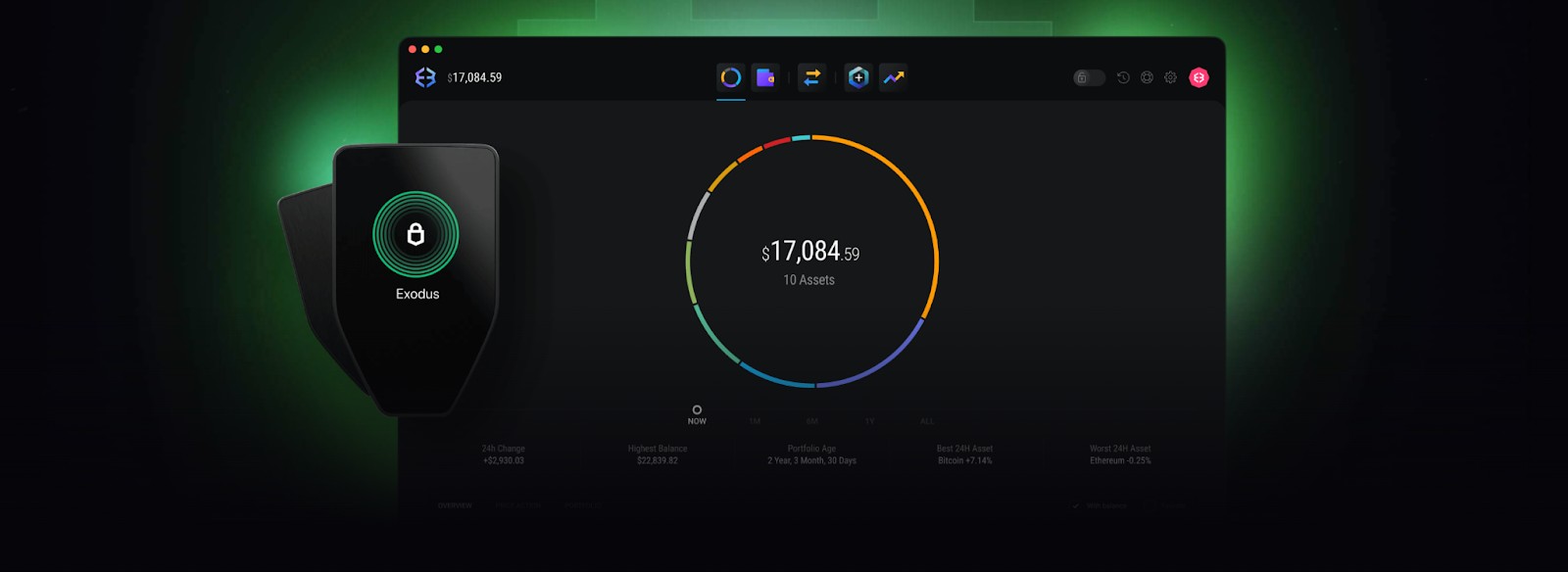
The wallet’s sleek interface syncs seamlessly across desktop, mobile, and browser extension versions, supporting direct Web3 and NFT interactions across multiple blockchains. It offers built-in crypto buying options through partners like MoonPay and Ramp, plus real-time portfolio tracking tools. For security, Exodus encrypts all data locally and never stores recovery phrases online, giving users full autonomy over their digital assets.
Exodus wallet features
Exodus wallet offers a comprehensive and user-friendly crypto experience designed for both beginners and advanced users. Below we have detailed on its key features for your better understanding:
Wide coin support. Handles over 350 cryptocurrencies including Bitcoin, Ethereum, Solana, Cardano, Dogecoin, and thousands of ERC-20 tokens, allowing diverse portfolio management.
In-wallet exchange. Users can swap more than 100 cryptocurrencies instantly within the wallet without needing KYC or moving funds externally, providing convenience and Exodus wallet security.
Staking rewards. Supports staking for popular coins such as Ethereum, Solana, Cardano, Polygon, Cosmos, Algorand, and Tezos, enabling users to earn passive income with clear reward tracking.
Hardware wallet compatibility. Seamlessly integrates with Trezor and Ledger devices, adding cold storage security while maintaining the wallet’s intuitive interface.
Cross-platform availability. Available on desktop (Windows, Mac, Linux), mobile (iOS, Android), and Web3 browser extensions, syncing securely across devices and allowing access to dApps, NFTs, and DeFi services.
Portfolio tracking. Real-time updates on asset valuation, performance charts, and balance breakdowns help users keep clear track of their investments.
Fiat on-ramping. Enables purchases and sales of crypto through credit cards, bank transfers, Google Pay, and Apple Pay using trusted third-party providers.
Security features. Private keys are stored locally, giving users full control; no personal data or KYC is required for wallet operation.
Pros and cons of Exodus wallet
It’s important to look beyond surface claims. Exodus has clear strengths but also limitations:
- Pros
- Cons
private keys encrypted and stored locally on the device;
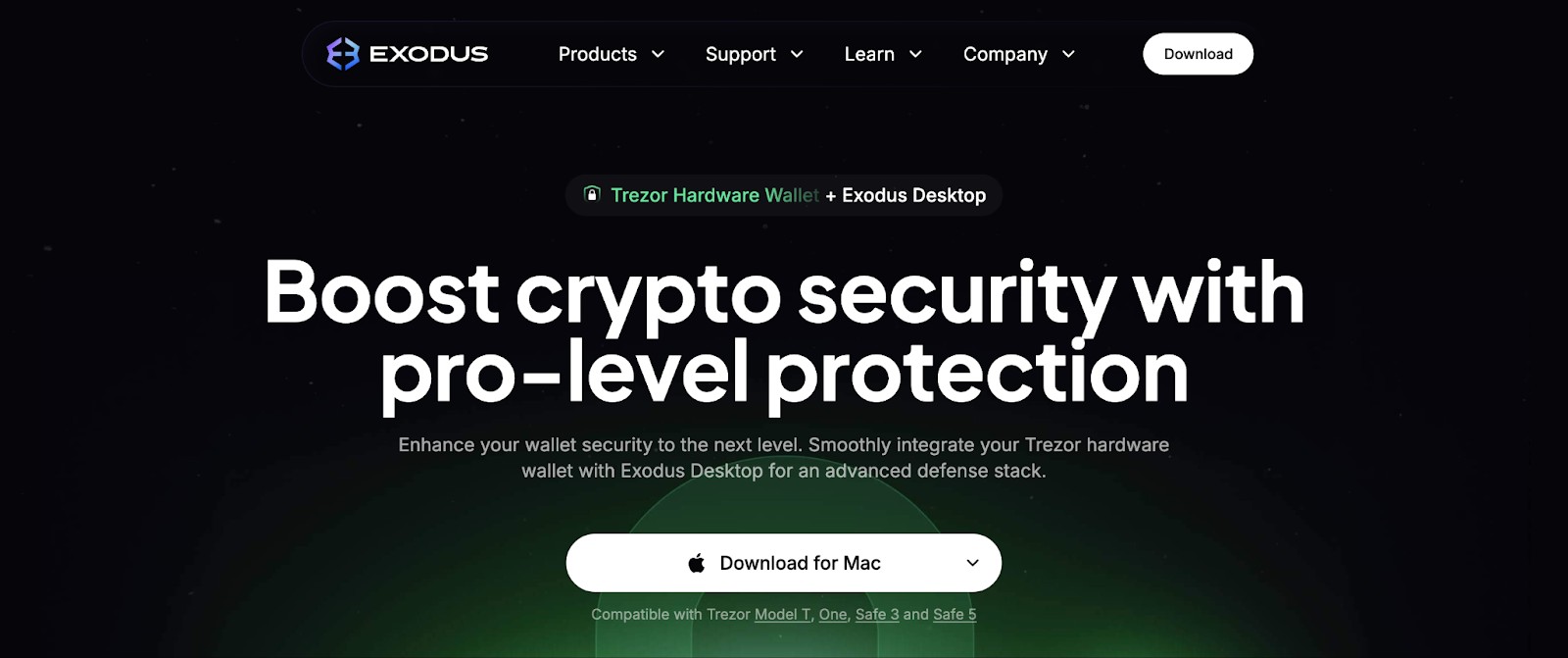
integration with Trezor hardware wallet for cold storage;
no KYC requirements, preserving anonymity;
standard 12-word recovery phrase for backup;
official guidance and practices to avoid phishing.
no two-factor authentication (2FA) or multisig options;
not fully open-source, limiting independent audits;
vulnerable to device malware or phishing attacks;
swap feature depends on third-party liquidity providers;
limited customization for some network fees.
Exodus wallet fees
Exodus fee structure is transparent and straightforward but has many aspects to it. Let’s understand this better:
Network fees. When sending crypto, users pay blockchain network fees directly to miners or validators. These fees vary based on the blockchain, transaction size, and current network congestion; Exodus merely passes these fees without adding a markup.
Sending crypto fees. Since fees depend on the blockchain’s demand at the time of sending, users might experience fluctuating costs. For example, Ethereum transfer fees can be higher during peak usage, while other blockchains like Solana or Polygon offer lower fees.
Receiving crypto fees. There are no charges to receive cryptocurrency, making it free to add funds from other wallets or exchanges.
Swap and exchange fees. Exodus allows in-wallet swaps between cryptocurrencies through integrated third-party exchange partners. The Exodus swap fees range approximately between 1% and 3%, which is often higher than what centralized exchanges offer but balances convenience and security within a non-custodial environment.
Account and service costs. Exodus does not charge subscriptions, setup fees, or monthly maintenance costs. Users benefit from a free-to-use wallet interface with optional purchases, such as buying crypto with fiat through third-party providers, who may charge their own fees.
Overall, Exodus crypto wallet fee system prioritizes transparency and ease of use. While swap fees are higher than centralized platforms, users gain convenience, privacy, and control over their crypto assets without hidden charges or mandatory payments. This makes Exodus particularly attractive for users valuing security and usability over minimal fees.
Is Exodus a cold wallet?
Exodus by default is a hot wallet, which means it runs on internet-connected devices. This makes it highly convenient for sending, receiving, and swapping coins quickly, but it also means that private keys are stored on a device that is online. Hot wallets are generally considered less secure than cold wallets, which keep keys completely offline and out of reach from most hacking attempts. As a result, Exodus on its own is better suited for everyday transactions and managing smaller balances.
When paired with a Trezor hardware wallet, Exodus transforms into a hybrid solution. In this setup, Exodus acts as the interface while Trezor keeps private keys offline, signing transactions only inside the hardware device. This allows users to enjoy the smooth design and multi-asset support of Exodus while maintaining the stronger security of Exodus cold storage. It does not make Exodus a cold wallet by itself, but the integration brings a balance between usability and protection that many long-term holders find appealing.
Is Exodus wallet safe?
When evaluating how safe Exodus wallet is, it’s important to remember that Exodus is a hot wallet, meaning it operates on internet-connected devices. This makes it more convenient but slightly less secure than a true cold wallet. Still, Exodus remains one of the most trusted and legitimate crypto wallets in 2026. It is non-custodial, so users hold full control of their private keys, which are encrypted and stored locally rather than on company servers. Independent Exodus wallet reviews consistently highlight its reliability, strong encryption, and Trezor hardware integration, which together make it a secure choice for everyday crypto management.
However, Exodus lacks two-factor authentication (2FA) and full open-source transparency, which means security ultimately depends on your device hygiene and backup practices. For the best protection, users can pair Exodus with a hardware wallet like Trezor, transforming it into a hybrid cold-storage setup that significantly improves security. Overall, Exodus is a safe wallet for active users and small-to-medium holdings, provided you follow standard security measures like safeguarding your recovery phrase and keeping your device malware-free.
Alternatives to Exodus wallet
If Exodus doesn’t fully meet your needs, there are other well-established wallets worth considering:
Trust wallet
Trust wallet provides access to a broader range of blockchains, making it especially attractive for mobile users who want to interact with DeFi platforms and dApps. The learning curve can be steeper than Exodus, but the trade-off is greater versatility for managing different assets.

MetaMask wallet
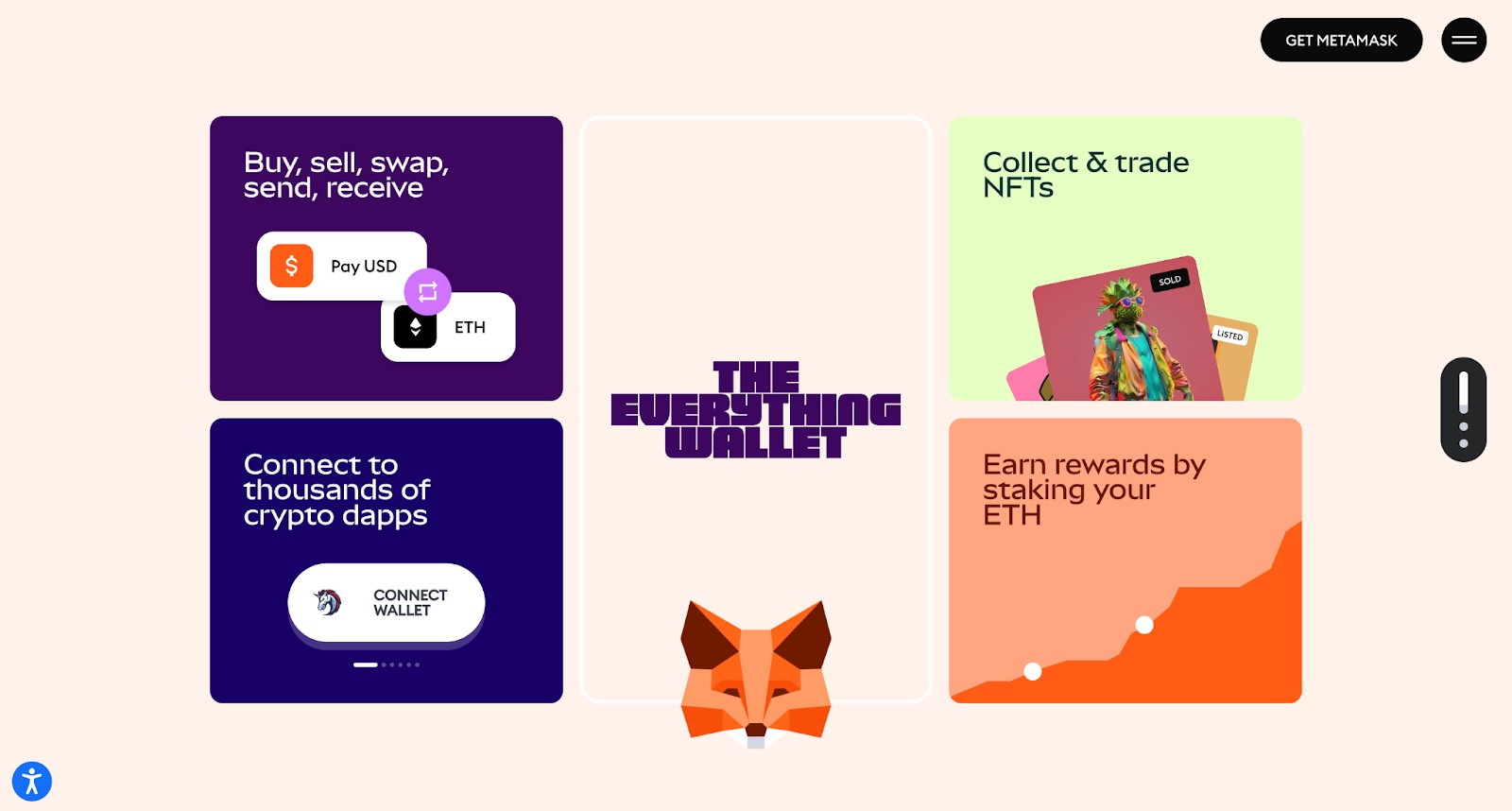
MetaMask has become a go-to option for those active in decentralized finance, particularly on Ethereum. It offers powerful tools and deeper customization, though it can feel less beginner-friendly. It’s most valuable for users who already understand Web3 mechanics and want fine-grained control over transactions.
Atomic wallet
Atomic wallet is another non-custodial option that includes an integrated exchange and staking features. While it doesn’t support as many assets as Exodus and its interface is less polished, it remains a solid choice for managing a variety of popular tokens.

For those looking beyond wallets, we’ve also compiled a selection of reliable cryptocurrency exchanges where you can securely buy, sell, and trade digital assets with confidence.
| Crypto | Foundation year | Min. Deposit, $ | Coins Supported | Spot Taker fee, % | Spot Maker Fee, % | Alerts | Copy trading | Tier-1 regulation | TU overall score | Open an account | |
|---|---|---|---|---|---|---|---|---|---|---|---|
| Yes | 2011 | 10 | 278 | 0.4 | 0.25 | Yes | Yes | Yes | 9.2 | Go to broker Your capital is at risk. |
|
| Yes | 2017 | 10 | 329 | 0.1 | 0.08 | Yes | Yes | No | 8.9 | Go to broker Your capital is at risk. |
|
| Yes | 2011 | 10 | 399 | 0.3 | 0.2 | No | Yes | Yes | 7.84 | Go to broker Your capital is at risk.
|
|
| Yes | 2012 | 10 | 249 | 0.5 | 0.5 | Yes | No | Yes | 7.68 | Go to broker Your capital is at risk. |
|
| Yes | 2014 | 5 | 30 | Not available | Not available | No | No | Yes | 7.6 | Go to broker Your capital is at risk.
|
Exodus feels like a bridge between simplicity and responsibility

When I first started using Exodus, what stood out was not just the design but how natural it felt to handle several coins in one place. Over time, I realized that convenience carries responsibility. Exodus will not hold your hand if you lose your recovery phrase, and it certainly will not refund mistakes during swaps. From my experience, the wallet works best when you treat it as an everyday tool but combine it with safer habits such as using a hardware device.
I have used Exodus through different market cycles and even during times of high Ethereum congestion; fees felt steep at moments, but the overall usability outweighed the friction. For me, Exodus is not perfect security, but it is a practical balance between easy management and personal control.
Conclusion
Exodus wallet stands out as a practical choice for everyday crypto users who value simplicity and versatility. Its intuitive design and support for over 300 coins make managing digital assets accessible to both newcomers and experienced traders. Features like integrated coin swaps and seamless Trezor hardware wallet support offer an added layer of convenience and security. While the swap fees may be higher compared to some competitors, the ease of use and robust asset management tools more than compensate for this trade-off. In the dynamic world of crypto, Exodus proves that user experience can be just as valuable as technical power.
FAQs
Can you use Exodus Wallet to interact with NFTs and decentralized applications?
What platforms and devices are compatible with Exodus Wallet?
How does Exodus Wallet maintain user privacy and data autonomy?
What are the main limitations and risks of using Exodus Wallet for crypto storage?
Editors' Top Picks and Insights

Lean Ethereum: Why Buterin wants to rebuild the network

SK Hynix debuts on Nasdaq: Largest U.S. offering by foreign company

SpaceX falls out of orbit: Does anyone still want Musk’s stock?

The crypto IPO problem: How high-profile listings became investor traps

U.S. Bitcoin reserve: Trump’s unrealized crypto promise

Aiming for leadership: Payment giants prepare a new stablecoin
Related Articles
Team that worked on the article
Oleg Tkachenko is an economic analyst and risk manager having more than 14 years of experience in working with systemically important banks, investment companies, and analytical platforms. He has been a Traders Union analyst since 2018.
Dan Blystone began his trading career in 1998 as an arbitrage clerk on the floor of the Chicago Mercantile Exchange (CME). He later traded bond and Eurex futures at proprietary firms such as Altea Trading, gaining valuable experience in high-frequency trading and risk management.
Chinmay Soni is a financial analyst with more than 5 years of experience in working with stocks, Forex, derivatives, and other assets. As a founder of a boutique research firm and an active researcher, he covers various industries and fields, providing insights backed by statistical data.
Copy trading is an investing tactic where traders replicate the trading strategies of more experienced traders, automatically mirroring their trades in their own accounts to potentially achieve similar results.
An investor is an individual, who invests money in an asset with the expectation that its value would appreciate in the future. The asset can be anything, including a bond, debenture, mutual fund, equity, gold, silver, exchange-traded funds (ETFs), and real-estate property.
Bitcoin is a decentralized digital cryptocurrency that was created in 2009 by an anonymous individual or group using the pseudonym Satoshi Nakamoto. It operates on a technology called blockchain, which is a distributed ledger that records all transactions across a network of computers.
Risk management is a risk management model that involves controlling potential losses while maximizing profits. The main risk management tools are stop loss, take profit, calculation of position volume taking into account leverage and pip value.
Index in trading is the measure of the performance of a group of stocks, which can include the assets and securities in it.

-
 Afghanistan
-
 Albania
-
 Algeria
-
 Angola
-
 Argentina
-
 Armenia
-
 Australia
-
 Austria
-
 Azerbaijan
-
 Bahamas
-
 Bahrain
-
 Bangladesh
-
 Belarus
-
 Belgium
-
 Bolivia
-
 Botswana
-
 Brazil
-
 Brunei
-
 Bulgaria
-
 Cambodia
-
 Cameroon
-
 Canada
-
 Chile
Chile
-
 China
China
-
 Colombia
-
 Congo
Congo
-
 Costa Rica
-
 Cote d'Ivoire
-
 Croatia
-
 Cuba
Cuba
-
 Cyprus
-
 Czechia
-
 DR Congo
-
 Denmark
-
 Dominican Republic
-
 Ecuador
-
 Egypt
Egypt
-
 El Salvador
-
 Estonia
-
 Eswatini
-
 Ethiopia
-
 Finland
-
 France
-
 Georgia
-
 Germany
-
 Ghana
Ghana
-
 Greece
-
 Haiti
Haiti
-
 Hong Kong
-
 Hungary
-
 India
India
-
 Indonesia
-
 Iran, Islamic republic
-
 Iraq
Iraq
-
 Ireland
-
 Israel
-
 Italy
Italy
-
 Jamaica
-
 Japan
Japan
-
 Jordan
-
 Kazakhstan
-
 Kenya
Kenya
-
 Korea
Korea
-
 Kuwait
-
 Kyrgyzstan
-
 Laos
Laos
-
 Latvia
-
 Lebanon
-
 Lesotho
-
 Libya
Libya
-
 Lithuania
-
 Luxembourg
-
 Madagascar
-
 Malaysia
-
 Malta
Malta
-
 Mauritius
-
 Mexico
-
 Moldova
-
 Mongolia
-
 Montenegro
-
 Morocco
-
 Mozambique
-
 Myanmar
-
 Namibia
-
 Nepal
Nepal
-
 Netherlands
-
 New Zealand
-
 Nigeria
-
 North Macedonia
-
 Norway
-
 Oman
Oman
-
 Pakistan
-
 Palestine
-
 Panama
-
 Papua New Guinea
-
 Paraguay
-
 Peru
Peru
-
 Philippines
-
 Poland
-
 Portugal
-
 Puerto Rico
-
 Qatar
Qatar
-
 Reunion
-
 Romania
-
 Rwanda
-
 Saudi Arabia
-
 Serbia
-
 Singapore
-
 Slovakia
-
 Slovenia
-
 Somalia
-
 South Africa
-
 Spain
Spain
-
 Sri Lanka
-
 Sweden
-
 Switzerland
-
 Syria
Syria
-
 Taiwan
-
 Tajikistan
-
 Tanzania
-
 Thailand
-
 Trinidad and Tobago
-
 Tunisia
-
 Turkey
-
 UAE
UAE
-
 Uganda
-
 Ukraine
-
 United Kingdom
-
United States
-
 Uruguay
-
 Uzbekistan
-
 Venezuela
-
 Vietnam
-
 Yemen
Yemen
-
 Zambia
-
 Zimbabwe
- Forex
- Crypto











