
Best Anonymous Crypto Wallets With No KYC For 2026


Editorial Note: While we adhere to strict Editorial Integrity, this post may contain references to products from our partners. Here's an explanation for How We Make Money. None of the data and information on this webpage constitutes investment advice according to our Disclaimer.
Best anonymous crypto wallets:
Best Wallet — supports 1,000+ assets, MPC security with no seed phrase, and a built-in DEX for cross-chain swaps.
Trezor Safe 5 — secure cold wallet with EAL6+ chip, color touchscreen, and integrated buy/sell/swap features.
Tangem Card/Ring — battery-free NFC cards with 6,000+ assets and an optional wearable ring for key storage.
D’Cent Biometric — biometric authentication, 4,600+ assets, and a built-in dApp browser for DeFi access.
ZenGo — seedless wallet with FaceLock, Web3 firewall, and a beginner-friendly mobile interface.
Kraken Wallet — non-custodial wallet backed by an exchange with DeFi, NFT, and multi-chain connectivity.
Ellipal Titan 2.0 — fully air-gapped cold wallet with QR signing, metal casing, and support for 10,000+ tokens.
In 2026, the cold-wallet market expanded by 30–34% year over year as retail investors moved their funds offline in response to repeated exchange hacks. While hot wallets still account for around 72–78% of active wallets globally, the shift toward cold storage is gaining speed, particularly across Asia and among institutional players. This growth highlights a broader demand for greater privacy and self-custody, with many users actively seeking a no KYC crypto wallet after high-profile breaches revealed the risks of centralized exchanges. At the same time, new regulations such as Europe’s MiCA and AMRL are tightening oversight and are set to restrict privacy coins by July 2027. As these rules advance, more traders are turning toward wallets that protect personal sovereignty and confidentiality.
This guide explores how privacy-focused wallets operate, reviews the latest developments in hardware and privacy coins, outlines the most important regulatory shifts, and shares practical strategies for trading securely in an evolving market.
Risk warning: Cryptocurrency markets are highly volatile, with sharp price swings and regulatory uncertainties. Research indicates that 75-90% of traders face losses. Only invest discretionary funds and consult an experienced financial advisor.
Best no KYC crypto wallets
Presented below is a full comparison of the leading crypto wallets without ID verification based on capabilities relevant to both traders and developers:
| Wallet | Supported Assets | Privacy & Security | Cold Storage | Key Strengths |
|---|---|---|---|---|
| Best Wallet (hot) | 1,000+ on 60+ blockchains | MPC, CoinJoin, Tor routing, biometrics | Yes (Ledger/Trezor pairing) | Balanced privacy + DEX, no seed phrase risk |
| Trezor Safe 5 (cold) | 1,000+ coins & tokens | Secure EAL6+ chip, open-source firmware | Yes | Strong physical security, integrated swaps |
| Tangem Card/Ring (cold) | 6,000+ on 20+ blockchains | NFC cards, EAL6+ chip, multi-card backup | Yes | Seedless storage with card/ring convenience |
| D’Cent Biometric (cold) | 4,600+ on 85 blockchains | Fingerprint auth, secure chip, Bluetooth/NFC | Yes | Biometric unlock, wide asset support |
| ZenGo (hot) | 1,000+ incl. BTC, ETH, NFTs | MPC, FaceLock, 3-factor recovery, Web3 firewall | Partial | Beginner-friendly, seedless with Web3 protection |
| Kraken Wallet (hot) | Multi-chain + ERC-20/SPL | Open-source, biometrics, no IP tracking | Yes | Exchange-backed, strong bridge to DeFi |
| Ellipal Titan 2.0 (cold) | 10,000+ on 40 blockchains | Fully air-gapped, QR signing, metal case | Yes | Maximum isolation, DeFi/NFT support |
Best Wallet (software hot)
Best Wallet is a multi-chain hot wallet that supports over 1,000 assets across 60+ blockchains, including Bitcoin, Ethereum, Solana, and XRP. It integrates CoinJoin, stealth addresses, Tor routing, and MPC key management for enhanced privacy and security.

Users can connect it to hardware wallets, access staking and presales, and benefit from $BEST token discounts, making it a balanced option for privacy and functionality.
Trezor Safe 5 (hardware cold)
TrezorSafe 5 is a next-generation hardware wallet. This anonymous multi-currency wallet secures 1,000+ coins and tokens with an EAL6+ secure element chip and open-source firmware. It comes with a large color touchscreen and works seamlessly with the Trezor Suite app for buying, selling, and swapping crypto.

Native cold storage, offline key generation, and Shamir Backup make it one of the most trusted cold wallets for long-term security.
Tangem Card/Ring (hardware cold)
Tangem offers an innovative card- and ring-based hardware wallet solution that supports over 6,000 assets across 20+ blockchains. Its NFC cards require no battery and use an EAL6+ chip, while the optional wearable ring adds extra convenience for authorizing payments. With built-in staking, swaps, and offline recovery, Tangem provides seedless cold storage in a highly portable form factor.

With built-in staking, swaps, and offline recovery, Tangem provides seedless cold storage in a highly portable form factor.
D’Cent Biometric (hardware cold)
D’Cent Biometric wallet is a hardware solution that supports 4,600+ assets on 85 blockchains, including Bitcoin, Ethereum, XRP, and Polygon. It features fingerprint authentication, Bluetooth and NFC connectivity, and offline seed storage for maximum security.

With an integrated dApp browser, swaps, and fiat on-ramps, this anonymous hardware wallet combines advanced biometric protection with broad asset coverage.
ZenGo (software hot)
ZenGo is a mobile-first wallet designed for beginners and advanced traders alike. It eliminates seed phrases through MPC technology and offers 3-factor recovery, including FaceLock biometrics.

Supporting 1,000+ assets, NFTs, staking, and fiat on-ramps, ZenGo also features a
Web3 firewall that warns against malicious dApps, making it one of the most secure and user-friendly hot wallets.
Kraken Wallet (software hot)
Kraken Wallet is a non-custodial hot wallet backed by one of the world’s largest crypto exchanges. It supports major coins like Bitcoin, Ethereum, Solana, Dogecoin, and thousands of ERC-20 tokens, with full DeFi and NFT connectivity.

Built with open-source code and biometric authentication, it offers seamless integration with hardware wallets, serving as a reliable bridge between centralized liquidity and self-custody.
Ellipal Titan 2.0 (hardware cold)
Ellipal Titan 2.0 is a fully air-gapped hardware wallet that isolates private keys from all networks. Supporting 10,000+ tokens across 40 blockchains, it signs transactions via QR codes and features a durable metal casing.

Paired with its mobile companion app, it offers DEX, staking, NFT support, and WalletConnect integration, making it ideal for users who prioritize maximum offline security while staying active in DeFi.
Never share your recovery phrase. Treat it like the key to your funds.
How to set up and use an anonymous crypto wallets with no KYC
Below is a step-by-step walkthrough showing you how to download, secure, and use the Best Wallet app to store, buy, send, and swap cryptocurrencies.
Step 1. Download Best Wallet
Begin by downloading the Best Wallet app — it’s free and available on both Android and iOS.

Go to the App Store or Google Play and install the app.
For extra privacy, consider enabling a VPN before you start.
Step 2. Register with your email
Open the app and enter your email address. This helps protect the wallet interface from bots.
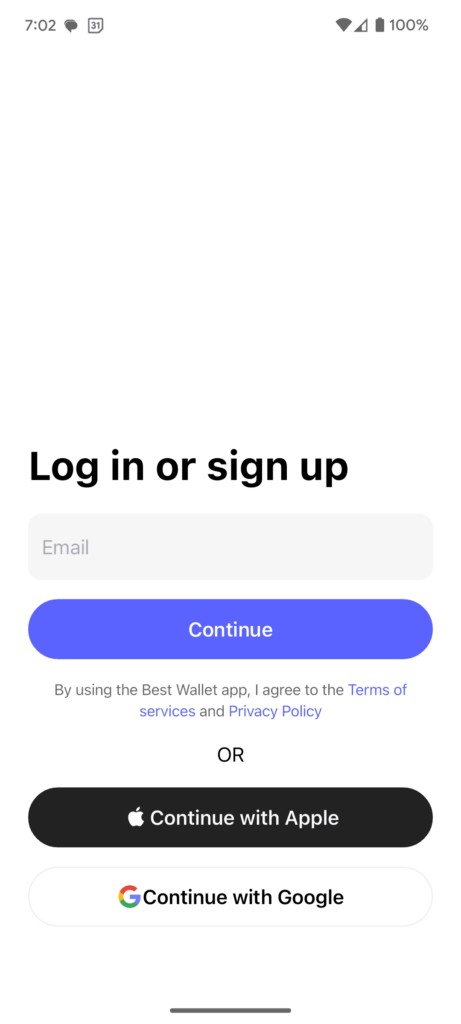
Best Wallet will send you a confirmation email.
Copy the verification code from the message and paste it into the app.
Step 3. Secure your wallet
Security is the most important step when setting up a crypto wallet. Best Wallet provides multiple layers of protection:

PIN code. Create a PIN to access the app.
Backup phrase. Write down the 12-word recovery phrase shown during setup. Keep it offline, never in cloud storage. This phrase is the only way to restore your wallet if you lose your phone or forget your PIN.
Biometric login. Enable fingerprint or Face ID for added security.
Two-Factor Authentication (2FA). Link your phone number and confirm logins with SMS codes.
Step 4. Fund your wallet
Once secured, your wallet is ready to receive crypto. You can:
Receive from another wallet or exchange. Tap the token, then Receive. Copy your wallet address or scan the QR code.
Add custom tokens. If a token isn’t listed, go to Manage Tokens → Import, paste the correct contract address, and select the right network (e.g., ERC-20 on Ethereum, BEP-20 on BNB Chain).

Funds will appear in your wallet balance after the transaction is confirmed on the blockchain.
Step 5. Buy, send, and swap crypto
Buy. Tap Trade → Buy, choose fiat currency, crypto, and payment method. The purchase is instant.
Send. Tap the token → Send, paste or scan the recipient’s address, confirm amount and network fee.
Swap. Tap Trade → Swap, select tokens to exchange, confirm the rate, and complete the swap.
Anatomy of an anonymous crypto wallet
Anonymous wallets have evolved beyond simple key‑pairs. Modern solutions combine multiple cryptographic techniques with hardware innovations to create self‑custodial vaults that never leak data. Key components include:
Multi‑party computation (MPC) replaces seed phrases. Instead of a single mnemonic stored on paper or a phone, MPC splits your private key among several devices or servers and assembles it only at signing time. Wallets like ZenGo use MPC and a 3‑factor recovery process, email, a recovery file and encrypted FaceLock, to eliminate single points of failure. This protects users against seed phrase theft while allowing wallet recovery if one factor is compromised.
Local key generation and account abstraction. Non‑KYC wallets generate keys locally without sending entropy to remote servers. Advanced wallets implement account abstraction (EIP‑4337), letting users define spending limits, timelocks or multi‑sig policies at the wallet level. This moves wallet logic into smart contracts and allows programmable recovery and social guardrails, useful for professional traders who delegate certain operations without surrendering full control.
Stealth addresses and address rotation. Anonymous wallets randomize receiving addresses, preventing observers from linking payments to a single identity. Implementation varies: CoinJoin protocols shuffle transactions, while ring signatures or zk‑SNARKs hide sender and receiver. Some wallets pre‑generate “stealth meta‑addresses” so that each inbound payment has a unique on‑chain footprint. Hardware wallets increasingly offer built‑in address labeling and automatic rotation to thwart address poisoning.
Zero‑knowledge rollups for enterprise privacy. On public chains like Ethereum, traders can use layer‑2 protocols that embed private transfers inside zero‑knowledge proofs. EY’s Nightfall_4 roll‑up (April 2025) replaced an optimistic design with a zero‑knowledge version that gives near‑instant finality without a challenge period. The simplified architecture eliminates liquidity providers and challenge windows, making private transact ions faster and more scalable for institutional users. Nightfall_4 also integrates x509 enterprise certificates to control access while preserving on‑chain privacy.
Seedless cold storage innovations. New hardware devices like Tangem cards and Cypherock X1 store keys in EAL6+ certified chips and require no seed phrase at all. Tangem issues multiple NFC cards tied to one wallet, if you lose one, others can restore access. The company even offers a wearable payment ring that authorizes transactions with a tap. Cypherock splits key shards across four NFC cards plus a vault, allowing distributed backups and eliminating the risk of a single point of compromise (Fintech Review). Such designs reflect a shift from memorized seed phrases to tamper‑resistant hardware with redundant recovery.
Security posture and emerging threats
The attack surface for anonymous wallets expands alongside adoption. Recent data show how severe the risks have become:
Massive losses from hacks and scams. As per Kroll, In 2025, crypto hacks caused $2.7 billion in losses. Centralized exchanges remained the prime targets, responsible for 71% of breaches, but DeFi hacks grew 42% due to smart‑contract flaws. Cross‑chain bridge exploits alone stole over $520 million, underscoring the need for robust multi‑chain protocols. Phishing attacks accounted for 48% of exchange breaches, while SIM‑swapping and malware continued to compromise hot wallets.
Layered vulnerability model. Researchers identify five weak layers: seed generation, software codebase, network transmission, operating system, and user behavior. Seed generation flaws, poor entropy or predictable random number generators, caused 12 % of wallet compromises in past incidents, while outdated libraries expose wallets to zero‑day exploits. Network metadata leaks through browser extensions and unencrypted API calls betray otherwise anonymous activity. Malware targeting clipboard data has siphoned hundreds of millions, and address‑poisoning scams, where attackers insert look‑alike addresses into your history, has resulted in millions in losses since 2023. Users remain the weakest link: phishing and social engineering account for over 70% of retail losses, illustrating that anonymity tools cannot compensate for poor operational hygiene.
Emerging AI‑driven and quantum threats. Hackers are leveraging machine learning to craft more convincing phishing campaigns and to automate vulnerability discovery. Cross‑chain bridges present lucrative targets because they lock large amounts of liquidity; a single flawed message parser can trigger cascading losses across networks. Looking ahead, post‑quantum attacks could threaten elliptic‑curve cryptography, prompting some wallets to adopt hybrid classical–quantum signatures. Learn how quantum computers could become a serious threat to Bitcoin in the future — and how developers are already preparing upgrades to protect the network from this emerging technology.
Legal and regulatory dynamics
Privacy‑preserving technology exists within a tightening legal environment. Key developments as of late 2025 include:
EU MiCA and AMRL
The Markets in Crypto‑Assets Regulation (MiCA), effective December 2024, demands 1:1 reserves for e‑money tokens and strict diversification rules. While MiCA bolsters investor confidence, driving the EU crypto market toward €1.8 trillion and encouraging 32% of investors to increase holdings, it indirectly squeezes privacy coins. The associated Transfer of Funds Regulation forces service providers to exchange sender and recipient data for all transactions. The follow‑up Anti‑Money‑Laundering Regulation (AMRL) will, from July 2027, ban service providers from handling privacy coins like Monero and Zcash. Firms must report transactions over €1,000 and are projected to face 20–30 % higher compliance costs.
Global divergence
Forty‑two jurisdictions have passed laws targeting privacy coins and anonymous services. The U.S. applies the FATF Travel Rule to exchanges, requiring identity transmission for transfers above US$1,000 and sanctioning mixers (e.g., Tornado Cash). While Japan prohibits privacy coin listings, Singapore permits non-KYC wallets but mandates Travel Rule compliance for custodians, which directly shapes how the best crypto wallets in Singapore operate and ensure regulatory alignment.. Nigeria and Argentina, facing inflation and banking crises, allow P2P privacy wallets, fueling widespread adoption. This patchwork leads to regulatory arbitrage: traders often hold a primary no‑KYC wallet for long‑term storage and a secondary, KYC‑compliant wallet for conversions, preserving privacy while minimizing legal exposure.
Institutional custody requirements
Regulators worldwide are drafting standards for wallet audits, mandatory multi‑signature setups and real‑time breach reporting. In North America and Europe, new guidelines require institutional funds to use cold storage with multi‑signature or MPC keys and to separate operational and vault functions. These rules have spurred growth in specialized custody providers and insured cold‑vault solutions.
| Region / Country | Regulatory Position | Status of Privacy Coins / Wallets | Trader Impact |
|---|---|---|---|
| European Union (EU) | AMLD5/6 mandates KYC for exchange-linked wallets. Non-custodial wallets not directly banned. | Monero delisted on Binance & Kraken (2024). | Wallet use legal if no fiat conversion. |
| United States | OFAC sanctions on Tornado Cash. FATF Travel Rule applied strictly. | Mixers banned, some wallets under scrutiny. | P2P non-KYC wallet use still legal. |
| Japan | FSA prohibits privacy coin listings on exchanges since 2018. | Monero, Dash, Zcash not listed locally. | Wallet usage legal but limited liquidity. |
| Singapore | MAS enforces Travel Rule compliance for custodians. Non-KYC wallets allowed privately. | Exchanges must block anonymous withdrawals. | Non-custodial wallets remain legal. |
| Canada | 2024 updates to FINTRAC laws extend KYC scope to large crypto platforms. | No direct wallet bans. | Non-KYC wallets legal; caution at exchanges. |
| Nigeria | Crypto regulations easing since 2023. No laws against privacy wallets. | Non-KYC wallets widely used in remittances. | Strong retail adoption. |
| Argentina | No explicit ban. Inflation drives demand for anonymous wallets. | High P2P usage of privacy coins. | Non-KYC wallets common for savings. |
| Netherlands | Tornado Cash developer prosecuted. Privacy wallets under strict scrutiny. | High legal risks for developers. | Regular users less affected. |
Practical recommendations for non KYC wallet users
Set up your anonymous crypto wallet securely by using:
Use dedicated devices and hardened OS environments. For high‑value trades or long‑term storage, generate wallets on a secure operating system (e.g., Tails or Whonix) on a device that never touches your regular browsing or messaging accounts. Keep firmware and software up to date, and disable auto‑connect features like Bluetooth and Wi‑Fi on cold devices.
Deploy a multi‑layer wallet strategy. Separate funds by purpose. Use an anonymous hot wallet for daily DeFi or NFT interactions; an MPC‑based wallet for active trading; and a hardware wallet for long‑term storage. Avoid reusing addresses, rotate them using built‑in features, and never paste from transaction history without verifying the full address (to thwart poisoning scams).
Leverage privacy tools responsibly. When mixing funds using CoinJoin, Whirlpool or similar services, always check the pool size and anonymity set, higher participation yields stronger obfuscation. Combine mixnets (e.g., Nym) with privacy coins for network‑layer anonymity. Understand that misconfigured settings can leak metadata; test with small amounts before large transfers.
Plan for regulatory compliance. In highly regulated regions, maintain a secondary KYC‑compliant wallet for on‑ramps/off‑ramps and keep your privacy wallet separate. Monitor local laws, Europe’s AMRL will ban privacy coin services by July 2027, and adjust holdings ahead of deadlines. For cross‑border transfers, use atomic swaps or decentralized bridges that don’t expose personal data, but be aware that cross‑chain protocols remain high‑risk (over $520 million stolen in 2025).
Enable redundant backups. Even seedless wallets need recovery planning. Use multi‑card hardware (e.g., Tangem) or split recovery shares across offline locations with Shamir’s Secret Sharing. Regularly test recovery procedures with small balances to ensure you can restore funds under pressure.
Future outlook
The privacy‑wallet landscape will continue to evolve as technology and regulation clash:
Rise of privacy‑compliant protocols. Developers are blending zero‑knowledge proofs with selective disclosure features that allow regulatory reporting without exposing full transaction history. This could satisfy Travel Rule obligations while preserving user anonymity for most interactions.
Post‑quantum and AI integration. Wallets will begin adopting hybrid cryptographic schemes to resist quantum attacks, and AI will aid anomaly detection, automatically flagging suspicious transactions and guiding users through safe transaction flows.
Surveillance vs. privacy arms race. As analytics firms deploy cross‑chain deanonymization tools, wallet developers will respond with more sophisticated obfuscation methods. The tension will likely spark legal battles over encryption rights and developer liability.
Smart traders should view privacy as a system, not a checkbox, combining technology, disciplined behavior, and awareness of evolving laws.
Once you’ve picked your privacy-first wallet, you’ll need a compliant on-/off-ramp to move funds between crypto and fiat. That’s where a solid, region-friendly exchange comes in, one with low fees, reliable bank rails, and strong security that won’t compromise your self-custody workflow. In the table below, we’ve shortlisted the best crypto exchanges in your region to pair with anonymous wallets: use them for conversions, cash-outs, and liquidity while keeping long-term assets in your non-KYC storage.
| OKX | Coinbase | Crypto.com | Cryptohopper | BTCC | |
|---|---|---|---|---|---|
|
Min. Deposit, $ |
10 | 10 | 1 | No | 10 |
|
Coins Supported |
600+ | 400+ | 400+ | 1000 | 399 |
|
Spot Taker fee, % |
0.1 | 0.5 | 0.5 | 0 | 0.3 |
|
Spot Maker Fee, % |
0.08 | 0.5 | 0.25 | 0 | 0.2 |
|
Alerts |
Yes | Yes | Yes | Yes | No |
|
Copy trading |
Yes | No | No | Yes | Yes |
|
TU overall score |
8.48 | 7.84 | 7.8 | 7.76 | 7.6 |
|
Open an account |
Go to broker Your capital is at risk. |
Go to broker Your capital is at risk. |
Go to broker Your capital is at risk. |
Go to broker Your capital is at risk. |
Go to broker Your capital is at risk.
|
Secure your crypto with air-gapped signing, multisig and PSBT workflows

If you want real privacy and safety without handing your identity to a platform, treat keys like the crown jewels and never let them touch the internet. Use one phone or laptop as your watch-only device to build and inspect transactions, and a separate offline device to sign them. Create the unsigned transaction, move it to the offline signer by QR or microSD, sign there, then move the signed transaction back to the online device for broadcasting. This keeps the secret keys offline while still letting you check exactly what you’re approving.
Don’t stop at a single hardware key. Use multisig across different vendors and types of devices so one compromised product can’t drain everything. Backups should be metal-backed, split across locations, and tested: do a dry run restore with a tiny amount to confirm your recovery procedure works. Verify device firmware before use and prefer wallets that support PSBTs and good coin-control features. These are practical, repeatable habits that make a verification-free wallet both private and hard to break into.
Conclusion
The evolving landscape of anonymous Bitcoin wallets without KYC highlights the growing necessity for individuals to protect their financial privacy amid tightening regulations and technological threats. As showcased by innovations like Best Wallet’s MPC security and Tangem’s seedless cold storage, users now have more robust tools to secure their assets without compromising anonymity. However, true privacy is not just about the wallet itself but also about disciplined operational habits and staying informed as rules and risks shift worldwide. Ultimately, in an era of increasing surveillance and regulatory pressures, the smartest traders treat privacy as an ongoing practice—combining the right technology with vigilance to fully control their digital sovereignty.
FAQs
What security risks remain when using the best anonymous Bitcoin wallets without KYC in 2026?
How do regulatory changes impact the use of non-KYC wallets in different regions?
What technological advancements are shaping the future of anonymous Bitcoin wallets without KYC?
Which setup practices maximize privacy when creating and managing anonymous Bitcoin wallets?
Editors' Top Picks and Insights




Related Articles
Team that worked on the article
Viktoras Karapetjanc is a seasoned financial trader, market analyst, and content creator with over 20 years of expertise in Forex, cryptocurrency, and stock markets. As a contributor to the Traders Union website, he provides in-depth analysis, data-driven strategies, and educational content to empower traders of all levels.
Dan Blystone began his trading career in 1998 as an arbitrage clerk on the floor of the Chicago Mercantile Exchange (CME). He later traded bond and Eurex futures at proprietary firms such as Altea Trading, gaining valuable experience in high-frequency trading and risk management.
Chinmay Soni is a financial analyst with more than 5 years of experience in working with stocks, Forex, derivatives, and other assets. As a founder of a boutique research firm and an active researcher, he covers various industries and fields, providing insights backed by statistical data.
Yield refers to the earnings or income derived from an investment. It mirrors the returns generated by owning assets such as stocks, bonds, or other financial instruments.
A bear market is a period of time in which an investment asset, such as stocks, bonds, or commodities, experiences a decline in price for an extended period of time.
CFD is a contract between an investor/trader and seller that demonstrates that the trader will need to pay the price difference between the current value of the asset and its value at the time of contract to the seller.
Crypto trading involves the buying and selling of cryptocurrencies, such as Bitcoin, Ethereum, or other digital assets, with the aim of making a profit from price fluctuations.
Ethereum is a decentralized blockchain platform and cryptocurrency that was proposed by Vitalik Buterin in late 2013 and development began in early 2014. It was designed as a versatile platform for creating decentralized applications (DApps) and smart contracts.

-
 Afghanistan
-
 Albania
-
 Algeria
-
 Angola
-
 Argentina
-
 Armenia
-
 Australia
-
 Austria
-
 Azerbaijan
-
 Bahamas
-
 Bahrain
-
 Bangladesh
-
 Belarus
-
 Belgium
-
 Bolivia
-
 Botswana
-
 Brazil
-
 Brunei
-
 Bulgaria
-
 Cambodia
-
 Cameroon
-
 Canada
-
 Chile
Chile
-
 China
China
-
 Colombia
-
 Congo
Congo
-
 Costa Rica
-
 Cote d'Ivoire
-
 Croatia
-
 Cuba
Cuba
-
 Cyprus
-
 Czechia
-
 DR Congo
-
 Denmark
-
 Dominican Republic
-
 Ecuador
-
 Egypt
Egypt
-
 El Salvador
-
 Estonia
-
 Eswatini
-
 Ethiopia
-
 Finland
-
 France
-
 Georgia
-
 Germany
-
 Ghana
Ghana
-
 Greece
-
 Haiti
Haiti
-
 Hong Kong
-
 Hungary
-
 India
India
-
 Indonesia
-
 Iran, Islamic republic
-
 Iraq
Iraq
-
 Ireland
-
 Israel
-
 Italy
Italy
-
 Jamaica
-
 Japan
Japan
-
 Jordan
-
 Kazakhstan
-
 Kenya
Kenya
-
 Korea
Korea
-
 Kuwait
-
 Kyrgyzstan
-
 Laos
Laos
-
 Latvia
-
 Lebanon
-
 Lesotho
-
 Libya
Libya
-
 Lithuania
-
 Luxembourg
-
 Madagascar
-
 Malaysia
-
 Malta
Malta
-
 Mauritius
-
 Mexico
-
 Moldova
-
 Mongolia
-
 Montenegro
-
 Morocco
-
 Mozambique
-
 Myanmar
-
 Namibia
-
 Nepal
Nepal
-
 Netherlands
-
 New Zealand
-
 Nigeria
-
 North Macedonia
-
 Norway
-
 Oman
Oman
-
 Pakistan
-
 Palestine
-
 Panama
-
 Papua New Guinea
-
 Paraguay
-
 Peru
Peru
-
 Philippines
-
 Poland
-
 Portugal
-
 Puerto Rico
-
 Qatar
Qatar
-
 Reunion
-
 Romania
-
 Rwanda
-
 Saudi Arabia
-
 Serbia
-
 Singapore
-
 Slovakia
-
 Slovenia
-
 Somalia
-
 South Africa
-
 Spain
Spain
-
 Sri Lanka
-
 Sweden
-
 Switzerland
-
 Syria
Syria
-
 Taiwan
-
 Tajikistan
-
 Tanzania
-
 Thailand
-
 Trinidad and Tobago
-
 Tunisia
-
 Turkey
-
 UAE
UAE
-
 Uganda
-
 Ukraine
-
 United Kingdom
-
United States
-
 Uruguay
-
 Uzbekistan
-
 Venezuela
-
 Vietnam
-
 Yemen
Yemen
-
 Zambia
-
 Zimbabwe
- Forex
- Crypto












