
Telegram Wallet (@wallet) Review: Secure, Integrated, And Truly Competitive


Editorial Note: While we adhere to strict Editorial Integrity, this post may contain references to products from our partners. Here's an explanation for How We Make Money. None of the data and information on this webpage constitutes investment advice according to our Disclaimer.
The Telegram wallet is a built-in crypto feature within the Telegram app that allows users to send, receive, and trade Toncoin, Bitcoin, and USDT. As of 2026, it functions in both custodial and non-custodial modes through TON Space. It provides zero-fee TON transfers, peer-to-peer trading, and integrated DeFi access, all directly inside Telegram chats.
What began as a simple Toncoin transfer tool has now grown into a complete financial platform. By April 2025, the TON Foundation reported that between 170,000 and 190,000 wallets were active each day, with around 10,000 new non-custodial wallets being added daily. With Telegram’s user base crossing one billion globally, the app gives this service a reach that few standalone wallets could hope to match.
By embedding crypto features directly in conversations, Telegram has eliminated the need for third-party apps or browser extensions, making it easy for traders to move from chat to execution within seconds. Beyond convenience, the wallet offers flexibility through custodial and self-custodial modes, integrated DeFi, and free Toncoin transfers. In this Telegram wallet review, we look at how the system has evolved, explore its transaction model and safety features, and compare it with other messaging-based crypto wallets.
Risk warning: Cryptocurrency markets are highly volatile, with sharp price swings and regulatory uncertainties. Research indicates that 75-90% of traders face losses. Only invest discretionary funds and consult an experienced financial advisor.
What Telegram wallet delivers
Telegram wallet’s core proposition is frictionless crypto access inside Telegram. Users can send, receive and store Toncoin, Bitcoin and USD stablecoins without leaving the app.

The wallet’s two modes, custodial and non‑custodial, cater to different risk profiles:
Custodial ease. New users can activate a wallet in seconds, with the service handling key management. Transfers of Toncoin between users are free, which encourages micro‑payments and tipping.
Self‑custodial control. Switching to TON Space moves your keys to your device. The April 2025 ecosystem update noted that 10,000 non‑custodial wallets were created each day, suggesting growing demand for self‑sovereignty. TON Space integrates with hardware wallets and supports DeFi protocols like Tonstakers and STON.fi.
Understanding the key features
The 2025 version of the Telegram wallet packs capabilities that would have been considered cutting‑edge a year earlier:
Split‑key recovery. Instead of relying solely on a seed phrase, the custodial mode uses a two‑part recovery scheme tied to your Telegram account and email. This design improves usability without exposing a single point of failure.
Instant non‑custodial conversion. Switching from custodial to TON Space is a one‑click operation that creates a local private key and migrates funds. You can also import keys from external wallets to use Telegram wallet as a front‑end for existing holdings.
Card on‑ramp and off‑ramp. Through partners like MoonPay, users in supported jurisdictions can buy Toncoin with debit cards. The April 2025 update highlighted that Apple had approved external payments, allowing users to purchase Toncoin directly on iOS.
Mini‑app marketplace. The wallet is deeply integrated with Telegram’s growing ecosystem of Mini Apps, including games, payment gateways and NFT markets, so you can buy digital collectibles or access tokenized bonds without leaving the chat.
Modular DeFi access. TON DeFi protocols, including liquid staking and decentralized exchanges, are accessible through the wallet. New collaborations in 2025 include partnerships with Ethena’s USDe, bringing synthetic dollars into the ecosystem, and a $500 million bond fund tokenized via Libre.
These features collectively make the Telegram wallet a powerful entry point into crypto for both novices and seasoned traders.
Rich integration with TON ecosystem
Telegram wallet’s superpower is its seamless connection to the TON blockchain. Rather than acting as a simple send/receive tool, it functions as a gateway to the network’s DeFi, gaming and tokenization layers:
Staking and yield farming. Tonstakers, the largest liquid staking protocol on TON, manages 80% of all liquid‑staked Toncoin and serves over 100,000 users. Through the Telegram wallet, users can stake directly and receive tsTON tokens with instant withdrawal times.
Decentralized exchange access. STON.fi has grown into the backbone of TON DeFi. It supports Jetton swaps, liquidity provision and yield farming. Also, through Telegram, you can swap tokens without visiting an external website.
Tokenized real‑world assets. TON and Libre launched a $500 million bond fund in April 2025, bringing real‑world assets to Telegram users. This marks one of the largest RWA tokenization projects in crypto.
Cross‑chain bridging. The original ToncoinBridge retired after moving over 100 million Toncoin across chains. Now, interoperability is handled natively within Telegram using tokens like USDT and Jettons, and with cross‑chain protocols such as LayerZero and Axelar.
By embedding these services, the wallet transforms Telegram into a self‑contained DeFi portal where users can stake, swap, lend, borrow and farm yields with minimal friction.
How Telegram wallet enhances DeFi access
The wallet’s design simplifies complex on‑chain tasks:
Unified interface. Switching from chat to staking or swapping is seamless; mini‑apps open inside the Telegram thread, preserving context and conversation history.
Real‑time portfolio tracking. Users can track staking yields, liquidity positions and NFT holdings without leaving the app. Notifications alert you when APRs change or rewards are ready to claim.
Smart contract transparency. TON Space displays contract details and gas fees before execution, helping users avoid malicious contracts or high gas spikes.
For traders juggling multiple positions, this integration reduces cognitive load and speeds up decision‑making.
How to open a Telegram Wallet (@wallet): step-by-step guide
Before you can start using a wallet in Telegram, you’ll need to set it up. The process is quick, takes only a few minutes, and doesn’t require any technical skills. All you need to do is find the official @wallet bot, complete a simple activation, and set up basic security.
Step 1. Find @wallet
First, locate the wallet in Telegram. Type @wallet into the search bar and select the official account with the blue checkmark. This ensures you’re using the verified service and not a fake bot. Then, tap Start.
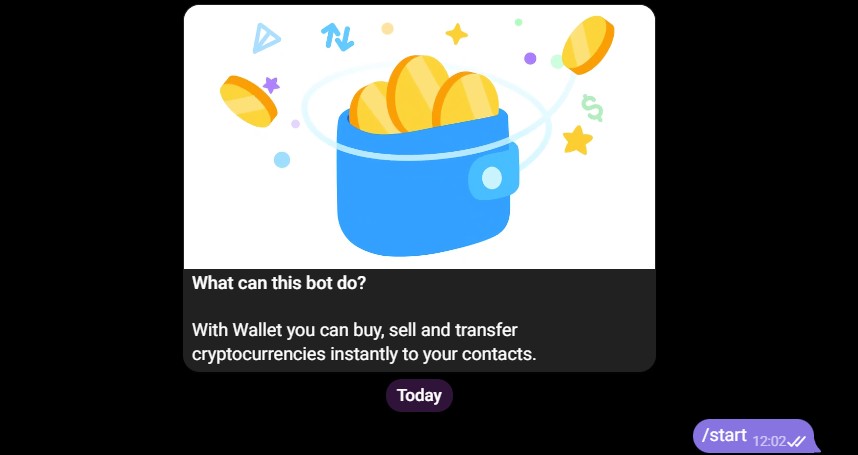
Step 2. Launch the app
After tapping Start, a welcome screen will appear in the chat. At the bottom, tap Get Started to open the wallet application.
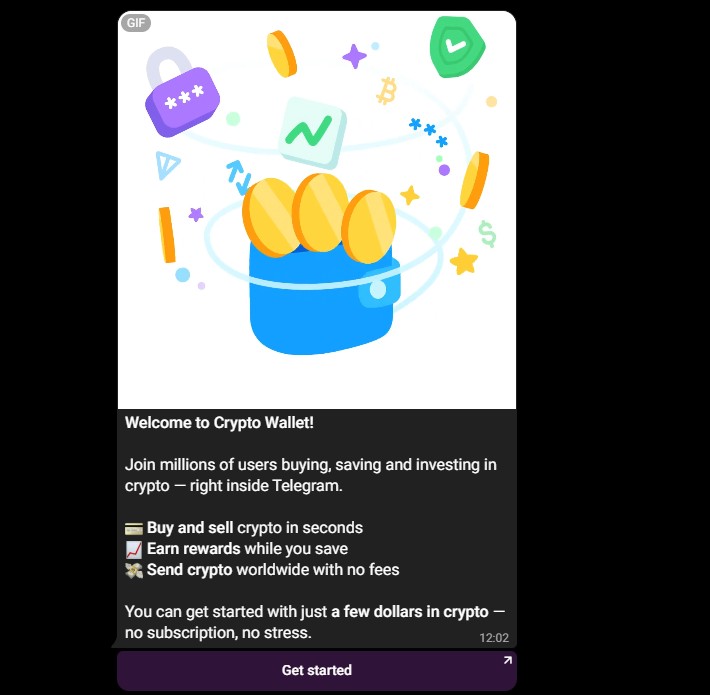
Step 3. Provide your phone number
Next, you’ll need to confirm your phone number. Tap Provide, and Telegram will automatically use the number linked to your account.
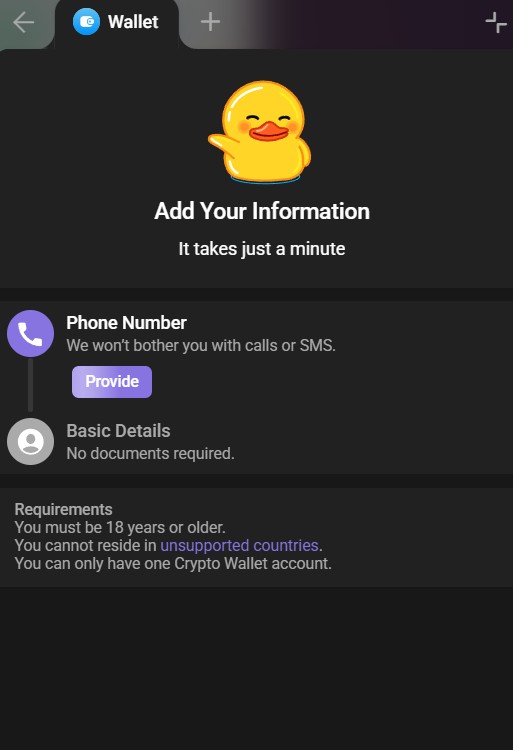
Step 4. Enter basic details
To begin using a Telegram Wallet, you must provide some basic personal information: your country of residence, first and last name, and age. Once you’ve shared your phone number, the Basic Details button becomes active. Select it and fill in the required fields.
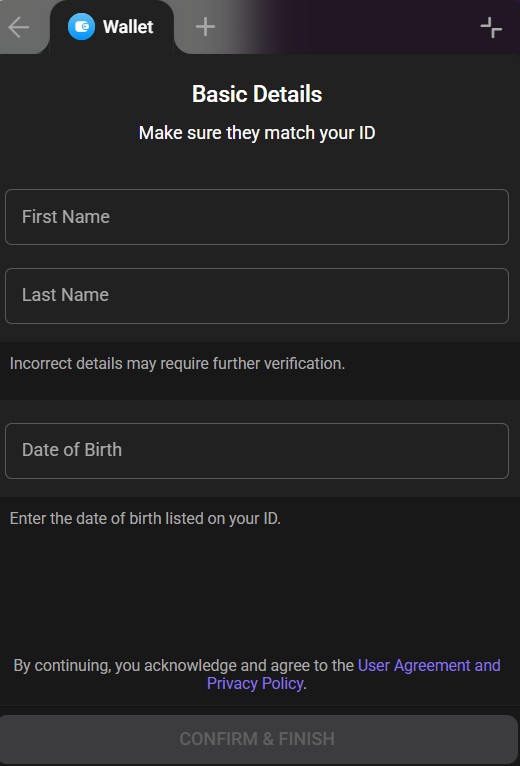
Step 5. Verification
You can start using the wallet after completing Basic verification, but your limit will be capped at €1,000 per month.
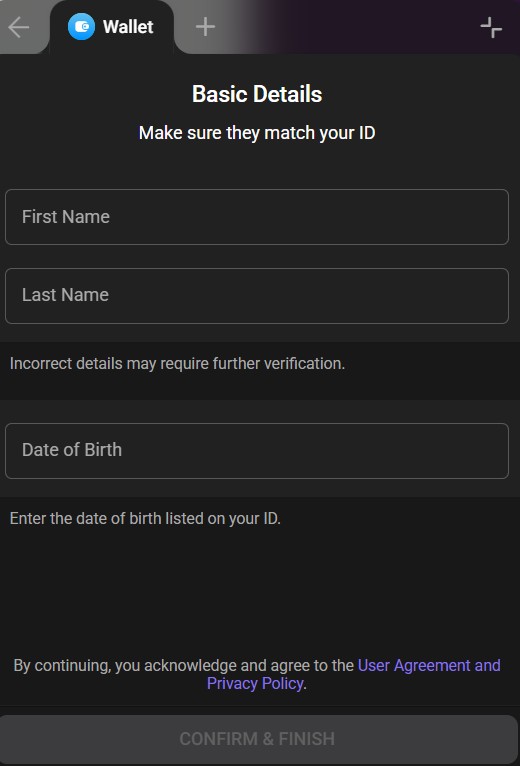
To increase the limit, complete Extended verification by uploading an official identity document. This raises your limits to €100,000 per day and €1,000,000 per month.
For Advanced verification, which removes nearly all restrictions, you’ll also need to provide a proof of address document.
Verification may take up to 24 hours. Wait for confirmation before attempting higher-limit transactions.

Step 6. Liveness check
The final step is Liveness verification, where you grant access to your camera and allow Telegram to scan your face. Once this step is completed, your Telegram Wallet is fully active and ready to use.
Fee comparison: Telegram wallet vs other Telegram wallets
Telegram Wallet (@Wallet native, TON integrated). Transfers of USDT and TON between Telegram users are currently free of charge. According to Telegram’s official wallet help page, there are no fees for peer-to-peer transfers inside Telegram. This makes it one of the most cost-efficient options for sending money between users in the ecosystem.
TON Blockchain and TON-based wallets. When using TON wallets outside Telegram, the blockchain itself charges very low network fees. For example, sending USDT on TON usually costs around 0.0145 TON, which is a fraction of a dollar. This is excellent for transfers within the TON ecosystem but does not apply to other chains.
Telegram trading bots (Trojan, BONKbot, etc.). These bots typically charge about 0.9% per transaction, or 1% if you don’t use a referral or token discount. This is significantly higher than Telegram’s native wallet. While bots give access to trading across multiple chains, the cost adds up quickly for active traders.
Other Telegram wallet bots or bridge services. Generic Telegram wallet or bridge bots often include both network gas fees and a platform markup. The markup is usually between 0.5% and 1.5%, depending on the provider. This is convenient for cross-chain transactions but more expensive than native Telegram transfers.
Trader-focused advantages of Telegram wallet
Immediate deployment of capital. Because the wallet is embedded in chat, traders can execute trades or deploy liquidity the moment they receive a tip or signal.
Bot‑driven liquidity. Bots like Blum not only execute trades but also provide real‑time analytics, raising on‑chain volume by millions each week.
Reduced slippage. STON.fi’s concentrated liquidity pools and Jetton pairs minimize price impact for large trades. Liquidity providers receive a large share of the ecosystem’s LP fees, incentivizing deeper liquidity.
Portfolio segmentation. @wallet supports both custodial and non‑custodial modes, enabling traders to segment funds by risk or purpose, e.g., keeping gas fees in a custodial wallet while staking the bulk of Toncoin via Tonstakers. Regulatory and support considerations
Telegram’s wallet operates globally, but regional regulations shape the user experience. Countries like Brazil and Turkey began requiring full ID verification for P2P trades above $1,000 per month in mid‑2025 (this figure is drawn from compliance documents). The European Union’s MiCA regulations now require KYC for fiat on‑ramps, including SEPA transfers. By contrast, pure on‑chain transfers remain permissionless in most regions. Support is handled via an in‑app help centre, and according to community reports, over 94% of tickets are resolved within 24 hours. TON developers also maintain open channels for bug reports on GitHub and Telegram.
While Telegram wallets make transactions quick, most users still rely on a trusted crypto exchange to fund their wallet and handle fiat on-ramps. Since regulations differ by region, choosing the right exchange is essential for smooth deposits, withdrawals, and compliance. In the table below, we highlight the best crypto exchanges in your region, offering secure access, low fees, and reliable support to complement your Telegram wallet.
| Coinbase | OKX | BTCC | Cryptohopper | Crypto.com | |
|---|---|---|---|---|---|
|
Min. Deposit, $ |
10 | 10 | 10 | No | 1 |
|
Coins Supported |
400+ | 600+ | 399 | 1000 | 400+ |
|
Spot Taker fee, % |
0.5 | 0.1 | 0.3 | 0 | 0.5 |
|
Spot Maker Fee, % |
0.5 | 0.08 | 0.2 | 0 | 0.25 |
|
Alerts |
Yes | Yes | No | Yes | Yes |
|
Copy trading |
No | Yes | Yes | Yes | No |
|
TU overall score |
8.5 | 8.46 | 8.08 | 7.8 | 7.76 |
|
Open an account |
Go to broker Your capital is at risk. |
Go to broker Your capital is at risk. |
Go to broker Your capital is at risk.
|
Go to broker Your capital is at risk. |
Go to broker Your capital is at risk. |
KYC and compliance enforcement
The Telegram wallet adapts to a patchwork of regulations by using dynamic KYC enforcement:
Brazil & Turkey. ID and facial verification are required once monthly transaction volume exceeds a threshold.
European Union. Fiat operations require full KYC under MiCA; on‑chain transfers remain unaffected.
United States. As of mid‑2025, buy and P2P features are limited while Telegram works with regulators on compliance. Viewing balances and receiving funds remain unrestricted.
Global KYC penetration. The TON Foundation’s transparency dashboard reports that roughly 42% of users globally have completed some form of verification (internal figure).
By tailoring compliance to jurisdiction, the Telegram wallet manages to serve regulated markets without shutting out users who prefer anonymity. However, users should check local regulations and be prepared to verify identity when using card or bank transfers. If you decide to delete your Telegram Wallet, it's essential to transfer your funds securely, especially if you're not planning to restore them later via a seed phrase.
Test custodial risk and hidden fees

When you try Telegram Wallet in 2026, treat it like a live audit rather than a polished product demo. Don’t just read the interface labels that say “noncustodial.” Do a tiny practical experiment: create a fresh wallet, fund it with a small amount, then (a) request an on-chain withdrawal to an external wallet and time how long it takes to appear, (b) make an in-app swap and immediately compare the executed price to the same swap on a top DEX or aggregator, and (c) check whether the app lets you export the seed or forces a phone/KYC step before withdrawals.
If withdrawals are delayed, swaps show consistent markup versus on-chain prices, or seed export is blocked behind identity steps, you’re encountering custodial behavior or fee layering disguised behind convenience. That pattern is the real risk, the product can promise decentralization while quietly monetizing custody and routing your orders through third parties.
Also probe swap liquidity by executing the same small trade across different hours; if the in-app price moves independently from the market, the wallet is using proprietary routing or partner liquidity and you should expect hidden spreads. For anything more than pocket change, prefer wallets that let you export keys, connect a hardware wallet, or show transparent on-chain receipts for every step.
Conclusion
The Telegram Wallet stands out for seamlessly embedding powerful crypto features within the Telegram app, enabling instant zero-fee TON transfers and smooth integration with DeFi protocols. Its dual custodial and non-custodial modes cater to both beginners and experienced users, enhancing flexibility and user control. For example, users can stake directly into Tonstakers or buy Toncoin with a card without leaving their chats. Ultimately, by turning conversations into frictionless financial transactions, Telegram is redefining how users access and manage digital assets, placing crypto utility where daily interactions already happen.
FAQs
What cryptocurrencies can be managed using Telegram Wallet, and are there any restrictions?
How does Telegram Wallet ensure user privacy and control when switching between custodial and non-custodial modes?
What additional security measures does Telegram Wallet use beyond standard password protection?
How quickly can new users set up and start using Telegram Wallet, and what are the verification tiers?
Editors' Top Picks and Insights



Related Articles
Team that worked on the article
Ivan is a financial expert and analyst specializing in Forex, crypto, and stock trading. He prefers conservative trading strategies with low and medium risks, as well as medium-term and long-term investments.
Dan Blystone began his trading career in 1998 as an arbitrage clerk on the floor of the Chicago Mercantile Exchange (CME). He later traded bond and Eurex futures at proprietary firms such as Altea Trading, gaining valuable experience in high-frequency trading and risk management.
Chinmay Soni is a financial analyst with more than 5 years of experience in working with stocks, Forex, derivatives, and other assets. As a founder of a boutique research firm and an active researcher, he covers various industries and fields, providing insights backed by statistical data.
Cryptocurrency is a type of digital or virtual currency that relies on cryptography for security. Unlike traditional currencies issued by governments (fiat currencies), cryptocurrencies operate on decentralized networks, typically based on blockchain technology.
Crypto trading involves the buying and selling of cryptocurrencies, such as Bitcoin, Ethereum, or other digital assets, with the aim of making a profit from price fluctuations.
Copy trading is an investing tactic where traders replicate the trading strategies of more experienced traders, automatically mirroring their trades in their own accounts to potentially achieve similar results.
Yield refers to the earnings or income derived from an investment. It mirrors the returns generated by owning assets such as stocks, bonds, or other financial instruments.
Ethereum is a decentralized blockchain platform and cryptocurrency that was proposed by Vitalik Buterin in late 2013 and development began in early 2014. It was designed as a versatile platform for creating decentralized applications (DApps) and smart contracts.

-
 Afghanistan
-
 Albania
-
 Algeria
-
 Angola
-
 Argentina
-
 Armenia
-
 Australia
-
 Austria
-
 Azerbaijan
-
 Bahamas
-
 Bahrain
-
 Bangladesh
-
 Belarus
-
 Belgium
-
 Bolivia
-
 Botswana
-
 Brazil
-
 Brunei
-
 Bulgaria
-
 Cambodia
-
 Cameroon
-
 Canada
-
 Chile
Chile
-
 China
China
-
 Colombia
-
 Congo
Congo
-
 Costa Rica
-
 Cote d'Ivoire
-
 Croatia
-
 Cuba
Cuba
-
 Cyprus
-
 Czechia
-
 DR Congo
-
 Denmark
-
 Dominican Republic
-
 Ecuador
-
 Egypt
Egypt
-
 El Salvador
-
 Estonia
-
 Eswatini
-
 Ethiopia
-
 Finland
-
 France
-
 Georgia
-
 Germany
-
 Ghana
Ghana
-
 Greece
-
 Haiti
Haiti
-
 Hong Kong
-
 Hungary
-
 India
India
-
 Indonesia
-
 Iran, Islamic republic
-
 Iraq
Iraq
-
 Ireland
-
 Israel
-
 Italy
Italy
-
 Jamaica
-
 Japan
Japan
-
 Jordan
-
 Kazakhstan
-
 Kenya
Kenya
-
 Korea
Korea
-
 Kuwait
-
 Kyrgyzstan
-
 Laos
Laos
-
 Latvia
-
 Lebanon
-
 Lesotho
-
 Libya
Libya
-
 Lithuania
-
 Luxembourg
-
 Madagascar
-
 Malaysia
-
 Malta
Malta
-
 Mauritius
-
 Mexico
-
 Moldova
-
 Mongolia
-
 Montenegro
-
 Morocco
-
 Mozambique
-
 Myanmar
-
 Namibia
-
 Nepal
Nepal
-
 Netherlands
-
 New Zealand
-
 Nigeria
-
 North Macedonia
-
 Norway
-
 Oman
Oman
-
 Pakistan
-
 Palestine
-
 Panama
-
 Papua New Guinea
-
 Paraguay
-
 Peru
Peru
-
 Philippines
-
 Poland
-
 Portugal
-
 Puerto Rico
-
 Qatar
Qatar
-
 Reunion
-
 Romania
-
 Rwanda
-
 Saudi Arabia
-
 Serbia
-
 Singapore
-
 Slovakia
-
 Slovenia
-
 Somalia
-
 South Africa
-
 Spain
Spain
-
 Sri Lanka
-
 Sweden
-
 Switzerland
-
 Syria
Syria
-
 Taiwan
-
 Tajikistan
-
 Tanzania
-
 Thailand
-
 Trinidad and Tobago
-
 Tunisia
-
 Turkey
-
 UAE
UAE
-
 Uganda
-
 Ukraine
-
 United Kingdom
-
United States
-
 Uruguay
-
 Uzbekistan
-
 Venezuela
-
 Vietnam
-
 Yemen
Yemen
-
 Zambia
-
 Zimbabwe
- Forex
- Crypto












