
Best Real Estate Tokenization Services In The World


Editorial Note: While we adhere to strict Editorial Integrity, this post may contain references to products from our partners. Here's an explanation for How We Make Money. None of the data and information on this webpage constitutes investment advice according to our Disclaimer.
The best real estate tokenization platforms in 2026 continue to transform how investors access, trade, and manage property-backed digital assets. Below are the top property tokenization platforms and blockchain real estate companies leading this innovation:
BinaryX. Best for small investors seeking blockchain-based fractional property shares from $50
Republic. Leading regulated marketplace offering tokenized real estate and startup investments
Figure. Major blockchain platform for tokenized home-equity loans and property-backed credit
Mogul. Accessible Avalanche-based platform for fractional property ownership from $250
Arrived. Beginner-friendly platform for fractional rental homes starting at $100
Real estate investing remains one of the most profitable asset classes, with long-term yields exceeding 70% in some tokenized real estate projects. Investors gain steady passive income, diversification, and capital leverage. However, the tokenization of real estate enhances these benefits even further, unlocking liquidity, accessibility, and transparency provided you use the best platform for real estate tokenization.
Understanding how blockchain tokenizes real estate can seem complex, but this guide will simplify it. Below, we explain what real estate tokenization is, how it works, and why blockchain real estate startups are redefining property investment.
What is real estate tokenization and how does it work?
The term real estate tokenization refers to converting physical property into digital tokens on a blockchain. Each token represents a fractional share of ownership, managed through smart contracts that execute automatically when conditions are met. A real estate tokenization platform development company builds this infrastructure, ensuring compliance, transparency, and secure record-keeping.
When property owners use real estate tokenization development solutions, they divide their property into smaller, tradeable units (tokens). These tokens are stored on a blockchain, making it possible to transfer digital ownership instantly and securely. This process boosts liquidity and lowers barriers to entry two of the biggest challenges in traditional real estate markets.
Blockchain real estate companies provide investors with opportunities to buy and sell property-backed tokens easily, while real estate tokenization services handle asset management, investor verification, and dividend distribution.
How real estate tokenization works
Consider an example: Mr. A owns a property worth $200,000 but struggles to find a single buyer. By turning to a real estate tokenization company, he divides his property into tokens priced at $1,000 to $2,000 each. Through this real estate tokenization platform, investors can purchase fractional shares, gaining partial ownership and proportional rights to the property.
Each tokenized share represents a portion of the asset. By using real estate tokenization development services, property owners can recapitalize faster and attract global investors. This process provides liquidity, faster sales, and greater access to high-value properties that were previously limited to institutional buyers.
In short, real estate tokenization platforms 2026 represent the next generation of blockchain real estate startups, merging the stability of property investment with the flexibility of digital assets.
Top real estate tokenization platforms in 2026
Real estate tokenization platforms have become the foundation of modern property investment. These blockchain real estate companies make it possible for individuals to own fractional shares of high-value properties and earn passive income securely through blockchain. Below are the top real estate tokenization platforms 2026 offering the best real estate tokenization services and development solutions.
BinaryX
BinaryX is a real estate tokenization platform that allows investors to purchase fractional shares of properties starting from as little as around $50. Each property is held in a separate SPV/DAO-LLC and tokenized on a blockchain, with the goal of generating rental income and enabling secondary trading of the tokens.

Key features
Minimum investment entry is very low (≈ $50 in some cases).
Tokenization of property ownership on blockchain (investors own the token which represents a share in the SPV).
Fractional ownership of international properties (for example Bali, Montenegro).
Rental income distribution to token-holders.
Transparency via blockchain registers and DAO-LLC governance model.
Secondary market for token trading (subject to platform terms).
- Pros
- Cons
Very low barrier to entry making property investing accessible.
On-chain tokenization gives clarity of ownership and structure.
Global property selection enables diversification by geography.
Transparent legal structure (each property in its own LLC) supports investor protection.
Young platform with less long-term track record compared to older players.
Returns are promotional (“up to” rental yields) and may depend heavily on property performance.
Jurisdiction, tax, regulatory and exit mechanics vary by property and region.
Secondary liquidity may still be limited depending on token-market maturity.
Republic
Republic is a broad investment platform (startups, private equity, real assets) that also offers tokenization of real-world assets (RWA) including real estate. The platform allows retail and institutional investors to purchase fractional interests or tokens in real-estate-related deals, starting at low minimums (e.g., $50). Republic plays a growing role in tokenizing assets and managing the issuance, compliance, and distribution infrastructure.

Key features
Platform supports design, launch and management of tokenized assets (including real estate).
Low minimum investment thresholds for many deals.
Access to curated real-estate opportunities alongside other asset types.
Educational content on tokenization and RWA for investors.
Infrastructure for compliance, investor onboarding, and token distribution.
- Pros
- Cons
Large investor base and strong deal-flow across asset types.
Tokenization capabilities give potential access to previously inaccessible investments.
Low minimums make it accessible for new investors.
Offers regulated issuance pathways and exposure to real estate via tokenized structures.
The real-estate supply on the tokenized side may be more limited compared to some dedicated platforms.
Secondary trading of tokens may be restricted, e.g., only whitelisted wallets or limited transferability.
Tokenization of real estate is still emerging, so liquidity and clarity of exit remain evolving.
Some token deals (e.g., mirror tokens of private companies) carry additional regulatory/market risk.
Figure
Figure is primarily a home-financing and credit marketplace company that relies on blockchain for origination, settlement and tokenization of loans (such as HELOCs). While its core business is not “buy a share of a rental property”, it uses blockchain infrastructure to tokenise and transact property-backed credit and securitisations. For example, it has created tokenised HELOC pools and uses the Provenance blockchain for mortgage registry.

Key features
Origination of home equity lines of credit (HELOCs) and other mortgage-backed assets, leveraging blockchain technology.
On-chain settlement infrastructure to shorten funding cycles, increase transparency and efficiency.
Tokenization of loan assets and making them available to investors via marketplace infrastructure.
Use of blockchain registry (mortgage ownership records) for property-backed assets.
- Pros
- Cons
Significant scale in home-finance origination, giving a real-world asset base.
Blockchain infrastructure designed for transparency and efficient settlement of property-backed credit.
Good fit for investors wanting exposure to property-backed debt rather than equity.
Not directly the same as fractional equity ownership of individual properties; focus is on debt and credit assets.
For the typical real-estate investor looking for rental income and property appreciation, this may feel less intuitive.
Liquidity and token-trading for these asset types may be less mature compared to traditional equities or REITs.
Mogul
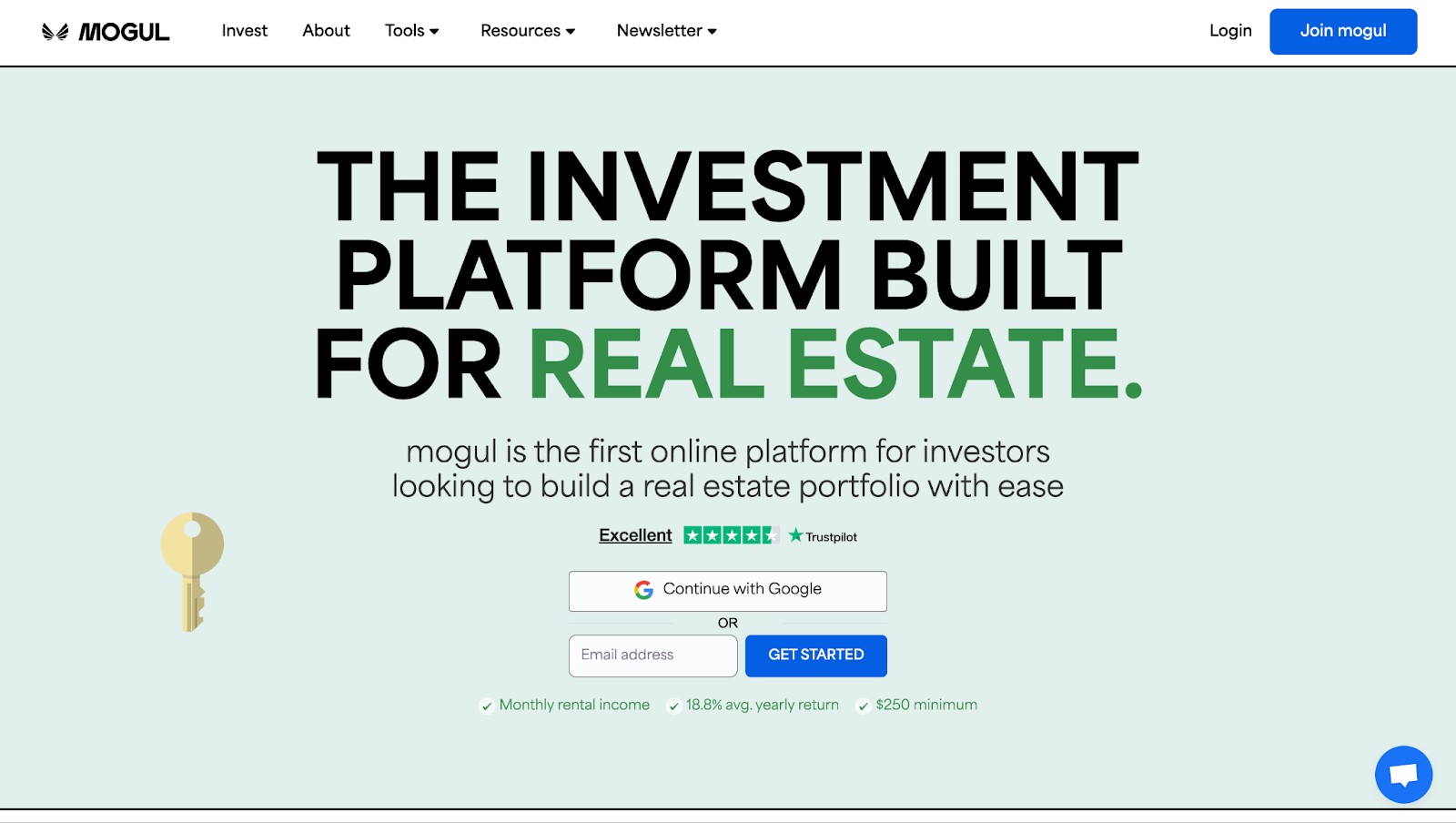
Mogul is a fractional real-estate investing platform that integrates blockchain for transparency and accessibility. It allows investors to own shares of rental properties starting with relatively low minimums (for example $250) and focuses on delivering rental income plus appreciation. It is built on a blockchain infrastructure (Avalanche) and tokenizes membership interests in LLCs that hold the properties.
Key features
Low minimum investment threshold ($250 in some cases).
Fractional ownership of rental properties (single-family, multi-family).
Blockchain integration: tokenisation of membership interests in property-holding LLCs on Avalanche chain.
Investor dashboard with performance tracking, rental income distributions, valuation updates.
- Pros
- Cons
Very accessible entry point for real-estate investment.
Use of blockchain gives added transparency and potential for trading or liquidity (depending on structure).
Focused on aligning investor incentives with property performance and management.
Although tokenised, the depth of liquidity and exit options may still be limited.
As with many property investments, returns vary by state, property, market and management and are not guaranteed.
Investors need to evaluate platform terms, fees, sponsor quality, property selection carefully.
Arrived
Arrived is a fractional real-estate investment platform that enables investors to buy shares in rental and vacation properties starting at around $100. The properties are pre-vetted and managed by Arrived; investors receive dividends from rental income and participate in appreciation over time. While evidently not purely an on-chain public token-platform, it offers a simplified way for beginners to access rental real estate.

Key features
Minimum investment around $100.
Fractional shares Fixed investment term (typically 5-7 years) with property sale event and dividend payouts in the interim.
of single-family rental or vacation properties.
All property management is handled by the platform, freeing the investor from landlord duties.
- Pros
- Cons
Very low entry barrier and beginner-friendly interface.
Clear process: pick a property, invest, receive passive income, participate in appreciation.
Good for investors wanting exposure to rental real estate without full ownership pain.
Not explicitly tokenised on a public blockchain (so may have fewer of the benefits of true tokenisation).
Secondary trading or liquidity may be limited or unavailable.
Returns depend on property market, property management, tenant occupancy and exit event timing
How is real estate tokenization regulated in 2026?
Real estate tokenization platforms operate under evolving global regulations designed to ensure financial transparency, investor protection, and compliance with blockchain standards. Whether managed by a real estate tokenization company or a blockchain real estate startup, tokenized assets are now recognized under several legal frameworks for both financial and non-financial assets. Regulations focus on ownership rights, taxation, and investor due diligence through AML/KYC standards.
United States
In the U.S., real estate tokenization projects fall under federal and state securities laws. The SEC requires platforms issuing or trading security tokens to comply with the Securities Act of 1933 and the Exchange Act of 1934.
A real estate tokenization development company operating in the U.S. must register or partner with a licensed Broker-Dealer or Alternative Trading System (ATS) to offer compliant trading services. The Internal Revenue Service (IRS) treats tokenized real estate as property, making it subject to capital gains tax.
Commonly applied frameworks for real estate tokenization services include:
Regulation D: for private placements and accredited investors.
Regulation A+: allowing public offerings with lighter compliance.
Broker-Dealer and ATS Regulations: governing licensed trading environments.
AML and KYC Requirements: ensuring investor verification and anti-fraud compliance.
These rules ensure that tokenized real estate companies provide transparency and investor protection comparable to traditional securities.
European Union
Within the European Union, real estate blockchain companies and tokenization development platforms must adhere to a unified regulatory structure introduced under MiCA (Markets in Crypto-Assets Regulation), fully implemented in 2024.
In addition, tokenized real estate platforms that issue securities fall under the Prospectus Regulation, which governs public offerings and investor disclosures. All EU-based real estate tokenization companies are also required to comply with:
Anti-Money Laundering (AML) directives.
Know Your Customer (KYC) verification.
This ensures that blockchain real estate tokenization platforms maintain secure and transparent operations while protecting investors across borders.
Offshore jurisdictions
In 2026, many property tokenization platforms will choose offshore jurisdictions such as Singapore, the Cayman Islands, and the British Virgin Islands for favorable taxation and flexible digital asset laws. These regions promote innovation in real estate tokenization development services but still require adherence to AML/KYC and securities regulations.
The tax implications of tokenized property depend on the jurisdiction’s stance toward tokenized real estate initiatives. Projects spanning multiple countries must also address cross-border compliance, ensuring each real estate tokenization solution meets the minimum legal requirements for investor protection and transparency.
How much money do you need to invest in tokenized real estate?
The investment amount on a real estate tokenization platform depends on the property’s market value and the minimum ownership share offered. Each project has unique pricing, and many tokenized real estate companies now allow participation from as little as $50.
For example, if a property is worth $1 million and you purchase 1%, your investment equals $10,000. On modern real estate tokenization platforms in 2026, even smaller portions are possible, making property ownership accessible to global investors. Some real estate tokenization development companies allow token purchases in stablecoins like USDT or USDC, with smart contracts ensuring transparent ownership.
How much can you earn from real estate tokenization?
Your income from tokenized real estate projects depends on the platform’s structure, property performance, and market conditions. Returns can come from several sources:
1. Rental income
Investors receive rental payments proportional to their ownership. Many real estate tokenization platforms distribute income in stablecoins (e.g., USDT or USDC) after deducting management and property maintenance costs.
2. Capital gains
When property values rise, token holders benefit from appreciation. Returns vary by jurisdiction and are subject to capital gains taxes.
3. Dividend payments
Some real estate blockchain companies share profits regularly with token holders based on performance metrics and board-approved schedules.
4. Platform fees
Each real estate tokenization platform charges different fees for trading, custody, and transaction processing. For instance, RealT retains around 2% of rental income, distributing the remaining 98% to investors.
5. Financing costs
If the property was purchased with debt, mortgage rates and terms will influence the net return.
Market conditions, property location, and type (residential, commercial, or industrial) also affect potential profits. A well-designed real estate tokenization solution can optimize these returns by automating rent distribution and reducing administrative costs.
Possible risks of real estate tokenization and how to avoid them
Like any investment, real estate tokenization carries risks from market volatility and security breaches to regulatory uncertainty. To reduce exposure, investors should:
Conduct thorough due diligence before investing in blockchain real estate tokenization platforms.
Understand local and international regulations or consult legal experts familiar with real estate tokenization services.
Verify project legitimacy by reviewing smart contracts and blockchain records.
Use secure wallets and enable two-factor authentication when storing digital assets.
Stay informed about the latest compliance rules for blockchain real estate startups.
Taking these steps ensures safer participation in real estate tokenization projects and lowers operational and legal risks.
Pros and cons of investing in tokenized real estate
Real estate tokenization comes with many advantages and disadvantages. Below are the pros and cons of real estate tokenization.
- Pros
- Cons
Accessibility. Tokenization lowers entry barriers, allowing fractional ownership for as little as $50.
Transparency. Blockchain ensures open, traceable, and immutable records of every transaction.
Liquidity. Investors can easily buy or sell tokens without waiting for traditional real estate settlements.
Automation. Smart contracts handle income distribution, ownership transfers, and compliance tasks automatically.
Portfolio diversification. Tokenized assets let investors expand holdings across global real estate markets.
Platform fees may reduce net profits.
Regulatory ambiguity persists in some jurisdictions.
Security risks exist if tokens are stored on vulnerable exchanges.
Market fluctuations can impact token value and rental income.
Despite these drawbacks, real estate tokenization platforms continue to grow in credibility, offering a balance of blockchain transparency and property-backed stability, a combination making them one of the most promising innovations in global investing.
Apart from tokenized real estate, you might also want exposure to other asset classes for balance, like stocks, ETFs, Forex, or crypto. To keep everything under one roof, consider a broker with a wide range of assets and straightforward terms. We’ve included a quick comparison of the best brokers with a broad lineup so you can diversify alongside your property tokens without juggling multiple platforms.
| Currency pairs | Crypto | Stocks | Min. deposit, $ | Max. leverage | Regulation | TU overall score | Open an account | |
|---|---|---|---|---|---|---|---|---|
| 50 | Yes | Yes | 10 | 1:1000 | No | 7.89 | Go to broker Your capital is at risk.
|
|
| 60 | Yes | Yes | 100 | 1:300 | CySEC, FCA, ASIC, FMA, FSCA, FSA Seychelles, EFSA, MAS, DFSA, SCB | 7.52 | Go to broker 80% of retail CFD accounts lose money. |
|
| 69 | No | No | 50 | 1:50 | CFTC, NFA | 6.81 | Go to broker Your capital is at risk. |
|
| 68 | Yes | Yes | No | 1:200 | FSC (BVI), ASIC, IIROC, FCA, CFTC, NFA | 6.8 | Go to broker Your capital is at risk. |
|
| 80 | Yes | Yes | 100 | 1:50 | CIMA, FCA, FSA (Japan), NFA, IIROC, ASIC, CFTC | 6.74 | Study review |
Tokenization works best when it removes barriers, not when it imitates them

When I first started exploring real estate tokenization, I realized most people focused on the technology, not the purpose behind it. In practice, tokenization isn’t just about digitizing property; it’s about transforming access. I’ve seen investors from countries with strict real estate barriers finally gain exposure to global property markets through secure blockchain platforms. From my own experience, the best results come when a real estate tokenization platform focuses on investor transparency and liquidity, not speculation. Over time, the platforms that stay compliant, maintain investor trust, and adapt to local laws will be the ones shaping the next decade of real estate.
Conclusion
In summary, the leading real estate tokenization platforms highlighted in this article are revolutionizing property investment by leveraging blockchain technology to enhance transparency, liquidity, and global accessibility. Platforms like RealT and Brickblock exemplify this shift, enabling fractional ownership and lowering traditional barriers to entry. The central takeaway is that tokenization is democratizing real estate, allowing investors from around the world to participate in markets previously out of reach. As these platforms continue to innovate, they are not only reshaping how we invest but are setting a new standard for the future of property ownership—one where opportunity is just a token away.
FAQs
How does tokenization improve accessibility for global real estate investors?
What role do smart contracts play in real estate tokenization platforms?
What are the potential liquidity limitations when investing in tokenized real estate?
How do platform structures impact the income and appreciation potential of tokenized real estate investments?
Editors' Top Picks and Insights

Bitcoin mining is getting greener, but the debate isn't over

Asia's largest IPO: How CXMT became China's most valuable company

Global fintech in 2026: Three trends that matter

From Jesus Christ to aliens: Polymarket's most absurd prediction markets

Hunting crypto owners: Why criminals have gone offline

BitMEX is shutting down: Why Trump could not save the exchange
Related Articles
Team that worked on the article
Dan Blystone began his trading career in 1998 as an arbitrage clerk on the floor of the Chicago Mercantile Exchange (CME). He later traded bond and Eurex futures at proprietary firms such as Altea Trading, gaining valuable experience in high-frequency trading and risk management.
Chinmay Soni is a financial analyst with more than 5 years of experience in working with stocks, Forex, derivatives, and other assets. As a founder of a boutique research firm and an active researcher, he covers various industries and fields, providing insights backed by statistical data.
Risk management is a risk management model that involves controlling potential losses while maximizing profits. The main risk management tools are stop loss, take profit, calculation of position volume taking into account leverage and pip value.
CFD is a contract between an investor/trader and seller that demonstrates that the trader will need to pay the price difference between the current value of the asset and its value at the time of contract to the seller.
A Security Token is one of the latest exchange instruments. It is a digital analog of physical securities (stocks, bonds), running on blockchain and representing a smart contract (as a non-fungible token).
Diversification is an investment strategy that involves spreading investments across different asset classes, industries, and geographic regions to reduce overall risk.
Volatility refers to the degree of variation or fluctuation in the price or value of a financial asset, such as stocks, bonds, or cryptocurrencies, over a period of time. Higher volatility indicates that an asset's price is experiencing more significant and rapid price swings, while lower volatility suggests relatively stable and gradual price movements.

-
 Afghanistan
-
 Albania
-
 Algeria
-
 Angola
-
 Argentina
-
 Armenia
-
 Australia
-
 Austria
-
 Azerbaijan
-
 Bahamas
-
 Bahrain
-
 Bangladesh
-
 Belarus
-
 Belgium
-
 Bolivia
-
 Botswana
-
 Brazil
-
 Brunei
-
 Bulgaria
-
 Cambodia
-
 Cameroon
-
 Canada
-
 Chile
Chile
-
 China
China
-
 Colombia
-
 Congo
Congo
-
 Costa Rica
-
 Cote d'Ivoire
-
 Croatia
-
 Cuba
Cuba
-
 Cyprus
-
 Czechia
-
 DR Congo
-
 Denmark
-
 Dominican Republic
-
 Ecuador
-
 Egypt
Egypt
-
 El Salvador
-
 Estonia
-
 Eswatini
-
 Ethiopia
-
 Finland
-
 France
-
 Georgia
-
 Germany
-
 Ghana
Ghana
-
 Greece
-
 Haiti
Haiti
-
 Hong Kong
-
 Hungary
-
 India
India
-
 Indonesia
-
 Iran, Islamic republic
-
 Iraq
Iraq
-
 Ireland
-
 Israel
-
 Italy
Italy
-
 Jamaica
-
 Japan
Japan
-
 Jordan
-
 Kazakhstan
-
 Kenya
Kenya
-
 Korea
Korea
-
 Kuwait
-
 Kyrgyzstan
-
 Laos
Laos
-
 Latvia
-
 Lebanon
-
 Lesotho
-
 Libya
Libya
-
 Lithuania
-
 Luxembourg
-
 Madagascar
-
 Malaysia
-
 Malta
Malta
-
 Mauritius
-
 Mexico
-
 Moldova
-
 Mongolia
-
 Montenegro
-
 Morocco
-
 Mozambique
-
 Myanmar
-
 Namibia
-
 Nepal
Nepal
-
 Netherlands
-
 New Zealand
-
 Nigeria
-
 North Macedonia
-
 Norway
-
 Oman
Oman
-
 Pakistan
-
 Palestine
-
 Panama
-
 Papua New Guinea
-
 Paraguay
-
 Peru
Peru
-
 Philippines
-
 Poland
-
 Portugal
-
 Puerto Rico
-
 Qatar
Qatar
-
 Reunion
-
 Romania
-
 Rwanda
-
 Saudi Arabia
-
 Serbia
-
 Singapore
-
 Slovakia
-
 Slovenia
-
 Somalia
-
 South Africa
-
 Spain
Spain
-
 Sri Lanka
-
 Sweden
-
 Switzerland
-
 Syria
Syria
-
 Taiwan
-
 Tajikistan
-
 Tanzania
-
 Thailand
-
 Trinidad and Tobago
-
 Tunisia
-
 Turkey
-
 UAE
UAE
-
 Uganda
-
 Ukraine
-
 United Kingdom
-
United States
-
 Uruguay
-
 Uzbekistan
-
 Venezuela
-
 Vietnam
-
 Yemen
Yemen
-
 Zambia
-
 Zimbabwe
- Forex
- Crypto










- What is real estate tokenization and how does it work?
- How real estate tokenization works
- Top real estate tokenization platforms
- How is real estate tokenization regulated
- How much money do you need to invest in tokenized real estate?
- How much can you earn from real estate tokenization?
- Possible risks of real estate tokenization and how to avoid them
- Pros and cons of investing in tokenized real estate
- Expert opinion
- Conclusion
- FAQs


