
How To Invest In Tokenized Real Estate: Full Guide



Editorial Note: While we adhere to strict Editorial Integrity, this post may contain references to products from our partners. Here's an explanation for How We Make Money. None of the data and information on this webpage constitutes investment advice according to our Disclaimer.
How to invest in tokenized real estate:
Real estate tokenization is the transformation of physical real estate assets into digital tokens based on blockchain technology. The concept has been gaining popularity for almost a decade now, and in 2026, it reached a new level, offering investors a wide range of opportunities. Real estate has traditionally been characterized by high barriers to entry, but tokenization opens up the market to even those without significant capital. This makes real estate investing more accessible and liquid, attracting the attention of both retail and institutional investors. Let's dive deeper into this topic.
How to invest in tokenized real estate
Investing in tokenized real estate allows individuals to own fractional shares of properties through blockchain technology. This innovative approach opens up real estate investing to a wider audience, providing liquidity, transparency, and lower barriers to entry. Here’s a step-by-step guide on how to invest in tokenized real estate:
Understand tokenized real estate
Tokenized real estate involves converting ownership or interest in real estate assets into digital tokens on a blockchain. Each token represents a fractional share of a property, allowing investors to buy, sell, or trade their stake. This type of investment offers benefits like easier access to high-value properties, liquidity through secondary markets, and reduced transaction costs.
Research the best projects for real estate tokenization
Real estate tokenization offers new opportunities for investors, but it is important to choose the right platform and understand the token buying process before investing. When choosing a platform to invest in, it is important to consider criteria such as reliability (including compliance and reputation), fee size, user-friendliness of the interface, and availability of various assets to invest in. Let’s take a look at the top platforms in this space:
Binaryx


Binaryx is a platform that offers comprehensive solutions for the tokenization of assets, including real estate. The company occupies one of the leading places in the market due to its ease of use and accessibility to a wide range of investors.

Features of the Binaryx platform. Binaryx has a simple and user-friendly interface, which makes the platform attractive to beginners. The platform also supports various payment methods and offers a wide range of tokenized assets available for investment.
Examples of tokenized assets available on Binaryx. Binaryx offers both residential and commercial real estate for investment. In fact, it features tokenized apartments and office buildings in various countries, allowing investors to diversify their portfolios.
Prospects for development and expansion of services. Binaryx plans to expand its services by adding new asset classes and integrating new technologies to improve the user experience. In the future, the platform intends to become one of the leading platforms for trading tokenized assets around the world.
RealT

RealT is an innovative platform that specializes in the tokenization of real estate in the United States. The company's mission is to provide investors around the world with the opportunity to purchase shares in real estate using tokens, providing accessibility and liquidity to real estate investments.

Features of the RealT platform. RealT focuses on real estate in the United States, providing investors with the opportunity to purchase fractional shares in real estate using tokens on the Ethereum blockchain. The platform is also open to international investors, allowing you to participate in the American real estate market from anywhere in the world.
Benefits of using the RealT platform. One of the key advantages of the platform is the low entry threshold, which starts at $50. In addition, investors receive regular rent payments in USDC tokens, which ensures a stable income and high liquidity of assets.
Propy

Propy is a blockchain platform that offers comprehensive solutions for automating real estate transactions. The company's main products include a real estate marketplace, smart contracts for processing transactions, and a blockchain-based property management system.

Main features of the Propy platform. Propy automates the process of buying and selling real estate using blockchain to ensure the security and transparency of transactions. The platform allows transactions to be conducted entirely online, including signing documents and exchanging assets.
How Propy helps real estate buyers and sellers. Propy reduces the costs and time associated with buying and selling real estate by eliminating intermediaries and automating the process using smart contracts. This makes transactions more transparent and secure for both parties.
DIBS Capital

DIBS Capital aims to provide investors with access to exclusive tokenized real estate assets, such as commercial and luxury real estate. The company strives to make high-yield assets available to a wide range of investors.
How DIBS Capital works with investors. DIBS Capital offers investors the opportunity to participate in tokenized projects with various investment levels, providing analytical data and forecasts for each property. The platform also provides ongoing support and advice to investors at every stage.
Features of the DIBS Capital business process model. The DIBS Capital model is based on a careful selection of assets for tokenization, which minimizes risks for investors. The platform uses advanced blockchain technologies to ensure the security and transparency of transactions.
Benefits of using the DIBS Capital platform. The platform provides opportunities for both large and small investors, providing high returns and access to luxury properties that are usually inaccessible to retail investors.
Atlant
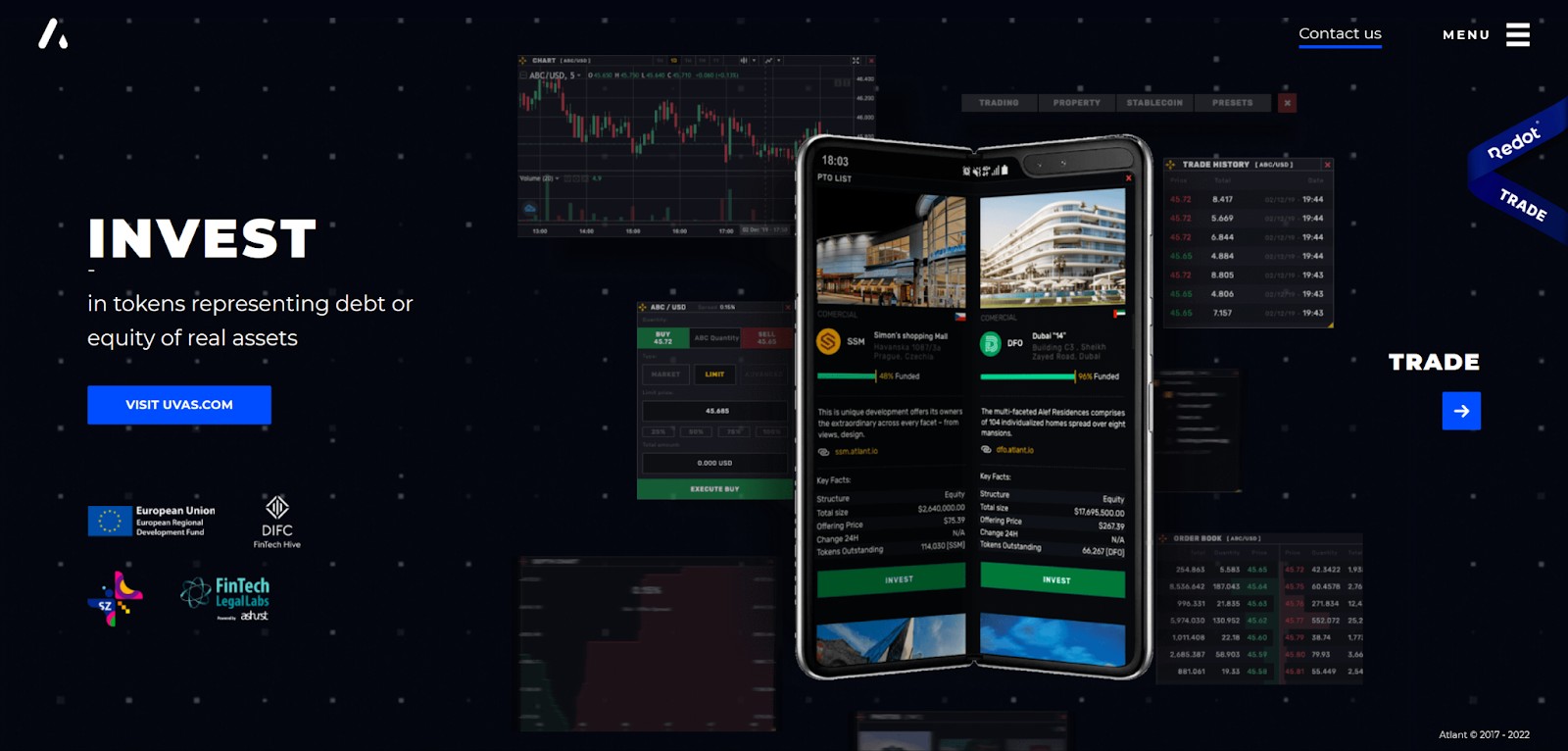
Atlant is a blockchain platform focused on the tokenization of commercial real estate. The company sees the tokenization market as a way to decentralize and democratize real estate investments, making them accessible to a wide range of investors.

Features of the Atlant platform. Atlant is distinguished by the transparency and decentralization of its platform, ensuring complete security of data and transactions. The platform provides access to commercial real estate investments with minimal costs and high levels of liquidity.
Create an account on a tokenization platform
Once you’ve selected a platform, you’ll need to create an account. This typically involves a verification process (Know Your Customer, or KYC) to confirm your identity and comply with local regulations. Be prepared to submit identification documents and go through a verification process.
Fund your account
Most tokenization platforms require funding your account with cryptocurrency, such as Ethereum (ETH) or stablecoins like USDT. Some platforms may also accept traditional fiat currencies like USD or EUR. Transfer the necessary funds to your account to be ready for investment.
Before selecting specific tokenized properties, investors need access to cryptocurrency or secondary markets where real estate tokens can be purchased, traded, or transferred. In practice, this often involves using cryptocurrency exchanges that support stablecoins, Ethereum-based tokens, and on-chain transactions. The table below compares several exchanges based on features that may be relevant for investing in tokenized real estate.
| Coinbase | OKX | Crypto.com | Kraken | Cryptohopper | |
|---|---|---|---|---|---|
|
Demo account |
No | Yes | No | No | No |
|
Coins Supported |
249 | 329 | 250 | 278 | 1000 |
|
Min. Deposit, $ |
10 | 10 | 1 | 10 | No |
|
Spot leverage |
1:3 | 1:10 | 1:3 | 1:5 | No |
|
Spot Maker Fee, % |
0.5 | 0.08 | 0.25 | 0.25 | 0 |
|
Spot Taker fee, % |
0.5 | 0.1 | 0.5 | 0.4 | 0 |
|
TU overall score |
8.6 | 8.48 | 8.44 | 8.32 | 7.85 |
|
Open an account |
Go to broker Your capital is at risk. |
Go to broker Your capital is at risk. |
Go to broker Your capital is at risk. |
Go to broker Your capital is at risk. |
Go to broker Your capital is at risk. |
Select properties to invest in
Browse through the available tokenized real estate offerings on the platform. Each listing will provide details on the property, such as its location, type (residential, commercial, rental), potential returns, and token price. Evaluate these properties based on your investment goals, such as long-term appreciation, rental income, or diversification.
Purchase tokens
Once you’ve identified a property to invest in, you can purchase tokens representing fractional ownership of that property. Depending on the platform, you may receive monthly or quarterly rental income from the property based on the number of tokens you own.After purchasing the tokens, they will be transferred to your digital wallet. Ensure that you use a secure and trusted cryptocurrency wallet that supports the platform’s token standard (often ERC-20 on the Ethereum blockchain).
Monitor your investment
Regularly check the performance of your tokenized real estate holdings. This includes tracking property appreciation, rental income, and any changes in the real estate market. Some platforms allow you to trade your tokens on secondary markets, offering liquidity and flexibility to sell your investment at any time.
How to choose tokenized real estate to buy
Here are the main factors to consider when evaluating tokenized projects, as well as examples of top projects that can serve as a guide for investors.
Property location. Location remains one of the most important factors in real estate, even in the case of tokenized assets. Investors should choose properties in areas with high demand for housing or commercial real estate, which can ensure sustainable growth in the value of tokens. For example, real estate in major cities such as New York or Los Angeles has higher liquidity and growth potential than in less developed regions.
Liquidity. Liquidity determines how quickly and easily you can sell your tokens on the market. Projects with high liquidity allow investors to more flexibly manage their assets, quickly selling tokens when needed. Liquidity may depend on the popularity of the platform on which the tokens are issued, as well as the interest of other investors in a particular property.
Platform reputation. Choosing a reliable platform for real estate tokenization is a key aspect of successful investment. Reputable platforms provide a high level of security, transparency, and regulatory compliance, which minimizes risks for investors.
Property economics. Before purchasing tokens, it is important to evaluate the economics of the property, such as current income, rental level, maintenance costs, and projected growth in value. Properties with stable income and high potential for token value growth are more attractive to investors.
Property readiness. Investors should consider whether the property is under construction or has already been commissioned and is generating income. Finished properties with existing tenants provide stable income and less risk compared to projects at the development stage.
Benefits of real estate asset tokenization
Real estate tokenization offers a variety of benefits to investors, including increased liquidity, lower barriers to entry, and transparency in transactions. This section will discuss the key benefits of tokenization and provide practical application examples.
Increased liquidity. Tokenization allows investors to purchase shares in real estate with smaller amounts, significantly increasing the liquidity of the market. Unlike the traditional real estate market, where selling a property can take months, tokenized assets can be sold almost instantly.
Accessibility and security. Tokenization makes the real estate market more accessible to small investors, allowing them to participate in large projects with minimal investment. For example, on the RealT platform, the minimum investment amount is only $50, opening the door to a wider audience.
Technological transparency. Blockchain technology plays a key role in ensuring the transparency and security of tokenized real estate transactions. All transactions are recorded on an immutable ledger, eliminating the possibility of fraud.
When investing in tokenized real estate, pay attention to the legislation and liquidity

In recent years, real estate tokenization has become one of the most discussed innovations in the investment sphere. However, it is important to understand that despite all the advantages, this process carries certain risks that are not always obvious at first glance. One of the key aspects that investors should consider is the legal framework for tokenized assets.
Laws governing tokenization can vary significantly from country to country, which affects the legitimacy and protection of investors. Before investing, I recommend carefully studying the legal side of the issue and making sure that the platform on which the tokenization takes place strictly complies with all local and international regulations.
In addition, it is worth paying attention to the liquidity of the tokens. Although tokenization promises improved liquidity compared to traditional methods of investing in real estate, this is not always the case in practice. Token liquidity can vary depending on the platform and the specific asset, so it is important to evaluate how quickly and profitably you can sell your tokens if the need arises. For this, I recommend choosing platforms that have a good track record and high user activity.
Another important aspect is risk diversification. Tokenization allows you to invest in fractional shares of real estate, which reduces the barrier to entry into the market, but at the same time it can increase the risk when concentrating funds in one asset or on one platform.
To minimize risks, I recommend not only distributing investments between different real estate properties, but also considering the different sectors and regions in which these properties are located. This approach will help you create a more sustainable investment portfolio in the long term.
Conclusion
Investing in tokenized real estate marks a transformative shift in the property market, democratizing access and enhancing liquidity for investors worldwide. Platforms like RealT and Brickblock exemplify how blockchain technology can streamline transactions and reduce traditional barriers. The primary benefit lies in the ability for everyday investors to own fractional shares of high-value properties, diversifying portfolios with lower capital requirements. Ultimately, tokenized real estate is reshaping how we perceive and participate in property investment, turning what was once an exclusive market into an accessible opportunity for all. In this new era, property ownership is no longer bound by borders or vast sums, but open to anyone willing to embrace innovation.
FAQs
What are the main risks associated with investing in tokenized real estate?
How does blockchain technology ensure transparency and security in tokenized real estate?
Is it possible to trade or sell tokenized real estate assets before the underlying property is sold?
What steps can investors take to diversify their tokenized real estate portfolio?
Editors' Top Picks and Insights

BitMEX is shutting down: Why Trump could not save the exchange

Do governments need crypto workers?

Brent nears $100: Why oil prices are rising

Gram Wallet launch: Can Telegram bring crypto to the masses?

AI without limits: How dangerous are neural networks?

Worldcoin on Wall Street: From iris scans to ETF
Related Articles
Team that worked on the article
Maxim Nechiporenko has been a contributor to Traders Union since 2023. He started his professional career in the media in 2006.
Dan Blystone began his trading career in 1998 as an arbitrage clerk on the floor of the Chicago Mercantile Exchange (CME). He later traded bond and Eurex futures at proprietary firms such as Altea Trading, gaining valuable experience in high-frequency trading and risk management.
Chinmay Soni is a financial analyst with more than 5 years of experience in working with stocks, Forex, derivatives, and other assets. As a founder of a boutique research firm and an active researcher, he covers various industries and fields, providing insights backed by statistical data.
CFD is a contract between an investor/trader and seller that demonstrates that the trader will need to pay the price difference between the current value of the asset and its value at the time of contract to the seller.
Index in trading is the measure of the performance of a group of stocks, which can include the assets and securities in it.
Diversification is an investment strategy that involves spreading investments across different asset classes, industries, and geographic regions to reduce overall risk.
Risk management is a risk management model that involves controlling potential losses while maximizing profits. The main risk management tools are stop loss, take profit, calculation of position volume taking into account leverage and pip value.
Cryptocurrency is a type of digital or virtual currency that relies on cryptography for security. Unlike traditional currencies issued by governments (fiat currencies), cryptocurrencies operate on decentralized networks, typically based on blockchain technology.

-
 Afghanistan
-
 Albania
-
 Algeria
-
 Angola
-
 Argentina
-
 Armenia
-
 Australia
-
 Austria
-
 Azerbaijan
-
 Bahamas
-
 Bahrain
-
 Bangladesh
-
 Belarus
-
 Belgium
-
 Bolivia
-
 Botswana
-
 Brazil
-
 Brunei
-
 Bulgaria
-
 Cambodia
-
 Cameroon
-
 Canada
-
 Chile
Chile
-
 China
China
-
 Colombia
-
 Congo
Congo
-
 Costa Rica
-
 Cote d'Ivoire
-
 Croatia
-
 Cuba
Cuba
-
 Cyprus
-
 Czechia
-
 DR Congo
-
 Denmark
-
 Dominican Republic
-
 Ecuador
-
 Egypt
Egypt
-
 El Salvador
-
 Estonia
-
 Eswatini
-
 Ethiopia
-
 Finland
-
 France
-
 Georgia
-
 Germany
-
 Ghana
Ghana
-
 Greece
-
 Haiti
Haiti
-
 Hong Kong
-
 Hungary
-
 India
India
-
 Indonesia
-
 Iran, Islamic republic
-
 Iraq
Iraq
-
 Ireland
-
 Israel
-
 Italy
Italy
-
 Jamaica
-
 Japan
Japan
-
 Jordan
-
 Kazakhstan
-
 Kenya
Kenya
-
 Korea
Korea
-
 Kuwait
-
 Kyrgyzstan
-
 Laos
Laos
-
 Latvia
-
 Lebanon
-
 Lesotho
-
 Libya
Libya
-
 Lithuania
-
 Luxembourg
-
 Madagascar
-
 Malaysia
-
 Malta
Malta
-
 Mauritius
-
 Mexico
-
 Moldova
-
 Mongolia
-
 Montenegro
-
 Morocco
-
 Mozambique
-
 Myanmar
-
 Namibia
-
 Nepal
Nepal
-
 Netherlands
-
 New Zealand
-
 Nigeria
-
 North Macedonia
-
 Norway
-
 Oman
Oman
-
 Pakistan
-
 Palestine
-
 Panama
-
 Papua New Guinea
-
 Paraguay
-
 Peru
Peru
-
 Philippines
-
 Poland
-
 Portugal
-
 Puerto Rico
-
 Qatar
Qatar
-
 Reunion
-
 Romania
-
 Rwanda
-
 Saudi Arabia
-
 Serbia
-
 Singapore
-
 Slovakia
-
 Slovenia
-
 Somalia
-
 South Africa
-
 Spain
Spain
-
 Sri Lanka
-
 Sweden
-
 Switzerland
-
 Syria
Syria
-
 Taiwan
-
 Tajikistan
-
 Tanzania
-
 Thailand
-
 Trinidad and Tobago
-
 Tunisia
-
 Turkey
-
 UAE
UAE
-
 Uganda
-
 Ukraine
-
 United Kingdom
-
United States
-
 Uruguay
-
 Uzbekistan
-
 Venezuela
-
 Vietnam
-
 Yemen
Yemen
-
 Zambia
-
 Zimbabwe
- Forex
- Crypto












