
Would Retail Investors Buy Tokenized Stocks? | TU Research



Editorial Note: While we adhere to strict Editorial Integrity, this post may contain references to products from our partners. Here's an explanation for How We Make Money. None of the data and information on this webpage constitutes investment advice according to our Disclaimer.
TU research suggests that retail investors are interested in tokenized stocks, but regulatory uncertainty remains the biggest obstacle to widespread adoption. 42% of respondents said they would consider investing in tokenized stocks, while another 31% would do so after learning more about the concept. Fractional ownership was identified as the biggest advantage by 34% of investors, followed by 24/7 trading (22%) and faster settlement (18%). At the same time, 32% cited the lack of regulation and investor protection as their main concern, ahead of uncertainty about ownership rights (24%) and security risks (21%). The research also found that 54% expect tokenized stocks to coexist with traditional equities rather than replace them, suggesting that investors view tokenization as an additional investment channel rather than a complete transformation of financial markets.
Tokenization has become one of the most discussed developments in global capital markets, with blockchain technology increasingly applied to traditional assets such as stocks, ETFs, bonds, and real estate. Major financial platforms, including Robinhood and Kraken, and Securitize, are developing tokenized asset solutions, while institutions highlight potential benefits such as fractional ownership, faster settlement, and broader market access.
However, widespread adoption depends not only on technological progress but also on investor confidence, regulatory clarity, and understanding of digital ownership. To examine whether retail investors are prepared for this shift, Traders Union conducted a proprietary survey of 1,500 investors worldwide, analyzing awareness, investment interest, perceived benefits, adoption barriers, and expectations for the future of tokenized stocks.
The research aims to answer six key questions:
Which benefits make tokenized stocks attractive to investors?
What concerns prevent wider adoption of tokenized securities?
How do investors expect tokenized stocks to affect the future of investing?
Findings
Based on TU Research, several important patterns emerge regarding retail investor attitudes toward tokenized stocks:
Investor awareness is growing, but deep understanding remains limited. Only 18% of respondents said they fully understand how tokenized stocks work, while 37% have general knowledge and another 24% have heard the term but do not understand the concept. This suggests that awareness of tokenized equities is increasing, but education remains a key barrier to wider adoption.
Most investors are open to tokenized stocks, but immediate adoption remains limited. 42% of respondents said they would consider investing in tokenized stocks, while another 31% would consider it after learning more about the concept. At the same time, 21% prefer traditional stocks, indicating that interest exists but investor confidence is still developing.
Fractional ownership is the strongest reason investors are interested in tokenization. 34% of respondents identified the ability to buy fractional shares as the biggest advantage of tokenized stocks, followed by 24/7 trading availability (22%) and faster settlement (18%). The findings suggest that investors are primarily attracted by improved accessibility rather than blockchain technology itself.
Regulation and investor protection are the biggest barriers to adoption. 32% of respondents identified the lack of regulation and investor protection as their main concern, while 24% cited uncertainty about ownership rights and 21% pointed to security risks. This indicates that trust in the legal and operational framework remains more important than technological concerns.
Traditional financial institutions remain more trusted than crypto-native platforms. 38% of respondents said they would prefer to buy tokenized stocks through a traditional broker, while 27% selected a major bank or financial institution. By comparison, only 21% preferred regulated crypto exchanges, suggesting that mainstream adoption may depend on integration with established financial providers.
Investors expect tokenized stocks to complement rather than replace traditional equities. 54% of respondents believe tokenized stocks will coexist with traditional shares over the next five years, while only 17% expect them to become the main investment format. This suggests that retail investors view tokenization as an additional investment channel rather than a complete transformation of equity markets.

Risk warning: All investments carry risk, including potential capital loss. Economic fluctuations and market changes affect returns, and 40-50% of investors underperform benchmarks. Diversification helps but does not eliminate risks. Invest wisely and consult professional financial advisors.
Institutional validation
Tokenization of financial assets has rapidly evolved from a blockchain innovation into one of the most widely discussed trends in global capital markets. While tokenized stocks are only beginning to reach retail investors, institutional organizations increasingly view tokenization as a potential modernization of securities infrastructure rather than a niche cryptocurrency application.
The World Economic Forum (WEF) reached this conclusion in its 2025 report "Asset Tokenization in Financial Markets: The Next Generation of Value Exchange." The report identifies tokenization as a new model of digital asset ownership capable of improving market efficiency, transparency, accessibility, and interoperability. According to the WEF, tokenized securities could enable fractional ownership, programmable financial products, faster settlement, and broader investor participation, provided regulatory and operational standards continue to develop. At the same time, the report emphasizes that legacy market infrastructure, fragmented regulation, interoperability, and liquidity remain major obstacles to large-scale adoption.
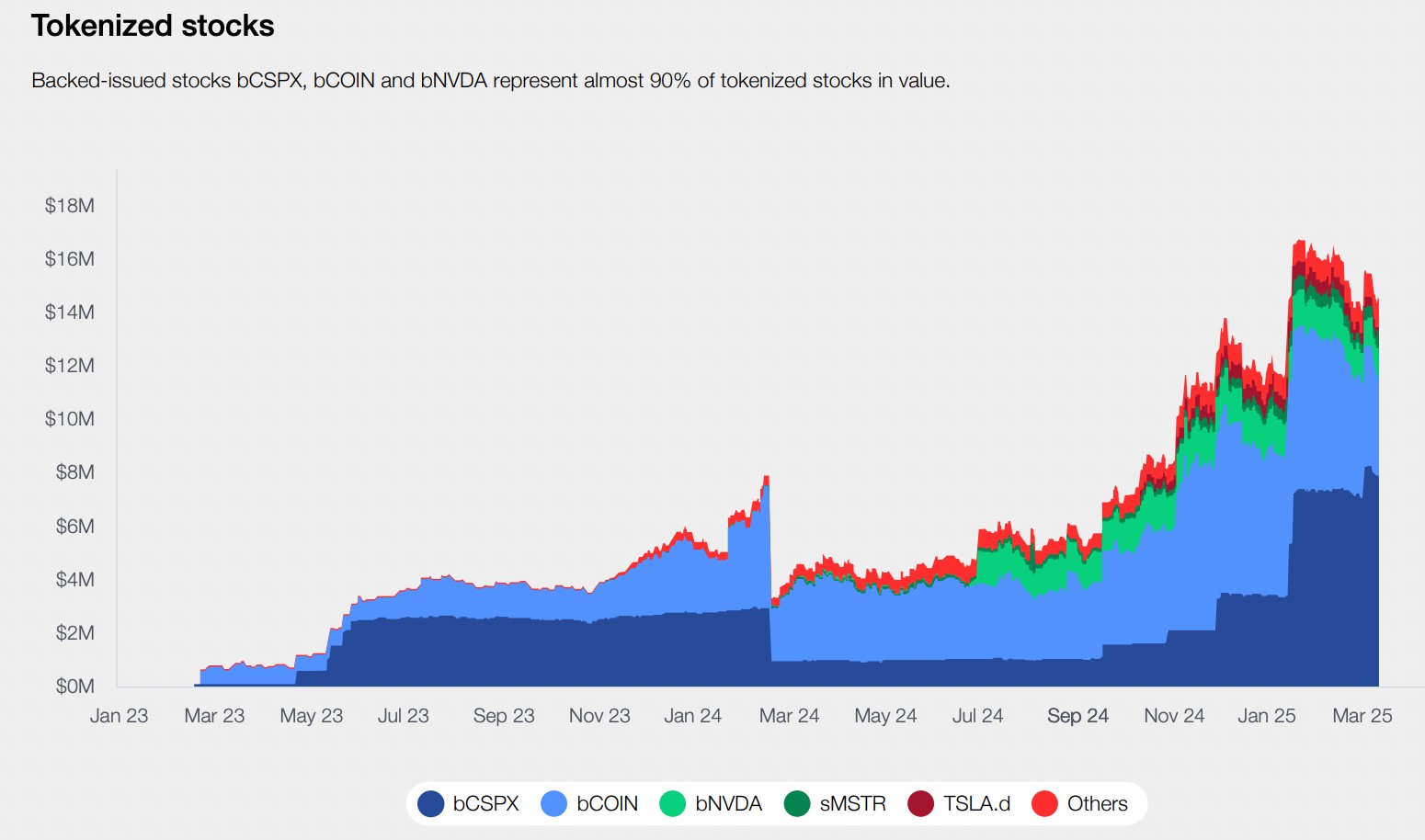
The OECD reached similar conclusions in its policy paper "Tokenisation of Assets and Distributed Ledger Technologies in Financial Markets: Potential Impediments to Market Development and Policy Implications" (2025). While acknowledging growing institutional interest, the OECD notes that adoption of tokenized securities remains limited because of unresolved legal questions surrounding ownership rights, custody, investor protection, and regulatory harmonization. The organization argues that successful tokenization will depend as much on legal certainty and supervisory frameworks as on technological innovation.
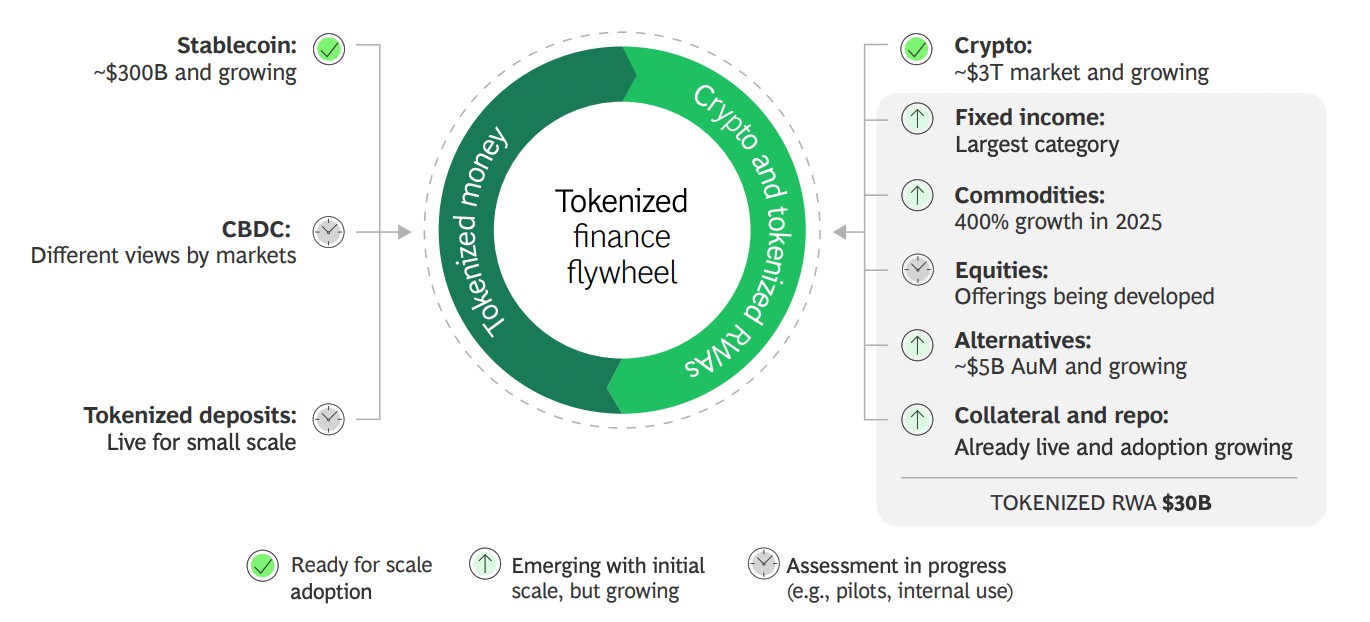
Infrastructure providers likewise view tokenization primarily as an evolution of existing financial markets rather than a replacement for them. In the BCG–DTCC report discussing digital asset securities interoperability, researchers argue that tokenized securities are expanding rapidly but that the industry's next stage depends on interoperability between traditional financial infrastructure and blockchain networks. The report highlights several practical advantages – including 24/7 transfers, fractional ownership, lower investment thresholds, and more efficient collateral management – while emphasizing that coordinated standards across market participants and regulators remain essential for broader adoption.
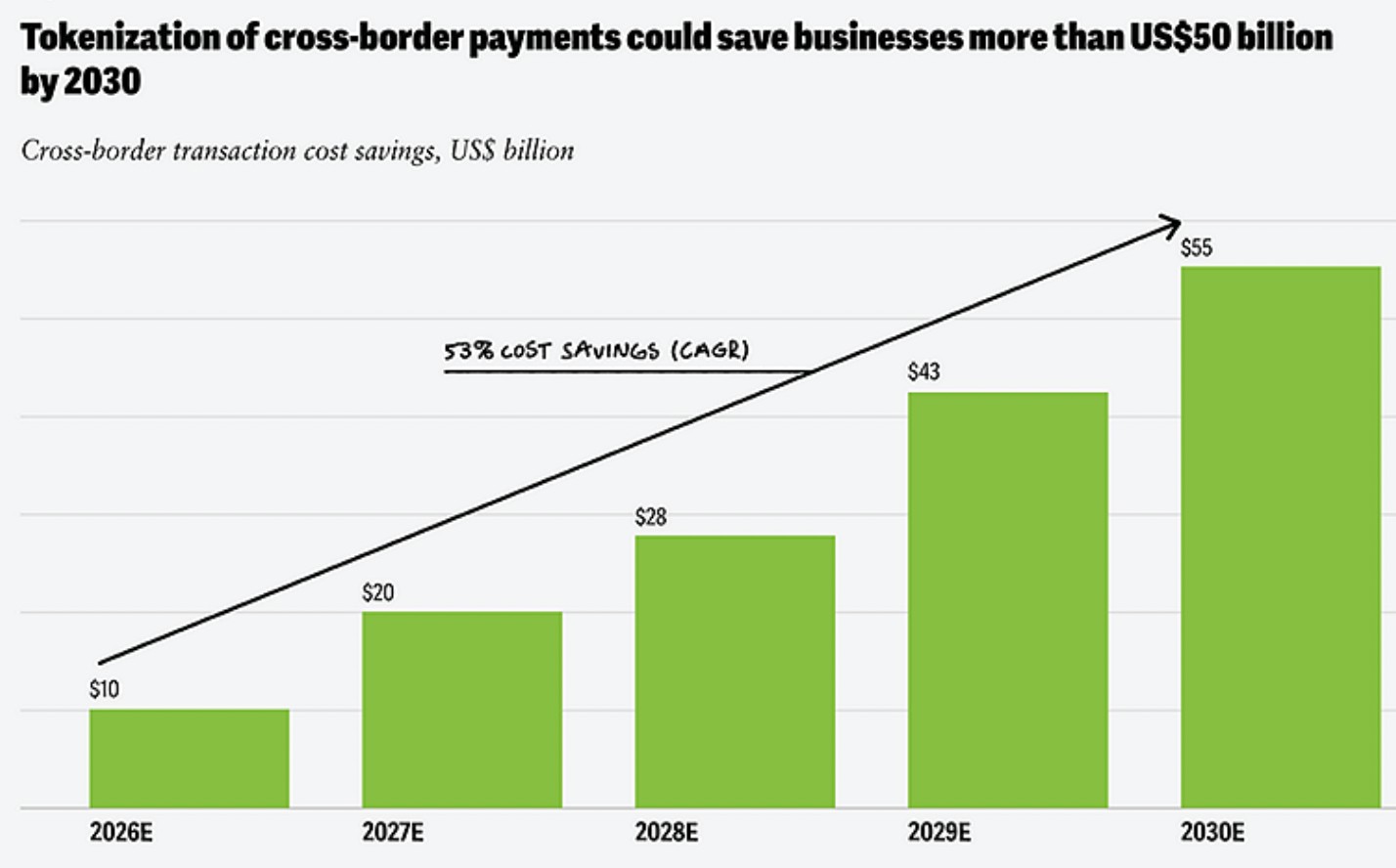
Large financial institutions increasingly see similar opportunities beyond securities markets. In Deloitte's "Financial Services Industry Predictions 2025", analysts forecast growing adoption of tokenized financial infrastructure, arguing that blockchain-based settlement networks could significantly reduce friction in global financial transactions over the coming decade. Deloitte views tokenization as part of a broader modernization of financial market infrastructure rather than simply an extension of cryptocurrency markets.
These institutional expectations are increasingly reflected in commercial market activity. Robinhood, Kraken, Coinbase and other platforms have announced initiatives involving tokenized equities, while specialized infrastructure providers continue expanding regulated tokenization services for real-world assets. The race to launch tokenized stocks demonstrates that financial institutions increasingly consider blockchain-based securities a commercial opportunity rather than an experimental technology.
Despite this momentum, institutional publications consistently reach one common conclusion: technology alone will not determine whether tokenized stocks become mainstream. The decisive factors remain investor confidence, legal ownership protections, regulatory clarity, custody arrangements, market liquidity, and operational resilience. In other words, the challenge is gradually shifting from whether tokenization works to whether investors trust it enough to allocate capital.
Theoretical research
The adoption of tokenized stocks can be explained through several established concepts in financial markets and behavioral finance. Unlike traditional equities, tokenized securities require investors to evaluate not only the underlying asset but also the technology, infrastructure, and legal framework behind ownership.
The first key concept is market accessibility. Tokenization can reduce traditional barriers to investing by enabling fractional ownership, faster settlement, and broader access to financial assets. The Bank for International Settlements (BIS) describes tokenization as a process that can integrate asset information, ownership rights, and transaction mechanisms into a unified digital infrastructure, potentially improving market efficiency. However, BIS also emphasizes that adoption depends on maintaining trust, legal certainty, and operational reliability.
The second concept is investor trust and technology adoption. According to the Technology Acceptance Model, users adopt new technologies when they perceive them as useful and reliable. In financial markets, perceived usefulness alone is insufficient: investors also require confidence in regulation, custody, and ownership protection.
The third concept is behavioral familiarity. Investors tend to prefer financial products that resemble existing market structures. Traditional stocks benefit from decades of investor experience with brokers, exchanges, and regulatory frameworks. Tokenized securities introduce unfamiliar elements, including blockchain networks, digital custody, and smart contracts, which may influence adoption through uncertainty and perceived risk.
Survey data
To understand whether retail investors are prepared for the emergence of tokenized stocks, we conducted a proprietary quantitative study examining investor awareness, adoption interest, perceived benefits, and concerns related to blockchain-based equities.
While institutional research focuses primarily on the potential efficiency gains of tokenization, this survey examines the practical question facing the market: are individual investors willing to trust and use tokenized versions of traditional financial assets?
The study compares investor expectations with institutional developments in tokenized securities, identifying the factors that may accelerate or slow retail adoption.
Methodology
The study was conducted using a structured online survey based on the CAWI methodology.
Sample composition: 1,500 retail investors.
Coverage: North America, Europe, Asia, Latin America, Africa, and emerging markets.
Age: 18–60 years old.
Participation criteria: respondents who actively invest or trade financial assets, including stocks, ETFs, cryptocurrencies, or other investment products.
Statistical confidence: 95%.
Estimated sampling deviation: ±2.5%.
Research team
The study was conducted by our experts:
Anastasiia Chabaniuk (Author, TU Research) – research design and interpretation.
Chinmay Soni (Fact-checker) – data validation and statistical verification.
Dan Blystone (Editor-in-Chief) – editorial and methodological supervision.
TU Research Team (Andrey Mastykin, Oleg Tkachenko) – data collection and analysis.
Have retail investors heard about tokenized stocks?
Although institutional adoption of tokenized assets is accelerating, retail awareness remains one of the biggest challenges for market growth. Before evaluating willingness to invest, the research examined whether investors are already familiar with the concept of tokenized stocks.
| Awareness level | Share of investors |
|---|---|
| Yes, and I understand how they work | 18% |
| Yes, but I only have a general understanding | 37% |
| I have heard the term but do not understand it | 24% |
| No, this is the first time I hear about them | 21% |
Insight: Most investors have encountered the concept of tokenized stocks, but deep understanding remains limited. Only 18% of respondents said they fully understand how tokenized equities work, suggesting that education may become a key factor determining adoption.
Would investors buy tokenized stocks?
The central question of the research was whether retail investors would actually consider purchasing tokenized versions of traditional equities.
Investor willingness to buy tokenized stocks:
Yes, I would consider investing – 42%.
Maybe, after learning more about them – 31%.
No, I prefer traditional stocks – 21%.
Unsure – 6%.

Insight: Interest in tokenized stocks is significant, with 73% of respondents either willing to invest or open to learning more about the concept. However, immediate adoption remains limited, indicating that education, trust, and regulatory clarity will play a key role in determining whether tokenized equities achieve mainstream acceptance.
What advantages of tokenized stocks attract investors most?
Tokenization is often promoted through several potential benefits, including fractional ownership, faster settlement, and broader access. The survey examined which advantages matter most to retail investors.
| Advantage | Share of investors |
|---|---|
| Ability to buy fractional shares | 34% |
| 24/7 trading availability | 22% |
| Faster transactions and settlement | 18% |
| Access to global markets | 16% |
| Lower fees | 10% |
Insight: Fractional ownership is the strongest driver of interest. Investors appear more attracted to improved accessibility than to blockchain technology itself, suggesting that tokenization will succeed primarily by solving practical investment problems.
What concerns prevent investors from buying tokenized stocks?
Despite growing institutional interest, tokenized securities face several adoption barriers. The survey examined which risks concern retail investors most.
Main concerns preventing retail investors from adopting tokenized stocks:
Lack of regulation and investor protection – 32%.
Uncertainty about ownership rights – 24%.
Security risks and hacking – 21%.
Lack of trust in platforms offering tokens – 15%.
Difficulty understanding the technology – 8%.

Insight: Regulation and ownership protection represent the largest barriers. Investors are less concerned about blockchain complexity itself and more concerned about whether tokenized assets provide the same legal protections as traditional shares.
Which assets would investors like to see tokenized?
To understand which markets could benefit most from tokenization, respondents were asked which assets they would prefer to access through blockchain-based ownership.
| Asset | Share of investors |
|---|---|
| Individual stocks | 29% |
| Real estate | 26% |
| ETFs | 18% |
| Gold and commodities | 15% |
| Bonds | 12% |
Insight: Stocks and real estate attract the strongest interest, reflecting demand for fractional ownership of assets that traditionally require larger amounts of capital.
Which platforms would investors trust for tokenized stocks?
One of the key challenges for tokenized securities is determining where investors would feel comfortable purchasing them. Although crypto-native platforms have played an important role in developing blockchain infrastructure, traditional financial institutions continue to benefit from stronger consumer trust.
Preferred platforms for purchasing tokenized stocks:
Traditional broker – 38%;
Major bank or financial institution – 27%;
Regulated crypto exchange – 21%;
Decentralized platform – 7%;
No preference – 7%.

Insight: Retail investors show a clear preference for established financial institutions. While blockchain platforms enable tokenization technically, mainstream adoption may depend on distribution through trusted brokers and regulated financial providers.
Would investors replace traditional stocks with tokenized stocks?
Tokenization is often presented as a future transformation of financial markets. However, adoption does not necessarily mean that investors will abandon traditional shares. The survey examined whether retail investors expect tokenized equities to replace conventional ownership models.
| Response | Share of investors |
|---|---|
| Yes, tokenized stocks will become the main investment format | 17% |
| They will coexist with traditional stocks | 54% |
| They will remain a niche product | 21% |
| Unsure | 8% |
Insight: Most investors expect tokenized stocks to complement rather than replace traditional equities. This suggests that adoption may follow the path of previous financial innovations, where new technologies gradually integrate into existing market structures.
PDF version of the TU research
Download the full PDF version of the TU research to access additional analysis, detailed survey data, and extended findings from our analytical team. The report includes complete methodology, charts, and behavioral insights referenced throughout the study.
Practical implications for investors
Several practical conclusions emerge from the research:
Tokenized stocks are likely to complement traditional investing rather than replace it. Most respondents expect tokenized equities to exist alongside conventional stocks rather than completely transform existing markets. Investors should therefore view tokenization as an additional access mechanism rather than a guaranteed replacement for traditional brokerage accounts.
Understanding ownership rights remains essential. Before investing in tokenized securities, investors should understand what exactly the token represents, how ownership is recorded, and whether the asset provides the same rights as a traditional share, including dividends and voting rights.
Regulation should be a key selection factor. The survey shows that investor confidence depends heavily on regulatory protection. Investors should evaluate whether tokenized stock platforms operate under recognized financial frameworks and provide transparent information about custody and asset backing.
Established financial providers may drive mainstream adoption. Retail investors show stronger trust in traditional brokers and financial institutions than purely crypto-native platforms. This suggests that future adoption may come through partnerships between blockchain providers and established financial companies.
Fractional ownership may become the strongest consumer benefit. The biggest advantage identified by respondents was the ability to access expensive assets with smaller amounts of capital. Tokenization may therefore expand participation among investors who previously faced high entry barriers.
Technology alone does not guarantee adoption. Although blockchain enables tokenized securities, investor behavior will ultimately determine market success. Trust, simplicity, transparency, and regulation are likely to matter more than technical innovation.
As tokenized stocks become easier to access across global markets, many traders also look for exchanges that support smooth and reliable trading of these digital equities. The list of best crypto exchanges for investing in tokenized stocks below offers a simple way to compare trusted platforms, helping you choose a venue that fits your trading habits and preferred funding methods.
Data sources and methodology references
World Economic Forum. Asset Tokenization in Financial Markets.
Organisation for Economic Co-operation and Development (OECD). Tokenisation of Assets and Distributed Ledger Technologies in Financial Markets.
Financial Stability Board (FSB). The Financial Stability Implications of Tokenisation.
Deloitte. Financial Services Industry Predictions 2025.
BCG and DTCC. Research on digital asset securities and financial market infrastructure.
World Economic Forum. (2024). Modernizing financial markets with wholesale central bank digital currency.
SSRN. Digital money and finance: A critical review of terminology.
Traders Union. Where To Buy Tokenized Stocks?
Traders Union. What Are Tokenized Stocks And How Do They Work.
IdSurvey. CAWI Methodology Overview.
Previous volumes in this series
Conclusion
Tokenized stocks are poised to expand retail investing, but their mainstream adoption will ultimately depend on trust, clear regulation, and education rather than technological innovation alone. While a significant majority of investors express interest—citing benefits like fractional ownership and 24/7 trading—they remain wary of regulatory uncertainty and unclear ownership rights. Traditional financial institutions, more than crypto-native platforms, are seen as the trusted gateways for these new digital assets. Ultimately, tokenized stocks are set to complement, rather than replace, traditional equities—suggesting that the future of investing will be shaped as much by confidence and clarity as by code. The real test will be whether tokenization can deliver not just new efficiencies, but the certainty and security that investors demand.
FAQs
What practical benefits do tokenized stocks offer to retail investors compared to traditional equities?
What are the primary barriers preventing the widespread adoption of tokenized stocks?
Do investors expect tokenized stocks to replace traditional stocks in the near future?
How does trust in financial platforms affect investor willingness to purchase tokenized stocks?
Editors' Top Picks and Insights

Is Bitcoin right for you? Five traits shared by many cryptocurrency holders

Chasing hits: Why investors are losing interest in Netflix

Tokenized stocks in the spotlight: How do they work and are they worth trading?

Do politicians make the best stock traders?

Crypto test drive: How automakers are exploring digital assets

Lindsey Graham death: U.S. senator’s crypto legacy
Related Articles
Team that worked on the article
Anastasiia has 17 years of experience in finance and content marketing. She believes that the support of information and expert opinion is very important for the success of investors and new traders.
Dan Blystone began his trading career in 1998 as an arbitrage clerk on the floor of the Chicago Mercantile Exchange (CME). He later traded bond and Eurex futures at proprietary firms such as Altea Trading, gaining valuable experience in high-frequency trading and risk management.
Chinmay Soni is a financial analyst with more than 5 years of experience in working with stocks, Forex, derivatives, and other assets. As a founder of a boutique research firm and an active researcher, he covers various industries and fields, providing insights backed by statistical data.

-
 Afghanistan
-
 Albania
-
 Algeria
-
 Angola
-
 Argentina
-
 Armenia
-
 Australia
-
 Austria
-
 Azerbaijan
-
 Bahamas
-
 Bahrain
-
 Bangladesh
-
 Belarus
-
 Belgium
-
 Bolivia
-
 Botswana
-
 Brazil
-
 Brunei
-
 Bulgaria
-
 Cambodia
-
 Cameroon
-
 Canada
-
 Chile
Chile
-
 China
China
-
 Colombia
-
 Congo
Congo
-
 Costa Rica
-
 Cote d'Ivoire
-
 Croatia
-
 Cuba
Cuba
-
 Cyprus
-
 Czechia
-
 DR Congo
-
 Denmark
-
 Dominican Republic
-
 Ecuador
-
 Egypt
Egypt
-
 El Salvador
-
 Estonia
-
 Eswatini
-
 Ethiopia
-
 Finland
-
 France
-
 Georgia
-
 Germany
-
 Ghana
Ghana
-
 Greece
-
 Haiti
Haiti
-
 Hong Kong
-
 Hungary
-
 India
India
-
 Indonesia
-
 Iran, Islamic republic
-
 Iraq
Iraq
-
 Ireland
-
 Israel
-
 Italy
Italy
-
 Jamaica
-
 Japan
Japan
-
 Jordan
-
 Kazakhstan
-
 Kenya
Kenya
-
 Korea
Korea
-
 Kuwait
-
 Kyrgyzstan
-
 Laos
Laos
-
 Latvia
-
 Lebanon
-
 Lesotho
-
 Libya
Libya
-
 Lithuania
-
 Luxembourg
-
 Madagascar
-
 Malaysia
-
 Malta
Malta
-
 Mauritius
-
 Mexico
-
 Moldova
-
 Mongolia
-
 Montenegro
-
 Morocco
-
 Mozambique
-
 Myanmar
-
 Namibia
-
 Nepal
Nepal
-
 Netherlands
-
 New Zealand
-
 Nigeria
-
 North Macedonia
-
 Norway
-
 Oman
Oman
-
 Pakistan
-
 Palestine
-
 Panama
-
 Papua New Guinea
-
 Paraguay
-
 Peru
Peru
-
 Philippines
-
 Poland
-
 Portugal
-
 Puerto Rico
-
 Qatar
Qatar
-
 Reunion
-
 Romania
-
 Rwanda
-
 Saudi Arabia
-
 Serbia
-
 Singapore
-
 Slovakia
-
 Slovenia
-
 Somalia
-
 South Africa
-
 Spain
Spain
-
 Sri Lanka
-
 Sweden
-
 Switzerland
-
 Syria
Syria
-
 Taiwan
-
 Tajikistan
-
 Tanzania
-
 Thailand
-
 Trinidad and Tobago
-
 Tunisia
-
 Turkey
-
 UAE
UAE
-
 Uganda
-
 Ukraine
-
 United Kingdom
-
United States
-
 Uruguay
-
 Uzbekistan
-
 Venezuela
-
 Vietnam
-
 Yemen
Yemen
-
 Zambia
-
 Zimbabwe
- Forex
- Crypto











