
Polkastarter Launchpad: In-Depth Guide For Traders In 2026


Editorial Note: While we adhere to strict Editorial Integrity, this post may contain references to products from our partners. Here's an explanation for How We Make Money. None of the data and information on this webpage constitutes investment advice according to our Disclaimer.
The Polkastarter launchpad is a decentralized multi-chain platform that offers early access to vetted crypto projects through fixed-swap IDOs. Users join sales by staking POLS, completing the allowlist requirements, and entering tier-based pools. Polkastarter supports Ethereum, BNB Chain and Polygon, and has a long record of high-performing IDOs. It is a secure, structured fundraising system that helps projects raise capital while giving investors transparent entry and predictable allocation rules.
The Polkastarter crypto launchpad operates as a cross-chain fundraising ecosystem where early-stage projects raise capital through fixed-swap IDOs. This structure reduces price manipulation and gives participants predictable entries. Over time, the platform expanded from simple token pools to a full environment supporting governance, curated project incubation and transparent sale mechanics. The official website of Polkastarter hosts IDO calendars, project documentation and updates for new and experienced users exploring how Polkastarter crypto functions.
Risk warning: Cryptocurrency markets are highly volatile, with sharp price swings and regulatory uncertainties. Research indicates that 75-90% of traders face losses. Only invest discretionary funds and consult an experienced financial advisor.
What is Polkastarter
The crypto launchpad Polkastarter uses a structured IDO model built around fixed-swap pools and token-gated access, creating a predictable entry system for participants. Its design supports retail users and larger investors by assigning allocation sizes based on POLS holdings and activity.
Key features. Token-gated entry ensures fairness and the Polkastarter IDO allowlist defines who can join each pool. Secure sale execution relies on blockchain oracles and the Polkastarter whitelist process organizes applicants by engagement and staking level.
User communication. Most updates about new Polkastarter IDOs appear on Polkastarter Twitter, where the team posts launch dates, maintenance notices and real-time announcements.

Polkastarter IDOs: performance and structure
The Polkastarter IDO framework is built around curated project selection, fixed pricing and tier-based allocations. This structure produces consistent launches across sectors like DeFi, real-world assets and especially gaming on Polkastarter, which has become one of the platform’s top-performing categories.
Allocation rules. The tiers on Polkastarter IDO determine allocation sizes. Higher POLS stakes open access to larger pools, while allowlisted wallets secure priority entry. For active investors, tracking the performance of a Polkastarter IDO helps set realistic expectations and compare opportunities across categories.
Historical returns. Earlier bull cycles saw standout cases of 50x to 100x gains, but typical returns from Polkastarter IDO now range between 2x and 5x. The model remains attractive for traders who want predictable pricing and structured early-stage entries.
How to participate in Polkastarter IDO
The process follows a simple flow:
Step 1. Connect a Web3 wallet and acquire POLS.
Step 2. Stake POLS to qualify for tiers and complete the Polkastarter whitelist process for each sale.
Step 3. Confirm the allowlist status; only approved wallets can access the join pool stage on Polkastarter.
Step 4. Fund the pool when it opens.
Insights into upcoming projects
Interest in the Polkastarter’s upcoming IDO lineup continues to grow, with several launches scheduled for early 2026. The calendar highlights AI tools, infrastructure protocols and gaming utilities expanding across multiple chains. Many entries on the upcoming IDOs list come from established teams moving from Ethereum to Layer-2 networks for faster settlement. You can check that out on their official website.
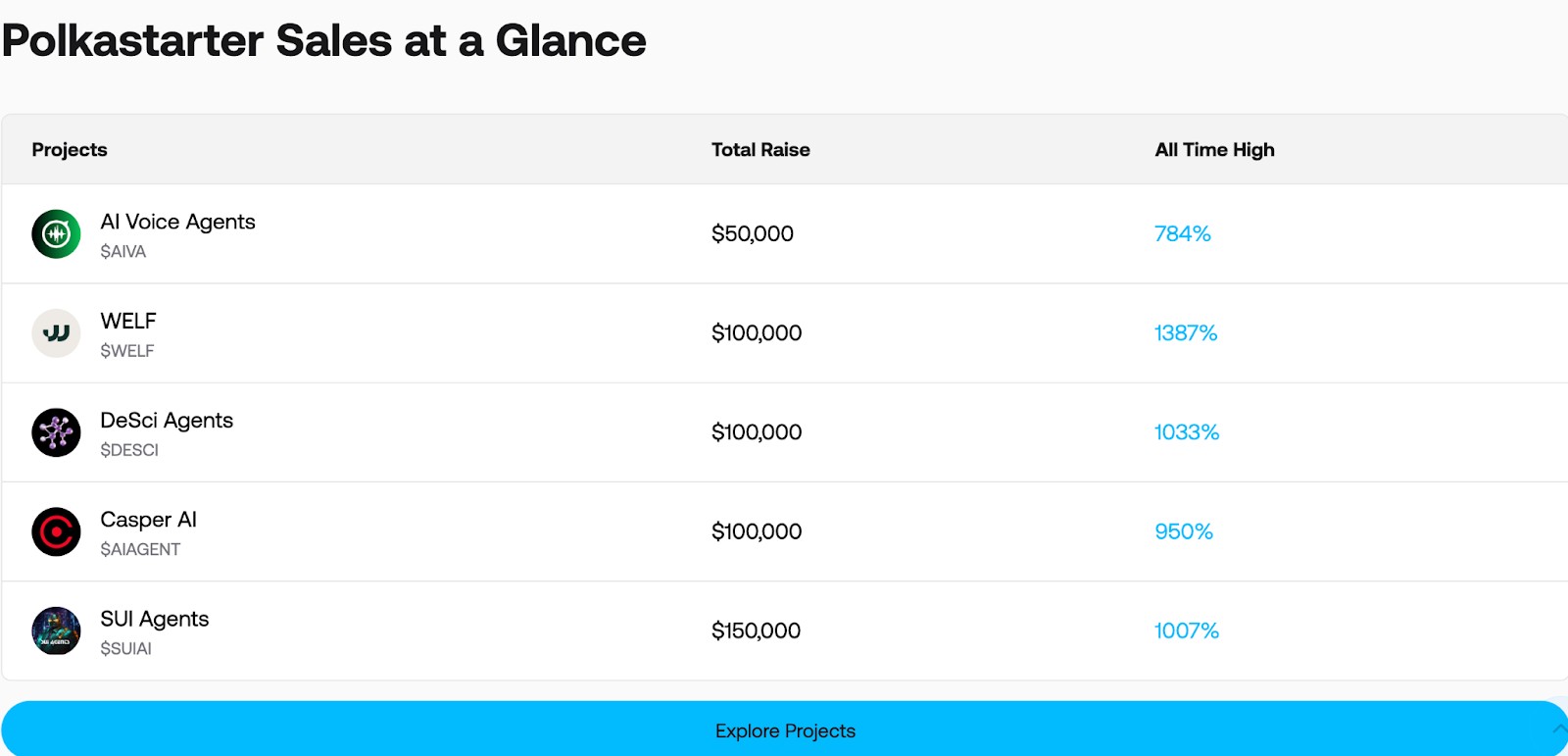
Early access often begins with private sales on crypto Polkastarter, which later transitions into public rounds with updated terms. Some teams also explore the upcoming IPO format, using smart contracts to mirror traditional offerings. Reviewing the full Polkastarter projects schedule helps investors catch early allocations and plan their participation window.
Evaluating legitimacy and transparency
Many users ask if Polkastarter is legit, and the platform’s long track record, curated project selection and VC partnerships support its credibility. Still, IDOs carry risk, especially when investors skip due diligence or rely only on marketing signals.
The typical Polkastarter IDO price is fixed in stablecoins, limiting volatility during the sale. After listing, however, token movement depends on market demand. Transparency is maintained through on-chain execution and clear communication, but investors must still verify project fundamentals before joining any sale.
Comparative advantages
The Polkastarter launchpad stands out for its interoperable network support and curated incubation model. Many new Polkastarter projects enter the platform’s affiliate pipeline, gaining early marketing, technical guidance and visibility before an IDO. This structured preparation helps new teams present clearer tokenomics and improves user confidence.
For traders, joining Polkastarter launches often provides benefits beyond tokens, including governance access, early community roles and eligibility for partner airdrops. These elements create a more complete environment compared to launchpads focused only on token sales.
| Feature | Polkastarter | DAO Maker | Seedify |
|---|---|---|---|
| Network Support | Ethereum, BNB Chain, Polygon | Ethereum, BNB Chain, Arbitrum | BNB Chain, Ethereum, Avalanche |
| Fundraising Model | Fixed-swap IDO | Strong Holder Offering (SHO), IDO | IDO, INO (NFT offering) |
| Access System | Tiered (POLS staking + whitelist) | Tiered (DAO Power score) | Tiered (SFUND staking) |
| Project Vetting | High – curated with affiliate support | High – community & internal selection | Medium – broader project range |
| Past ROI (Top Projects) | Up to 100x+ (e.g., SuperFarm, Ethernity) | Up to 200x+ (e.g., Orion Protocol) | Up to 75x (e.g., Bloktopia) |
| Governance Role | Yes (via POLS) | Yes | Limited |
| Affiliate Incubation | Yes (marketing + tech support) | No | No |
| Notable Strength | Fast visibility, strong ecosystem | Strong VC exposure, detailed metrics | Focus on gaming and NFTs |
Exchanges and liquidity
Tokens from Polkastarter IDOs typically appear on major DEXs soon after the sale ends. Most users trade on their preferred exchange, depending on the chain selected during the IDO. Early listing provides immediate liquidity, helping participants manage entries and exits with minimal slippage.
How to buy tokens on Polkastarter?
The actual purchase happens on DEXs after launch, not inside the launchpad itself. You can see if any of the exchanges below support the purchase functionality. These are the best crypto exchanges in your region, so even without Polkastarter support, having an account with them would be good.
| Coinbase | OKX | BTCC | Cryptohopper | Crypto.com | |
|---|---|---|---|---|---|
|
Min. Deposit, $ |
10 | 10 | 10 | No | 1 |
|
Coins Supported |
400+ | 600+ | 399 | 1000 | 400+ |
|
Spot Taker fee, % |
0.5 | 0.1 | 0.3 | 0 | 0.5 |
|
Spot Maker Fee, % |
0.5 | 0.08 | 0.2 | 0 | 0.25 |
|
Alerts |
Yes | Yes | No | Yes | Yes |
|
Copy trading |
No | Yes | Yes | Yes | No |
|
TU overall score |
8.5 | 8.46 | 8.08 | 7.8 | 7.76 |
|
Open an account |
Go to broker Your capital is at risk. |
Go to broker Your capital is at risk. |
Go to broker Your capital is at risk.
|
Go to broker Your capital is at risk. |
Go to broker Your capital is at risk. |
Use research, tier control and structured exits to reduce IDO risk

When evaluating opportunities on the Polkastarter launchpad, I always start by checking fundamentals rather than hype. Review tokenomics, vesting, team activity and whether past updates match the project’s promises. Even though Polkastarter IDOs are curated, the risk profile is still high, so I prefer spreading small allocations across several launches instead of concentrating on one. I also monitor the Polkastarter whitelist process closely, since meeting each project’s requirements early increases the chance of securing a spot.
After the sale, I avoid chasing volatile price spikes. Tokens listing after a Polkastarter IDO often go through sharp corrections, so having a predefined exit range helps avoid emotional decisions. I also keep separate wallets for high-risk IDO allocations and track announcements on Polkastarter’s Twitter (X) page for updates that may affect timelines or token distribution. With careful due diligence, tier management and disciplined trade execution, Polkastarter can be a productive part of an early-stage crypto strategy.
Conclusion
In summary, the Polkastarter launchpad in 2026 stands as a leading gateway for crypto investors to access promising new projects through structured IDOs and an evolved tier-based participation system. By demystifying the process of joining allowlists and highlighting the importance of security in token investments, the article empowers readers to navigate the often volatile crypto landscape with confidence. For example, projects launched via Polkastarter in previous years have demonstrated strong initial returns, underlining the platform’s rigorous vetting process and vibrant community support. Ultimately, understanding how to leverage Polkastarter’s features can provide a significant edge, reminding us that in the fast-paced world of crypto, informed participation is the key to capitalizing on true innovation.
FAQs
What are the requirements to qualify for different tiers on the Polkastarter launchpad?
How does the Polkastarter whitelist process influence IDO participation?
What types of crypto projects most frequently launch on Polkastarter, and why?
What are the typical risks associated with participating in a Polkastarter IDO?
Editors' Top Picks and Insights





Related Articles
Team that worked on the article
Aleksandra Chaikina has been a contributor to Traders Union since 2021. With over 15 years of experience in copywriting and more than 5 years focused on financial content, she specializes in producing detailed guides, analytics, and comparative reviews across various sectors, including cryptocurrencies, Forex, investment strategies, and financial technologies.
Dan Blystone began his trading career in 1998 as an arbitrage clerk on the floor of the Chicago Mercantile Exchange (CME). He later traded bond and Eurex futures at proprietary firms such as Altea Trading, gaining valuable experience in high-frequency trading and risk management.
Chinmay Soni is a financial analyst with more than 5 years of experience in working with stocks, Forex, derivatives, and other assets. As a founder of a boutique research firm and an active researcher, he covers various industries and fields, providing insights backed by statistical data.
An investor is an individual, who invests money in an asset with the expectation that its value would appreciate in the future. The asset can be anything, including a bond, debenture, mutual fund, equity, gold, silver, exchange-traded funds (ETFs), and real-estate property.
Trade execution is knowing how to place and close trades at the right price. This is the key to turning your trading plans into real action and has a direct impact on your profits.
Risk management is a risk management model that involves controlling potential losses while maximizing profits. The main risk management tools are stop loss, take profit, calculation of position volume taking into account leverage and pip value.
Cryptocurrency is a type of digital or virtual currency that relies on cryptography for security. Unlike traditional currencies issued by governments (fiat currencies), cryptocurrencies operate on decentralized networks, typically based on blockchain technology.
CFD is a contract between an investor/trader and seller that demonstrates that the trader will need to pay the price difference between the current value of the asset and its value at the time of contract to the seller.

-
 Afghanistan
-
 Albania
-
 Algeria
-
 Angola
-
 Argentina
-
 Armenia
-
 Australia
-
 Austria
-
 Azerbaijan
-
 Bahamas
-
 Bahrain
-
 Bangladesh
-
 Belarus
-
 Belgium
-
 Bolivia
-
 Botswana
-
 Brazil
-
 Brunei
-
 Bulgaria
-
 Cambodia
-
 Cameroon
-
 Canada
-
 Chile
Chile
-
 China
China
-
 Colombia
-
 Congo
Congo
-
 Costa Rica
-
 Cote d'Ivoire
-
 Croatia
-
 Cuba
Cuba
-
 Cyprus
-
 Czechia
-
 DR Congo
-
 Denmark
-
 Dominican Republic
-
 Ecuador
-
 Egypt
Egypt
-
 El Salvador
-
 Estonia
-
 Eswatini
-
 Ethiopia
-
 Finland
-
 France
-
 Georgia
-
 Germany
-
 Ghana
Ghana
-
 Greece
-
 Haiti
Haiti
-
 Hong Kong
-
 Hungary
-
 India
India
-
 Indonesia
-
 Iran, Islamic republic
-
 Iraq
Iraq
-
 Ireland
-
 Israel
-
 Italy
Italy
-
 Jamaica
-
 Japan
Japan
-
 Jordan
-
 Kazakhstan
-
 Kenya
Kenya
-
 Korea
Korea
-
 Kuwait
-
 Kyrgyzstan
-
 Laos
Laos
-
 Latvia
-
 Lebanon
-
 Lesotho
-
 Libya
Libya
-
 Lithuania
-
 Luxembourg
-
 Madagascar
-
 Malaysia
-
 Malta
Malta
-
 Mauritius
-
 Mexico
-
 Moldova
-
 Mongolia
-
 Montenegro
-
 Morocco
-
 Mozambique
-
 Myanmar
-
 Namibia
-
 Nepal
Nepal
-
 Netherlands
-
 New Zealand
-
 Nigeria
-
 North Macedonia
-
 Norway
-
 Oman
Oman
-
 Pakistan
-
 Palestine
-
 Panama
-
 Papua New Guinea
-
 Paraguay
-
 Peru
Peru
-
 Philippines
-
 Poland
-
 Portugal
-
 Puerto Rico
-
 Qatar
Qatar
-
 Reunion
-
 Romania
-
 Rwanda
-
 Saudi Arabia
-
 Serbia
-
 Singapore
-
 Slovakia
-
 Slovenia
-
 Somalia
-
 South Africa
-
 Spain
Spain
-
 Sri Lanka
-
 Sweden
-
 Switzerland
-
 Syria
Syria
-
 Taiwan
-
 Tajikistan
-
 Tanzania
-
 Thailand
-
 Trinidad and Tobago
-
 Tunisia
-
 Turkey
-
 UAE
UAE
-
 Uganda
-
 Ukraine
-
 United Kingdom
-
United States
-
 Uruguay
-
 Uzbekistan
-
 Venezuela
-
 Vietnam
-
 Yemen
Yemen
-
 Zambia
-
 Zimbabwe
- Forex
- Crypto












