
Bitpanda Launchpad: Full Guide For 2026


Editorial Note: While we adhere to strict Editorial Integrity, this post may contain references to products from our partners. Here's an explanation for How We Make Money. None of the data and information on this webpage constitutes investment advice according to our Disclaimer.
The Bitpanda launchpad gives users early access to selected Web3 token sales. To join, you need a verified Bitpanda account, VSN staking for access tiers, and the Bitpanda DeFi Wallet to commit funds during the sale. Tokens are distributed automatically, often with vesting. The platform focuses on a curated, compliance-friendly structure for EU users.
Under current market conditions, many investors are looking for early access to new crypto projects with clear rules and transparency. Bitpanda Launchpad is often discussed as one option that tries to balance innovation with user protection. This article explains what Bitpanda launchpad is, how it works, how to participate, and what benefits and risks matter most in 2026.
What is Bitpanda launchpad?


The Bitpanda launchpad is a token sale platform where new crypto projects offer their tokens to users before a wider market listing. Bitpanda reviews each project before approval, which creates a curated environment instead of an open, high risk setup.
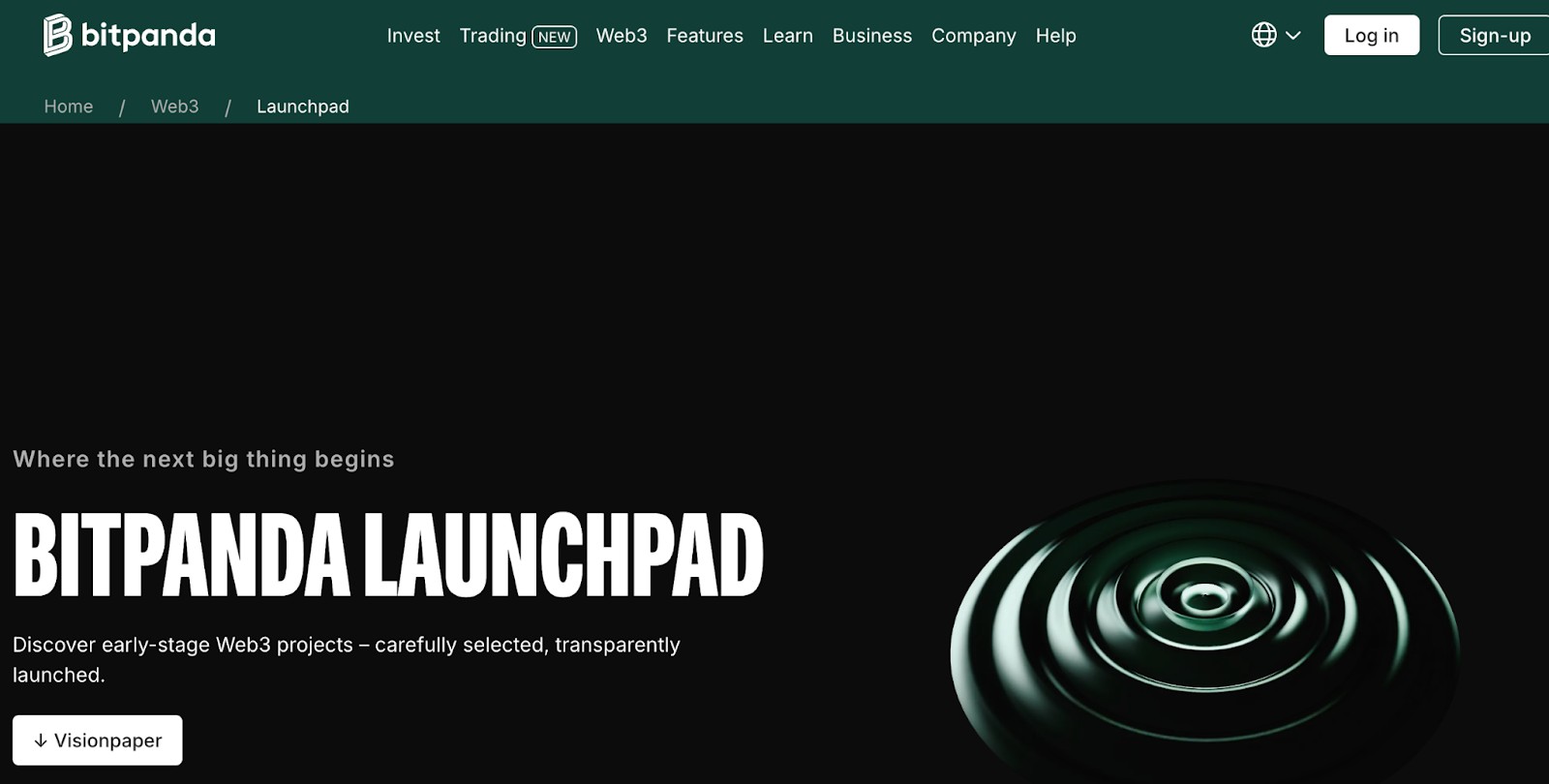
All participation happens through Bitpanda’s integrated tools, so users do not need external wallets or complicated contract steps. This approach aims to give investors a clearer and more regulated entry point into early Web3 opportunities.

How Bitpanda launchpad works
The Bitpanda launchpad follows a simple three part structure designed to make early token sales easier for users.
1. Project selection
Bitpanda reviews and approves each project before it goes live. This helps reduce the risk of low quality launches and gives users more confidence in the listed projects.
2. Access through Vision token staking
Participation is tied to staking Vision, also known as VSN. Vision is Bitpanda’s unified utility token, created from combining previous ecosystem tokens. The more VSN you stake, the higher your access tier tends to be, which can mean earlier entry or a larger allocation.
3. Participation through the Bitpanda DeFi Wallet
All token sales take place inside the Bitpanda DeFi Wallet. This removes the need for external wallets, manual contract actions, or complex setup steps. In practice, the process is simple. Stake VSN, reach a tier, join a sale inside the wallet, and receive tokens once distribution is complete.
Pros and cons of Bitpanda launchpad
- Pros
- Cons
Curated projects. Bitpanda screens launch candidates, which lowers the chance of running into obvious scams compared with fully open launchpads.
Simple participation flow. Sales are joined through the Bitpanda DeFi Wallet, so users do not need to manage multiple wallets, bridges, or complex contract steps.
Europe focused compliance approach. Bitpanda operates under European regulatory standards, so launchpad is built around transparency and user protection expectations common in the EU.
Clear utility for VSN. Vision token staking is directly connected to launchpad access, giving VSN a practical role beyond trading.
Non custodial structure. Users participate from a non custodial wallet, keeping control of funds and received tokens during the process.
KYC required. Full participation depends on having a verified Bitpanda account, which is not suitable for users looking for anonymous access.
Tier dependency on VSN staking. Allocation size and early access rely on staking VSN, so users may feel pressure to buy and lock up a token they might not otherwise hold.
Limited number of launches. Because of stronger curation, there may be fewer launch opportunities compared with bigger high volume launchpads.
Early stage risk remains high. Even vetted projects can fail, deliver weak performance, or face sharp price drops after listing.
Possible vesting limits. Many launches include lockups and gradual token unlocks, reducing short term liquidity for participants.
How to join Bitpanda launchpad? Step-by-step guide
Joining the Bitpanda launchpad is simple, even for beginners. The steps follow Bitpanda’s account system, VSN staking tiers, and a guided flow inside the Bitpanda DeFi Wallet. Below is a clear breakdown of how to join your first launch.
Create and verify your Bitpanda account
Complete registration and finish KYC to unlock staking and launchpad features.
Obtain VSN
Buy VSN on Bitpanda or transfer it to your account if supported in your region.
Stake VSN to unlock your tier
Higher tiers can receive earlier access or larger allocations.
Install the Bitpanda DeFi Wallet
All launchpad sales take place through the wallet interface.
Select a live or upcoming launch
Review tokenomics, supply details, and allocation rules before joining.
Commit funds during the sale window
Follow wallet instructions to confirm your participation.
Receive your tokens after distribution
Tokens are delivered automatically, and many projects include vesting schedules.

Risks and warnings
Early stage tokens come with high risk, even in a curated environment. Prices can rise or fall sharply after listing, and there is no guarantee that a project will deliver its roadmap or hold long term value. Users should treat every sale as a speculative investment.
There are also structure related risks. Many allocations include vesting, so you may not be able to sell tokens immediately. Access depends on staking VSN, which means your results can shift if the value of VSN changes while it is locked. Always use official Bitpanda apps to avoid scam versions, and join sales only with money you can afford to lose.
Fees on Bitpanda launchpad
There is no fixed fee for every sale on the Bitpanda launchpad. Instead, costs depend on several factors linked to each project. Below are the main areas where users may face expenses.
Opportunity cost of staking VSN. Staked VSN cannot be used for other investments.
Network fees in the Bitpanda DeFi Wallet. Standard blockchain transaction costs apply.
Sale specific costs. Some projects include their own conditions or fees in the token sale terms.
Always review the details for each launch so you understand the full cost before joining.
Security and regulation
Bitpanda is a well known European crypto broker with a strong focus on compliance. The Bitpanda launchpad follows the same approach, offering a more regulated and transparent setting than many offshore launchpads. This results in clearer project information and higher disclosure standards for users.
Regulation improves safety and transparency, but it does not remove risk. Early stage token sales remain speculative, and returns depend on the project and market conditions, not on the platform itself.
Bitpanda launchpad compared with other launchpads
Bitpanda launchpad follows a more curated and compliance oriented model than many popular crypto launchpads. The main differences are in access rules, user experience, and risk profile.
| Feature | Bitpanda launchpad | Typical crypto launchpads |
|---|---|---|
| Project selection | Strong curation with fewer launches | Often high volume with lighter filtering |
| Regulation focus | Europe oriented compliance first approach | Frequently offshore or lightly regulated |
| Access model | Tier access through VSN staking | Usually native launchpad token staking or open access |
| Wallet experience | Built into Bitpanda DeFi Wallet with guided flow | Often requires external wallets and manual steps |
| Custody | Non custodial participation through wallet | Varies, many use external non custodial wallets |
| Best for | Users wanting simpler and more regulated early access | Users chasing many high risk launches |
| Main trade off | Fewer launches and KYC requirement | More choice but higher scam and quality risk |
This makes Bitpanda launchpad a solid option for investors who prefer a simpler entry into early stage Web3 projects with more emphasis on trust and transparency, while other launchpads may suit traders who prioritize deal flow and are comfortable with higher risk.
Who Bitpanda launchpad is best for
The Bitpanda launchpad is a good choice for users who want early stage token access inside a guided and compliance focused environment. It works well for investors who prefer a simple wallet experience and who are comfortable staking VSN to unlock tier benefits. It may not suit users who want KYC free access, who dislike staking models, or who prefer to chase high risk microcap launches with frequent sale events.
As users explore early token sales through the Bitpanda launchpad, it often helps to also look at the broader trading landscape. Checking a few of the best crypto exchanges in your region can give context on where tokens may list later, how liquidity typically forms, and which platforms fit your long term holding or trading plans. This wider view makes it easier to move funds smoothly and stay flexible as new projects develop beyond the launchpad stage.
| OKX | Coinbase | Crypto.com | Cryptohopper | BTCC | |
|---|---|---|---|---|---|
|
Min. Deposit, $ |
10 | 10 | 1 | No | 10 |
|
Coins Supported |
600+ | 400+ | 400+ | 1000 | 399 |
|
Spot Taker fee, % |
0.1 | 0.5 | 0.5 | 0 | 0.3 |
|
Spot Maker Fee, % |
0.08 | 0.5 | 0.25 | 0 | 0.2 |
|
Alerts |
Yes | Yes | Yes | Yes | No |
|
Copy trading |
Yes | No | No | Yes | Yes |
|
TU overall score |
8.48 | 7.84 | 7.8 | 7.76 | 7.6 |
|
Open an account |
Go to broker Your capital is at risk. |
Go to broker Your capital is at risk. |
Go to broker Your capital is at risk. |
Go to broker Your capital is at risk. |
Go to broker Your capital is at risk.
|
A simple and regulated path to early token access

When I look at early token sale platforms, I focus on how clearly they guide users through the process, and the Bitpanda launchpad does this well. The staking rules are easy to follow, the DeFi Wallet flow removes common blockchain mistakes, and the projects I reviewed came with clear documentation. This creates a calmer experience for users who want early access without dealing with confusing tools or unsafe project listings.
I also see that Bitpanda targets a different type of audience than high volume launchpads. Many platforms push speed and constant deal flow, while Bitpanda leans toward trust, transparency, and controlled participation. That approach suits European users who prefer a regulated setting and fewer but better curated launches. For anyone who wants structured access and is comfortable with staking VSN, this platform can be a sensible entry point into early Web3 projects.
Conclusion
The Bitpanda launchpad offers a clear and guided way to join early stage token sales inside a familiar Bitpanda environment. It focuses on transparency, compliance, and ease of use, which makes it a practical option for users who want structured access to new Web3 projects. The staking model with VSN, the curated project selection, and the wallet based participation flow all work together to reduce common friction points found on other launchpads.
Even with these advantages, early token sales remain high risk. Project performance, market conditions, and vesting schedules all influence outcomes far more than the platform itself. If you join each sale with a measured approach and a clear risk budget, the Bitpanda launchpad can be a useful tool for diversifying your crypto portfolio.
FAQs
Can I use the Bitpanda launchpad without staking VSN?
Most launches require VSN staking for meaningful access. Some events may offer limited participation without staking, but allocations are usually very small.
What is a smart way to approach allocation sizes on launchpad?
Set a fixed risk budget for early tokens and stick to it regardless of how attractive a launch looks.
How do I judge whether a launchpad project is worth joining?
Focus on whether the token has a clear use case and a realistic path to demand rather than short term marketing.
How can I check if a Bitpanda launchpad project is trustworthy?
Review the project’s whitepaper, tokenomics, team background, and roadmap. Bitpanda performs initial screening, but final due diligence is still the user’s responsibility.
Related Articles
Team that worked on the article
Dan Blystone began his trading career in 1998 as an arbitrage clerk on the floor of the Chicago Mercantile Exchange (CME). He later traded bond and Eurex futures at proprietary firms such as Altea Trading, gaining valuable experience in high-frequency trading and risk management.
Chinmay Soni is a financial analyst with more than 5 years of experience in working with stocks, Forex, derivatives, and other assets. As a founder of a boutique research firm and an active researcher, he covers various industries and fields, providing insights backed by statistical data.
-
 Afghanistan
-
 Albania
-
 Algeria
-
 Angola
-
 Argentina
-
 Armenia
-
 Australia
-
 Austria
-
 Azerbaijan
-
 Bahamas
-
 Bahrain
-
 Bangladesh
-
 Belarus
-
 Belgium
-
 Bolivia
-
 Botswana
-
 Brazil
-
 Brunei
-
 Bulgaria
-
 Cambodia
-
 Cameroon
-
 Canada
-
 Chile
Chile
-
 China
China
-
 Colombia
-
 Congo
Congo
-
 Costa Rica
-
 Cote d'Ivoire
-
 Croatia
-
 Cuba
Cuba
-
 Cyprus
-
 Czechia
-
 DR Congo
-
 Denmark
-
 Dominican Republic
-
 Ecuador
-
 Egypt
Egypt
-
 El Salvador
-
 Estonia
-
 Eswatini
-
 Ethiopia
-
 Finland
-
 France
-
 Georgia
-
 Germany
-
 Ghana
Ghana
-
 Greece
-
 Haiti
Haiti
-
 Hong Kong
-
 Hungary
-
 India
India
-
 Indonesia
-
 Iran, Islamic republic
-
 Iraq
Iraq
-
 Ireland
-
 Israel
-
 Italy
Italy
-
 Jamaica
-
 Japan
Japan
-
 Jordan
-
 Kazakhstan
-
 Kenya
Kenya
-
 Korea
Korea
-
 Kuwait
-
 Kyrgyzstan
-
 Laos
Laos
-
 Latvia
-
 Lebanon
-
 Lesotho
-
 Libya
Libya
-
 Lithuania
-
 Luxembourg
-
 Madagascar
-
 Malaysia
-
 Malta
Malta
-
 Mauritius
-
 Mexico
-
 Moldova
-
 Mongolia
-
 Montenegro
-
 Morocco
-
 Mozambique
-
 Myanmar
-
 Namibia
-
 Nepal
Nepal
-
 Netherlands
-
 New Zealand
-
 Nigeria
-
 North Macedonia
-
 Norway
-
 Oman
Oman
-
 Pakistan
-
 Palestine
-
 Panama
-
 Papua New Guinea
-
 Paraguay
-
 Peru
Peru
-
 Philippines
-
 Poland
-
 Portugal
-
 Puerto Rico
-
 Qatar
Qatar
-
 Reunion
-
 Romania
-
 Rwanda
-
 Saudi Arabia
-
 Serbia
-
 Singapore
-
 Slovakia
-
 Slovenia
-
 Somalia
-
 South Africa
-
 Spain
Spain
-
 Sri Lanka
-
 Sweden
-
 Switzerland
-
 Syria
Syria
-
 Taiwan
-
 Tajikistan
-
 Tanzania
-
 Thailand
-
 Trinidad and Tobago
-
 Tunisia
-
 Turkey
-
 UAE
UAE
-
 Uganda
-
 Ukraine
-
 United Kingdom
-
United States
-
 Uruguay
-
 Uzbekistan
-
 Venezuela
-
 Vietnam
-
 Yemen
Yemen
-
 Zambia
-
 Zimbabwe
- Forex
- Crypto










- What is Bitpanda launchpad?
- How Bitpanda launchpad works
- Pros and cons of Bitpanda launchpad
- How to join Bitpanda launchpad?
- Risks and warnings
- Fees on Bitpanda launchpad
- Security and regulation
- Bitpanda launchpad compared with other launchpads
- Who Bitpanda launchpad is best for
- Expert opinion
- Conclusion
- FAQs


